10 Ways to Optimize Cloud Costs Without Sacrificing Performance
Jayakrishnan M
Contents Overview
Introduction
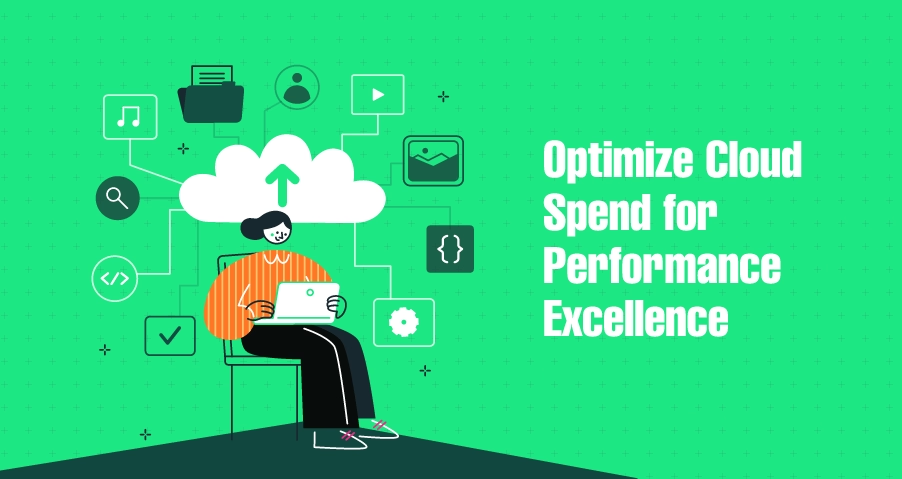
Optimize Cloud Costs is essential for businesses that want to control cloud spending while maintaining high performance. Flexibility and scalability characterize cloud computing, but the management of costs can be a real challenge. Cloud computing services offer businesses robust infrastructure, but expenses can spiral out of control quickly when not properly optimized. However, it is possible to optimize cloud costs without compromising performance. Here are 10 strategies that can be used to better manage your cloud spending while keeping performance levels high.
Right Sizing Your Resources
Cloud providers normally enable users to choose the size of their virtual machines or storage. As you avoid over-provisioning when you go through your workload requirements carefully, you will have an appropriate set of resources and thus save unnecessary cost.
Monitor Unused Resources with CloudWatch
For periodic usage – e.g. for hosting a web application constantly, you can benefit from the reserved instances. The latter involves contracts usually spanning from one to three years; thus, you save considerably compared with a pay-as-you-go pricing model.
Apply Auto-scaling
Auto-scaling gives you an opportunity to scale up or down the number of virtual machines based on your system’s needs at different times of the day. You only pay for those resources when they are needed by your system, so during periods of lower usage, you are not wasting money because your configuration happens to be too big.
Scheduling Non-Production Resources
Development, test, or staging environments are not required to function 24×7. Schedule your non-production resources to automatically turn off during after-work hours (like nights and weekends) in order to save on unnecessary costs while keeping the effects on productivity low.
Make Use of Spot Instances for Flexible Workloads
Spot Instances, though cheaper than On-Demand Instances, can be interrupted when their capacity is needed elsewhere by the provider. These are a cost-efficient way to optimize your spending for flexibility or non-critical workloads.
Monitor and Manage Idle Resources
Unused resources like idle virtual machines or an over-provisioned storage quickly inflate the cost. Regularly monitor and terminate idle resources to ensure you are only paying for what is actively used.
Leverage Cloud Cost Management Tools
Most cloud providers offer cost management tools that let you monitor expenditure and set budgets. These allow you to gain insights over resource usage, thereby helping in taking informed decisions regarding where cost can be cut or more allocated for performance.
Optimize Data Storage
Not all data needs to reside in high-performance tiers. Moving infrequently accessed data to cold storage or archival solutions means you can get rid of storage costs dramatically while still providing the access you need.
Leverage Serverless Architectures
This is serverless computing, running your code without a provisioning or management of servers. You pay based on compute time of your application and which is cost-effective when applied to event-driven workloads with no loss of performance.
Review and Optimize Cloud Usage
Cloud environments are in constant flux so your usage behavior is guaranteed to change over time. Periodic review of cloud usage ensures that the following are up to date and in step with current needs: your cost-optimisation strategy not wasting costs without sacrificing performance.
Conclusion
By implementing these strategies, organizations can achieve a balance between cost-efficiency and high performance. Regular monitoring, proper resource allocation, and leveraging the right tools allow you to optimize cloud costs continuously. Following these 10 steps ensures that your cloud environment remains scalable, flexible, and cost-effective, ultimately maximizing the return on your cloud investments.
Introduction Secrets management in platform engineering: Platform engineers, though far from sight, are the backbone to a world of moving pieces – in the fast-changing landscape of cloud infrastructures, where an ever-changing setup continually creates needs for secure, scalable, and efficient cloud environments. One critical aspect of what they do includes managing secrets: securely managing […]
Discover why monitoring and logging are critical in DevOps. Learn how they enhance efficiency, ensure reliability, and provide actionable insights for high-performance operations.
Discover serverless computing, its key use cases, and practical implementation strategies. Learn when to use serverless architecture and how to optimize cloud-native applications for better scalability and cost-efficiency.