
Back
#Artificial Intelligence #Ecommerce #Uncategorized
AI Personalization in Ecommerce: Why 45% of Conversions Now Depend on It, and What Your Architecture Needs to Deliver

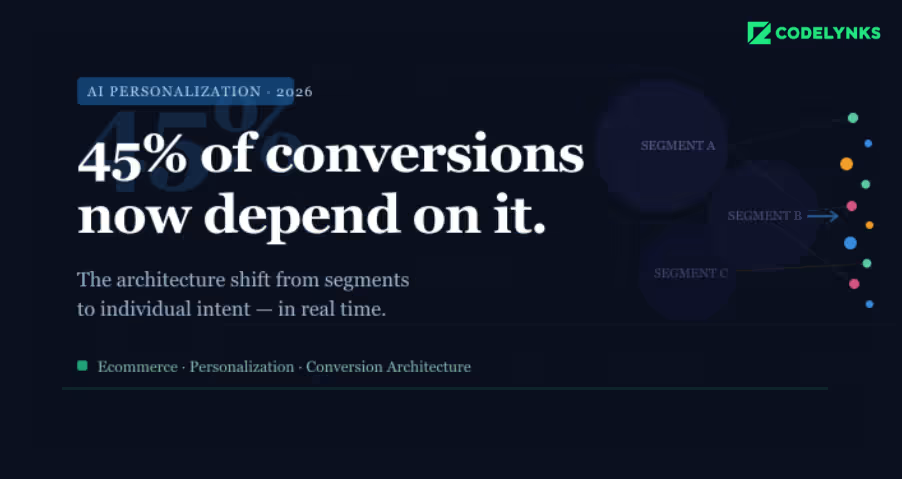
Table of Contents
Introduction
AI personalization in ecommerce has moved from a competitive advantage to a baseline expectation. In 2026, nearly 45% of online conversions are influenced by AI-driven personalization, according to industry analysis.
Most e-commerce product recommendation engines were built on the same premise: group customers into segments and serve each segment a curated experience. Segment-based personalization drove meaningful gains for a decade. In 2026, the data says it is no longer enough.
This post covers what that shift requires architecturally, where most implementations fall short, and how to evaluate whether your current setup can support genuine individual-level personalization. AI personalization in ecommerce now relies on real-time session data instead of static segmentation.
Why AI Personalization in Ecommerce Has Shifted to Real-Time
From Segments to Sessions: What Has Changed : Segment-based personalization works like this: a user who has previously bought running shoes gets shown running accessories. A user in the 25-34 age bracket sees a different homepage banner than a user in the 45-54 bracket. The model is built offline, updated periodically, and applied at request time by looking up the user’s segment and returning pre-computed recommendations.
Individual-level personalization in 2026 works differently. The model observes the current session: what the user clicked, how long they hovered, what they added and then removed from the cart, and what they searched for. It updates its representation of that user’s intent in real time and adjusts the experience, not just the recommendations but also the layout, pricing display, and promotional offers, based on that updated intent.
The distinction matters architecturally. Segment lookup is a read from a pre-computed table. Real-time intent modeling is an inference operation, often involving a neural network, that must be completed within 100-200 milliseconds to avoid impacting page load performance.
The Five Architecture Decisions That Determine Personalization Performance
1. Where inference runs: The most common personalization failure mode is latency. The recommendation model runs in a central data center, 80-150 ms from the user, and the network round trip erodes the user experience before a single recommendation is served.
The biggest limitation of traditional systems is their inability to support AI personalization in ecommerce at the individual level.
The 2026 pattern that high-performing retailers are moving toward is edge inference. Lightweight recommendation models, typically distilled versions of larger models, run at CDN edge nodes close to the user. Full model updates happen centrally and are pushed to the edge on a schedule. The trade-off is model size: edge inference works well for session-level features but cannot run models that require full purchase history or complex cross-session signals.
Decision point: if your target inference latency is under 50ms, edge inference is worth the architecture complexity. If 100-150ms is acceptable, central inference with a well-placed CDN layer is simpler and usually sufficient.
2. Feature pipeline design: Personalization models are only as good as their features. The feature pipeline is the component that transforms raw behavioral events (clicks, searches, purchases, and hovers) into the numerical representations the model uses.
The two-pipeline pattern is now standard: a batch pipeline that processes historical data and generates user embeddings updated daily or hourly and a streaming pipeline that processes real-time session events and updates the in-session representation. At inference time, the model combines both. Historical context provides the long-range signal; session context provides the intent adjustment.
The most common implementation mistake is running only the batch pipeline and calling it real-time personalization. Batch embeddings updated daily cannot capture within-session intent changes. A user who arrived to browse shoes but then searched for a gift idea is being shown the wrong product three pages into their session.
3. Catalogue embedding and search indexing: Recommendation systems need to match a user representation to products in a large catalog. Naive systems do this with collaborative filtering on interaction matrices. Modern systems embed both users and products in the same vector space and use approximate nearest neighbor (ANN) search to find relevant products in milliseconds.
This requires a vector database. Pinecone, Weaviate, and pgvector (for teams already on PostgreSQL) are the common choices in 2026. The catalogue embedding needs to be updated whenever product attributes, inventory, or pricing changes. Serving recommendations for out-of-stock products or products at the wrong price is a trust problem that is harder to recover from than a lower conversion rate.
4. A/B testing infrastructure: Personalization cannot be validated without proper experimentation infrastructure. The challenge is that standard A/B testing assumes independent assignment: user A sees variant 1, user B sees variant 2, and the two groups do not interact.
In e-commerce, users interact: a recommendation served to one user can influence what another user sees in social contexts, inventory is shared, and pricing changes affect the whole market. Rigorous personalization A/B testing uses holdout groups rather than split tests, ensuring a percentage of users always receive the baseline experience and measurement is against that holdout rather than against a simultaneous variant.
5. Data governance and consent management: Personalization at this level requires significant behavioral data. In markets with GDPR, DPDP (India’s Digital Personal Data Protection Act, effective from 2025), and CCPA, that data collection requires explicit consent and clear data retention policies.
The architecture implication: the consent state must be a first-class signal in the feature pipeline. A user who has opted out of behavioral tracking should receive a degraded but functional experience, not an error. Consent management platforms need to integrate directly with the event collection layer, not as an afterthought in the front end.
Businesses investing in AI personalization in ecommerce are seeing measurable conversion improvements.
Build vs Buy: The 2026 Decision Framework
Managed personalization platforms like Dynamic Yield, Bloomreach, and Nosto have matured significantly. For retailers below $50 million in annual GMV, a managed platform almost always delivers better ROI than a custom build. The engineering cost of building and maintaining a two-pipeline feature system, a vector database, and edge inference infrastructure is significant.
Above $50 million GMV, the calculus shifts. At that scale, the recommendation model is a competitive differentiator. Managed platforms apply the same algorithms to all their clients. A custom model trained on your specific catalog, customer base, and business logic can outperform a generic one meaningfully, and the data to train it well is available.
A hybrid architecture is also common: a managed platform for standard recommendation placements and custom models for the highest-value surfaces like the homepage, checkout, and post-purchase experience.
What the Conversion Data Actually Measures
The 45% of conversions driven by AI personalization figure comes from measuring purchases that followed a personalized recommendation or personalized layout change. It does not measure counterfactual conversions, purchases that would have happened anyway without personalisation.
Realistic lift from implementing individual-level personalization over segment-based systems ranges from 15 to 30% in conversion rate, depending on catalogue size, traffic volume, and the quality of the baseline. Smaller catalogues see smaller lifts because the recommendation space is constrained. Higher-traffic sites see larger lifts because the models have more data to work with.
Average order value lift from personalization is typically 8-15%. The mechanism is product adjacency: a well-trained model surfaces complementary products that the customer would not have found through browse navigation.
Key Takeaway
AI personalization in e-commerce is no longer about segments—it’s about real-time intent modeling at the session level.
To compete in 2026, your architecture must support the following:
- sub-200ms inference
- streaming + batch feature pipelines
- vector-based product retrieval
- consent-aware data systems
Retailers who invest in this shift are seeing 15–30% conversion lifts and measurable revenue impact. Those who don’t are optimizing a model that the market has already outgrown. AI personalization in e-commerce is no longer about segments—it is about real-time intent modeling at the session level.
Need help with AI personalization architecture for your e-commerce platform? Talk to our engineering team at Codelynks. Contact us
More Blogs: FinOps in 2026: Best Ways to Cut Cloud Waste by 30–40%



