
Back
#Uncategorized
Composable Booking Engine Architecture for OTAsC

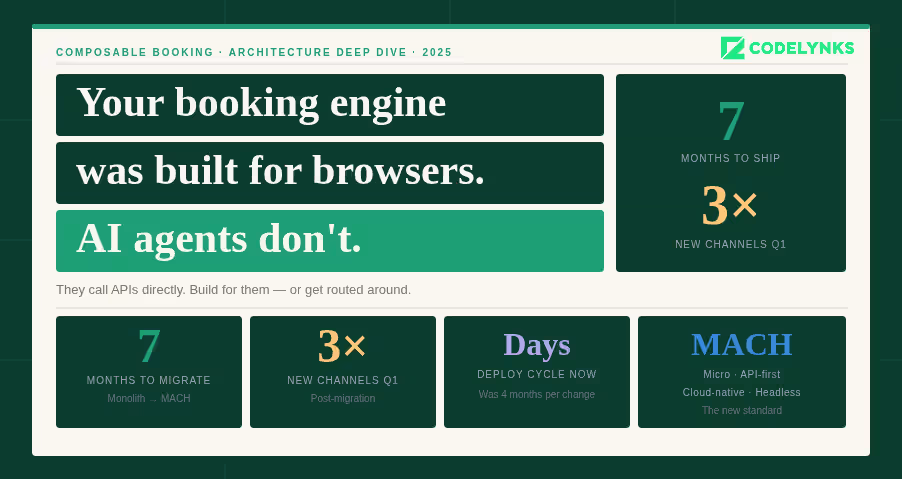
Table of Contents
Introduction
Composable booking engine architecture is reshaping how modern OTAs support AI booking agents, dynamic packaging, and API-first travel commerce.
Your booking engine was built for browsers. AI agents do not use browsers. Your Booking Engine Was Built for Browsers. AI Agents Do Not Use Browsers. The next wave of travel bookings will not come through a human typing into a search box. It will come through AI agents operating autonomously on behalf of travelers, calling your APIs directly to check availability, price, and confirmation. If your booking engine requires a browser session to complete a transaction, AI agents will route around you to a platform that does not.
A mid-size OTA operating across Southeast Asia came to us in mid-2025 with a problem that had become familiar: their booking engine, built on a monolithic PHP stack in 2018, was taking four months to ship a pricing rules change. Every new distribution channel, a new airline GDS connection, a new hotel chain API, required touching the same codebase and passing the same regression suite. Engineering velocity had collapsed. Revenue from new channels was being left on the table because the cost of integration had become prohibitive.
They shipped a composable booking architecture in seven months. Deployment cycles for individual services are now measured in days. Three new distribution channels went live in the first quarter after migration. This post explains the sequence we followed and where the decisions actually matter.
Why Monolithic Booking Engines Are Failing Now, Not Later
Monolithic travel platforms were designed for a single delivery channel: a web browser, with a human in the loop. That assumption is now incorrect on two fronts.
First, AI-powered booking agents, whether built on Claude, GPT-4o, or custom models, require structured API access to inventory, pricing, and availability. They do not render HTML. They do not fill in forms. They call REST or GraphQL endpoints and expect machine-readable responses. A monolithic booking engine that serves a rendered UI cannot serve an AI agent without significant reverse engineering.
Second, dynamic packaging has become the standard expectation for premium travelers. A flight, a hotel, an activity, and travel insurance, assembled into one iterable itinerary, confirmed in a single checkout. Monolithic platforms handle this through tightly coupled modules. When any one module changes, the whole checkout breaks. That coupling is why pricing updates take months.
> A monolithic booking engine is not a technical problem. It is a revenue ceiling.
The average composable-architecture OTA in 2026 deploys features 80% faster than a monolith-based competitor. That number tracks with what we observed with our Southeast Asian client.
The MACH Foundation in Travel Commerce
MACH stands for Microservices, API-first, Cloud-native, and Headless. In a travel context, this means:
Microservices: Each commerce function, flight search, hotel availability, rate calculation, checkout, confirmation, and post-booking management runs as an independent service with its own database, its own deployment pipeline, and its own failure boundary. A problem in the hotel availability service does not cascade to check-out.
API-first: Every function is exposed through a documented, versioned API before any frontend consumes it. This is the piece most travel platforms get wrong. They build the API as an afterthought to the UI. In a MACH stack, the API is the product. The UI is one consumer.
Cloud-native: Services scale independently. Flight search at peak demand requires different compute than post-booking email workflows. Pay-as-you-go scaling reduces infrastructure costs by 30 to 40% for seasonal travel businesses that see 5x demand swings.
Headless: The frontend presentation, whether a web app, a mobile app, a WhatsApp booking bot, or an AI agent, is decoupled from the backend commerce engine. Any channel can consume the same API. New channels add zero backend work.
> AI booking agents do not fill in forms. They call APIs. If your booking flow requires a browser session, an AI agent cannot book through you.
The Travel Stack Decomposition Sequence (TSDS)
We have run enough of these migrations to know that the sequencing matters more than the technology choices. This is the six-step decomposition sequence that has worked consistently.
Step 1: Inventory and Availability API: Extract the flight search, hotel availability, and activity inventory functions first. These are read-heavy, stateless, and cacheable. They cause the least disruption when extracted and they deliver the first visible performance win: faster search response times. Target: extracted within weeks 1 to 6.
Step 2: Pricing and Rate Engine: The rate calculation engine is the most complex extract because it carries the most business logic. Map every pricing rule before touching any code. Build contract tests against current behavior. Extract it to a dedicated service with its own test suite. Target: weeks 6 to 14.
Step 3: Checkout and Payment Orchestration: Checkout is the highest-stakes service because any failure here is a lost booking. Extract this after Steps 1 and 2 are stable. Build idempotency into every payment API call from the start. Integrate Stripe, Razorpay, or your regional gateway through an adapter layer so the payment provider can be swapped without touching checkout logic. Target: weeks 12 to 20.
Step 4: Dynamic Packaging Engine: Once inventory, pricing, and checkout are independent, dynamic packaging becomes straightforward: a composition service that calls the three downstream services, assembles an itinerary, and returns a single bookable product. This is the service that AI agents will call most frequently. Target: weeks 18 to 24.
Step 5: CMS and Content API: Destination content, hotel descriptions, activity details, and promotional banners are extracted to a headless CMS (Contentful, Sanity, or Storyblok are the common choices in travel). This eliminates the dependency between marketing content updates and engineering releases. Target: weeks 20 to 26.
Step 6: Frontend Delivery Layer: The last step is rebuilding the consumer-facing frontend against the new API layer. This is where most teams want to start. It is the wrong place to start. Build the API surface first. The frontend will be faster and cheaper to build when it does not have to work around backend constraints.
The OTA we worked with reached Step 4 before migrating their primary frontend. Three months before the frontend migration completed, they had already launched a WhatsApp booking channel and an API integration with a corporate travel management platform, both consuming the same new API layer.
Where Teams Underestimate the Work
Two areas consistently surprise teams mid-migration.
GDS integration complexity: Global Distribution Systems (Amadeus, Sabre, Travelport) expose SOAP-based APIs with response schemas that were designed before REST existed. Wrapping these in clean REST or GraphQL adapters is essential but time-consuming. Budget 4 to 6 weeks specifically for GDS adapter work. Do not absorb it into the inventory service timeline.
Booking state management: A booking in progress carries state across multiple services: seats held in inventory, a price locked in the rate engine, payment in process. In a monolith, a database transaction handles this. In a distributed system, you need explicit saga orchestration. The Saga pattern with choreography (services reacting to events) handles most travel booking flows. The Orchestrator pattern (a central service coordinating the saga) is better for complex multi-leg itineraries where rollback logic is intricate.
> The cost of a composable migration is front-loaded. The cost of staying monolithic is back-loaded and compounding.
What This Means for Travel Leaders
If you are running an OTA or a hotel booking platform with a monolithic core, three decisions this week will tell you whether you are on the right path:
Check whether your booking engine exposes any documented APIs today. If the answer is no, AI agent distribution is not accessible to you. That gap will widen through 2026 and 2027.
Ask your engineering team how long it takes to ship a pricing rule change end to end. If the answer is longer than two weeks, you are paying a compound productivity tax that TSDS Step 2 eliminates.
About the author: The Codelynks engineering team has designed and shipped commerce platforms and booking engines for travel, retail, and marketplace clients across Southeast Asia and the GCC. [Connect on LinkedIn](https://linkedin.com/company/codelynks).*
FAQ’s
A composable booking engine separates each commerce function, flight search, pricing, checkout, and packaging into independent microservices that communicate via APIs. This allows each component to be updated, replaced, or scaled independently without affecting the others.
Following the Travel Stack Decomposition Sequence, a mid-size OTA with a team of six to eight engineers can complete a full composable migration in 24 to 30 weeks, with early wins from the inventory and pricing extractions visible within the first three months.
Yes. This is the primary technical advantage of an API-first architecture. AI booking agents, operating autonomously on behalf of travelers, require REST or GraphQL endpoints. A monolithic booking engine that relies on browser sessions cannot serve these agents.
Headless separates the frontend from the backend via APIs. Composable goes further: every backend function is also an independent, swappable service. A headless OTA still has a monolithic backend. A composable OTA has both a decoupled frontend and a decoupled backend.
Amadeus, Sabre, and Travelport all offer REST-based API access alongside their legacy SOAP interfaces. Building a clean adapter layer around GDS connections is standard practice in a composable migration and prevents GDS-specific quirks from leaking into the rest of the booking stack.



