
Back
#Uncategorized
AI Engineering Services for Enterprises: What They Include and Why They Matter

Content Overview
Introduction
AI engineering services for Enterprises are becoming essential as organizations move from AI experimentation to production deployment. Most enterprises do not fail at AI because of bad ideas. They fail at the build. A model that works in a notebook is not a system that works in production. AI engineering services close that gap by turning AI concepts into scalable, secure, and reliable business systems.
This post explains what enterprise AI engineering services cover, why large organizations need them, and how to pick a provider that ships.
What are AI engineering services?
AI engineering services are professional services that design, build, deploy, and maintain AI systems for production use. They combine data engineering, machine learning, software engineering, and operations to deliver systems that run at scale. The work ends with a live system, not a slide deck.Strategy tells you where to go. AI engineering gets you there.
Why enterprises need AI engineering services
Enterprises carry weight that startups do not. Legacy systems, strict compliance, large data volumes, and many stakeholders all slow AI down. Building AI inside this environment takes engineering discipline, not just data science.
Three problems push enterprises toward outside engineering help:
- The skills gap. Senior ML and AI engineers are scarce and expensive to hire.
- The production gap. Internal teams build prototypes that never reach users.
- The integration gap. New AI has to connect to systems built decades ago.
AI engineering services solve all three. They bring the people, the production discipline, and the integration experience in one team.
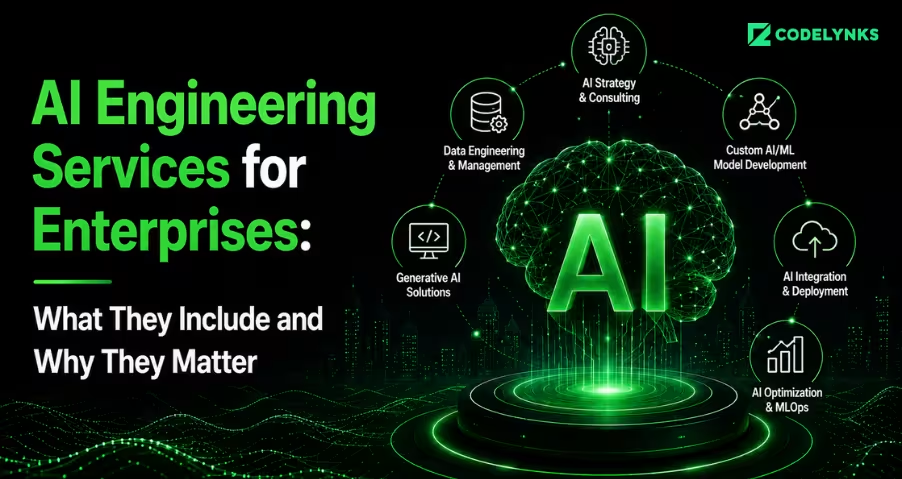
Core AI engineering services for enterprises:
A full provider covers the lifecycle from data to deployment. Here are the services that matter most.
Data engineering and pipelines: AI runs on clean, accessible data. Engineers build pipelines that collect, clean, and move data to
where models need it. They fix quality problems that block accuracy. Without this layer, nothing downstream works.
Custom machine learning development: Off-the-shelf tools rarely fit a complex enterprise need. Engineers build and train custom models for your specific problem. This covers prediction, classification, recommendation, forecasting, and anomaly detection.
Generative AI and LLM integration: Many enterprises now want large language models inside their products and workflows. Engineers integrate LLMs for search, support, document processing, and content generation. They add retrieval, guardrails, and evaluation so the output stays accurate and safe. Popular foundation model providers include OpenAI and Anthropic, whose models are widely used in enterprise AI applications.
AI system architecture and integration: A model is one part of a system. Engineers design the full architecture and connect the AI to your existing stack, including CRMs, ERPs, and internal tools. They plan for scale, cost, and security from the start.
MLOps and deployment: Models need a path to production and a way to stay healthy there. MLOps services cover deployment, versioning, monitoring, and retraining. This is the discipline that keeps AI working after launch, when most projects quietly break.
Model evaluation and governance: Enterprises answer to regulators, auditors, and customers. Engineers build evaluation and
governance into the system. They test for accuracy, bias, and safety, and they document how the system makes decisions.
Enterprise use cases for AI engineering: AI engineering services apply across functions and industries. Common examples:
| Function | Example application |
| Customer service | LLM assistants that resolve tickets and route cases |
| Finance | Fraud detection and risk scoring at scale |
| Operations | Demand forecasting and supply chain optimization |
| Sales and marketing | Lead scoring and personalization engines |
| Legal and compliance | Document review and contract analysis |
| Manufacturing | Predictive maintenance on equipment |
The pattern is the same in each case. A repeatable, data-heavy task becomes faster and more accurate with a system built around it.
Benefits of enterprise AI engineering services
Done well, these services produce results you can measure:
- Faster delivery. A specialist team ships in months, not years.
- Lower risk. Phased builds let you stop before large spending.
- Production reliability. Systems built by engineers stay up and stay accurate.
- Cost control. Right-sized architecture keeps inference and infrastructure costs in check.
- Internal capability. Good providers transfer knowledge so your team can run the system.
The point is not AI for its own sake. The point is a working system tied to a business metric.
How to choose an AI engineering services provider
Not every vendor that says AI can build production systems. Screen for four things:
- Production track record. Ask for live systems with real users, not pilots.
- Full-lifecycle capability. They handle data, build, deployment, and support.
- Enterprise experience. They know compliance, security, and legacy integration.
- Phased engagements. You can exit between phases and keep what was built.
Walk away from anyone who quotes a fixed price before seeing your data. Serious engineers scope after they understand the problem.
What it costs and how long it takes
A proof of concept usually runs a few weeks and lands in the low tens of thousands. A full production engagement runs three to six months and into six figures for an enterprise.
Three factors move the numbers: data quality, compliance requirements, and integration depth. Messy data and deep legacy integration cost the most. Ask for a phased quote so you control spend at each stage.
Related blog: How We Use Claude in Our Product Development



