Transforming eCommerce: AI and Machine Learning for Personalized Customer Journeys
Jayakrishnan M
Contents Overview
Introduction
The more accustomed people become to online shopping, the more pressure is on businesses to provide an even more engaging and relevant experience for consumers. Personalization is a critical differentiator in eCommerce, and in this regard, AI particularly Machine Learning (ML) plays a prominent role as a facilitator. Machine learning is transforming the way online retailers interact with customers in ways such as personalized recommendations, customized content, and seamless shopping journeys. This results in superior customer experience, increased engagement, loyalty, and ultimately, higher sales.
In this blog, we dig into how AI-based machine learning is powering personalized shopping experiences and revolutionizing the way the modern consumer interacts with online retailers.
The Power of Personalization with AI in eCommerce
Personalization has become an integral part of the successful eCommerce strategy. Contemporary consumers expect brands to understand their tastes and, therefore, suggest things that they are likely to like. This is achieved by machine learning that filters vast amounts of customer information, including but not limited to, browsing history, purchase behavior and any kind of engagement pattern.
Provide Personalized Product Recommendations: AI in eCommerce machine learning algorithms work on the customer’s data to predict what product the user would be interested in. For example, a recommendation engine, which works on the basis of machine learning, identifies individual behavior and accordingly recommends personalized products in real time; this helps a customer become satisfied with the recommendation made available, thus turning into a sale with a higher possibility.
An excellent example of the same is Amazon. In its recommendation system powered by AI, a significant percentage of overall sales is derived due to the fact that it suggests products according to the personal shopping habits of its customers.
Improving Customer Interaction Using AI in eCommerce
Other than making recommendations for products, machine learning aids the improvement of customer interaction. AI can vary everything from content to promotions and even the interface itself according to the preferences of the customer.
Tailoring Content and Offers: AI in eCommerce enables retailers to personalize beyond just product recommendations. For example, through dynamic email marketing campaigns filtered using AI algorithms, a specific offer, promotion, or content is sent to the customer based on his/ her preferences and behavior. Hence, every customer gets the right message, focused on their needs rather than a one-size-fits-all type of generic messaging.
Personalized Search and Browsing: AI in eCommerce optimization of search results with machine learning results in better online shopping because online shopping can target results to each user’s behavior individually. For example, the result that a customer might see after entering a search query can be prioritized based on past interactions, previous purchases, or predicted preferences. With this effect, browsing is fast and fun, thereby increasing the possibilities for an overall positive experience in shopping online.
Dynamic Pricing and AI in eCommerce
Another area where AI in eCommerce and machine learning is revolutionizing eCommerce includes dynamic pricing strategies. AI-driven algorithms analyze demand, competition, seasonality, and other subtle customer behavior patterns, which they use to adjust real-time prices and extend customized discounts and personalized price points to individual customers.
Dynamic Pricing for the Various Customer Segments: Dynamic pricing based on AI powers a customized price for retailers based on certain parameters, for instance, the customer’s loyalty or buying frequency. This allows retailers optimum sales and maximum profit apart from offering personalized shopping experiences that resonate with every shopper.
A great example in point would be when an eCommerce site offers a discount special to a loyal customer based on his previous buying patterns, thus making the shopping experience more personalized and rewarding for the customer.
Machine Learning with Visual Search Technology
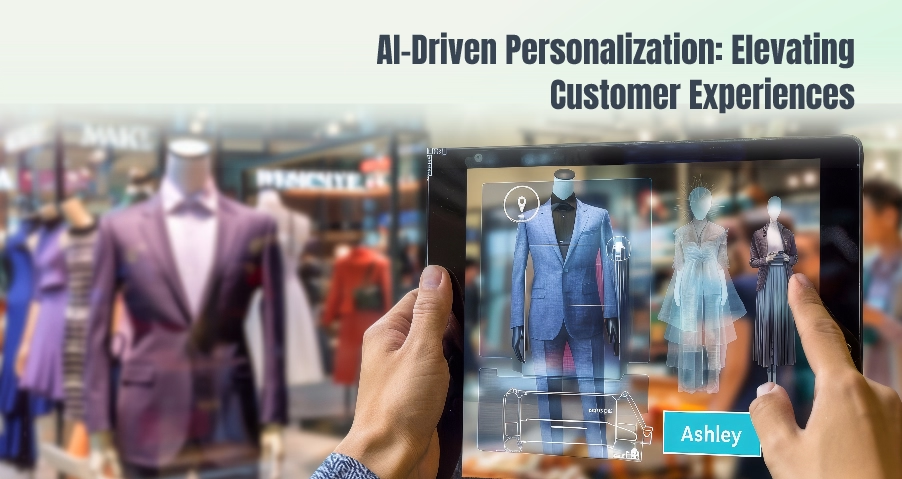
Machine learning is even spotted in visual search technology to personalize eCommerce. This idea is not based on just text-based search but on uploading images and getting recommendations based on those images.
Improving Search Accuracy and User Experience: Image search with AI raises the probability of accuracy in the desired product by interpreting the visual contents of the uploaded image, like color, style, and shape. If a customer uploads a picture of a dress she likes, the AI will prompt similar items on the retailer’s site. The search becomes more intuitive and personal and helps the customer get exactly what she wants faster.
Visual search is particularly effective in fashion or home decor businesses, where visual cues are a strong player in buying decisions.
Seamlessness Across Omnichannel Experiences
Personalization doesn’t end at a customer’s device or desktop. AI-driven machine learning is changing the retailing paradigm for providing seamless, personalized shopping experiences across an entire network of channels–online, in-store, or through mobile applications.
Data Integration Across Channels: Machine learning allows retailers to collect and analyze data from different facets like mobile apps, websites, and physical stores, which means they can personalize the customer’s experience across all channel interactions. For instance, a customer can browse items on the mobile device while receiving respective product suggestions at the in-store and online portals.
Machine learning can even be used to enhance the in-store experience. Some retailers are using AI to provide individually tailored shopping assistants that use customer data to make product recommendations and provide lists of recommended items and customized promotions while a customer is shopping in a store.
Data Security and Ethical AI in Personalization
To this end, the increasingly dominant personalization in eCommerce needs to meet concerns around data privacy and the use of AI in an ethical manner. Consumers increasingly understand how their data are used and business parties must be transparent and comply with data protection regulation.
Data Privacy and Transparency: AI systems that scrape and process customer data are covered by the data protection laws such as GDPR or CCPA. Retailers should ensure that the customer is in control of his/her data, hence allowing opting in or out of a personal experience. Therefore, AI systems will be built to be transparent in ways that will give consumers light on how their data is used to deliver personal experiences for shoppers
Conclusion
AI in eCommerce is fundamentally altered with the most personalized shopping experiences for the customers through machine learning. The dynamics involved in pricing and product recommendation, omnichannel personalization, as well as visual search, are now made possible by AI to help retailers create customer journeys that are engaging, loyal, and selling-based.
It’s no longer a choice but a necessity for eCommerce businesses seeking to stay ahead in the business to invest in AI-powered personalization technologies. As machine learning continues to improve, the future of personalized shopping will only get more refined. There is great benefit to retailers and consumers alike.
The UPI Outage May Not Be an NPCI Problem. It Could Be Your Bank’s Core Banking Infrastructure. UPI processed 22.72 billion transactions in June 2026, worth Rs 28.92 lakh crore. That is 23% growth year-on-year in volume, 20% in value. FY2026-27 projections put the network at 379 billion annual transactions a 57% increase over the […]
Two Channels, Two API Contracts: Why Indian D2C Brands Need Headless Commerce Now India’s D2C retail landscape bifurcated in 2026 and most engineering teams missed the moment it happened. On one side: ONDC, living in 400 cities, carrying over 3 lakh sellers on a 3% commission rail built on the open Beckn protocol. On the […]
Introduction: E-commerce Sale Season SRE Reliability Audit Checklist The E-commerce Sale Season SRE Reliability Audit Checklist helps retailers identify infrastructure bottlenecks before major flash sale events. By auditing database capacity, payment gateways, inventory systems, and CDN performance, teams can improve reliability and prevent revenue-impacting outages. The problem is not whether your platform will receive peak […]