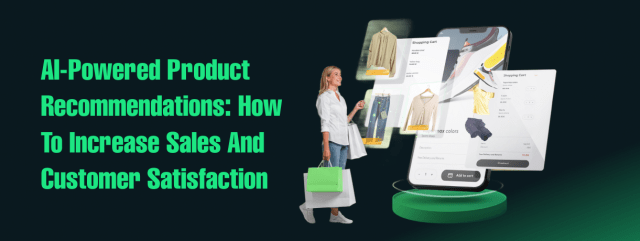
How AI-Powered Product Recommendations Drive Sales and Boost Customer Satisfaction
Jayakrishnan M
Contents Overview
Introduction
The world of eCommerce can never be more competitive than today, and whatever else it is, delivering personal shopping experiences has come to be a key differentiator for a business. Modern consumers want online retailers to understand and share their preferences, offer tailored product suggestions, and create seamless interactions. This is where AI stands to make all the difference through AI-powered product recommendations that are drastically changing how businesses engage with customers.AI-Powered Product Recommendations are transforming how eCommerce businesses personalize user experiences.
Although these AI-based tools increase customer satisfaction because of the relevant product suggestions they provide, they tend to sharply increase sales since they lead the customers toward products that they are most likely to purchase. This blog explores how AI-powered product recommendations work, their benefits, and how they can be strategically leveraged toward increasing sales and improving the overall shopping experience.
AI-Powered Product Recommendations play a major role in helping eCommerce brands deliver highly personalized shopping experiences.
The Power of AI-Powered Product Recommendations
In a nutshell, the AI-based product recommendation systems use machine learning algorithms to analyze customer data, observe patterns, and predict which products a particular customer would likely to be interested in buying. It enables enterprises to offer recommendations based on individual shopping behaviors, like browsing history, past purchases and their interactions with various products.
With AI-Powered Product Recommendations, businesses can deliver highly relevant suggestions based on real data. With AI-Powered Product Recommendations, retailers can predict customer needs more accurately and increase the chances of a successful purchase.
Working of Product Recommendation Engines
AI recommendation engines collate and process data in huge amounts that are being brought in from a whole range of touchpoints, such as visit history on the website, purchase history, products being viewed, and search queries. These AI models create a profile for the customer and generate real-time suggestions that fit his taste pattern. These recommendations are very much personalized, hence the chances of conversion are also higher in that regard.
For instance, the recommendation engine of Amazon accounts for a large proportion of the revenues that the company accumulates in the form of suggestions of items that go along with a history of purchase, similar types of items, or things often bought together. Such tailored recommendations can be the key to making shopping even more engaging for businesses. AI-Powered Product Recommendations depend on machine learning models that analyze huge volumes of customer behavior data in real time.
Role of AI in Sales Growth
AI-product-based recommendations are a great tool that can increase conversion chances and average order value (AOV) by fetching the highly relevant products to customers. The ways are as follows:
Conversion Rates: One of the greatest advantages of AI-powered recommendation is that it can definitely help improve your conversion rates. Personalized product ideas ensure that customers are exposed to things they will most likely buy, hence saving them from decision fatigue and leading them towards a faster purchasing choice. AI recommendations are perfectly suited for converting browsers into buyers since they implement knowledge about shoppers’ needs and provide relevant product suggestions at each stage of the shopping journey.
Upselling and Cross-Selling: Effective upselling and cross-selling of goods and services is also expected from AI recommendations. Based on preferences, purchasing patterns, and channels from customer analytics, AI can recommend an accessory or a product of higher value. For instance, if a customer is looking to buy a laptop, the recommendation engine can recommend accessories like laptop bags, external drives, or a software package that increases the overall value of sales. One of the biggest advantages of AI-Powered Product Recommendations is their impact on conversion rates and average order value.
Customer Satisfaction through Personalization
In the context of eCommerce today, personalization is important for achieving increased customer satisfaction and loyalty. Based on AI, a recommendation of the right product to the appropriate customer naturally offers a level of personalization that makes shopping enjoyable and smooth. AI-Powered Product Recommendations enhance customer satisfaction by showing the right products to the right users at the right moment.
Tailoring the Shopping Experience: AI suggestions do not display irrelevant products to the customer but rather display relevant products that tell the customers their preference and needs. Personalized shopping not only makes the buying process simple for the customer but connects him/her to the brand, as the customer feels the retailer understands his unique preferences. This will result in improvement in retention rates due to increase in satisfaction.
Reduce Cart Abandonment: Cart abandonment is a serious concern in eCommerce. Using AI-powered recommendation capabilities, this can be counteracted by trigger and reminder following personalization. For example, AI can mail follow-up emails with product recommendations based on the items left in the cart, along with some further incentive through discount or other complementary product recommendations that will help the customer in completing the purchase.
Inclusion of AI-Powered Recommendations in eCommerce
Effective implementation of AI-powered product recommendations for eCommerce businesses may involve the following strategies:
Leverage Data Effectively: A successful AI recommendation system is data-intensive. Businesses should collect data through several touchpoints: website visits, customer demographics, purchase history, and contact with marketing campaigns. The more data that an AI system has available, the more accurate its suggestions will be and the more personalized those suggestions will be to users.
Customize Recommendation Types: AI-driven recommendation systems can be tailored to business needs. Some standard types of recommendations include the following:
Frequently Bought Together: Products often purchased along with the current selected product are suggested.
Similar Products: If a product has been viewed or purchased, a system suggests similar products.
Top Picks for You: This is a personalized recommendation based on the browsing and purchasing behavior of the customer.
Future Trends: AI and Hyper-Personalization: Advanced technologies in AI will drive hyper-personalization as the future for product recommendations. Hyper-personalization is taking the principle of personalization to a next level by considering not just customer behavior but also other external factors such as real-time locations, weather conditions, or social trends. Therefore, business activities will encourage highly contextualized suggestions feeling even more relevant to the customer’s present situation with this feature.
Also, visual search and voice-activated shopping will have much more importance in AI-generated recommendations later. It will become very easy for the customers to find those products and buy them. Henceforth, the eCommerce experience will be increasingly improved.
Implementing AI-Powered Product Recommendations helps increase sales, improve customer satisfaction, and strengthen brand loyalty. Businesses that implement AI-Powered Product Recommendations experience higher engagement, improved loyalty, and sustained sales growth.
Conclusion
AI-based product recommendations are proving to be the perfect sales booster for eCommerce business houses looking to enhance the satisfaction of customers and have a keen focus on the growth of sales figures. Relevant and personalized product suggestions can lift the shopping experience and go on to raise conversion rates, average order values, and long-term customer loyalty.
While it may no longer be a question of if, but when for such an investment for the eCommerce businesses, having AI powered recommendation systems has indeed become a necessity, given the rising tide of personalization in an online marketplace. Sales will then experience tremendous growth, as well as even stronger relationships between customers and retailers by the proper use of AI.
Introduction: E-commerce Sale Season SRE Reliability Audit Checklist The E-commerce Sale Season SRE Reliability Audit Checklist helps retailers identify infrastructure bottlenecks before major flash sale events. By auditing database capacity, payment gateways, inventory systems, and CDN performance, teams can improve reliability and prevent revenue-impacting outages. The problem is not whether your platform will receive peak […]
Introduction AI personalization in ecommerce has moved from a competitive advantage to a baseline expectation. In 2026, nearly 45% of online conversions are influenced by AI-driven personalization, according to industry analysis. Most e-commerce product recommendation engines were built on the same premise: group customers into segments and serve each segment a curated experience. Segment-based personalization […]
The eCommerce industry is changing quite rapidly in today’s digital-first world. Online shopping is gaining traction fast, creating pressure on businesses to ensure the heightening of customer experiences and growth aligning with exponentially increasing shopper expectations. AI in eCommerce is reshaping this space with smarter, faster, and more intuitive solutions By tapping into AI capabilities, […]