
HR Analytics: The Key to Informed Strategic HR Decisions for Business Success, 2025

Business team using HR analytics tools

Introduction

In the competitive business world of today, data has come to be an influential driving factor behind strategic decisions in all the departments, and HR is certainly no exception. This approach is reshaping how businesses relate to talent, engage people, and plan HR strategies in correspondence with organizational goals. Data can empower HR teams to make better decisions that will definitely result in benefit for the organization and its people.

What is HR Analytics?

HR Analytics refers to the systematic collection, analysis, and interpretation of data concerning human resources. It is more profound than just tracking simple metrics such as headcount and turnover rate. People Analytics goes deeper into understanding workforce patterns, behaviors, and trends. HR professionals can make informed, people-focused decisions on recruitment, employee retention, and overall organizational performance based on the exploitation of data from Human Resources Analytics.

Benefits of HR Analytics on Strategic HR Decisions

HR Analytics refers to the systematic collection, analysis, and interpretation of data concerning human resources. It is more profound than just tracking simple metrics such as headcount and turnover rate. HR Analytics goes deeper into understanding workforce patterns, behaviors, and trends. HR professionals can make informed, people-focused decisions on recruitment, employee retention, and overall organizational performance based on the exploitation of data from workforce Analytics.

In recruitment, data-driven HR would show the sources that are yielding the best candidates and predict long-term employee performance. This simply translates to an HR team being able to streamline their efforts at attracting top talent more efficiently.

Most importantly, however, is the use of data-driven HR decisions, which can provide insights into knowledge gaps, demographics of the workforce, and productivity trends that will assist businesses in planning for the needs of the future and having the right people in the right roles at the right time.

How HR Analytics Impacts Organizational Success

Applied strategically, HR Analytics will lead to measurable business outcomes. Data-driven insights allow HR teams to align their strategies with the broader organizational objectives. For example, by applying analytics to optimize engagement, there comes the multiplier impact of higher productivity, lesser absenteeism, and retention, positively impacting the bottom line of the company.

This methodology also helps in long-term planning by predicting workforce trends and identifying potential risks. In this respect, be it forecasting hiring needs or tracking employee development, these insights ensure that the HR function is not only reactive but proactive as well in addressing workforce challenges.

Real World Applications of HR Analytics

There are numerous companies nowadays that utilize HR Analytics simply to be in a more favorable position in the list. For example, big businesses use analytics to predict staff turnover through an analysis of historical data on employees pertaining to satisfaction and performance. With those insights, therefore, several strategies that the departments of HRs apply would fit accordingly into their own needs.

Predictive analytics are used by some organizations in recruitment to estimate the likelihood of the success of the individual applying for a particular role. With past performance data analysis, companies build hiring models that allow for better predictions of the job fit, thus averting costly recruitment mistakes.

Challenges in Implementing HR Analytics

Although it has several advantages, conducting HR Analytics does not come free of challenge. The most common challenge facing organizations in implementing HR Analytics is that of data privacy and security. Their departments deal with confidential employee data, and thus proper management of sensitive information is quite imperative. Integrating with existing systems and overcoming resistance to changing traditional data-handling methods are common challenges faced by organizations implementing data-driven practices for the first time.

However, there exist challenges that forces businesses to overcome them and, finally, implement this approach. The right tool and proper strategy would help businesses overcome the challenges identified above and further allow the successful implementation of the methodology. Of course, a culture that values data and proper training of the HR teams can unlock all the potential of these insights.

The Future of HR Analytics

Future of this approach will be shaped by the advancement in AI and machine learning. Such systems will continue to be much more developed, giving the ability of making decisions close to real-time, improving foreseeability about the outcome of those decisions.

Therefore, this methodology will continue to play a very key role in defining the future of HR and its work, supporting business success.

This approach therefore, represents the newest approach for business in talent management and planning the workforce. It allows organizations to make strategic HR decisions by using data to create not only more efficient but also the most productive and engaged workforces. Indeed, as technology continues to advance, it will become part of the core strategic steps toward long-term success among HR leaders.

More Blogs: The Importance of Continuous Feedback and Performance Reviews in Employee Development

AI and Business Analytics: Transforming Decision-Making in Modern Enterprises

AI and Business Analytics transforming decision-making in modern enterprises

Introduction

Today, in a fast-paced business environment, enterprises are increasingly turning to technology to create a competitive advantage. Business applications of AI and business analytics indeed is a game-changers for organizations seeking to optimize decision-making processes because it enables them to make decisions much faster and more promptly with the ability to process huge volumes of data, track trends, and make predictions based on that data.

This blog delves into 10 key ways through which AI and business analytics are reshaping decision-making in modern enterprises as well as how these technologies shape the future of business strategy.

Empowering Data-Driven Decisions

An ability to allow and help enterprises to rely more on data rather than on intuition in making their decisions is undoubtedly the most powerful way AI and business analytics change decision-making. Decisions that were previously based on experience or assumptions can now be driven by real-time data analysis, leading to more accurate and unbiased decision-making.

Business analytics of AI systems enable the enterprise to analyze big data sets, discover hidden patterns, and make data-driven recommendations, which leads to more accurate decisions and better business results.

Predictive Capabilities

The predictive capabilities of businesses have changed quite a lot because of the powered AI and machine learning approach. The behaviors of customers and even market trends can be predicted by an AI model, in addition to other operational risks, based on historical data.

It enables organizations to anticipate changes in their customers’ demand hence optimizing their inventory management and proactively developing strategies to avoid risks before those risks happen. Predictive analytics gives a company the foresight to remain ahead of its competition.

Optimization of Operational Efficiency

The modern enterprise has always focused on operational efficiency, with AI and business analytics playing a very important role in streamlining operations. The AI-driven analytics tools can analyze the workflows, find the inefficiencies in the system, and suggest improvement processes that will decrease cost and improve productivity.

For example, AI optimizes supply chain management to predict delays in deliveries and suggest alternative routes to save costs and improve service levels.

Enhancing Customer Experience

With the rising customer experience era, AI and business analytics are given prime importance to allow companies to understand customer needs immediately. Through customer behavior, purchase history, and feedback, AI generates recommendations suited to the specific needs of the client, optimizes the pricing strategy, and markets according to the customer’s desire.

Personalization through this degree enhances customer satisfaction with increased loyalty in the long run, and leads to higher revenue.

Facilitating Real-Time Decision Support

The business environment is changing very frequently these days; therefore, most decisions have to be taken in real time. Traditional methods of data analysis are too slow for the demands that are created in such a fast-paced business environment, but AI and Business Analytics help a business analyze data right from the moment it is available.

From market shifts to changes in the price of a particular good or the readjustment of resources, AI analytics provide decision-makers with real-time information,hence acting fast in the right way.

Scenario Analysis and Simulations Enable

AI analytics platforms enable firms to simulate scenarios and to calculate the likelihood of various outputs so that decisions can be made before their implementation. This will enable decision-makers to determine the possible consequences of implementing different strategies – say, launching a new product or entering a new market- without any real-life risks attached to those decisions.

Firms can now make wiser decisions, reduce potential losses, and maximize potential gains.

Cutting through Human Bias in Decision Making

Human bias is the major challenge when decisions are being made. AI and business analytics reduce the influence of subjective judgment with data-driven insights that are free from personal biases or assumptions.

Because the AI algorithms take data without bias, recommendations through the algorithms become fact-based. With this, judgments become more objective, thus more just and accurate, particularly in matters regarding hiring, pricing strategy, or customer relations.

Innovation By Insight

Nowadays, data is the richest treasure a business can have. AI and business analytics unlock the potential of that data for innovation. With an analysis of market trends, customer preferences, and emerging technologies, businesses find new routes toward product development, improvement in services, and process improvements.
AI-driven insights help businesses remain in tune with and ahead of industry trends, thus breeding a culture of continuous innovation and adaptation.

Risk Management Enhancement

In a world where uncertainty and volatility only abound, AI and business analytics form an essential element of improving risk management for businesses. AI models analyze past occurrences and identify and pinpoint elements that may signal possible risks, allowing businesses to take preventive actions in a bid to forestall them.

From financial forecasting to cybersecurity, AI-driven analytics lay the platform to devise comprehensive risk management techniques that protect business assets for long-term sustainability.

Collaboration and Cross-Functional Alignment

AI tools are enabling cross-organizational collaboration possible and breaking down silos because, with AI tools, data is analyzed and shared in one platform, making it easier for teams belonging to different departments-therefore marketing, finance, or operations teams can come together with aligned strategies for common goals.

This improves enterprise decision-making which leads to better outcomes and greater operational harmony.

Conclusion

The fastest-evolving technologies are AI and business analytics, transforming the present decision-making approach of modern enterprises. It has enabled innovation with real-time insights and reduced risk for competitive advantage in any business looking to thrive in today’s data-driven world.

Codelynks helps organizations optimize their decision-making processes by using the power of AI and business analytics. We are now offering customized solutions by inviting expert services from our team in order to enable businesses to drive data-based decision-making that is smarter, faster, and more informed. Partner with Codelynks to transform your business through innovative, AI-driven, and analytics-backed strategies.

More Blog: The Ultimate 7 Transformative Advantages of Multi-Cloud Strategies Empowering Modern Enterprises

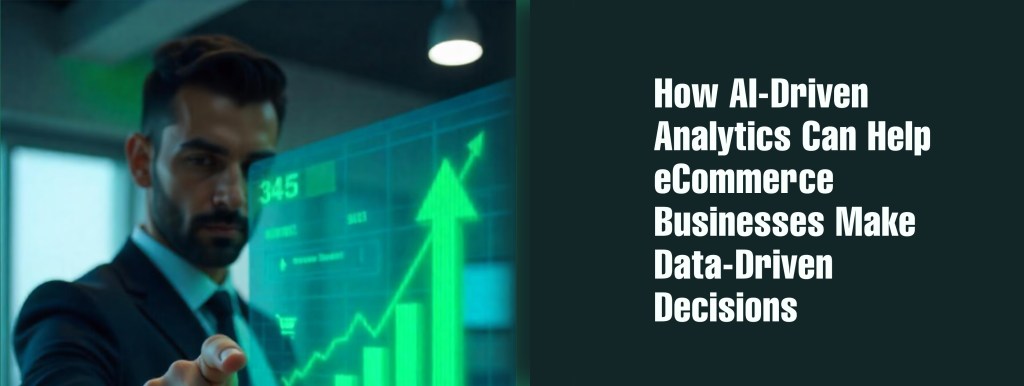
How AI-Driven Analytics Empowers eCommerce Businesses

AI analytics graphic displaying eCommerce data insights and performance metrics.

Introduction

The growth of eCommerce has translated into the generation of very large amounts of data coming directly from customer interactions, sales transactions, and online behavior.

As such, for eCommerce firms, converting this data into actionable insights is key to staying ahead of the game and ensuring that customer experience is not compromised. With AI-driven analytics, data is turned into meaningful information that helps inform decisions.

In this paper, we will discuss how analytics in e-commerce drives data-driven decision-making in the e-commerce industry.

Understanding AI-Driven Analytics and the Effect on eCommerce

AI-driven analytics refers to the use of artificial intelligence to analyze large data sets quickly, accurately, and efficiently. Through the use of AI, eCommerce businesses can process vast amounts of information and extract trends that would otherwise be challenging to uncover. This allows companies to understand customer preferences, optimize pricing strategies, forecast demand, and personalize the shopping experience.

Advantages of AI in Data Analytics

Speed and Accuracy: AI tools can analyze huge datasets in seconds, which provides insights faster than traditional analytics methods. With machine learning algorithms, AI will predict future trends based on historical data.

Customization Potential: AI-driven analytics allows for tailored insights, which can help personalize offerings to customer segments.

Key Ways AI-Driven Analytics Enhance Decision-making in eCommerce

For eCommerce companies, AI-driven analytics provides numerous advantages. From understanding customer behavior to optimizing inventory management, here are the main ways AI analytics supports data-driven decision-making:

Analyze Customer Behavior: One of the most important impacts of AI in eCommerce is that it can analyze customer behavior in real-time. The analytics from AI can capture insights from customer browsing patterns, purchase history, and engagement on different channels. It helps businesses understand which products are of interest to the customers, how often they shop, and what price ranges they prefer.

Product Offering Improvement through Customer Data: AI helps businesses learn about the popularity of different products and the needs of customers. This knowledge in turn allows them to customize their offerings to better satisfy customer expectations, leading to satisfaction and loyalty.

Personalization and Customer Segmentation: In eCommerce, personalization is the key to creating an engaging shopping experience. AI-driven personalization enables businesses to recommend products based on individual preferences, past purchases, and browsing behavior. By leveraging AI algorithms, eCommerce companies can create tailored marketing messages, which can improve the chances of conversion.

Improving Marketing ROI with Customer Segmentation: Such would allow more granular analysis of customer groups based on their probability to respond appropriately to a certain promotion and optimization of marketing spend based on return on investment.

Price Strategy Optimization: The right price is critical to eCommerce because of the heavy competition in the market. AI-driven pricing analytics help companies monitor competitor pricing, customer demand, and conditions in the market in real-time. With this, eCommerce businesses can adjust their prices dynamically to remain competitive and profitable.

Dynamic Pricing Models and Market Responsiveness

With AI, eCommerce brands can implement dynamic pricing models that adjust based on factors such as inventory levels, competitor prices, and seasonal demand. This approach not only maximizes sales but also ensures better inventory management, reducing overstock and stockouts.

Inventory Management and Demand Forecast

Efficient inventory management is required for an eCommerce company to meet customer demand without excessive stock. With AI-based demand forecasting, companies can determine which products are likely to be in demand based on historical sales data, trends, and market analysis.

Minimizing Overstock and Lowering Costs

AI can help eCommerce brands avoid overstocking, tying up capital, and understocking, which is a missed sale. With the optimization of inventory levels, warehousing costs can be cut down and cash flow can improve.

Improving Customer Service through AI Analytics

In eCommerce, the customer service experience has to be seamless and responsive to satisfy customers. Customer service analytics through AI tracks support queries, customer feedback, and service interactions so that companies can know which areas need improvement and where there are recurring issues.

Using AI in Personalization of Customer Care

Businesses can personalize customer support with the help of AI analytics, focusing on customers with a high lifetime value and resolving their issues faster. This will not only enhance customer satisfaction but also increase loyalty and retention.

Implementing AI-driven Analytics into Your eCommerce Business

Integrating AI-driven analytics into e-commerce does not have to be scary.
Follow these steps to ensure successful integration and obtain the best possible benefits:

Step 1: Define clearly what business goals are, and pinpoint where data-driven decision-making can add the most value. It may be about improving customer experience, optimizing pricing, or enhancing marketing campaigns.

Step 2: Choose the analytical artificial intelligence tools that are in alignment with your business needs. There are numerous options available to aid customer analytics, inventory management, and even demand forecasting. 

Step 3: Integrate the Data Sources Integration with “all the sources of relevant data” to make the best use of AI analytics, and combine all website data, CRM, ERP, and other systems to provide complete insights. 

Step 4: Train Your Team Empower your teams with the ability to read and use AI-driven analytics appropriately. Training your employees in the use of AI tools and interpreting data insights maximizes the impact of technology. 

Step 5: Monitor and Adjust Once AI-driven analytics are implemented, continuously monitor its performance. Use insights to refine your strategies, making adjustments to optimize results

Future of AI-Driven Analytics in eCommerce

As AI continues to advance, its role in data-driven decision-making in eCommerce will only grow. Future AI capabilities will provide even more precise customer insights, allowing businesses to anticipate customer needs before they arise. Additionally, AI-powered analytics tools will become more accessible, enabling smaller eCommerce businesses to compete effectively with larger players.

Conclusion

AI-driven analytics has transformed the eCommerce sector because it allows businesses to make data-driven decisions that help to improve customer experience, pricing, and inventory management.

At Codelynks, we develop AI-powered solutions that allow eCommerce companies to leverage data for strategic decision-making. Our team of experts in AI and analytics helps businesses maximize their potential in a competitive market.

More Blog: Revolutionary AI in eCommerce: Transforming Customer Service in 2024

Transforming eCommerce: AI and Machine Learning for Personalized Customer Journeys

AI in eCommerce personalized product recommendations

Introduction

The more accustomed people become to online shopping, the more pressure is on businesses to provide an even more engaging and relevant experience for consumers. Personalization is a critical differentiator in eCommerce, and in this regard, AI particularly Machine Learning (ML) plays a prominent role as a facilitator. Machine learning is transforming the way online retailers interact with customers in ways such as personalized recommendations, customized content, and seamless shopping journeys. This results in superior customer experience, increased engagement, loyalty, and ultimately, higher sales.

In this blog, we dig into how AI-based machine learning is powering personalized shopping experiences and revolutionizing the way the modern consumer interacts with online retailers.

The Power of Personalization with AI in eCommerce

Personalization has become an integral part of the successful eCommerce strategy. Contemporary consumers expect brands to understand their tastes and, therefore, suggest things that they are likely to like. This is achieved by machine learning that filters vast amounts of customer information, including but not limited to, browsing history, purchase behavior and any kind of engagement pattern.

Provide Personalized Product Recommendations: AI in eCommerce machine learning algorithms work on the customer’s data to predict what product the user would be interested in. For example, a recommendation engine, which works on the basis of machine learning, identifies individual behavior and accordingly recommends personalized products in real time; this helps a customer become satisfied with the recommendation made available, thus turning into a sale with a higher possibility.

An excellent example of the same is Amazon. In its recommendation system powered by AI, a significant percentage of overall sales is derived due to the fact that it suggests products according to the personal shopping habits of its customers.

Improving Customer Interaction Using AI in eCommerce

Other than making recommendations for products, machine learning aids the improvement of customer interaction. AI can vary everything from content to promotions and even the interface itself according to the preferences of the customer.

Tailoring Content and Offers: AI in eCommerce enables retailers to personalize beyond just product recommendations. For example, through dynamic email marketing campaigns filtered using AI algorithms, a specific offer, promotion, or content is sent to the customer based on his/ her preferences and behavior. Hence, every customer gets the right message, focused on their needs rather than a one-size-fits-all type of generic messaging.

Personalized Search and Browsing: AI in eCommerce optimization of search results with machine learning results in better online shopping because online shopping can target results to each user’s behavior individually. For example, the result that a customer might see after entering a search query can be prioritized based on past interactions, previous purchases, or predicted preferences. With this effect, browsing is fast and fun, thereby increasing the possibilities for an overall positive experience in shopping online.

Dynamic Pricing and AI in eCommerce

Another area where AI in eCommerce and machine learning is revolutionizing eCommerce includes dynamic pricing strategies. AI-driven algorithms analyze demand, competition, seasonality, and other subtle customer behavior patterns, which they use to adjust real-time prices and extend customized discounts and personalized price points to individual customers.

Dynamic Pricing for the Various Customer Segments: Dynamic pricing based on AI powers a customized price for retailers based on certain parameters, for instance, the customer’s loyalty or buying frequency. This allows retailers optimum sales and maximum profit apart from offering personalized shopping experiences that resonate with every shopper.

A great example in point would be when an eCommerce site offers a discount special to a loyal customer based on his previous buying patterns, thus making the shopping experience more personalized and rewarding for the customer.

Machine Learning with Visual Search Technology

Machine learning is even spotted in visual search technology to personalize eCommerce. This idea is not based on just text-based search but on uploading images and getting recommendations based on those images.

Improving Search Accuracy and User Experience: Image search with AI raises the probability of accuracy in the desired product by interpreting the visual contents of the uploaded image, like color, style, and shape. If a customer uploads a picture of a dress she likes, the AI will prompt similar items on the retailer’s site. The search becomes more intuitive and personal and helps the customer get exactly what she wants faster.

Visual search is particularly effective in fashion or home decor businesses, where visual cues are a strong player in buying decisions.

Seamlessness Across Omnichannel Experiences

Personalization doesn’t end at a customer’s device or desktop. AI-driven machine learning is changing the retailing paradigm for providing seamless, personalized shopping experiences across an entire network of channels–online, in-store, or through mobile applications.

Data Integration Across Channels: Machine learning allows retailers to collect and analyze data from different facets like mobile apps, websites, and physical stores, which means they can personalize the customer’s experience across all channel interactions. For instance, a customer can browse items on the mobile device while receiving respective product suggestions at the in-store and online portals.

Machine learning can even be used to enhance the in-store experience. Some retailers are using AI to provide individually tailored shopping assistants that use customer data to make product recommendations and provide lists of recommended items and customized promotions while a customer is shopping in a store.

Data Security and Ethical AI in Personalization

To this end, the increasingly dominant personalization in eCommerce needs to meet concerns around data privacy and the use of AI in an ethical manner. Consumers increasingly understand how their data are used and business parties must be transparent and comply with data protection regulation.

Data Privacy and Transparency: AI systems that scrape and process customer data are covered by the data protection laws such as GDPR or CCPA. Retailers should ensure that the customer is in control of his/her data, hence allowing opting in or out of a personal experience. Therefore, AI systems will be built to be transparent in ways that will give consumers light on how their data is used to deliver personal experiences for shoppers

Conclusion

AI in eCommerce is fundamentally altered with the most personalized shopping experiences for the customers through machine learning. The dynamics involved in pricing and product recommendation, omnichannel personalization, as well as visual search, are now made possible by AI to help retailers create customer journeys that are engaging, loyal, and selling-based.

It’s no longer a choice but a necessity for eCommerce businesses seeking to stay ahead in the business to invest in AI-powered personalization technologies. As machine learning continues to improve, the future of personalized shopping will only get more refined. There is great benefit to retailers and consumers alike.

More Blog: 5 Steps to Scaling Gen AI: A Data Leader’s Guide to Enterprise Success

Social Media Algorithms Decoded: 7 Proven Steps to Skyrocket Your Content’s Reach

Social media algorithms decoded with visual icons showing engagement strategies and steps to boost content reach.

The complex digital world that operates very fast requires mastery of algorithms in social media for effective targeting of intended or desired audiences. The bigger and more complex algorithms deployed by these social platforms, such as Facebook, Instagram, and Twitter, determine which types of content get prioritized and when they appear in users’ feeds. Therefore, businesses and marketers will need to understand how these algorithms work and thus formulate ways that help the content reach a high audience.

The business may, in turn, have to change and adjust with these constantly shifting algorithms. We specialize in this service at Codelynks, making use of expert SEO techniques to enhance content visibility and engagement. In this guide, we explore seven proven strategies to boost social media performance and ensure your content reaches its full potential.

Understanding the Basics of Social Media Algorithms

However, prior to optimization strategies, understanding social media algorithms is crucial. Social media algorithms, in their simplest form, analyze user behavior such as likes, comments, shares, and click-through rates to determine which posts are more relevant to individual users. The more a user engages with similar content, the more that type of content will turn up in the feed.

The algorithms are a little different from one platform to another, but they all remain focused on user engagement and relevance of content. Codelynks employs advanced tools and data analytics that track the algorithm updates to help clients remain ahead in this competitive landscape.

Produce High-Quality, Engaging Content

A perfect strategy, regardless of how much you know about how social media algorithms work, will always begin with solid content. High engagement (likes, comments, shares) turns out to be one of the key factors, which algorithm favors in giving popularity to the post as it signals the post is relevant for the users.

  1. How to make engaging content
  2. Emphasize storytelling, which will appeal to your audience.
  3. Use interesting eye-catching visuals, videos and infographics for raising interaction.
  4. Add calls to action – CTAs that encourage people to comment, like, and share.

At Codelynks, we work collaboratively with brands in crafting compelling social media strategies that capture attention and engage people in such a manner that their content is algorithm-friendly.

Consistency is the Key

The social media algorithm favors accounts that publish on a steady, predictable schedule. Posting too seldomly may lead to decreased engagement – a dead giveaway to the algorithm that your content isn’t as important.

To avoid this:

  1. Frame a posting calendar that ensures that content will be published in a consistent manner, avoiding the need for inconsistency in output.
  2. Use scheduling tools to automate posting and maintain constant activity.
  3. Experiment by posting times and see when your audience is very active.

Codelynks provides content scheduling and management. This way, you can be assured that your posts would regularly reach your audience, which further increases the opportunity to be chosen by the algorithm.

Promote Organic Engagement

Social algorithms reward genuine engagement. Do not just post content and sit back expecting it to stick; engage with your audience by thinking through comments and participating in the conversation – run polls or questions to encourage people to interact.

For example, when using Instagram, if the users engage more with your posts within the first hour, then the algorithm becomes probable to give priority to your content. This sudden spike of engagement proves to the system that your content is relevant enough to be shown to a greater audience.

We work at Codelynks to help businesses create real engagements through engagement-based strategies that align with the latest changes in the algorithms.

Use Hashtags Correctly

Indeed, even in the present, hashtags are a mighty tool for making content organized and visible, specifically on Instagram and Twitter. However, its effectiveness depends on the use of highly relevant, popular hashtags related to your niche. Over or misusing them can have just the opposite effect, making your content appears spammy and less trustworthy.

Our experts at Codelynks keep themselves updated on trending hashtags and keyword research so you get a perfect blend of popular and niche-specific tags that will drive maximum mileage from your content without penalizing your account.

Diversify Your Content Format

Social media sites prefer to render a blend of content types such as pictures, videos, stories, and more. Such help keeps your audience engaged and also tells the algorithm that your profile is dynamic and active.

Example

  1. Videos usually gain better engagement than static images on platforms like Instagram and Facebook.
  2. Instagram Stories tends to gain high engagement and appears at the top of a user’s feed.
  3. Live videos tend to garner more comments and shares, hence increase their reach.
  4. Codelynks helps the brand diversify content, hence unlock all the kinds of algorithm-friendly content types on various social media platforms.

Leverage Data Analytics to Fine-Tune Your Strategy

Monitoring and optimizing are the key to mastering social media algorithms. The analysis of performance data, such as engagement rates, impressions, and click-throughs, gains insight into what type of content works well for a person’s audience and what needs tweaking.

We give you the in-depth analytics and reporting tools that enable you to track the performance of your content. With data right at the heart of our approach, we work on refining your strategy to get maximum reach and engagement within your social channels.

How Can Codelynks Help You Harness the Changes in Social Media Algorithms

Algorithms related to social media are generally constantly changing: staying informed of up-to-date changes is one of the ways to maintain robust content visibility. Being one of the leading digital marketing and SEO companies, Codelynks specializes in offering business solutions that help companies get the most out of the potential of their content strategies and never stumble in front of such challenges. Our experts keep track of the latest changes in algorithms and use advanced tools to fine-tune social media strategies that build real engagement and drive results.

Whatever is your aim-be it composing beautiful content, post plan or just tracking performance data, Codelynks is here to offer you the full service pack that is going to enhance your social media presence and get your content in front of the most possible people.

Conclusion

In today’s incredibly competitive digital landscape, understanding and adapting to social media algorithms is crucial to success; three of its most important key maneuvers are high-quality content, authentic engagement, and consistent, regular posting across multiple content formats.

Codelynks is here to provide the toolbox, know-how, and data-driven strategies required by businesses to step ahead of the changing game of social media algorithms while delivering their marketing goals. Look no further than Codelynks to help you stay ahead of the curve while ensuring that your social media content truly stands out.

More Blogs : How to Leverage Social Media for Brand Building: 7 Proven Strategies | Codelynks

Maximize Brand Impact: 7 Tactics for Leveraging Social Media

Leverage social media for branding strategies infographic

Introduction

Social media platforms have evolved into powerful tools for businesses to establish and grow their brand presence. To leverage social media for branding, companies must go beyond logos and slogans and focus on continuous interaction, engagement, and meaningful contact with their target audience. Strategic planning, content creation, and data analysis are essential for building trust and long-term loyalty.

Understanding the connection between social media and branding strategy is fundamental for an SEO. Strong brand visibility on networks such as Instagram, Facebook, LinkedIn, and X (formerly Twitter) can better improve organic reach and ranking. This article explores seven strategies to effectively leverage social media for branding.

Build a Strong Brand Identity Across Platforms

A strong brand identity should cultivate recognition across several social media channels. To leverage social media for branding effectively:

Brand guidelines on design and messaging.

  1. Same profile picture, handle, and bio structure across channels
  2. Similar tone-informal, formal, playful.
  3. A strong brand identity can be easily recognizable and associate users with a set of values or experiences, thus helping to develop trust in the long term.

Develop Relevant, Engaging, and Shareable Content to Leverage Social Media for Branding

Content is at the center of every social media strategy. Relevant, engaging, and shareable content does not only boost audience engagement but extends your brand’s organic reach as well.

  1. Divide images, videos, and infographics to capture attention.
  2. Use ‘storytelling’ and ‘short-form video content’ to engage audiences in real time.
  3. Content that gets produced encourages users to engage with it in some form of comments, likes, or shares. This helps sharable content get eyeballs on your brand and increases organic reach and contributes to brand awareness.

Influencer Marketing Campaignsrketing Campaigns

Influencer marketing is a highly effective way to leverage social media for branding and grow your brand awareness organically.

Identify relevant influencers whose audiences are likely to fit within your brand’s target market.

  1. Use micro-influencers for niche-specific activities.
  2. Track the performance of influencer campaigns, so that ROI is properly measured.
  3. Influencer marketing builds credibility in the brand and enhances customer trust —two essential foundations for strong brand building.

Launch Influencer Marketing Campaigns

Influencer marketing is a highly effective way to leverage social media for branding and grow your brand awareness organically. By collaborating with influencers whose audiences match your target market, you can reach new users who are likely to engage with your brand.

  • Identify influencers whose audience aligns with your target market to leverage social media for branding effectively.
  • Collaborate with micro-influencers for niche-specific campaigns.
  • Track campaign performance to measure ROI and refine your strategy.

Using influencer marketing not only builds credibility and trust but also helps you leverage social media for branding faster by reaching audiences that value the influencer’s recommendations.

Leverage Data Analytics to Refine Your Strategy and Leverage Social Media for Branding

User-generated content (UGC) is a much-sought-after fruit of brand building. It serves as proof of social verification where it is proven that other customers have interacted positively with your brand.

  1. Run contests or sweepstakes which challenge people to create UGC.
  2. Re-share the photographs and videos of your users correctly attributed.
  3. Create branded hashtags to promote the posting of brand experiences on social media
  4. Apart from strengthening brand trust, using UGC gives you free content for running your social media campaigns

Leverage Data Analytics to Refine Your Strategy

A successful social media campaign should be data-driven to maximize its impact. Use analytics tools to identify which types of content perform best and understand how the audience interacts with the brand.

  1. Keep tabs on such key metrics as the engagement rate, reach, and conversions.
  2. Use Google Analytics, alongside platform-specific insights (e.g., Facebook Insights).
  3. Apply A/B testing in order to figure out what works for them.
  4. Data-driven insights lead to continuous improvement, making sure that your strategy adapts as audience behavior and trends change over time.

Loyalty Building of Customers

Building a brand is not just gaining followers but building loyalty. The person who does repeat purchases will also market your brand for others.
Try exclusive offers and loyalty programs for the followers of social media.
You can personalize messages and do shoutouts for engaging with your followers.

You must address the concerns of the customer and his complaints. The relationship building will help you build a good connection with your customers.
Customer loyalty builds your brand and encourages people to refer your brand to others through word-of-mouth.

Create a Relationship Between SEO and Social Media

Social media doesn’t directly impact your SEO rankings, but it heavily impacts brand visibility and organic traffic. Google considers brand mentions and signals of engagement when determining credibility.

  1. Optimize social media profiles with keywords.
  2. Leaning on social media backlinks to improve your domain authority.
  3. Promote blog posts you want your audience to share that links back to your website that in turn provides referral traffic.
  4. Simply put, integrating social media activities with SEO will boost organic visibility in addition to enhancing your ranking positions in the search engines.

Conclusion

To use social media for effective brand building, the strategy would incorporate content production, engagement of the target audience, influencer marketing, and data analytics. A user-generated content program, loyalty programs, and a strong brand identity all add to enhancing the presence of your brand in customers’ minds. On the other hand, aligning SEO strategies with that of social media campaigns allows amplification of organic reach and driving meaningful traffic.

An SEO should view social media in the context of your activities as a whole: Their purpose goes beyond “getting followers”; it creates a differentiated, credible brand that resonates with the target and for which people will feel long-term loyalty.

More Blogs : Social Media Algorithms Decoded: 7 Proven Steps to Skyrocket Your Content’s Reach

Mastering DevOps Monitoring and Logging: Proven Strategies for 2024

Illustration showing DevOps monitoring and logging processes with tools and strategies for 2024

Introduction

DevOps monitoring and logging have been such cornerstones in the modern environment of rapid, shifting DevOps that is present today. This is because, at the end of the day, these practices are crucial to ensuring effective reliability, optimal performance, and fluid deployment throughout the software development lifecycle. I have more than 12 years of experience as a DevOps specialist and have a first-hand feel for how effective monitoring and logging really inspire operational excellence. This post will analyze their roles in DevOps and the best practices for their implementation.

Why DevOps Monitoring and Logging is Important

DevOps mainly focuses on agility, collaboration, and continuous improvement. For this, a team needs real time-visibility into their systems and applications. DevOps monitoring and logging have been such cornerstones in the modern environment of rapid, shifting DevOps that is present today. Both are meant to support organizations to detect a problem in an early stage, enhance performances, and ensure that all systems are working out.

Monitoring is just tracking system performance in real-time, with metrics such as CPU usage, memory consumption, and response times. Monitoring tools alert teams to problems, and then that team can move fast to react.

Logging is essentially the recording of any and all system events and activities. Logs capture detailed information about transactions, errors, and user activity, and thus are invaluable for troubleshooting and audits.

Monitoring and logging go hand in hand and can give a whole view of the system so that DevOps teams can keep maintaining availability and quick response times to issues.

Best Practices for DevOps Monitoring and Logging

Early Detection of an Issue and Faster Incident Response: In the DevOps world, effective DevOps monitoring and logging help minimize costly downtime. Tools like Prometheus, Nagios, or Datadog help teams to discover anomalies before they balloon out of control into critical service incidents. For instance, if, out of nowhere, your server’s CPU usage shoots up, monitoring systems can alert your team so that it can address the issue before the service goes down.

It will accelerate the diagnosis and root cause with correlated monitoring data and logs. For instance, an alert that can be attributed to a slow response time may be correlated with database error logs. The engineers can find and correct the problem on the spot.

Better Security and Compliance: DevOps monitoring and logging play a critical role in safety and compliance, ensuring visibility into every event and anomaly. Solutions like Splunk and ELK Stack (Elasticsearch, Logstash, Kibana) track attempts to access a system in a shady manner or who are penetrating data breaches or other suspicious activity. Logging is required for auditing those activities that may comply with different regulations, such as GDPR or HIPAA.

For example, in terms of a security attack, proper logging would trace what happened back from the given incident, identify which vulnerability was exploited, and work to take corrective action so that such an incident will not occur again. Without proper logging, it’s hard to determine what went wrong and how it can be prevented in the future.

Continuous Improvement with Data-Driven Insights: DevOps monitoring and logging help teams track performance trends over time and identify areas for optimization. System metrics in all of these matters are kept under constant monitoring, thereby allowing teams to fine-tune their applications for increased efficiency.

Monitoring often shows specific processes that consume too much memory and so the cause of the occurrence is investigated, which enhances optimizations that improve performance.

Good Practices for Monitoring and Logging in DevOps

To get the maximum benefit from DevOps monitoring and logging, best practices should be followed which suit your infrastructure and operational needs:

Establish a Proactive Monitoring Approach : Monitoring should not only be a reactive but also proactive form of work in an effective DevOps team. Alerts are so commonly configured with metrics for CPU usage, memory consumption, disk I/O, and response times, among others. For sure, the thresholds should reflect the operational limits, without causing unnecessary false alarms but still timely.

Implement tools such as Grafana that would allow you to build custom dashboards for KPI across applications and infrastructure. These are dashboards that may even give you a centralized view of your systems’ health to track possible issues long before they can become apparent.

Log Aggregation and Centralization: Log data can become very scattered if logged across many different services and environments. Use tools like Graylog or Fluentd for aggregating logs from heterogeneous sources. That way, log aggregation will be centralized, as this will really help in the search and filtering process, and it will save a lot of time during the incident response process.

In addition to this, logs must be structured and uniform. This would make it quite simple for the system to parse it programmatically and determine relations across different components of your system.

Automating Response to Alerts: One of the key ways to make the process more effective in DevOps is automation. Actually, this point about automatically being able to respond to monitoring alerts is a great example of how you can reduce downtime and recover faster. For example, if the CPU on a server has reached a certain threshold, your monitoring tool can automatically trigger scaling scripts which will then spin up servers necessary to propagate the load.

The automation cuts down the scope of manual intervention and allows more strategic work for the team.

Enable Log Rotation and Retention Policies: The longer that logs become, the more they could pose problems with storage management. Note that you enable log rotation policies wherein you archive or delete old logs automatically so you would not allow a surplus of log data to take up all your disk space. Implement retention policies consistent with your business operational needs as well as compliance requirements.

For example, the production logs might have to be maintained for six months due to legal reasons, while the development logs would only need to be stored or deleted for a shorter time period.

Leverage AI and ML for Predictive Analytics: Many of the advanced DevOps monitoring and logging systems today include AI and machine learning for predictive analytics. Tools such as New Relic and Dynatrace can analyze historical data to understand patterns and predict when system resources may get exhausted. The generated predictions inform teams to take preventive action to avoid outages as much as possible.

Conclusion

This is the land of DevOps, where speed, reliability, and efficiency are everything. DevOps monitoring and logging are the foundational elements of modern operational excellence. Indeed, they deliver that visibility to quickly identify and resolve issues, enhance security, and optimize performance. Proactive monitoring, centralized logging, and automated responses by the teams of DevOps will ensure that the applications run smoothly, offering value to the users every time. These are the best practices you need to implement to get your DevOps pipeline on the right path to long-term success and stability.

More blogs: 7 Essential Steps for Migrating to Microservices: Ensure a Smooth DevOps Transition

Serverless Computing: Top 5 Scenarios and Effective Implementation Tips

Serverless Computing architecture showing event-driven functions, microservices, and real-time data processing in the cloud

Introduction

Serverless computing is one of those transformative technologies in the ever-changing world of cloud computing. It has allowed developers to rethink and redesign ways to build, run, and deploy applications without traditional server management. With the help of serverless architectures, infrastructure concerns can be abstracted; hence, developers can focus completely on writing code while the scaling, maintenance, and provisioning are taken care of by the cloud providers. So, when is serverless the right solution, and how do you implement it well?

Here, we will go through five fundamental use cases of serverless computing and provide the reader with useful advice on its implementation for maximum efficiency and scalability.

Event-Driven Applications

The most common event-driven application that serverless computing is applied to is in build scenarios. The characteristic of such applications is that they react towards specific events, including updates in a database, uploads of files, or HTTP requests. Of particular advantage in such an environment are serverless platforms like AWS Lambda, Azure Functions, and Google Cloud Functions, which can run small units of code and run in response to predefined triggers.

For example, an e-commerce website may leverage serverless functions to automatically process payments or update the stock of inventory based on a customer’s order. These functions only run when invoked, so serverless computing is a cost-effective play, paying as much only for the actual compute time consumed.

Implementation Best Practices:

  1. Make your functions small, specific, and fast.
  2. Use event-driven architectures where different services can invoke serverless functions based on real-time events, such as S3 file uploads or database changes.
  3. Leverage managed services such as AWS EventBridge or Azure Event Grid to integrate serverless functions into your larger cloud-ecosystem.

Microservices Architecture

Serverless computing is well-suited to microservices architectures, which divide an application into small, independent services that communicate with each other using APIs. You can improve scalability and maintainability while cutting the complexity of managing individual instances of the server by running each microservice as a separate function or set of functions.

For instance, an e-commerce application will employ microservices in order to go as far as authentication of users, inventory management, the processing of a payment gateway, and order fulfillment, all acting independently as different serverless functions. This makes it even easier to scale the services appropriately.

Implementation Best Practices:

  1. Divide large monolithic applications into smaller, more focused microservices that can be developed and released independently.
  2. Use an API gateway like AWS API Gateway or Azure API Management to handle communication between serverless microservices and other services.
  3. Ensure that all your microservices are stateless to fully benefit from scalability through serverless.

Real-Time Data Processing

One of the strong use cases for serverless computing is real-time processing of data. It can be applied in applications requiring streams of processing, such as IoT devices, financial transactions, or social media feeds to process and respond to events happening with data in real-time.

For example, IoT applications that gather data from thousands or hundreds of sensors use serverless functions to process incoming streams of data and initiate alerts, with the processed information being sent to the respective databases. Serverless computing does not require provisioning and managing servers to handle the large volume of incoming data since the functions scale up depending on the demand created.

Implementation Best Practices:

  1. To handle high-volume input data streams, one can rely on services such as AWS Kinesis, Google Cloud Pub/Sub, or Azure Event Hubs, all managed by Amazon, Google, and Microsoft respectively.
  2. Use serverless functions to handle transformations and processing of real-time data streams where certain metrics are hitting the threshold or triggering workflows.
  3. Implement monitoring and logging solutions like AWS CloudWatch or Azure Monitor to keep track of data processing performance or if there is any bottleneck.

Scheduled Tasks and Automation

Serverless computing fits well with automated scheduled tasks that do occur periodically or at set times for execution. It applies very well to the regular sending of a daily report, running regular backups, or processing maintenance scripts.

For example, it might be a case where a team of marketers would send weekly email campaigns through an automated serverless function. A time-based event triggers the serverless function to execute a task at the exact scheduled time and does not require any manual intervention in doing so or incur any overhead of infrastructures.

Implementation Best Practices:

  1. Use cloud-native schedulers like AWS CloudWatch Events or Azure Logic Apps to schedule executions of serverless functions at specific intervals.
  2. Ensure scheduled tasks handling functions do not cause failures by being stateless such that they can be run independently so they will not fail or delay.
  3. Reduce operation overhead through serverless functions, used for infrastructure maintenance, like database backups or data cleaning processes.

Cost-Effective, Scalable Web Apps

Scaling up and cost-effectiveness in the development of web applications are usually a priority for startups and small businesses. Serverless computing enables companies to deploy web applications without worrying about the need to provision servers, short-lived traffic spikes, or scaling infrastructure.

Business can use services such as AWS Lambda or Azure Functions to develop websites and APIs that only consume resources when there is user traffic. It is therefore ideal for applications that have variable or unpredictable workloads because the serverless functions automatically scale up when there is growing traffic to ensure high availability without pre-provisioned infrastructure.

Implementation Best Practices:

  1. Divide large monolithic applications into smaller, more focused microservices that can be developed and released independently.
  2. Use an API gateway like AWS API Gateway or Azure API Management to handle communication between serverless microservices and other services.
  3. Ensure that all your microservices are stateless to fully benefit from scalability through serverless.

How to Implement Serverless Computing

Serverless computing is quite effective if one would implement serverless in his environment once there are identified the right usage cases for serverless computing.

Here are some tips for getting going on serverless computing as well as maximizing its benefits.

Select the Platform: Major cloud providers provide serverless platforms, among which AWS, Azure, and Google Cloud are more comprehensive. Select one suitable for your already existing cloud infrastructure and business requirements.

Cold Starts Optimization: Latency incurred by serverless functions can sometimes be caused by the cold start, where the environment takes about a few seconds to spin up. Reducing the impact of latency should begin with having light code, being conservative about dependencies, and using provisioned concurrency for your most critical applications.

Cost Management: Because serverless computing is inherently inexpensive, it’s important to be on top of the usage patterns that can create runaway costs from excessive invocations or long-running functions. Use cloud cost monitoring tools to watch out for spending and optimize function execution.

Microservices Mindset: Since serverless functions are best suited for stateless operations, embrace the microservices architecture where every function performs a specific task and scales easily with minimal faults isolated from each other.

Infrastructure as Code (IaC): Deploy serverless platforms using IaC tools, such as AWS CloudFormation, Terraform, or the Serverless Framework. With IaC, manage serverless deployments to automate the deployment process and version control configurations for consistency across environments.

Conclusion

Serverless computing ended the myth of having to manage infrastructure directly while building, deploying, and scaling applications. From event-driven workloads to costing out optimizations for web applications, the use cases for serverless are both diverse and extremely valuable for modern DevOps and cloud teams.

Knowing when to use serverless computing and doing it well will allow organizations to focus more on delivering value and innovation rather than the overhead of managing the servers. Serverless computing offers organizations to build microservices, process real-time data, and run scheduled automations in a powerful, scalable, and cost-effective manner, making it an integral component for modern cloud environments.

More Blogs : The Amazing Ultimate 2025 Guide to AI in eCommerce Trends and Predictions

Kubernetes Optimization: Top 7 Ways to Boost Resource Utilization

kubernetes-optimization-tips-2025

Introduction

Kubernetes continues to be the leading container orchestration application, and its optimization has been critical for development teams looking to realize fully high performance with efficient usage of resources. Resource management, scaling workloads, and minimization of operational cost become key issues in achieving high-performing Kubernetes clusters.

Below are seven tips on improving Kubernetes optimization so that your clusters run efficiently and effectively.

Tips on improving Kubernetes optimization

Optimizing Kubernetes Resource Requests and limits: Among other things, how well you define your resource requests and limits for each pod turns out to be a main factor affecting Kubernetes optimization. Kubernetes lets you define the minimum amount of CPU and memory that a container can use (requests)and maximum amount that a container can use (limits). You really need to find that balance when you are defining those limits and requests.

In case the resource requests are too high, the applications tend to over-consume your resources, starving other applications of resources. If the resource requests are too low, you may cause underutilization of hardware or even force the pod into throttling under load, degrading performance.

Best Practices

  1. Monitor and measure the actual resource usage of your applications by using tools like Prometheus and Grafana.
  2. Use a VPA to automatically scale back requests based on historical usage patterns.
  3. Tune your requests and limits periodically as your application grows or gets scaled up.

Kubernetes Horizontal Pod Autoscaling: The greatest factor leading to better Kubernetes performance is the Horizontal Pod Autoscaling (HPA). HPA automatically scales the number of replicas of a pod in a deployment based on CPU or memory usage. As such, dynamically scaling your pods allows Kubernetes to ensure that an increased load does not cause your application to break down due to overprovisioning on resources.

However, better ways to set your scaling metrics and thresholds can optimize HPA.

Best Practices

  1. Use custom metrics besides the default CPU and memory metrics to align HPA better with your application’s performance
  2. Test your HPA configurations in various environments, ensuring good scaling behavior under load
  3. Review your HPA thresholds and metrics regularly, as traffic patterns and workloads are likely to evolve over time

Optimize Kubernetes Node Resource Utilization with Cluster Autoscaler: The Kubernetes Cluster Autoscaler plays a major role in optimizing the utilization of resources based at the node level. Cluster Autoscaler adds or removes nodes from a Kubernetes cluster based on resource usage so that your cluster will have enough resources to meet the current demands without wasting infrastructure costs.

Setting up Kubernetes optimization correctly ensures proper cluster autoscaling, avoiding over-scaling and under-scaling, which would result in inefficient use of resources or poor performance.

Best Practices

  1. Set appropriate node group size and distribute workloads across node pools for the best possible utilization of resources.
  2. Automatically remove nodes when not in use to avoid costs that are not really necessary.
  3. Make use of the spot instances or whatever low-cost instances are available for non-critical applications.

Define Quotas and Limits for Namespaces: Another Kubernetes optimization strategy is defining quotas and limits for Kubernetes resources in namespaces. Quotas allow for the boundaries of what will be used with regard to total CPU or memory, together with other resources at large within a namespace. This ensures the prevention of resource starvation and fair distribution of resources among applications.

With proper configuration of quotas and limits, a resource may not be hogged by a certain application in a cluster, hence improving overall performance and resource usage.

Best Practices

  1. Resource quotas should be defined based on the needs and priority of the applications.
  2. Namespaces should be monitored; quotas should be updated based on changes in the workloads of the applications.
  3. Combination of resource quotas with Kubernetes priority classes to ensure that vital applications get enough resources.

Levers Available Within Kubernetes for Monitoring and Logging: Keeping tabs on your clusters is a never-ending process in the art of Kubernetes optimization. Utilizing powerful monitoring and logging tools gives you a clear view of how resources are being utilized and where possible bottlenecks may be lurking.

The most commonly used Kubernetes monitoring tools often include Prometheus, Grafana, and Elasticsearch. These help track resource usage, monitor pod performance, and reveal room for improvement in every cluster setup.

Best Practices

  1. Set up alerts for the high utilization of all types of resources like CPU, memory, and disk I/O.
  2. Provide logging solutions including Fluentd or Logstash in order to gather and analyze logs spread across your cluster.
  3. Monitor those performance metrics and log for improvements needed in resource optimization over time.

Scalable Kubernetes Networking with CNI Plugins: Network performance and large clusters form a very important part of Kubernetes optimization. CNI, or Container Network Interface, is what manages networking in Kubernetes. The role and performance are different, and various types of CNI plugins are available in the market- Calico, Flannel, and Weave to name a few.

As a best practice, optimizing your networking stack has a great importance as far as enhancement of the pod-to-pod communication, the reduction in latency issues, and overall Kubernetes performance is concerned.

Best Practices

  1. Select an appropriate CNI plugin for your application’s networking requirements, depending on one or more aspects like security, performance, and scalability.
  2. Continuously observe your network traffic and bandwidth usage to identify probable bottlenecks.
  3. Leverage service mesh technologies like Istio for better routing, load balancing, and network security.

Kubernetes Cost Optimization By Resource Efficiency: Besides performance, there is another crucial area of the optimization of Kubernetes cost management. Poorly configured clusters can lead to over-provisioned resources and increased cloud costs. Optimizing for resource efficiency directly means reducing operation costs without affecting the performance of operations.

Best Practices

  1. Implement FinOps as a strategy for monitoring and controlling the expenditure of cloud across Kubernetes clusters.
  2. Right-size the pods and nodes to avoid over-provisioning resources.
  3. Through Kubecost or CloudHealth tools, you can gain Kubernetes cost visibility and resource utilization.

Conclusion

With the changes happening in the world today, the implementation of Kubernetes ensures optimization, thereby keeping it at its highest performance levels, minimizing cost when it comes to operations, and saving on optimum resource utilization. Optimization of Kubernetes in any means-from tuning their resource requests and limits to policy-based automation of advanced auto scaling strategies-actually works best.

By following these seven tips, you are headed towards improving the performance of your Kubernetes cluster and the utilization of resources. Whether you are managing an extremely small cluster or large-scale deployments, when you take time to fine-tune your setting, you’ll ultimately enjoy higher productivity, reliability, and cost efficiency in the long run from scalability.

Keeping the curve ahead, it is important to periodically review one’s Kubernetes configuration and stay on top of the latest tools as well as best practices so that one’s clusters are continuously optimized with respect to the evolving needs of the business.

More Blogs: 7 Reasons Why DevSecOps is the Future of Secure Software Development

8 Essential Soft Skills for Junior Developers in 2026

Essential soft skills for junior developers including communication, teamwork, problem-solving, adaptability, and time management.

Introduction

Essential soft skills for junior developers, such as communication, teamwork, adaptability, and problem-solving, are critical for success in modern software engineering teams. While programming languages, frameworks, and technical expertise remain important, soft skills are increasingly becoming the foundation for long-term career growth and effective workplace collaboration.

At Codelynks, mentorship programs help junior developers strengthen essential collaboration skills, developer communication skills, and adaptability needed to thrive in fast-paced development environments. These skills enable developers to work effectively across teams, manage challenges confidently, and contribute to high-performing software projects.

Most junior developers work in collaborative environments where technical teamwork, workplace communication, and problem-solving abilities directly impact productivity and project success. Strong soft skills also help developers build trust, improve team efficiency, and prepare for future leadership opportunities.

In this blog, we explore the top eight soft skills every junior developer should develop alongside technical expertise to succeed in their career. Whether you are starting your software engineering journey or aiming to improve your professional growth, mastering these skills can significantly improve your performance and accelerate software engineering career growth.

Essential Soft Skills for Junior Developers: Effective Communication

It is essential for junior developers working in teams to communicate effectively. Whether they are working with their colleagues, making presentations to non-technical stakeholders, or drafting codes, clear communication aids the smooth running of the operations. This also involves active listening, which in this case can involve the understanding of different perspectives that make way for innovative solutions. Workplace communication helps junior developers clearly explain technical ideas, participate in meetings, and contribute effectively to collaborative software projects.

Adaptability and Flexibility

The world of technology is always in a fast flow, and new tools and frameworks have popped up quite often. Junior developers have to learn in a flash by changing with the requirements that are amended, workflow, or technology, so strategies need to be adopted about working with Agile methodologies when plans and priorities are changed abruptly to complete projects effectively. Adaptability is one of the most valuable soft skills for developers because technologies, frameworks, and business requirements constantly evolve in the software industry.

Essential Soft Skills for Junior Developers: Teamwork & Collaboration

Developers typically do not work in a vacuum. Software development in the modern era is fundamentally a team sport- whether it is a frontend developer working with a backend developer, a designer paired with a product manager, or any other pairing. Strong junior developers learn how to collaborate with teams, articulate what they require, and meaningfully contribute to group efforts. Technical teamwork plays a major role in software development because developers regularly collaborate with designers, testers, DevOps engineers, and project managers to deliver successful applications.

Receiving and Acting on Feedback

Constructive feedback is something very important to grow as a software developer. The junior developer has to be open to feedback and improve by using criticism. There should not be any point in taking criticism personally when it improves the quality of code and teamwork.

Time Management and Self-Organization

The junior developers need to be adept at many tasks to help them handle things properly. Whether it is related to the deadlines of certain projects or the fact that learning should not hinder coding tasks, it all amounts to reliability, and organization while having a set goal clearly in mind can help avert procrastination in developers.

Emotional Intelligence and Empathy

Emotional intelligence empowers junior developers to understand the dynamics in their teams. Empathy helps developers understand teammates’ challenges and users’ needs better and eventually collaborate better and improve the user experience.

Problem-Solving and Critical Thinking

Junior developers will face unfamiliar problems. Applying a problem-solving approach involves debugging code, but it also helps in analyzing requirements and suggesting optimal solutions. Critical thinking helps in breaking down complex issues, hence paving the way for logical solutions step-by-step.

Perseverance and Learning Attitude

Developing is very full of deadlocks and learning curves. This perseverance will give developers enough push through tough projects. The continuous attitude towards learning will then ensure that the developer remains updated on the latest technologies and best practices in the industry.

Conclusion

At Codelynks, we offer regular & specialized training sessions designed to nurture both the technical and interpersonal abilities of our employees. Mentorship programs at Codelynks help junior developers build essential soft skills for junior developers, including adaptability and problem-solving. Our programs empower developers to communicate effectively, manage their time wisely, and excel in collaborative environments, giving them the edge they need to thrive in today’s dynamic tech landscape.

More Blogs: Top 9 Best Coding Resources for Beginners to Learn Programming in 2025

  • Copyright © 2026 codelynks.com. All rights reserved.

  • Terms of Use | Privacy Policy