How to Debug Code Efficiently: 7 Proven Tips for Developers | Codelynks

Mastering these seven tips will help you debug code efficiently, improving your productivity and problem-solving skills. The more you practice, the better you’ll get at identifying issues and writing clean, reliable software. Learning to debug code efficiently is an essential step toward becoming a skilled developer.

Introduction

Debug code efficiently is a core element of the software development process, therefore it is very important that you learn to debug your code effectively to enhance your programming skills. Though debugging can be a scary proposition for any beginner, with proper tools and effective strategies, the process of debugging can be quickly streamlined to solve errors in coding.

In this tutorial, we’re going to see seven key tips in helping beginners debug code effectively and make more confident in solving problems.

How to Debug Code Efficiently

Understand the Problem Before You Start Debugging: It stands to reason that if you want to learn how to debug code successfully, you must first understand what problem you are trying to solve. As easy as it is to want to dive directly into the code and start adjusting things, you will be sure to develop frustration and more bugs over time.

Take a step back from the issue and introspect before beginning to debug. Scroll down the error message, logs, or output of your program. Knowing what the code is supposed to do versus what it is actually doing will save you hours of your precious time and you won’t rush into making unnecessary changes.

Best Practices

  1. Always reproduce the issue persistently to understand the conditions causing the bug.
  2. Use Logging or print statements for collecting additional information about the bug.
  3. Divide and conquer: Break the problem down into smaller parts to find where the problem happens.

Debugging Tools: Debugging tools built into most integrated development environments(IDEs) can be used to debug codes efficiently. In this approach, you could pause the process, inspect your variables, and step through the code line by line to identify and resolve issues.

Popular IDEs like Visual Studio Code, IntelliJ IDEA, and PyCharm have rich debugging capabilities, and with breakpoints, watches, and variable inspections, you can quickly isolate the cause of the problem.

Best Practices

  1. Place breakpoints at multiple points in your code where you suspect the bug to be.
  2. Step through the code execution to see how the flow goes, and how variables behave.
  3. Use conditional breakpoints to fire under certain conditions, avoiding noise when debugging.

Write Repeatable Test Cases: Sometimes test cases prove tricky and reproduce the bug consistently. This makes debugging much easier. Writing unit tests is an excellent way to ensure that your code behaves as you expect it to, and when it doesn’t, it proves invaluable in identifying where things are going awry.

TDD is a good introduction to coding where the approach is structured, using a test-driven development: it is easier to debug and maintain code for beginners since you simply write test cases for individual functions or modules so that you isolate the bug and work on fixing it without affecting the rest of the codebase.

Best Practices

  1. Write test cases for the smallest possible unit of code to isolate the bug.
  2. Use assertions to verify expected outcomes.
  3. Run tests frequently to ensure fixes don’t introduce new bugs.

Isolate the Bug by Simplifying the Code: The easiest strategy to debug an intricate bug is, in fact, to simplify the code. Strip down your code to the smallest possible version that still reproduces the bug. So, you focus on the core issue without being distracted by unrelated logic when you reduce complexity.

It also simplifies the testing of certain parts of your program and points one to the root cause of a bug. Once the bug is repaired, add other pieces gradually and test them one by one in order to ensure that no new problems have been introduced.

Best Practices

  1. Comment out sections of code to reduce the scope of the bug.
  2. Break large functions or modules into smaller, more manageable pieces.
  3. Test small pieces of code to confirm correctness before adding back the complexity.

Leverage Logs and Error Messages: Good logging is a precious resource when you are learning how to debug code efficiently. Logs allow you to get a very detailed view of what is happening inside your application and thus could give you vital insights into the flow of execution, the values of variables, and even the occurrence of errors.

Many programming languages and frameworks come with built-in libraries for logging, which you can use to capture essential runtime data. For beginners, it is therefore important to log only relevant information without filling the output with garbage data that is not of direct interest to you. Key events, errors, and variable states should also be logged for easier tracing of specific problems.

Best Practices

  1. Log meaningful messages including context such as variable values and function names.
  2. Diversify your log levels with debug, info, and errors in order to classify your logs appropriately and filter the information you seek.
  3. Check your logs systematically as traceable events that led to the bug.

Don’t be Ashamed to Use Online Resources: Sometimes, the best thing is to take advantage of what the wider developer community already knows. Many common bugs and errors have been documented widely on the internet, and one can search for a solution on Stack Overflow, GitHub, or even Reddit.

The error messages often contain much information about the potential cause of the problem. When looking for the solution, pay attention to the specific error message or issue you are experiencing. You may find that someone else already encountered and resolved a similar problem in advance, saving you the time and effort.

Best Practices

  1. Lookup error messages or symptoms of a bug in developer forums and documentation.
  2. If it’s a bug in a particular version of the software, use version-specific keywords.
  3. Therefore, always evaluate the online solutions in a test environment before you apply them to your codebase

Take Breaks and Revisit the Code: Actually, sometimes debugging is mentally taxing, and you get more desperate to track it down. So, taking a break and coming back to it with fresh eyes does wonders-most of the time. This is particularly useful for new coders who may not move on but keep staring at the same section of code, thinking that it can’t possibly be right.

Best Practices: When you have moved away for some time, you’ll find patterns or inconsistencies that weren’t immediately in evidence. Debugging with a clear mind will boost your efficiency and reduce frustration.

  1. Take short, frequent breaks during long debugging sessions.
  2. Request someone to do peer review from a colleague or mentor to get a second viewpoint.
  3. Maintain a log of what you have tried and what has not worked in order to avoid going in circles.

Conclusion

Debugging is the most important technique for any developer, and learning to master how to debug code properly could have a major impact on your productivity, as well as problem-solving skills. When you learn to understand a problem, use debugging tools, write reproducible tests, and improve your code, you’ll definitely be able to make the debugging process much easier and tackle bugs more successful.

Debugging is pretty tough for a newcomer, but the following seven tips will make you more confident when identifying and fixing code issues. In other words, the more you debug the code, the better your debugging skills will be. The following will guarantee you produce clean, reliable software over time.

Patience, a good strategy, and some right tools will serve to help you master the art of debugging and put you well on track as a developer.

More Blog: 7 Game-Changing Examples of How AR and AI Integration is Revolutionizing Industries

5 Game-Changing Technologies in the Future of Software Development

Introduction

Rapid technological progress has always been one of the defining characteristics of the software industry. With every step forward in the industry, developers and organizations have to be a step ahead of the curve through innovations. This article will discuss five emerging trends and technologies shaping the future of software development, changing the way we construct and deploy our software.

Top Innovative Technologies Driving the Future of Software Development

AI and Machine Learning in Software Development : AI and ML have initiated the revolution in the process followed in developing software; this is bound to extend even further. AI is no longer confined to some use case such as in a chatbot or just an automation tool integrated into every phase from code generation, to testing, and deployment.

Some of the most outstanding advances include AI-powered code completion tools, like GitHub’s Copilot, which supports developers by providing code snippets relevant to the current context. These tools not only speed up the development process but also enhance the quality of the code, hence lowering human errors. AI and ML further enhance the testing of software, as it can generate the test cases and help code self-healing.

Software development in the future will remain ever-changing with AI being increasingly used in DevOps pipelines for continuous integration and continuous deployment, thereby ensuring that software changes its contexts within dynamic environments with minimal direct human interference.

Low-Code and No-Code Platforms: Today, low-code and no-code platforms have received significant popularity amid the greater demand for faster development cycles, and also due to the scarcity of skilled developers. These platforms have given users without any knowledge in programming a chance to design applications via the intuitive interfaces of drag and drop.

Low-code platforms help accelerate the speed of development while reducing its costs; thus, accelerating business change as businesses increasingly push for digital transformation. In industries in which speed to market is a competitive advantage, low-code platforms enable rapid prototyping and agile development.

In the next few years, an even more democratized future of software development can perhaps emerge, where applications can be contributed to and made, not just by developers, but also by many others. However, skilled developers would be playing the important role of tailoring, scaling, and security for such applications in complex enterprise environments.

Cloud Computing, Serverless Architecture: Cloud computing remains the driving force behind software development. The shift toward remote work and globalization brought along with it cloud-native applications, the shining light at the end of the tunnel. Scalability, flexibility, and cost efficiency are the main reasons developers are increasingly adopting cloud platforms like AWS, Microsoft Azure, and Google Cloud.

Among the major trends in this space is serverless architecture. Serverless computing allows application developers to develop and deploy their applications with no need to know the underlying infrastructure. This model makes operations less complicated, so that the developers’ job is to focus entirely on writing code, as services like AWS Lambda manage all aspects of scaling and resource management.

Future applications will come from serverless architecture, along with microservices. It will unlock full software development where developers can do application development in modular and lightweight pieces of software that can be scaled individually.

Evolution of DevOps and Continuous Integration: Indeed, the adoption of the culture and practices of DevOps has altered the way teams work together and deliver software fast, with higher reliability. The crossroads of AI and machine learning seem poised to continue evolving DevOps in a couple of years ahead.

Continuous integration and delivery will continue to rise toward the intelligent pipeline, in which monitoring, testing, and deployment are all fully automatic. AI-driven analytics will track things like bottlenecks and predict potential issues even before they occur, thereby avoiding them and significantly reducing downtime. Overall software quality will increase.

Moreover, IaC will continue to evolve to let developers develop and manage infrastructure through code, further streamlining the development flow. This trend will provide a future landscape where DevOps is an essential component of software development.

Quantum Computing: New Frontier: Among the most exciting emerging technologies that would hopefully redefine the future of software, quantum computing is certainly in one of the top spots in that queue. Although still in its infancy, this is an area promising to solve certain complex problems that are so complex that cannot be approached by today’s classical computers.

Quantum algorithms may revolutionize many applications in software developments-cryptography, optimization problems, and AI training. Quantum computing will be able to do massive parallel calculations that could bring new possibilities to areas like drug discovery, financial modeling, and material science.

It is still a few years away from the integration of quantum computing into mainstream life, but developers should be made aware of the latest updates on its development and application. As quantum hardware and software advance toward maturity, new development tools and platforms focused on quantum capabilities may come along the way.

Conclusion

The future of software development is exciting with emerging technologies and trends that promise to transform how we create, test, and deploy it. From the perspective of complexity, AI and machine learning will take out most day-to-day development hassles, while low-code platforms democratize the space – making development available to non-technical users. Operations are likely to continue to become easier with cloud computing and serverless architecture as DevOps evolves to integrate smarter automation tools.

Quantum computing is on the horizon as something of a game-changer, pushing boundaries in just what is possible with software. Developers and organizations here need to be looking closely at these trends and prepared to adapt and innovate in response as the industry continues to mature.

By embracing these technologies now, you’ll be well-positioned for success in the future of software development.

More Blog: DevOps Security and Compliance: 7 Best Practices for Modern Organizations

7 Strategies for Building a Culture of Innovation in Software Development Teams

Software development team collaborating to foster a culture of innovation in their projects

Introduction

Culture of innovation is essential for software development teams to stay ahead in a fast-paced technology landscape In an era of fast-paced technology, software development teams are no longer in a quest for merely technical expertise to stay ahead of the game. Innovation drives a good software solution, bringing means to resolve complex problems, fulfill customer’s high expectations, and adapt to the constantly changing marketplace. However, creating an innovation culture is more than overnight magic; it requires intentional strategies that empower developers and facilitate creativity among a team.

We would discuss seven strategies that help a software development team evolve an innovation culture. These techniques would unlock the potential of teams and help them deliver breakthrough solutions consistently.

Ways to Inspire Creativity and Innovation in Software Development Teams

Nurturing a Growth Mindset to Foster Innovation in Software Development: A culture of innovation begins with the mindset. Software developers have to be taken to challenges where new ideas can be tried out and failures learned from.
A Growth Mindset is creative, encouraging continual improvement.

  1. Grant credibility and motivation to try out things, even when they collapse.
  2. Motivate the developers to take in feedback and learn from their mistakes.
  3. Training and provision of new skills and technology.
  4. Then, challenges will be viewed by teams as excellent opportunities for learning, and they will welcome new ideas and solutions.

Encourage Interdisciplinary Teamwork for Creative Solutions: The environment that supports innovation is where different ideas and perspectives are brought together. Here, teamwork is between developers, designers, product managers, and other stakeholders related to the work. It promotes creative problem solving as well as new ideas.

  1. Use agile frameworks such as Scrum or SAFe to encourage cross-functional work.
  2. Hold brainstorming often across departments.
  3. Open up shared mechanisms, such as internal wikis or CoPs.

When teams collaborate effectively, ideas that might not emerge through individual effort can surface, enhancing their collective inventive ability.

Grant Autonomy to Teams to Boost Innovative Thinking: When developers are granted the freedom to explore ideas and test solutions, they enjoy their autonomy. This has the impact of making team members own the results from their contributions, thus bringing innovative outcomes.

  1. Use self-organizing teams to manage workload and allocate decision-making responsibilities.
  2. Empower developers to choose the tools, frameworks or libraries they want to use in the project.
  3. Micromanaging should be avoided, trusting that the team will deliver.
  4. Autonomy does not only give rise to innovation but also good morale and productivity for a team, and therefore, developing an ownership and innovation-generative culture.

Provide a Safe Ground for Experimentation and Risk-Taking: Not every idea will work, and that is okay. A climate of innovation will require a trusted team that can experiment in an environment where the failures are not held against them. Innovation thrives off trial and error-and generally, off the mistakes along the way as one learns.

  1. Celebrate failures and lessons learned through successful experiments.
  2. Develop innovation sprints or hackathons to try new ideas.
  3. Reduce the fear of repercussions to encourage risk.
  4. When teams feel free to experiment, they make more substantial bold moves, which then leads to meaningful innovations.

Integrate Innovation into Agile Processes: Agile methodologies provide a dynamic framework for innovation strategies within software development workflows. Retrospectives and frequent sprints can outline areas of change and creative solution-implementing actions.

  1. Use retrospectives to reflect on what worked and what didn’t.
  2. Implement design thinking workshops to brainstorm innovative features.
  3. Provide time in sprints to try out the proof-of-concepts and any type of research.
  4. Agile processes enable a rapid pivot and test innovative concepts within an agile team in the most efficient way possible.

Promote Continuous Learning and Development: An innovation culture ensures that developers are up to date with the latest tools, technologies, and rapidly evolving industries. Continuous learning enables the teams to innovate by increasing their technical knowledge and enhancing the ability to solve problems effectively.

  1. Train on new and emerging technologies through workshops, certifications or online courses.
  2. Participate in conferences, webinars, and tech meetups.
  3. Provide mentorship programs to enhance skill development and innovation.
  4. Keeping developers abreast of the latest developments in the industry will help them introduce innovative solutions that can give the organization a competitive edge.

Recognize and Reward Innovation in Software Development Teams: For any form of innovation in an organization, there is always the requirement to recognize and reward the developers involved. Recognition and reward systems of innovation will motivate developers to come up with unique and innovative solutions.

Advance and reward innovation to motivate the members to develop creative thinking and find new ideas. A recognition system that highlights innovative input instills the power of innovation in the culture of development.

  1. Provide a peer-to-peer recognition mechanism for innovative ideas.
  2. Establish rewards or incentive schemes through creative problem solving.
  3. Celebrating innovative solutions publicly via all-hands meetings or newsletters.
  4. Recognition serves to inspire the individual, creating motivation in oneself and inspires others to be significantly active in pushing the innovation culture so that it can succeed within the team.

Conclusion

With a competitive market demanding cutting-edge solutions, a culture of innovation needs to be constructed within software development teams. Organizations can therefore cultivate an environment where creativity thrives by developing an overall growth mentality, encouraging teamwork, giving autonomy, and incorporating innovation in an agile process. Continuous learning and recognition enforce this culture, keeping developers motivated and involved.

It is the mandate of the senior team members to inspire and lead teams into an innovation culture. That is how when all the parts of your DNA induce innovation, all software solutions will be nudging the boundaries and leaving the rest in awe.

By embracing these 7 strategies, organizations can foster innovation in software development, empowering teams to consistently deliver creative solutions that meet evolving market demands.

More Blogs: Choosing the Right Technology for Your Web Development

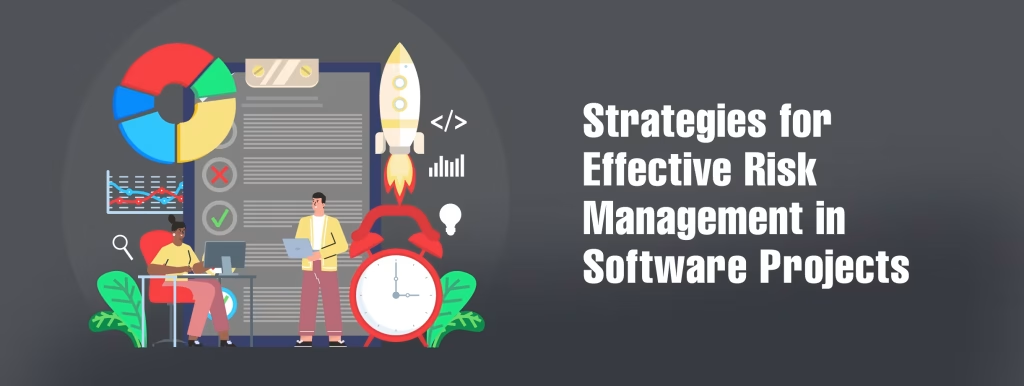
7 Proven Strategies for Effective Risk Management in Software Projects

Software project risk management strategies for developers

Introduction

As software systems get more complex, it becomes tough to ensure the smooth delivery of projects. Good management of risk will definitely avoid delays and make sure that an increased budget overrun is avoided, and products are developed with high quality. Actual risks must be identified by software teams from planning stages to after deployment. We’ll talk about seven tried and tested strategies senior developers and project managers can use to perform extremely well in this blog.

Managing Technical Debt in Software Project Risk Management

The most primary step in effective risk management should be to identify risks as early as possible in the project planning phase. It is well understood to note technical as well as business risks that may creep up. Third-party APIs are part of it. There can be unclear requirements too, which might disallow the process further in the development lifecycle of the software.

  1. Have brainstorming sessions with key stakeholders.
  2. Set up a risk registry to record and document potential risks and their impact.
  3. Applying scenario planning would provide potential failures.
  4. Earlier construction of contingency plans without disruption is possible through anticipative identification of risks.

Risk Mitigation Plan for Software Project Risk Management

Software development is dynamic, and agile frameworks, especially Scrum and Kanban are designed to manage changing risks. Agile frameworks give the facility of the risk constant across iterations. Project risks can be monitored and addressed in daily stand-ups, sprint reviews, and retrospectives.

  1. Create a backlog for identified risks and rank them.
  2. Use burn-down charts to track risk impacts
  3. Include product owners in the decision-making process
  4. Agile practices fit well into continuous delivery and allow development teams to respond fast to changing requirements or challenges

Emphasis of Communication and Transparency

One of the most common risks that arise when developing software is the break in communication, especially among the developers, testers, and stakeholders. Clear channels will ensure that identified risks and mitigation strategies reach all people in the team.

  1. Use real-time communication tools, such as Slack or Microsoft Teams
  2. Ensure the risk mitigation plan for the project is communicated across all the stakeholders involved in the project
  3. Create an openness culture to have a conversation about all risks
  4. Communicating in an open manner eliminates escalations because teams are ready to deal with commonly arising issues; hence, never escalate.

Managing Technical Debt in Software Project Risk Management

It can erode quickly if not managed well. So technical debt, when it is not taken care of, threatens to be a substantial risk to the success of a software project. It leads to poor code quality, increased development time, and reduced flexibility in the later iterations.

  1. Technical debt should be checked frequently through code reviews.
  2. Refactoring time must be planned for the sprint.
  3. Automated testing would help in catching problems early.
  4. Technical debt will not compromise future development cycles and, not impact delivery timelines once the code is clean and scalable.

Risk Mitigation Plan for Software Project Risk Management

A risk mitigation plan acts as an actionable basis for effective risk management. It describes how specified risks will be addressed and mitigated in case they occur. Each identified risk should have predetermined responses, and ownership assignment ought to be done to ensure rapid resolution.

  1. Use a risk matrix to classify risks according to severity and probability
  2. Identify owners for prioritized risks
  3. Review the risk mitigation plan regularly to ensure it remains updated
  4. Having a well-thought-out mitigation plan will help teams be better equipped to respond in advance to challenges and ensure that their software projects stay on track.

Project Governance for Monitoring Risks

Project governance frameworks provide a structured way of risk tracking and resolution. Governance ensures that risks are followed up upon for continued observation, and those identified should be escalated to decision-makers when appropriate.

  1. Regularly conduct project health assessments.
  2. Develop a risk review board for high-impact projects.
  3. Utilize tools that support project governance that can automate the tracking and alerts.
  4. If governance is in place, then the senior developers and project managers can be guaranteed that any potential risk identified will be caught and addressed at the early cycle stage.

Use of Tools and Automation in Software Project Risk Management

There are a number of tools and platforms that software teams can employ in tracking and mitigating the risks. This starts from the project management software like Jira, to automation frameworks that help identify, monitor, and close risks.

Find a way of integrating it with agile workflow when you use Jira for risk monitoring.

  1. To reduce deployment risks, use pipelines for continuous deliveries
  2. Use DevOps tools, which allow you to automate most of your repetitive activities and minimize human errors.
  3. Automation allows teams to focus on high-value work as they eliminate any hands-on work that could become a source of risks.

Conclusion

Risk management is the backbone of any good software project. Software teams can reduce the chances of disruptions occurring by identifying risks early and through correct adoption of agile practices along with usage of automation. Other factors contributing to long-term success in projects include building a culture of transparency as well as technology debt management.
This is why the efficient handling of risks throughout the entire lifecycle has come to be an important tool in the arms of senior developers and project managers for ensuring on-time and within-budget delivery of quality solutions. With these seven practical strategies for software development, your team remains proactive in ensuring smooth delivery and risk-free software development.

More Blogs: How Cloud Services Drive Efficient Software Development: 10 Key Insights

10 Proven Strategies to Scale Software Projects Effectively

Scaling software projects using cloud infrastructure for optimal performance

Introduction

Scaling software projects at scale is probably the most challenging job of a lead cloud engineer. In view of the increase in customer demands on a daily basis, projects being more complicated, one has to outshine the competition. Effective scaling in software projects has become indispensable. Here are 10 proven strategies that allow for seamless scalability, leveraging cloud infrastructure, automated tools, and agile methodologies.

Scalability using Cloud Infrastructure for Software Projects

The cloud gives enormous scope to scale software projects. Solutions based on the cloud give organizations the flexibility and scalability of a resource that is available on demand. Whether you are using AWS, Microsoft Azure, or Google Cloud, the cloud platforms ensure horizontal as well as vertical scaling of the applications. This ensures optimal performance even when your project is growing.

Agile Development for Flexibility

Agile development is the way to scale software projects. It allows adaptability and rapid responses to changes in scope or business requirements using an iterative approach. It encourages continuous delivery and collaboration between cross-functional teams, with no bottlenecks in your project to ensure it scales.

Focus on Modular Architecture

A modular architecture is necessary for the scaling of large software systems, as it is more possible to split up a project into even smaller, independent modules, or microservices, which can be developed separately and independently without affecting the whole system. This method enhances maintainability and flexibility and allows you to scale individual parts of the project according to user demand.

Automate Testing and Deployment Processes

Testing and deployment can be tedious and error-prone, especially with an increasing number of projects. Automating these processes becomes essential for efficiently managing and scaling projects. Implementing automation tools like Jenkins, Travis CI, or CircleCI will ensure faster releases with fewer errors, thus enhancing reliability in the growth of software.

Invest in Cloud-Based Monitoring and Analytics Tools

Monitoring becomes more important as your software project scales. Tools like New Relic, Datadog, and Prometheus will help you track performance in real time. Analytics gives insights into potential bottlenecks, consumption of resources, and user behavior, which thus makes it easier to either adjust the resources or tweak the software for enhanced performance at rising demand levels.

Overcome Scaling Challenges with Load Balancing

Scaling software projects inherently brings new challenges, such as increased traffic and the need to maintain performance. Load balancing is an effective solution, allowing traffic to be distributed across multiple servers to prevent system overload. In ensuring high availability and even performance as your software scales, there are really nice tools such as HAProxy, Nginx, and AWS Elastic Load Balancing.

Ensure Scalability with DevOps Integration

The practice of DevOps needs importance throughout the lifecycle for maintaining scalability. DevOps encourages the integration of dev and operations teams to ensure collaboration and continuous improvement. Some of the practices that include IaC, monitoring, and automated CI/CD pipelines must ensure that your infra scales with your software.

Code Optimization for Performance

As the software project grows, inefficiencies in code cause performance problems. Perform code review routinely and use performance analysis tools to detect bottlenecks or inefficiencies. This optimized code consumes resources the least. The response times increase and the software is able to meet all growing user demands.

Prepare for Scaling with Capacity Planning

Capacity planning accommodates the forecasting of future needs that your software will need. By projecting growth and performing load testing on your system, you can avoid unexpected outages or slowdowns. Engage in doing load testing at the start and revisit the capacity planning to ensure that your infrastructures can support your future growth.

Work Collaboratively Across Teams

Scaling software projects requires an effective collaboration between development, operations, product management and other stakeholders involved. Communication tools like Slack or Microsoft Teams could be set up alongside suitable project management platforms, for example, Jira or Trello, in order to keep all on the same page. Collaboration fosters innovation and avoids problems caused by scaling too hastily or inefficiently.

Conclusion

Scaling software projects most effectively requires a thoughtful approach that combines strategic planning with technology adoption and efficient collaboration. To achieve this, explore leveraging cloud infrastructure, process automation, and agile development-outlined below and importantly, embrace on the basis of the challenges to be met with from scaling your project. Anticipated performance, reliability, and also user satisfaction over the software will be guaranteed.

More Blogs : 7 Strategies for Building a Culture of Innovation in Software Development Teams

10 Reasons Quality Assurance Drives High-Quality Software Outcomes

Roles of Quality Assurance in ensuring high-quality software development

Introduction

In a software development market that is as cutthroat as this, delivering quality software ensures that the users get what you intend to give them, and therefore you are sure to have a firm ground in the market. In building software, while the development teams play their part, Quality Assurance is equally important as it ensures that the product meets both functional and non-functional requirements. QA goes beyond mere testing and is an integral strategic part of the software development life cycle: checking the product early helps find defects, increase reliability, and gain final user satisfaction. 

In today’s discussion, we’ll look at 10 key roles of Quality Assurance toward successful delivery of high-quality software.

Roles of Quality Assurance toward successful delivery of high-quality software.

Early Detection of Defects in Software: Early detection of software defects is a key role of Quality Assurance. Continuous testing and development ensure that bugs, glitches, or performance bottlenecks are detected well ahead of user-level exposure.

Why Does It Matter?

Early detection of defects not only reduces the cost of later fixes but also accelerates the release cycle. QA teams employ various forms of automated tools that help them test and identify defects continuously, thereby letting only high-quality code move toward production.

Building Software Reliability: Another important aspect that QA provides is the overall reliability of the software being developed. With it, the software can definitely be depended upon and will work as it is supposed to in any kind of condition, thereby bringing satisfaction and trust to the users. QA testing with extreme intensity is conducted to ensure each component of the software performs well when integrated thus performing well under heavier loads or complex environments.

Load testing and stress testing help determine how well the software performs when being subjected to large-scale data inputs or heavy user traffic. In this way, the software remains stable and reliable even at pressured times.

The Shift-Left Approach: In the development of new softwares, QA is no longer a true afterthought. The trend of shift left involves moving and integrating QA from the earlier stages of development. Therefore, testing begins on day one, allowing developers to address defects as they occur rather than waiting until the final stages of development.

Why This Matters?

Quality assurance is indeed an exercise that begins early, thereby reducing the possibility of an error from happening in the first place. Early testing is, therefore, an integral part of an overall scheme to deliver quality software faster.

Automating Software Testing: Manual testing is quite cumbersome and useless. Automated testing is a strategy adopted by the QA teams for the repetitive execution of tests in volume. Automation saves much time in execution as more test cases can be covered in less time.

Benefits of Automation

  1. Reduces Human Error in Testing
  2. Improves the cycle of feedback, and the developers can easily solve the problems quickly
  3. Supports broad consistency in automated testing of projects
  4. Tools: Selenium, JUnit, TestNG are some tools that are generally applied by QA teams to perform automatic testing.

Effective Intercommunication Across Teams: Quality assurance is an important component that assists teams in intercommunication that develop software. Being a link between the developers, operations, and the product team assures that everyone shares one idea of quality orientation and performance expectations.

Why Does It Matter?

QA and development teams should effectively communicate to avoid misinterpreting the requirements. It is more than likely that when the QA team clearly communicates with the development team, the risk of misunderstanding and failing to meet the final product will be reduced and end up serving the needs and expectations of the customer.

Testing Functionality and User Experience: Apart from bug detection, QA ensures that the software does behave in a manner it is expected to and does provide for a seamless user experience. A function test will ensure that the software performs according to its specification, whereas usability testing will ensure that the users can easily use the software.

Example: QA teams do end-to-end tests where they simulate the usage scenarios of real-world users to test software performance on different devices, platforms, and browsers.

Mitigating Risk and Reducing Downtime: A great QA process ensures that risks that are associated with the deployment of software are controlled by businesses. Identifying failure points in the system through QA teams is crucial to prevent costly outages or service interruptions.

Why This Matters?

For instance, in finance and healthcare, any industry relating most to the reliability of its software, managing risks through QA prevents outages and ensures uninterrupted service.

Preventing Security Vulnerabilities: As hackers’ activities have become increasingly common, software security testing has become an integral part of the QA process. The QA teams try to check for bugs with security vulnerabilities that involve weak authentication mechanisms and disclosure of sensitive information.

Why It Matters?

When a piece of software is considered safe, it helps the user as well as the organization by being safe from data breaches and the loss of confidential information.

Quality Metric Tracking and Measurement: The quality assurance team tracks key quality metrics such as defect density, test coverage, and time taken to close the issues in order to have continuous improvement.

Monitoring these metrics helps identify trends and bottlenecks in the development process. It ensures valuable insights can be applied to improve future iterations.

Why This Matters?

This allows businesses to develop their process to provide better software products in the next iteration.

Customer Delight and Retention End: Ultimately, what quality assurance seeks to deliver is a product that surpasses or meets the expectations of the customers. High-quality software leads to increased customer satisfaction, loyalty, and subsequently an improved business outcome. By ensuring the product is free of bugs and is secure, yet at the same time user-friendly, the long-term success of the product is the direct benefit of QA teams.

Example: Well-managed QA will ensure catching of most problems after the release to ensure delivery of the product that gives value and in which customers may actually have a chance to rely on it.

Conclusion:

In short words, quality assurance aims at catching bugs, ensuring that the software is working towards its objectives as expected and provides a simply excellent user experience. From early defect detection to automation, risk management, and security testing, QA plays the pivotal role of success in software products.

The integration of the above 10 important roles will help your team deliver quality-software releases within the market, satisfactory to the users-thereby leading to business success.

More Blogs : Key Factors to Consider When Choosing a QA Testing Partner

How Cloud Services Drive Efficient Software Development: 10 Key Insights

Cloud Services for Software Development

Introduction

With the onset of the Pandemic, businesses were quick to realize the opportunity to look forward to leveraging cloud services as a tool for efficiency, agility, and scalability in today’s fast-paced digital landscape. Cloud-based solutions allow distributed teams to streamline their processes, eliminate infrastructure costs, and become more effective in their collaboration.

However, a more pertinent aspect of this article is that it points out the following ten essential strategies of using cloud services that can help improve software development efficiency, making you ahead in competition and able to get back to clients within time and budget with the offered projects.

Leverage Cloud Services for Software Development Collaboration

One of the major benefits of using cloud services is team collaboration, especially in software development. Software development teams can work on the same project at the same time due to Google Cloud, AWS, and Microsoft Azure, which are cloud platforms. Slack, Jira, and Trello tools allow transparency, efficient communication, and good tracking of work in progress, management of tasks, and final delivery of project results within a schedule.

Cloud Services for Software Development: DevOps Integration

Cloud-based services change the pattern of how people will utilize DevOps services in their organizations. Cloud-based integration tools make it possible for the implementation of continuous integration and continuous deployment. Their practices of testing, deploying, and monitoring can be automated by DevOps pipelines through the cloud. The process saves time-to-market periods with quality standards being maintained. This involves services like AWS CodePipeline and Google Cloud Build, which generally reduce the cycles of a development process; hence, the practice is efficient to develop software.

Agile Development with Cloud Services for Software Development

Agility thrives when teams have flexible, scalable infrastructure supporting work, and cloud services prove to provide that. Ensuring that resources scale up or down according to project demands helps ensure development teams remain agile. This makes it possible for businesses to respond fast to changes in the market, customer needs, or project scope without delay or over-spending.

Use Cloud Infrastructure in Scopes of Scalability

Scalability is one of the major aspects in software development, mainly for projects that are expected to grow in size or complexity. Cloud infrastructure allows the scaling of computing power and storage according to the changes in the project. Cloud infrastructure would automatically be readjusted to support your own software whether Amazon EC2 or Microsoft Azure Virtual Machines or Google Compute Engine, thus eliminating downtime and giving consistent performance.

Cloud Services – Cost Effective

Budget management in software development projects is a big concern for any project manager. With cloud services, it becomes irrelevant to spend a lot on front-end hardware because they can pay for what they use. Their model is pay-as-you-go and has proven very effective for managing costs, especially the smaller start-ups or companies that scale pretty fast. However AWS and Microsoft Azure are examples of cloud services. They provide tools for cost analysis in order to help teams predict and manage costs as well.

Automated Backups and Disaster Recovery

Redundancy and disaster recovery on data are built right into the cloud platforms. Because of this, you do not have to lose any data when developing your software project through a cloud provider. Automated backup systems provided with Google Storage from cloud-based programs, AWS S3, and more give you version control and automatically recover critical files in case of an outage or system failure. Through this, teams can continue to be productive with little to no downtime based on unexpected events.

Better Security and Compliance

Security that can keep pace with increasing cyber threats in the present world is one of the major aspects of safety for software projects. Cloud-based services offer enterprise-grade security, including encryption, identity and access management, and automated threat detection. Platforms like AWS, Azure, and Google Cloud comply with international standards such as ISO 27001, GDPR, and HIPAA, so your software is developed to industry standards and safeguards sensitive data.

Cloud Services for Software Development: Testing and QA

Testing large scale software development projects is very expensive and error-prone if done manually. Nowadays, firms like Sauce Labs, BrowserStack, and AWS Device Farm provide ease to the developers as they can test their software on various environments and devices. On a cloud platform, automated testing, regression testing, and performance testing can be done easily, which further accelerates the development process and enables better quality of software.

Centralized Project Management and Documentation

Cloud-based tools allow teams to remain organized and focused on the core deliverables. Tools like Asana, Confluence, and Monday.com ensure that centralized documentation, management of tasks, and reporting are done in such a way that access to up-to-date information about the project will be possible by any team member involved. This type of centralization ensures accountability and aligns everyone involved throughout the development lifecycle.

Continuous Monitoring and Optimization

A powerful tool for the efficient development of software is the monitoring and analytics capabilities of Cloud services. Among them are AWS CloudWatch from AWS, Azure Monitor from Azure, and Google Stackdriver from Google,  which can provide real-time monitoring of the performance of software applications so that bottlenecks or inefficiencies caught early enough become major issues. Continuous resources, performance, as well as user behavior monitoring, enables development teams to make data-driven decisions to optimize their applications and improve overall efficiency.

Conclusion

In today’s competitive atmosphere, utilizing cloud services for software development is no more a luxury but a necessity. There is extensive enhancement of collaboration with cost optimization while ensuring scalability and strengthening security by using cloud services that provide all these utilities and platforms in order to streamline the process of development.

Embracing cloud technology allows you to effectively lead and control development projects towards successful delivery in terms of time, budgets, and quality output. The discussed 10 strategies can be used to benefit from a maximum use of the services offered by cloud and make your project successful.

Along with the adoption of DevOps, agile methodologies, or even security enhancement, improvement comes to a cloud service regarding better productivity and scalability not only of the team in general but also their efficiency in delivering software development. Finally, the best way to keep up with the competitive edge and keep pace with the ever-evolving demands of modern software development is to harness the power of cloud services.

More Blogs : Serverless Computing: Top 5 Scenarios and Effective Implementation Tips

Mastering Code Reviews: 7 Key Takeaways from My Experience

Code review process improving software quality and collaboration

Introduction

Code review lessons is one of the most important software engineering practices for improving software quality, developer collaboration, and long-term maintainability. Although some development teams initially see peer code review as an additional step in the workflow, it plays a critical role in identifying bugs early, enforcing coding standards, and improving overall code quality.

After more than two decades in the software industry, I have seen firsthand how software code review improves engineering best practices and supports collaborative development. Effective code reviews help teams share knowledge, improve communication, and deliver more reliable software products.

In this article, I share seven important lessons from my experience with code review best practices and explain how peer review processes contribute to successful software development projects.

Peer review Improves Code Quality

Code review introduces an improvement of code quality. Even experienced developers can make mistakes; everybody can make mistakes. Fresh eyes can predict future problems, logical mistakes, and edge cases missed. So, the code follows the quality standards assigned to the project, and thus software becomes more solid, robust, and much easier to maintain.

Reviews encourage knowledge sharing Across Teams

Reviews contribute to collaborative development and, therefore, the sharing of knowledge. The junior developers get comments from the senior developers, whereas more experienced employees acquire new techniques; this type of cooperative learning contributes to the prosperity of the whole team, which leads to a more productive and self-assured workforce.

Early bugs can be caught through this collaborative process

Another practical benefit of peer review process is the early catching of bugs. Catching bugs very early, before the code is allowed in production, saves the time and effort spent in debugging later in the lifecycle of the software. This proactive step helps minimize downtime and allows the project to run smoothly.

Maintaining consistent coding standards becomes easier with peer feedback

Consistency is the key in software development, especially when teams are huge. Code reviews are an integral part of the enforcement mechanism of coding standards and best practices; this ensures uniformity and maintainability of the codebase. Teams can align their style guides to make it easier to onshore new developers and maintain code over time.

Code Review Enhances Team Collaboration and Communication

Apart from the technical changes, reviewing code encourage collaboration and communication among team members. Where the intent behind implementing certain codes is explained, all confusion and ambiguity will be avoided. This interaction builds trust within the team and brings everyone on the same track as the project.

Code Review Supports Agile Development Practices

In agile fast-paced development environments, continuous reviews of code ensure that software becomes incrementally developed without losing quality. Agile teams incorporate code reviews into their workflows to maintain integrity of code while quickly releasing features. The process of iterative review enhances the speed and quality, for delivering value on a constant basis.

Code Review Facilitates the Use of Tools

With teams scaling up, using code review tools such as GitHub, Bitbucket, or GitLab becomes more of an imperative to a streamlined process. They allow for structured platforms for reviewing, commenting, and following the changes and also tie into pipelines to allow automated code quality checking and enhance team productivity.

Conclusion

Code reviews are a critical part of modern software engineering workflows. Beyond improving software quality assurance, they strengthen developer collaboration, enforce coding standards, and support continuous learning within engineering teams.

By integrating peer code review and pull request review practices into daily development workflows, organizations can improve code maintainability, reduce bugs, and deliver more reliable software products.

More Blog: The Ultimate 7 Transformative Advantages of Multi-Cloud Strategies Empowering Modern Enterprises

Top Cloud Computing Trends to Watch Over the Next Decade

Cloud Computing Trends

Introduction

Cloud computing has already made a significant impact on the ways businesses operate,  improving scalability and the on-demand availability of computing resources. Indeed, it will only continue to evolve for us as we enter the next decade in its development, abetted by the additions of artificial intelligence, automation, and edge computing, and will remain competitive only if they stay ahead of these key trends.

The article delves into the most influential trends defining cloud computing and how it will reshape and transform businesses and industries around the globe.

Edge Computing on Center Stage: The most evident next decade’s trend in cloud computing would be the growth of edge computing. Edge computing has brought processing closer to the location of the original environment; therefore, latency decreases and real-time data processing becomes possible, for example, for applications such as autonomous vehicles, IoT devices, or a smart city.

It means businesses can now readily access cloud-based resources without the latency generated by having to send data to and from a central server. The more extensive that 5G technology extends, the more that role is expected to play out toward making it faster and more efficient in the provisioning of cloud services.

Increasing Multi-Cloud and Hybrid Cloud Strategies: The advancement in cloud technology is forcing more and more businesses to shift their workloads to the cloud. Among them, most prefer a multi-cloud or hybrid cloud approach. In a multi-cloud strategy, services from multiple cloud providers such as AWS, Google Cloud, Microsoft Azure, and others are used to avoid vendor lock-in, providing greater flexibility. Hybrid is a combination of private and public cloud environments where business can optimize infrastructure according to specific needs.

Such approaches provide greater control over workloads, security, and performance. Businesses can expect more hybrid and multi-cloud architectures to make the scenario more scalable and agile in the decade ahead.

AI and Machine Learning Power Cloud Innovation: Cloud computing is also being transformed with artificial intelligence and machine learning. Given its present stage, it is expected that there will be further expansion in the next ten years. AI-powered tools have been integrated into cloud platforms to automate even the most complex of tasks while improving the analysis of data and enhancing decision-making processes.

For example, AI-based cloud computing will deliver predictive maintenance for manufacturing, chatbot-assisted automatic customer services, and even next-level cyber security features. It is upon the building of AI that cloud computing will reach full maturation and even get smarter in its quest to present real-time insight-driven business innovation.

The Serverless Computing Continues to Expand: Serverless computing is not a phrase that one can ignore when running an application, especially when seeking newer and more efficient ways to operate it. Recognized in simpler terms as Function-as-a-Service (FaaS), serverless computing is becoming increasingly popular as people seek to move towards less resource-intensive and manual server provisioning and management.

More and more companies will look towards serverless computing throughout the next decade, making agility and cost-efficiency the focus of its operations. It is only with serverless architectures that business organizations will focus more on the creation and deployment of applications instead of at the infrastructure.

Cloud Security Centers More Attention: The more sensitive data being sent to the cloud, the more important it is that the organization focuses on the security of the cloud. Cybersecurity threats are shifting their direction, and businesses need to make sure that their cloud environments are secure and in perfect alignment with data protection regulations.

We will see improvements in Zero Trust Architecture, AI-based security systems, and encryption techniques addressing cloud security challenges in the next couple of years. Organizations will invest heavily in security solutions that can identify, prevent, and mitigate the risks before they strike operations.

Quantum Computing and Impact on Cloud: While still in the infancy stage, quantum computing is something worth watching. This technology could revolutionize cloud computing to a great extent. Quantum computers can process huge amounts of data and can solve problems exponentially faster than other computers. As this technology matures, it would give cloud providers unprecedented amounts of power which would let breakthroughs be made in drug discovery, cryptography, and financial modeling.

Where mainstream adoption of quantum computing will probably take nearly a decade, cloud providers are now exploring how they can integrate this new technology onto their platforms.

Cloud-Native Technologies and Containers: Containers and microservices have become the building blocks of modern application development with cloud-native technologies. By packaging the application itself with all its dependencies, containers allow the application to be deployed more easily in a variety of operating environments. Kubernetes leads the pack as far as the container orchestration platform goes, in terms of managing applications at scale in the world of containers.

With cloud-native architectures, the development of scalable and resilient applications will become usual over the next decade, enabling innovations in business within a cost-effective and performance-improved application in the cloud.

Sustainability and Green Cloud Computing: Considering the companies’ focus on sustainability, green cloud computing is certainly a trend that will prevail in the coming decade. Currently, cloud providers are keenly interested in energy-efficient data centers and renewable energy sources for zeroing their carbon footprints.

Also, enterprises would prefer cloud service providers who fit in their sustainability goals in line. As climate change has become a ticking bomb for everyone, there will be more innovation with respect to energy-efficient cloud infrastructure as well as more green practices.

5G Networks Super Charging Cloud Performance: The new generation of 5G technology is going to change the cloud computing experience by providing transfer speeds much faster than ever as well as lessening latency. The new generation of 5G technology is going to change the cloud computing experience, particularly enhancing the features of the cloud-based application, especially in gaming, healthcare, and self-driving automobiles.

With 5G networks, cloud providers will be able to offer ultra-low latency services, making applications like virtual reality (VR), augmented reality (AR), and Internet of Things (IoT) devices a lot more feasible than ever before.

Rise of Automation in Cloud Management: Over the next decade, automation will play an even larger role in cloud computing. Already, cloud providers offer tools that automatically simplify routine management tasks such as scaling resources, performance monitoring, and security patches. This trend will accelerate with the objective of increasing the reduction of manual workloads on the shop floor and improving the operational efficiency of businesses.

With automated AI, management of the cloud will be made intuitively easy, and businesses will be able to focus on more strategic and less on day-to-day work.

Conclusion

Cloud computing is going to explode in the next decade. Keeping all that in mind, advancements in edge computing, AI, quantum computing, etc will push the envelope in the coming years. Organizations that remain abreast of such trends are bound to enjoy the complete essence of cloud technologies and will lead to innovation, efficiency, and gaining competitive advantage in this digital age.

With further maturity of these technologies, the cloud will become yet a more fundamental component through which organizations work, transforms industries, and reshapes the future of computing.

More Blog: Securing Cloud Infrastructure: Key Best Practices to Mitigate Threats

Personalized Shopping with AR: 5 Powerful Ways It’s Transforming Retail Experiences

Customer exploring personalized shopping with AR using smartphone inside a modern retail store.

Introduction

In a world where consumers are actively searching for convenience and engagement, personalized shopping with AR is transforming the retail environment. Augmented reality (AR) brings digital elements to the real world, which allows retailers to deliver their customers specially customized experiences that had been impossible before. Personalization now has become more than a trend in the customer-centric retail sector-it is a necessity. With AR technology, the retailer can meet such expectations by providing an immersive and relevant shopping journey.

In this blog post, we are going to discuss 5 ways personalized shopping through AR is changing the game when it comes to retail and what it means for businesses seeking to stay one step ahead.

Virtual Try-Ons for Personalized Shopping with AR

The most visible application of personalized shopping with AR is in virtual try-on technology. Clothing, eyewear, and cosmetics companies use AR to allow customers to try products virtually, making recommendations personalized based on their preferences.

For instance, customers can use AR-powered applications to imagine how a pair of glasses or a certain shade of lipstick would look on them. This technology is enhancing online shopping and reducing the possibilities of returns. Brands create trust and drive customer satisfaction through this technology by giving them relevant product recommendations.

Personalized Shopping with AR for Product Discovery and Navigation

AR takes product discovery to the next level by taking online shopping to the offline platform and vice versa, enabling more immersive shopping. Retailers could guide customers in product selection by using AR suggestions that are personalized according to the customer’s preferences. For example, an in-store display could be based on purchases or products that a customer has browsed online in the past.

Such retail innovation brings both the online and offline channels closer, as the product that a customer would be interested in will have minimal efforts in searching for such products. It allows navigation on how customers spend less time hunting for products and more time engaging with the right products.

Interactive Loyalty Programs and Promotions

Retailers can make AR apps more personal and interactive experiences for the customers by stimulating loyalty programs. For example, one may get the special treats or discounts only through participating in an AR-based treasure hunt or challenge within that store.

Personalized offers solicit higher levels of customer engagement and loyalty to the brand. Businesses infuse uniqueness to the loyalty programs through the integration of AR, letting the customers return to stores, therefore turning shopping into an enjoyable and rewarding experience.

Customized In-store Experience using AR

With the aid of AR, the in-store retail experience of the customer can be customized: this is so because AR gives real-time information on products. The consumers may use an AR application in their smartphone to read the barcodes of products and obtain actualized information such as care instructions, compatibility with other purchases, or user reviews.

Certain retailers have even adapted their shopping assistants powered with AR, that accompany the customer through the store, specify what matches their taste and assist them in making a smooth purchase. This is an innovative application of ARs, not only elevating customer satisfaction but also increasing in-store engagement.

Real-time data insights for better personalization

In fact, on the back end, retail AR provides much more useful data for businesses to fine-tune their personalization strategies. Through AR interactions, retailers can determine which products a customer finds the most interesting or how a customer navigates a store.

Insights from that data allow retailers to fine-tune subsequent recommendations and promotions for particular customers. The ability to provide real-time, tailored shopping experiences deepens customer relationships and makes repeat business much easier to come by.

Conclusion

Personalized shopping with AR transforms retail environments, creating new opportunities for communicating with customers and enhancing the overall experience. Virtual try-ons, recommended items tailored to individual preferences, and loyalty programs in interactive formats open the doors for meaningful interaction between the retailer and their audience through AR.

Businesses seeking to be competitive in the retail market can no longer afford not to embrace AR technology as part of their offerings. Retailers should focus on using technology that can create immersive, personalized shopping journeys for customers to help build lasting customer relationships and increase satisfaction.

As AR technology becomes more sophisticated, so does the potential for its use in retail: from immersive experiences in the stores themselves to personal styling consultations. At the moment, personalized shopping with AR provides a powerful tool for tailoring retail journeys to meet customers’ needs for engagement.

With AR shaping the future for shopping, retailers who adopt this technology will be best positioned to lead the charge on providing that customer experience which today’s shopper needs.

More Blogs: 7 Game-Changing Examples of How AR and AI Integration is Revolutionizing Industries

  • Copyright © 2026 codelynks.com. All rights reserved.

  • Terms of Use | Privacy Policy