
Back
#Business
Bharat-VISTAAR Cloud Infrastructure: Powerful 120M-Farmer Stack

Content Overview
Bharat-VISTAAR is live. Is Your Cloud Infrastructure Ready for 120 Million Farmers?
On February 17, 2026, India’s Agriculture Minister launched Bharat-VISTAAR (Virtually Integrated System to Access Agricultural Resources) in Jaipur, pushing the Digital Agriculture Mission into active deployment. The platform serves 120 million farming households. It pulls from AgriStack’s three foundational registries, integrates ICAR crop advisory packages, delivers real-time mandi prices and weather data, and runs in 11 languages planned for rollout by Q3 2026. The engineering problem is not the app. It is the cloud infrastructure behind the 10.31 crore Farmer IDs, the state-level federated registries, and the data pipelines that must work in districts where connectivity disappears for hours at a time. State implementation teams are discovering this now. Most are discovering it the hard way.
The Federated Architecture Is Not Optional
AgriStack is not a centralized database with a state API wrapper. It is a federated Digital Public Infrastructure built on InDEA 2.0 and the Vistaar Protocol, where each state maintains its own Farmer Registry, Geo-Referenced Village Maps, and Crop Sown Registry, and the central Ministry connects to these via standardized APIs. This is a deliberate design choice rooted in data sovereignty. States own their farmer data. The center aggregates and enables.
A federated DPI is not a distributed monolith. The difference matters from the first line of architecture.
This architecture has direct cloud consequences. You cannot build a single-region AWS deployment at the central level and call it done. You need:
– State-level compute environments close to local data sources
– Bidirectional sync protocols tolerant of intermittent connectivity
– Separate IAM boundaries per state with central audit federation
– Data residency controls aligned to DPDP Act provisions for state government systems
The Vistaar Protocol defines how data is represented and shared across the stack. It does not define how it survives a cloud zone failure at the state level. That is your engineering responsibility.
Where State Cloud Deployments Are Failing
Working with a state-level AgriTech implementation partner in Madhya Pradesh, our team reviewed infrastructure across four districts targeting the Kharif 2026 Farmer ID registration push. Three failure patterns appeared in every district.
Synchronous API coupling to central registries. State systems were calling central AgriStack APIs synchronously during field registration sessions. When central API latency exceeded 3 seconds, field officers abandoned the session. The fix is an event-driven architecture with local write-ahead queues and eventual consistency to the central registry, not synchronous coupling.
No offline fallback for the Gram Panchayat layer. Bharat-VISTAAR is designed to run on basic mobile devices in low-connectivity environments. The cloud architecture backing it must support an offline-first mobile API gateway at the Gram Panchayat level. Most deployments we reviewed had no concept of edge caching or offline token issuance for field agents. State AgriStack registries that cannot survive a 6-hour connectivity window will miss the farmers they were built for.
Single managed Kubernetes clusters running registry, analytics, and AI workloads together. Farmer Registry workloads have predictable, high-volume read patterns. Bharat-VISTAAR’s multilingual AI advisory model runs on-demand inference with unpredictable burst. Running these on the same cluster without workload isolation means a crop advisory request spike during sowing season can starve the Farmer ID lookup service at exactly the wrong moment.
The FACRM: Federated AgriStack Cloud Readiness Model
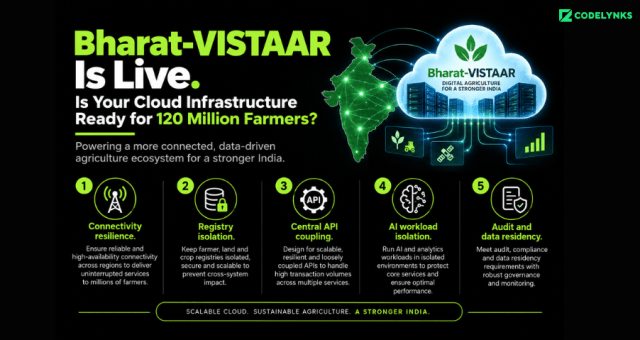
The Federated AgriStack Cloud Readiness Model (FACRM) gives state teams a structured lens to assess their cloud infrastructure before the next phase of Bharat-VISTAAR rollout. It has five dimensions:
1. Connectivity resilience. Can the state registry survive a 6-hour WAN outage without data loss or corruption? Are write-ahead queues in place at the taluk level?
2. Registry isolation.Are Farmer Registry, Crop Sown Registry, and Village Map services on separate compute boundaries with independent scaling policies?
3. Central API coupling. Is the state’s connection to central AgriStack APIs asynchronous and queue-buffered, or synchronous and brittle?
4. AI workload isolation. Are inference workloads for Bharat-VISTAAR’s multilingual model separated from registry read/write workloads, with dedicated GPU burst capacity on a time-shared schedule?
5. Audit and data residency. Does the cloud architecture produce a complete audit log of all data reads and writes per Farmer ID, queryable by the Ministry’s central audit system without exposing raw farmer data?
Score each dimension from 1 to 5. A state ready for Kharif 2026’s final registration target should score at least 18 out of 25. Most state deployments we have audited score between 9 and 13.
Choosing the Right Cloud Services for AgriStack
The instinct among state technology teams is to reach for Kubernetes because it is what the cloud consultants they hired know. Kubernetes-first deployments are the wrong default for state AgriStack infrastructure. Most states need managed services and lightweight edge runners, not a container platform built for multi-tenant SaaS companies.
For the registry and sync layer: managed PostgreSQL with read replicas at the state level, AWS DynamoDB or Azure Cosmos DB for the offline queue buffer, and a message broker (Kafka or AWS SQS) for the central API decoupling layer. For Bharat-VISTAAR’s AI model: AWS SageMaker or Azure ML managed endpoints with auto-scaling disabled during off-peak windows to control costs. For the edge layer at taluk and Gram Panchayat: lightweight Node or Go API proxies on managed container services (AWS Fargate, GCP Cloud Run), not full Kubernetes clusters.
Multi-cloud is worth considering between the state and central layers. If your state runs on a government MeghRaj node and the central Ministry is on AWS, a cross-cloud event bridge with message transformation is a manageable integration pattern. A replicated private cloud across both is not.
What a Bharat-VISTAAR Rollout Requires at Scale
The Union Budget 2026 allocated Rs 150 crore to Bharat-VISTAAR. The Digital Agriculture Mission holds Rs 2,817 crore. The target is 30 crore farm plots across 604 districts by Kharif 2026. These numbers translate directly into infrastructure requirements: 300 million daily API calls at peak sowing and harvest periods, 11 language models serving advisory content simultaneously, and satellite imagery ingestion from the National Pest Surveillance System running continuous update cycles.
The states that will meet their registration targets are the ones that treat cloud architecture as a dependency of the political commitment, not a downstream implementation task. The ones that treat it as an IT procurement decision will spend Q4 2026 debugging production incidents during paddy harvest season.
A single Farmer ID resolution query that fails in the field sets back trust in the entire DPI by a season.
What This Means for Agriculture and AgTech Leaders
If your organization is building on AgriStack — as a state implementation partner, an AgriTech SaaS provider, or a platform integrator connecting ICAR data to field advisory apps — your cloud architecture needs a FACRM audit before the Rabi 2026 registration window opens. Specifically, this week:
Run a connectivity failure drill on your state registry. Disconnect the central API integration for 30 minutes and observe what happens to field registration sessions. If agents cannot continue working, you have a synchronous coupling problem that needs fixing before the next major registration push.
Review your workload placement. If AI advisory workloads share a compute boundary with Farmer Registry services, build a separation plan. The cost of isolation is low. The cost of a sowing-season outage is measured in farmer trust.
More Blogs : Building for the Bima Vahak: What Offline-First Really Means for Rural Insurance Apps



