
Back
#Artificial Intelligence
How to Build a Context Engineering Layer for Production in 2026

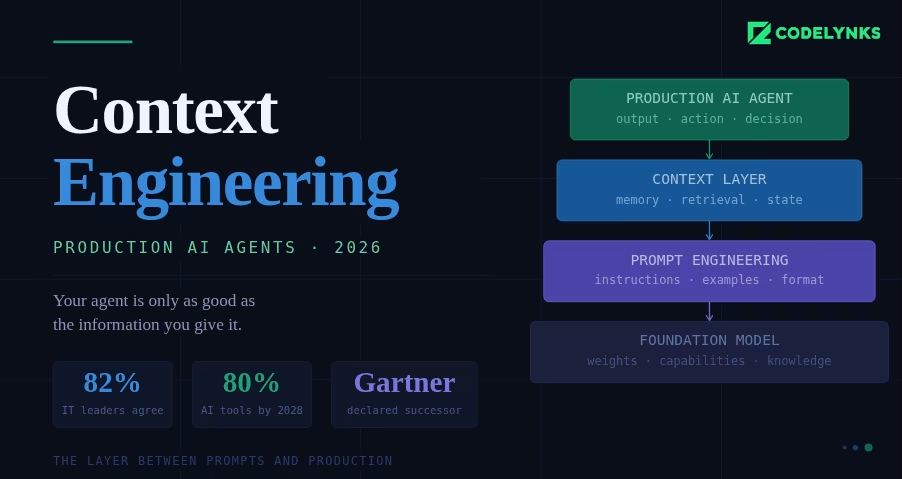
Table of Contents
Your AI agent is only as good as the information you give it. Prompt engineering optimises the question. Context engineering optimises the information. In 2026, the difference between AI agents that work in production and agents that fail in production is almost always the context layer.
In July 2025, Gartner declared context engineering the successor to prompt engineering, predicting it will appear in 80% of AI tools by 2028. The 2026 State of Context Management Report found that 82% of IT and data leaders agree prompt engineering alone is no longer sufficient to power enterprise AI at scale. The field has moved. This post explains what a production-ready context engineering layer looks like and how to build one.
Why a Context Engineering Layer Is Not the Same as RAG
The most common mistake when teams encounter context engineering for the first time is treating it as a retrieval problem. They build a vector database, chunk their internal documents, and use semantic search to pull relevant chunks at runtime. That is RAG (Retrieval-Augmented Generation). It is useful. It is not a context engineering layer.
RAG retrieves documents based on query similarity. Context engineering assembles governed, structured, versioned information packages that the agent needs to reason correctly about your business. The difference matters for three reasons:
- Reliability. RAG depends on the semantic similarity of the query to the document. Important business rules expressed in language that does not match the query get missed. Structured context products do not rely on similarity search.
- Governance. When a policy changes, you need the agent to know immediately. A vector database is eventually consistent at best. A governed context product is updated, versioned, and promoted through a defined lifecycle.
- Auditability. When an agent makes a consequential decision, you need to know exactly what context it had. With a versioned context product, you can answer that question. With fuzzy retrieval, you cannot.
The Five Components of an Enterprise Context Engineering Layer
1. Context Inventory: A cataloged store of your organization’s knowledge, structured for machine consumption. This includes business glossary terms and their definitions, data lineage and entity relationships, process rules and decision logic, compliance constraints and policy documents, and product and domain knowledge.
The inventory is not a document dump. It is curated, classified, and kept current. Think of it as the knowledge base your agents draw from, maintained with the same discipline as your code.
2. Integration Architecture: Connectors and pipelines that bring context from source systems into the context registry in near real-time. When a pricing rule changes in your ERP, the context layer needs to know. When a customer account status updates in your CRM, the agent handling that customer’s request needs current data.
This is a data engineering problem as much as an AI problem. Your context pipelines need the same reliability and observability as your data pipelines. Treat them accordingly.
3. Context Products: Versioned, tested bundles of context assembled by domain. A customer service agent gets the customer service context product, which contains the information that agent needs to handle customer queries correctly. A finance agent gets the finance context product. These bundles are version-controlled, tested for completeness, and promoted through a staging and production lifecycle.
Context products should be as small as possible while remaining complete. Giving every agent your entire organisational knowledge base wastes tokens and introduces noise. Domain-specific context products improve both response quality and cost.
4. Orchestration Layer : A runtime system that intercepts each incoming query, classifies its intent, selects the appropriate context product, and injects it before the model sees the query. This is where the majority of your latency and token cost decisions get made.
The orchestration layer also handles dynamic context assembly: pulling current data from live systems when the query requires it (the customer’s current order status, the product’s current inventory level) and combining it with the static context product appropriate for the domain.
5. Governance and Lifecycle Process: The component most teams skip and then regret. Context governance defines who can update a context product, how changes are reviewed and approved, how context products are promoted from development to staging to production, and how stale or incorrect context is identified and corrected.
Without governance, your context layer rots. Business rules change, product details change, policies change, and the context your agents have becomes increasingly wrong. A well-governed context layer is what separates an AI deployment that stays reliable at twelve months from one that degrades.
How to Build a Context Engineering Layer in Five Phases
Building a context engineering layer is a phased effort. Attempting to build all five components simultaneously is how context engineering projects fail.
- Inventory existing knowledge assets. Catalogue what you have: internal wikis, policy documents, data dictionaries, process documentation. Classify by domain and assess quality. This phase reveals gaps that need to be filled before the context layer can be useful.
- Build integration pipelines. Start with the highest-value source systems. For a customer-facing agent, that is typically the CRM, the product catalogue, and the policy management system. Normalise outputs into a context registry schema.
- Package context products by domain. Define the domains your agents operate in. Build the first context product for your highest-priority agent. Validate it against real queries before building the next one.
- Deploy query-intent routing. Implement the orchestration layer. Start with simple intent classification (which domain does this query belong to?) and expand to finer-grained routing as you learn from production traffic.
- Implement governance and lifecycle management. Define the review process for context product updates. Set up monitoring for context drift (where agent performance degrades because the context has become stale). Build the feedback loop.
What Production Performance Looks Like
Teams that build a proper context engineering layer before scaling agent deployment consistently report better production outcomes than teams that scale first and fix context later. The patterns we see in practice: fewer hallucinations because the agent has accurate, current information rather than relying on model memory; lower token costs because domain-specific context products are smaller than full knowledge dumps; faster remediation when agents behave unexpectedly because the context layer is auditable.
The upfront investment in context infrastructure pays back within the first few months of production operation.
Need Help With This?
Codelynks builds production AI systems for clients in healthcare, retail, and fintech. Context engineering layer design and implementation is a core part of our AI practice. If you are building agents for production deployment and want to get the architecture right, talk to our team at Contact us



