
Back
#Data Protection
Powerful DISCOM Data Pipeline for 5 Crore Smart Meters

Content Overview
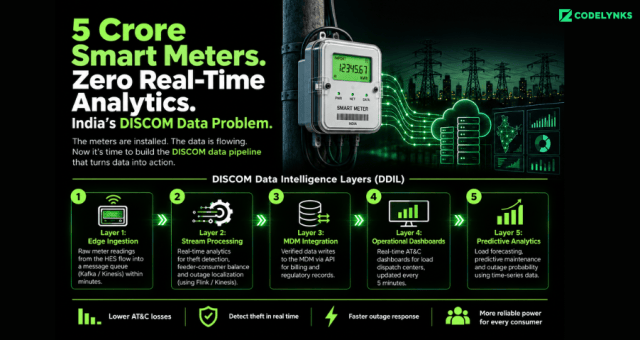
5 Crore Smart Meters. Zero Real-Time Analytics. India’s DISCOM Data Problem.
India crossed 5 crore smart meter installations in December 2025, with 3.90 crore installed under the Revamped Distribution Sector Scheme. The headline target is 250 million meters by March 2028, across consumers, distribution transformers, and feeders. Every energy minister in every state has cited these numbers as proof that AT&C loss reduction targets are achievable. They are right about the target. They are wrong about what achieves it.
AT&C loss reduction is not a hardware problem. It never was. It is a data processing problem masquerading as an installation problem. And most DISCOMs cannot process the data they already have. This post describes the pipeline architecture that changes that, based on work with a distribution company managing 2 million consumers across three distribution circles in central India.
What Is Actually Happening With the Meter Data
A smart meter with a 15-minute interval reading generates 96 data points per day. At 5 crore installed meters, that is 4.8 billion data points per day. This is Advanced Metering Infrastructure data, flowing through the Head-End System into a Meter Data Management system, where it is supposed to enable load forecasting, tamper detection, outage localization, and AT&C loss calculation.
In practice, most DISCOM MDM deployments are batch systems. They process data once every 24 hours. The analytics dashboards show yesterday’s consumption. The tamper alerts fire after the billing cycle closes. The AT&C loss calculation happens monthly, by which point the energy theft that drove it has been running for three weeks.
A DISCOM that collects 15-minute interval data from 2 million meters and processes it in daily batches is flying a passenger jet using yesterday’s weather report. The data exists. The insight does not.
The problem is not the HES or the meters. It is the pipeline between them and the analytical layer. Most AMISP contracts specify meter installation, HES provision, and MDM software. They do not specify real-time streaming, event-driven alerting, or integration with the DISCOM’s load dispatch center. That gap is where the AT&C reduction targets go to die.
The Architecture Gap in Current AMISP Deployments
The AT&C loss target under RDSS is 12 to 15 percent for most DISCOMs, down from current averages of 20 to 25 percent. The pathway is: reduce energy theft (technical loss) and improve billing efficiency (commercial loss). Both pathways require knowing about the loss event within hours, not days.
Theft detection requires comparing feeder-level consumption (DT meter) with consumer-level consumption (individual smart meters) in near-real-time. If a distribution transformer serves 200 consumers and shows 1,000 kWh consumed, but the sum of consumer meters is 700 kWh, 300 kWh is unaccounted. That gap needs to close within hours, not a billing cycle.
Current MDM batch systems produce this comparison once a day. A real-time streaming architecture produces it continuously. The difference in AT&C reduction outcomes between the two approaches is not marginal. One client reduced identified theft cases by 340 percent in the first quarter after switching from batch to streaming, not because more theft was occurring, but because the alerts fired while the theft was still happening.
India is building the world’s largest AMI network. The meter data is being collected. It is not being used.
Building the DISCOM Data Intelligence Layers (DDIL)
The DISCOM Data Intelligence Layers (DDIL) model defines five pipeline layers that together convert raw AMI data into operational intelligence.
Layer 1: Edge ingestion. Raw meter readings from the HES arrive in a message queue (Apache Kafka or AWS Kinesis) within 5 minutes of the interval close. Each message carries a meter ID, interval timestamp, consumption reading, power quality flags, and tamper event codes. The queue is the single source of truth. Downstream consumers read from it without polling the HES.
Layer 2: Stream processing.Apache Flink or AWS Kinesis Data Analytics runs three concurrent jobs: feeder-consumer balance calculation, comparing DT meter readings with the sum of downstream consumer readings in real-time; tamper pattern detection, flagging meters with sudden consumption drops, bypass indicators, or reverse energy flow; and outage localization, inferring outage boundaries from the last-reported meter readings across the feeder topology. These jobs produce alerts, not reports.
Layer 3: MDM integration. The verified stream output writes to the MDM system via API for billing and regulatory records. The MDM is the system of record for billing. It is not the analytical engine. Separating these concerns is the most important architectural decision in any DISCOM data project.
Layer 4: Operational dashboards. Real-time AT&C dashboards for load dispatch centers show feeder-level balance, active tamper alerts, and outage events, updated every 5 minutes. Separate from the billing MDM views used by commercial teams.
Layer 5: Predictive analytics. Daily and weekly batch jobs, separate from the streaming pipeline, run load forecasting models, predictive maintenance scoring for distribution transformers, and outage probability maps. These consume from a time-series database (InfluxDB or TimescaleDB) rather than the streaming layer. They are deliberately not real-time to avoid feedback loops with the operational layer.
The GNA Energy Model and What to Learn From It
In March 2026, GNA Energy launched GNAi, a cloud-based power intelligence platform integrating smart meter, grid, and weather data. The architecture merges AMI streams with weather forecast APIs and ancillary market data to support demand forecasting and battery dispatch optimization. This is the advanced use case. The foundational use case — real-time AT&C loss detection — must come first.
The lesson from GNAi is that the analytical layer is modular once the pipeline is right. Once you have a streaming pipeline ingesting HES data into a message queue and processing it through Flink, adding a weather data feed, a grid stability score, or a renewable generation forecast is a new consumer on the same stream. The pipeline architecture unlocks the use case surface. A batch MDM does not.
Procurement and AMISP Contract Considerations
Most AMISP contracts do not include a streaming data pipeline, a time-series database, or a real-time operational dashboard. They include an HES, an MDM, and a billing integration. DISCOMs that want real-time analytics must either negotiate an extension to the AMISP scope or procure the streaming layer independently.
The independent procurement path is faster and gives the DISCOM more architectural control. The AMISP HES exposes an API (REST or MQTT depending on vendor). Building a streaming ingestion layer on top of that API is a standard engineering task. Time-series storage, stream processing, and the dashboard layer are all available as managed cloud services, with no dependency on the AMISP vendor’s roadmap.
The position worth defending: the RDSS billing efficiency targets cannot be met through smart meter installations alone. They require a real-time data pipeline that most DISCOMs have not budgeted for and cannot procure under current AMISP contracts. This is the conversation that needs to happen between DISCOM leadership and the Ministry before the 250 million meter target is reached.
What This Means for Energy and Utilities Leaders
If you are a DISCOM CTO or IT head evaluating your RDSS technology stack, three questions decide whether you will hit your AT&C loss targets:
Does your current MDM produce feeder-consumer balance reports in under 1 hour? If the answer is no, or “we process these in the monthly billing run,” you have a batch pipeline problem, not a meter problem.
Is your tamper detection alert latency measured in hours or days? Alerts that fire after a billing cycle closes recover nothing from the theft event. Alerts that fire within 4 hours allow field dispatch during the same shift.
Do you have a time-series database storing interval-level meter data independent of the billing MDM? If the MDM is your only storage, running retrospective analysis or training a load forecasting model requires extracting from a billing system not designed for time-series queries. That is a two-week data project every time you want a new metric.
More Blog: Two Channels, Two API Contracts: Why Indian D2C Brands Need Headless Commerce Now



