
Back
#Uncategorized
DISCOM LLM Deployment: Why Fine-Tuned AI Beats General-Purpose LLMs

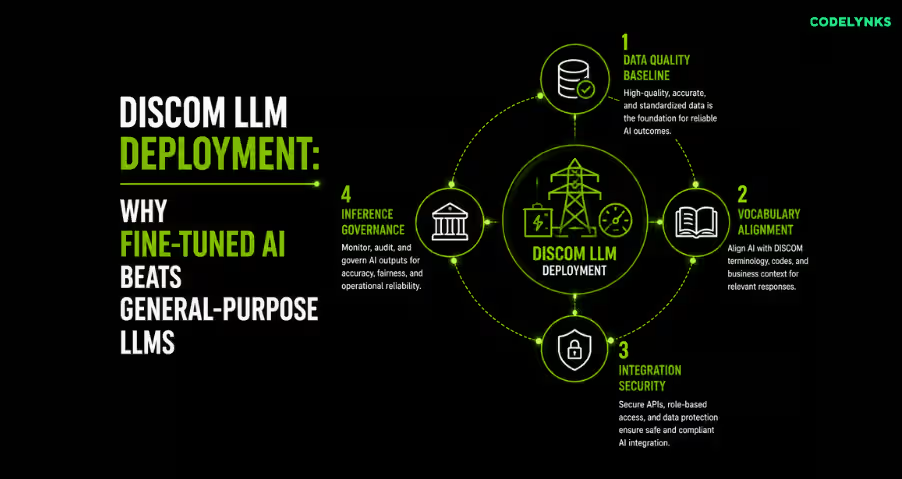
Table of Contents
DISCOM LLM Deployment: Why Fine-Tuned AI Beats General-Purpose LLMs
A state DISCOM in western India 2.3 lakh smart meters deployed under RDSS Phase 1, generating 96 interval readings per meter per day came to us with a real problem. They had a team of 14 engineers manually reviewing fault alerts, outage reports, and equipment condition logs. The volume was doubling every eight months as smart meter rollout accelerated. They wanted an LLM to classify faults, summarize outage causes, and generate field crew dispatch recommendations.
They had tried two commercial LLM APIs and a RAG prototype. None worked reliably enough to reduce manual review load. The faults it got wrong were the most dangerous ones. This post explains exactly why that happened and what a reliable architecture looks like for DISCOMs at India’s scale.
Why General-Purpose LLMs Fail on Grid Data
A general-purpose LLM trained on the internet does not know what a 33/11 kV distribution transformer protection relay does. It will confidently tell you it does.
The vocabulary problem in grid operations is severe. Terms like “restricted earth fault protection,” “Buchholz relay trip,” “zone-3 overcurrent,” and “SCADA analog point stale” have precise technical meanings that differ from their surface semantics. A model trained on Wikipedia, GitHub, and Common Crawl has seen these terms, but has not seen them in the context of Indian grid equipment nomenclature, CERC regulations, or DISCOM-specific SOPs.
The result is confident misclassification. In the western India DISCOM’s testing, GPT-4 with RAG correctly classified 71 percent of fault alerts on common fault types blown fuses, overload trips, and meter communication failures. On the fault types that matter most differential protection trips, earth fault on underground cable segments, and reverse power relays accuracy dropped to 38 percent. Manual review of the LLM’s outputs was taking longer than manual review without the LLM, because engineers had to verify each recommendation that touched high-risk equipment.
The RAG approach made this worse, not better. Equipment manuals for the DISCOM’s transformer fleet were scanned PDFs from 2003 and 2009. OCR quality on these documents averaged below 80 percent. Feeding OCR-corrupted equipment specifications into a RAG retriever produces retrieval that looks semantically relevant but carries embedded transcription errors. RAG on a scanned equipment manual from 2003 is not retrieval. It is OCR error propagation at LLM scale.
The Data Problem Is Not Volume. It Is Annotation.
India’s DISCOMs under RDSS are generating more smart meter telemetry than any country-level power system has ever produced at this speed of rollout. The data problem for LLM deployment is not volume. It is that the telemetry is correct, the annotations are missing, and the domain vocabulary exists in scanned PDFs from 1998.
A smart meter sends a tamper alert when the magnetic field around it changes. That alert could mean theft, a transformer fault, a nearby industrial load cycling, or a meter malfunction. The alert code is machine-generated and consistent. The diagnosis which determines whether you send a field crew, raise a police complaint, or schedule equipment maintenance is in the head of an experienced lineman and in a paper shift log that was never digitized.
Building a fine-tuned LLM for DISCOM fault classification requires labeled training data: alert events with confirmed root cause diagnoses. Most DISCOMs have four to seven years of paper shift logs, sometimes partially digitized into Excel files with free-form text fields. Structuring this into a labeled dataset is the longest phase of any DISCOM LLM project. It typically takes three to four months and requires domain expert involvement throughout.
The data problem in DISCOM AI is not volume. It is that the telemetry is correct, the annotations are missing, and the domain vocabulary exists in scanned PDFs from 1998.
Fine-Tuning vs. RAG: The Right Architecture for Grid Operations
The grid operations LLM architecture decision comes down to task type.
RAG is appropriate for document retrieval tasks: equipment manuals, CERC regulations, SOP lookups, equipment replacement specifications. If an engineer asks “what is the protection coordination scheme for a 33/11 kV substation with a 5 MVA transformer,” RAG against well-structured source documents can answer correctly. The prerequisite is that the source documents are machine-readable, current, and indexed with domain-aware chunking. This is not a retrieval problem. It is a document preparation and chunking problem.
Fine-tuning is required for classification and generation tasks: fault categorization, outage cause summarization, dispatch recommendation generation, anomaly detection from telemetry time series. These tasks require the model to understand the relationship between input signals and grid state knowledge that is not in any document and cannot be retrieved. It must be embedded in model weights through training on labeled examples from the DISCOM’s own operational history.
A production architecture for a state DISCOM combines both. A fine-tuned base model handles classification and generation. A RAG layer handles document lookup when the fine-tuned model needs to reference regulatory context or equipment specifications. The two components do not compete they serve different query types through a routing layer.
For the western India DISCOM, the final architecture uses a fine-tuned Llama 3.1 70B model trained on 14 months of labeled fault event data (18,400 events, annotated by four senior engineers over 11 weeks). The base model’s fault classification accuracy on the held-out test set reached 88 percent on common fault types and 76 percent on high-risk fault types against GPT-4’s 38 percent on the latter category. The RAG layer handles regulation lookups and equipment spec queries only.
The DISCOM LLM Readiness Assessment (DLRA)
Before committing to LLM deployment, a DISCOM needs to pass a 4-layer readiness assessment:
Layer 1: Data Quality Baseline: Can you produce a labeled dataset of fault events with confirmed root causes? Minimum viable size for fine-tuning is 5,000 labeled examples across the fault types you care most about. If your diagnosis records exist only on paper shift logs, estimate the time and cost to digitize and annotate before starting LLM work. Projects that skip this estimate consistently underrun their data preparation budget by 3 to 5x.
Layer 2: Vocabulary Alignment: Do your equipment manuals, SCADA alarm definitions, and SOP documents exist in machine-readable format? Run a vocabulary overlap analysis between your key domain terms and the pre-training vocabulary of the base model you intend to fine-tune. Overlap below 40 percent on critical terminology indicates you need either more aggressive fine-tuning or a different base model.
Layer 3: Integration Security: Can your SCADA system expose fault alert data to an AI inference endpoint without violating IEC 62351 or IS 13234 (CERC cybersecurity guidelines for power system communication)? Most Indian DISCOMs have SCADA environments that are air-gapped or under strict data residency controls. Your LLM inference must run on-premises or in an isolated government cloud environment not on a commercial API.
Layer 4: Inference Governance: Who reviews and overrides LLM recommendations? For high-risk fault types differential protection trips, earth fault on underground cables the LLM recommendation must be advisory, not executable. Design the workflow so a certified engineer confirms before any dispatch or switching action. Automate the advisory generation; keep the decision human.
What a 6-Month DISCOM LLM Deployment Looks Like
Month 1 to 2: Data audit and annotation sprint. Digitize shift logs, structure fault event records, annotate root causes with two domain experts. Target: 8,000 labeled events minimum.
Month 2 to 3: Document preparation. OCR reprocessing of equipment manuals with domain-specific post-correction. Structure CERC regulation text into clean, chunkable markdown. Build the RAG index with domain-aware chunking (section-level, not paragraph-level, for equipment manuals).
Month 3 to 4: Fine-tuning on base model (Llama 3.1 or Mistral 7B for smaller DISCOMs, 70B for state-level scale). Evaluate on held-out labeled dataset. Iterate on fine-tuning parameters until high-risk fault accuracy exceeds 70 percent.
Month 4 to 5: Pilot in non-production mode. Route live fault alerts through the LLM alongside existing manual review. Compare recommendations to engineer decisions. Use disagreements as additional labeled data for a second fine-tuning round.
Month 6: Production deployment with human-in-the-loop workflow for high-risk faults. Automated routing for low-risk fault types where LLM accuracy exceeds 85 percent.
What This Means for Energy and Utilities Leaders
DISCOM LLM deployment is a 2026 decision, not a 2027 one. Smart meter rollout under RDSS is accelerating across states Haryana begins August 2026. Every meter deployed increases the alert volume your operations team handles. The teams that start data annotation and document preparation now will have fine-tuned models in production by Q1 2027. Those that wait will start data preparation when their engineers are already drowning in unreviewed alerts.
Three things you can assess this week on your own: count the number of fault alert records with structured, confirmed root-cause diagnoses in your existing digital systems. If the number is below 5,000, start the annotation project before any LLM procurement. Check whether your SCADA data can be exported without violating your existing cybersecurity controls. Check whether your equipment manuals exist in machine-readable form. These three questions determine whether you are 6 months or 18 months from a production system and the difference is not technology, it is data.
About the author: Codelynks engineering team. Codelynks is an AI engineering consultancy based in Kochi, India, building LLM, data, and cloud systems for energy, healthcare, and financial services clients.



