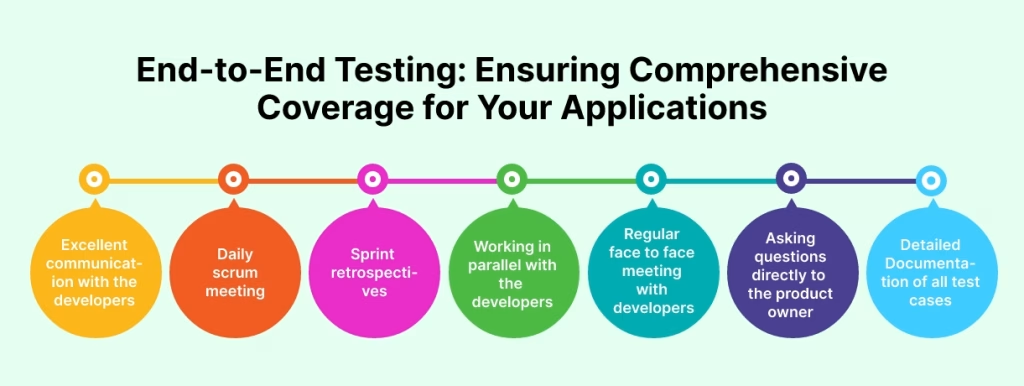
End-to-End Testing: Ensuring Comprehensive Coverage for Your Applications
Jayakrishnan M
Contents Overview
Introduction
End-to-end testing is essential for ensuring software reliability and validating complete application workflows in modern software development. As applications become more complex with multiple integrations, APIs, and external services, relying only on unit testing or functional testing is no longer enough.
End-to-end testing verifies that all components in an application work together correctly by simulating real user interactions from start to finish. This testing approach improves software quality assurance, reduces production issues, and ensures that critical application workflows function as expected across different environments.
In this article, we explore end-to-end testing best practices, test automation strategies, and methods for improving software reliability through comprehensive workflow testing.
What Is End-to-End Testing?
Testing methodology is defined by E2E testing, designed to test the application’s overall workflow wherein all components are working in harmony with each other. Instead of just testing individual units of code, it also involves the testing of interaction between different modules and external systems and databases.
In an E2E test, a tester simulates real-user scenarios from the initial steps of a workflow till its end. For example, in an e-commerce application, testing workflows testing may include adding an item to the cart and then proceeding with checkout, processing payment, and finally confirming the order. The rationale is that the system should be reliable, and all functionality should be strongly covered.
Why Is End-to-End Testing Important?
While unit and integration tests do play their part, they only test parts of the application testing, however, means testing all parts of the system to ensure that everything works seamlessly together.
Here are a few reasons why E2E testing is crucial:
Real-World Functionality: Most of the errors caught are those that the user may encounter in a live environment. It allows having confidence that an application will work under real conditions.
Includes Coverage of Many Systems: Most applications today integrate with third-party services such as payment gateways, APIs, databases. E2E testing should help ensure that all those third-party services work properly with your application by providing complete coverage.
Reduces the Risk of Failure: Since automated testing verify workflows from start to end, they catch defects that would otherwise be overlooked by unit or functional testing. That’s fewer bugs reaching the production level and thus less expensive failures post-deployment.
E2E testing is specifically very helpful for intricate workflows involving various types of user actions. It ensures all elements-the front-end, back-end, and external services-work together as expected.
Key Steps in Implementing End-to-End Testing
The following should be implemented in order to make QA testing as effective as possible:
Clear Test Scenario Definition: Before you start testing, define clear test scenarios on the basis of your users’ journey. That is to say, define the key workflows through which your users are going to go. Logging in, making a purchase, or submitting a form are all examples. Clarity about which of the user interactions is more important and hence take up a more prominent space of attention in a testing effort.
For every scenario you design for the test, take it down to a detail of what one individual will do from start to end, including every system and component that interfaces in this process. The greater the detail you have in your test scenarios, the better your coverage will be.
Automate Where Possible: Software testing processes tend to consume a lot of time mainly when it is designed for a large application with more workflows. This has to be improved by automating as many of your E2E tests as possible. This can be achieved using test automation tools such as Selenium, Cypress, or TestComplete so that the efforts put on the manual side can be reduced and consistent results exist for tests running across different environments.
Automated testing frameworks help QA testing teams execute workflow validation scenarios efficiently while improving software reliability and reducing manual effort. You can also include automated E2E tests in your CI/CD pipeline to be executed automatically after every code commit or build, providing immediate feedback on the stability of the application. Integrating end-to-end testing into CI/CD pipelines helps development teams identify issues early and maintain stable software releases.
Test Across Multiple Platforms and Devices: E2E tests should be run on various platforms and devices so that thorough testing is assured. Applications today are accessed on various devices: desktop, mobile phone, and tablets. The requirement is to test how your application behaves in different screen sizes, operating systems, and browsers. Cross-platform testing tools like BrowserStack and Sauce Labs, help validate your application’s performance across multiple devices and configurations, simulating different environments. Testing application workflows across browsers, operating systems, and mobile devices improves software quality assurance and ensures consistent user experiences.
Monitor and Maintain Test Suites: E2E testing is far from being a “set-and-forget it” process. Your test cases will need updates as your application evolves with the inclusion of new features, integrations, and workflows. Therefore, E2E test suites must be regularly reviewed and maintained so that they stay relevant and updated in line with the new features, integrations, and workflows included in the application. Track test performance metrics, including test execution time, pass/fail rates, flakiness. Identify and debug the cause of test unreliability and “flakiness” so that tests fail consistently; otherwise, two efficiencies or bugs slip through and are missed.
Speed Up Using Parallel Testing: For big applications, a test run can be tremendous and slow down your releases. Running multiple test cases simultaneously to complete the test suite in the minimum amount of time that takes is made possible by parallel testing. Among the tools that support parallel execution are Cypress and Selenium Grid, which would guarantee faster feedback as well as efficient testing.
Best Practices for Successful End-to-End Testing
So, for now, here are the best practices on how your testing strategy will then be made to be as effective as possible:
Prioritize Key Flows: Concentrate on important user journeys and core functionality.
Automate repetitive tests; wherever possible, this reduces effort and guarantees consistency; manual effort is reduced.
Validate integrations with third parties; check third-party systems such as payment gateways or APIs to see whether they are working seamlessly with your application.
Run Tests Repeatedly: Ensure to add E2E tests to the CI/CD pipeline and get run after each code change.
Results Analysis and Rework: Very often look at test results, correct problems, and then revise your test approach.
Summary
End-to-end testing plays a critical role in improving software reliability, validating application workflows, and ensuring high-quality user experiences. By combining automated testing, regression testing, and comprehensive QA testing strategies, development teams can identify issues early and reduce production failures.
Organizations that implement software quality assurance best practices and integrate automated testing into CI/CD pipelines can improve software quality assurance, accelerate releases, and deliver more reliable applications across multiple platforms and environments.
What Is Shift-Left Testing? Most teams get shift-left testing wrong. They take the tests they already run and schedule them earlier. Same suite, new start time. That is not shift-left. It moves the pain forward without reducing it, and it teaches the organization that the initiative failed. Real shift-left changes how quality gets built into […]
Introduction Transparent VAPT services play a crucial role in strengthening organizational infrastructure security in this digital age. The present world has made vulnerability assessment and penetration testing an indispensable tool for protection against external threats. However, due to the increase in cyber threats, it is essential to have transparent VAPT services that maintain openness and […]
Learn how to set up Appium for iOS Simulator automation on macOS with this step-by-step guide. From installing prerequisites to running your first test, this tutorial helps engineers and QA professionals streamline their mobile app testing workflows.