
Back
#Uncategorized
Multi-Agent AI in Indian 3PL: Powerful Freight Visibility Before Agent Automation
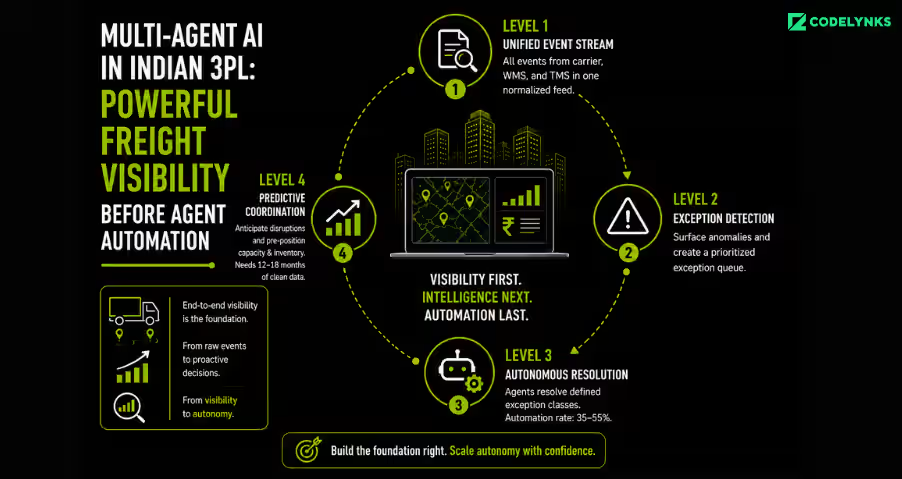
Table of Contents
Multi-Agent AI in Indian 3PL: Powerful Freight Visibility Before Agent Automation
A Tier-1 FMCG 3PL managing 9,200 PIN codes across 11 states came to us with a specific problem. Their carrier partners reported shipment status through three different channels simultaneously: WhatsApp messages from field agents, a TMS API with 6-hour refresh latency, and a legacy SMS system that predated GPS tracking. When a delivery failed in Nagpur, their operations team needed 4 hours to determine whether the package was at the hub, in transit, or unaccounted for. They wanted to build an AI agent to resolve exceptions faster. The actual problem was that no agent can resolve an exception it cannot see.
Agentic AI is the right technology for logistics exception management. Gartner projects that half of all cross-functional supply chain solutions will use intelligent agents by 2030, up from under 5% in 2025. Indian operators are investing. The failure rate is high. Over 40% of current agentic AI projects are expected to be scrapped by 2027, most because of integration problems rather than model quality. The pattern repeats: someone builds the agent before building the data layer the agent needs to operate. This post describes what the data layer requires, what a multi-agent logistics system actually looks like in production, and how to assess where your operations sit today.
Why Freight Visibility Is Harder Than Route Optimization
Route optimization is a largely solved problem. Locus, FarEye, MapmyIndia Mappls, and a half-dozen other platforms solve it competently for Indian road conditions. Freight visibility knowing where a shipment is, why it deviated from plan, and what state it is in right now is not solved, because the data comes from structurally incompatible sources.
In a typical Indian 3PL operation, shipment events originate from at least four systems: a transportation management system (which may have 6-hour batch sync), a warehouse management system (which records outbound confirmation but not in-transit status), a carrier API (where the carrier is large enough to have one), and field agent communication via WhatsApp or SMS for the long-tail of FTL carriers.
A carrier that sends status via WhatsApp is not an integration gap. It is 40% of your FTL volume in India
An agent that reads three conflicting ETAs for the same shipment does not pick the right one. It picks one and acts on it. That outcome is worse than surfacing all three to the ops team, because the agent’s action say, sending a delivery failure notification to the customer may be wrong.
The freight visibility problem is a data normalization problem: every event, regardless of source, needs a shipment ID, a GPS or hub-level location, a timestamp, and a standardized status code. Without this unified event stream, multi-agent architecture has nothing to reason over.
What Multi-Agent Architecture Actually Means in Logistics
Multi-agent logistics systems are not a single LLM answering questions about shipments. In production deployments, they are a set of specialized agents with defined responsibilities and handoff protocols.
The architecture that works in practice separates four concerns:
A visibility agent reads all event sources continuously TMS webhooks, WMS outbound confirmations, carrier API polls, and structured WhatsApp message parsers for long-tail carriers. It maintains a normalized shipment state record for every active movement in the network.
An Exception Detection Agent monitors the shipment state records against expected lifecycle milestones. It flags deviations: a shipment that has not checked in at a hub within 2 hours of expected arrival, a delivery that was attempted but not rescheduled within the SLA window, a carrier that has gone silent for more than 90 minutes.
A Resolution Agent executes pre-defined resolution playbooks for exception classes that have known, bounded responses: automatically rescheduling a failed delivery attempt within SLA, triggering a carrier escalation when silence exceeds threshold, generating a customer notification with the correct delivery window estimate.
An Escalation Agent routes exceptions that fall outside defined playbooks to human operators, along with the full context from the Visibility Agent and the reason the exception was not auto-resolved
The orchestrator the component that routes between agents and manages state is the most underspecified part of every logistics AI brief we receive. That gap costs six months of rework.
The Multi-Agent Logistics Intelligence Maturity Model (MALIM)
Most Indian 3PLs are at Level 1 or below. The model has four levels:
Level 1: Unified Event Stream. All carrier, WMS, and TMS events flow into a single normalized feed. Every event has a shipment ID, location reference, timestamp, and status code. No event source is read-only by a single team. Carrier WhatsApp messages are parsed into structured records. This level is purely about data infrastructure. No AI is required.
Level 2: Exception Detection. Agents surface anomalies against expected lifecycle milestones. No autonomous action is taken. The output is a prioritized exception queue for human operators, ranked by financial exposure and SLA proximity. This level reduces mean time to detect from hours to minutes.
Level 3: Autonomous Resolution. Agents handle defined exception classes without a human in the loop. The resolution playbook for each class is documented, tested, and audited quarterly. The ops team reviews resolution logs, not individual exceptions. Automation rate is meaningful here: typically 35 to 55% of exception volume for mature playbooks.
Level 4: Predictive Coordination. Agents anticipate disruptions from weather feeds, traffic data, carrier historical reliability, and seasonal demand patterns. They pre-position capacity and inventory before exceptions occur. This level requires 12 to 18 months of clean Level 1 and Level 2 data to train on.
Where Agentic Logistics Projects Break Down
The agentic logistics project that fails is always the one where someone built the exception resolution agent before solving the data normalization problem.
The POC runs on clean synthetic data. The demo is impressive. The production deployment encounters carrier APIs that return partial records, WMS events that arrive out of sequence, and a TMS that batches updates at midnight. The agent produces confident wrong answers. The ops team stops trusting it within 3 weeks. The project is shelved.
Forty percent of agentic AI projects will be scrapped by 2027, and this is the failure mode. It is not a model quality problem. It is a data infrastructure problem.
The specific issues in Indian 3PL context:
Small FTL carriers have no API. Their only communication channel is WhatsApp. Building a WhatsApp message parser that reliably extracts shipment ID, status, and location from unstructured field agent messages is a data engineering problem, not a machine learning problem and it needs to be solved before the exception agent is built.
Carrier API reliability varies. Some APIs return stale cached data without indicating the cache age. The Visibility Agent needs to track data freshness per source and flag stale records, not treat all events as current.
WMS outbound confirmation and TMS dispatch events are often asynchronous by 15 to 45 minutes. A shipment that appears as “not dispatched” may actually be in transit. The Exception Detection Agent needs to account for this lag before flagging an exception.
> *Want to assess your current data infrastructure before building the agent layer? Read about [Codelynks’ approach to supply chain AI architecture](/services/ai-engineering) including how we map data sources and define exception playbooks before touching a model.*
Integration Architecture: What Agents Need to Operate
The minimum viable data layer for a Level 2 deployment requires four components:
A **normalized event bus** Apache Kafka or AWS EventBridge that ingests events from all sources and applies a shared schema on write, not on read. Schema-on-read approaches always accumulate technical debt in heterogeneous source environments.
A **shipment state machine** that defines the expected lifecycle for each shipment type (FTL, LTL, last-mile) and triggers exception detection when state transitions deviate from expected timing. The state machine is not an AI component. It is a rules engine.
A **carrier connectivity layer** that manages API polling schedules, handles authentication for each carrier’s proprietary system, and routes WhatsApp message streams through a parser service. Building this for 650 carrier partners the scale of our reference operator takes 3 to 4 months and is not glamorous work.
**Tool-call definitions for agents**, not free-form prompt completions. In production logistics, an agent action must be deterministic and auditable. A tool call that triggers a carrier escalation via API is auditable. A prompt completion that drafts an escalation message and sends it via email is not. Every resolution action needs a typed function signature, not a creative writing request.
What This Means for Logistics Leaders
The path to agentic logistics runs through data infrastructure, not model selection. Here are three things you can do this week without engaging anyone:
Audit your data sources. List every system that generates a shipment event TMS, WMS, carrier APIs, WhatsApp, SMS, IVR. For each, note the update frequency, the data format, and who owns the integration. If this list takes more than a day to produce, your data infrastructure is not ready for agent deployment.
Map your top five exception types by volume. For each, ask: does my team have a documented resolution playbook, or does resolution depend on who is on shift? An exception class without a documented playbook cannot be automated regardless of how capable the agent is.
Check your detection time. How long does it take your ops team to detect that a high-value shipment has missed a hub checkpoint? If the answer is more than 30 minutes, you are at Level 0, not Level 1. The agent cannot help until the detection problem is solved.
Agentic logistics delivers real value at Level 3. Getting there requires 6 to 9 months of disciplined data infrastructure work before the first agent is deployed. The operators who invest in that foundation in 2026 will be the ones with a genuine competitive edge in 2027.
About the author: The Codelynks AI Engineering team has designed and shipped multi-agent systems for logistics, fintech, and enterprise clients across India and Southeast Asia.



