
Back
#Security
Non-Human Identity Security: 12 Controls to Secure Cloud Identities in 2026

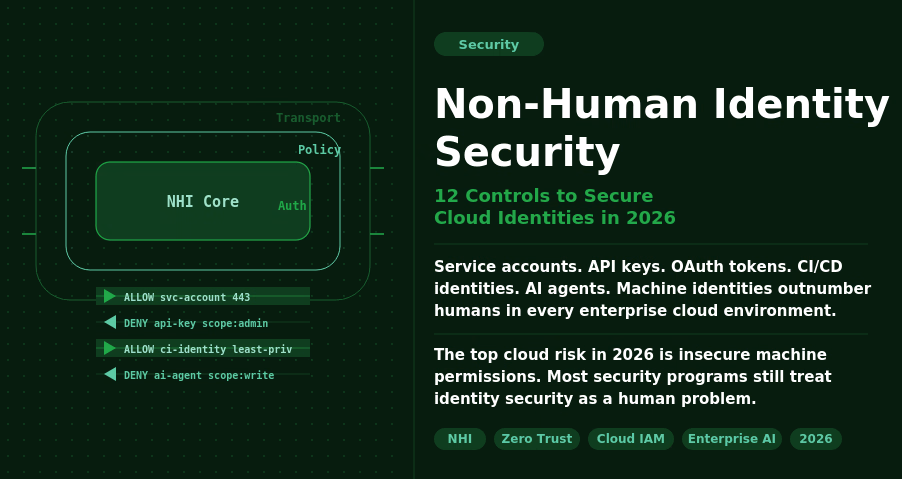
Table of Contents
The Problem No One Is Prioritising
Non-human identity security is one of the biggest cloud risks organizations face in 2026. Service accounts, API keys, OAuth tokens, CI/CD identities, and AI agents now outnumber human users across enterprise cloud environments. Without strong governance, these machine identities become easy entry points for attackers.
Most security programs still treat identity security as a human problem: MFA, SSO, and role-based access control for employees. Non-human identities (NHIs) get an afterthought. They are created quickly, granted broad permissions, and rarely audited. When a developer leaves, their service account stays active. When a project ends, its API key keeps working.
The 2026 data makes the stakes clear. The top cloud security risk this year is exposure of insecure machine permissions, not phishing or misconfigured storage buckets. Identity governance for non-human accounts is the gap that attackers are actively exploiting.
What Counts as a Non-Human Identity
Any identity that is not tied directly to a human logging in interactively:
- Service accounts (GCP, AWS IAM roles, Azure managed identities)
- API keys and access tokens stored in code, config files, or CI/CD pipelines
- OAuth service-to-service credentials
- Database connection strings and secrets
- AI agents and autonomous workflows that access data and execute actions
- Webhook endpoints and event-driven function identities
The agentic AI wave has made this harder. AI agents need broad access to do their jobs: read files, query databases, call APIs, and send messages. They are powerful exactly because they can act. That power needs to be scoped carefully, but most teams are moving too fast to do it well.
Why 2026 Is a Turning Point
Three converging factors make NHI security urgent this year.
AI agent proliferation. 35.7% of organizations are now running AI or LLM workloads in production, per CSA data from March 2026. Only 19.1% report adequate visibility and controls over those workloads. AI agents authenticate like service accounts, but they make decisions autonomously. A compromised AI agent identity does not just leak data; it can take action at scale.
Attackers have noticed. Threat actors are increasingly targeting service accounts and AI agent identities for lateral movement. A service account with admin-level IAM permissions is more valuable than a compromised employee account because it does not have MFA, does not get locked out after failed attempts, and does not raise alerts when it runs at 3am.
Governance is lagging badly. Less than one in four organizations has a documented, formally adopted policy for creating or removing AI identities. Forgotten credentials (unused or unrotated keys with high-risk permissions) dropped from 84.2% in 2024 to 65% in 2026. Progress, but still two-thirds of organizations carry this exposure.
The Non-Human Identity Security Checklist
These 12 controls cover the fundamentals. If your team can check all 12 against your current cloud environment, you are in better shape than most.
Discovery and Inventory
- Complete NHI inventory. Run a full audit across cloud providers, CI/CD systems, and code repositories. You cannot secure what you cannot see. Tools like AWS IAM Access Analyzer, GCP Policy Analyzer, or third-party NHI management platforms give you the map.
- Assign ownership. Every NHI should have a named human owner and a team. When ownership is unclear, no one audits it. Build ownership into your provisioning workflow, not as an afterthought.
- Map NHIs to business context. Know which application or workflow each identity serves. This context is essential when triaging access reviews and decommissioning old systems.
Least-Privilege Access
- Scope permissions to the task. A service account that needs to read from one S3 bucket should have permission for that bucket only. Not the bucket and everything else in that region. Review and scope every NHI against its actual access patterns using cloud provider access analysis tools.
- Prefer managed identities over long-lived keys. AWS IAM roles, Azure managed identities, and GCP workload identity federation eliminate the need to store long-lived credentials. Use them wherever your platform supports them.
- Separate identities for separate functions. One service account per application function. Not one shared account for your entire data pipeline. Shared accounts mean shared blast radius.
Credential Lifecycle Management
- Enforce credential rotation. Set a maximum lifetime for all long-lived secrets: 90 days is a reasonable default, 30 days for high-privilege accounts. Automate rotation using HashiCorp Vault, AWS Secrets Manager, or equivalent. Manual rotation schedules are not reliable at scale.
- Secrets out of source code. Scan your repositories now for hardcoded credentials using tools like GitLeaks or Trufflehog. Set up pre-commit hooks and CI pipeline checks to prevent new secrets from entering the codebase.
- Decommission promptly. When a project ends, a developer leaves, or a system is deprecated, the associated NHIs must be revoked within 24 hours. Build this into your offboarding and system retirement checklists.
Monitoring and Detection
- Log every NHI action. Enable CloudTrail, GCP Audit Logs, or Azure Monitor for all service accounts and AI agents. Know what each identity accessed, when, and from where. Without logs, you cannot investigate incidents or prove compliance.
- Alert on anomalous access. Set alerts for NHIs accessing resources outside their normal scope, calling APIs at unusual times, or attempting actions they are not permitted to take. Behavioural baselines take two to four weeks to establish, but they are worth the setup time.
- Quarterly access reviews. Schedule a quarterly review of all NHI permissions against actual access patterns. Remove unused permissions. Revoke identities with zero activity in 60 days. This single practice closes most of the forgotten-credential exposure.
Where to Start
If you have not run a full NHI inventory, start there. You cannot prioritize what you have not mapped. Most teams discover three to five times more non-human identities than they expected during the first audit.
The checklist above is not a one-time exercise. It is a repeating operational cadence. Build discovery, rotation, and access review into your regular security processes, not a separate annual audit that no one has time for.
The teams that solve NHI security in 2026 will be the ones treating machine identities with the same rigor they apply to human accounts. The 100-to-1 ratio is not slowing down. Governance needs to catch up.
Need help securing your cloud identity posture? Talk to our engineering team at Codelynks. www.codelynks.com/contact



