
Back
#Uncategorized
Powerful RERA Data for AVM: Accurate Valuation in 2026

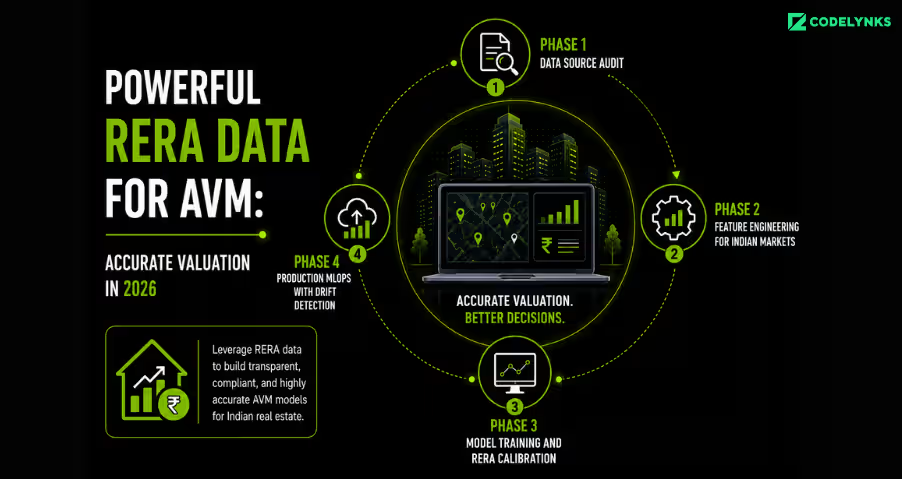
Table of Contents
Powerful RERA Data for AVM: Build Accurate Property Valuation Models in 2026
India’s Real Estate Regulatory Authority portals across 32 states and union territories hold the most granular property transaction dataset the country has ever assembled. Registered sale agreements, unit-level pricing, floor-plan specifications, and project-phase data all submitted by developers and sellers as a legal compliance requirement. For a Bangalore-based PropTech platform we work with, analyzing this dataset against their existing AVM training data revealed a structural problem: their model trained on scraped listing prices was overvaluing properties in 7 out of 12 states by a median of 11 percent compared to RERA-registered transaction prices.
For their mortgage pre-qualification product, that overvaluation was systematically approving loan amounts against property values that would not hold up in a banker’s independent appraisal. This post explains the training data problem, the MLOps discipline that solves it, and the infrastructure that keeps an AVM accurate as India’s property market moves.
Why Training on Listing Prices Is the Wrong Starting Point
Most property valuation models including most of India’s PropTech AVM implementations train on property portal listings. Housing.com, 99acres, MagicBricks: these portals have high volume, structured data, and consistent schemas. For a data engineer building the first version of an AVM, they are the obvious choice.
The problem is that listing prices are asking prices. Sellers systematically overprice listings by 8 to 20 percent depending on locality and property type. In negotiation-heavy markets which describes most of urban India the gap between list price and registered price is a constant, if locality-varying, premium that a model trained on listing prices will never correct for.
Training a property valuation model on listing prices is training it on asking prices. RERA registration data is what properties actually sell for.
RERA-registered transaction data has two properties that listing data does not: it reflects actual completed transactions (not aspirational pricing), and it is a legal record that cannot be post-rationalized. A developer who registered a unit sale at ₹82 lakh cannot retroactively change that record to support a higher AVM comps analysis.
The Bangalore platform’s RERA data audit found that in 3 out of 12 states, the listing-to-transaction price gap exceeded 18 percent consistently over 24 months. These were states where developers had pricing power and buyers were accepting sub-listing prices after extended negotiation. The AVM trained on listings was not just inaccurate it was inaccurate in the direction that produces overvaluation, which is the failure mode most dangerous for a mortgage pre-qualification product.
Most PropTech AVMs in India overvalue by 8 to 14 percent because they train on listing prices, not transaction prices. The overvaluation is systematic and predictable by locality.
The Micro-Market Problem: Why National Models Fail in India
The strongest contrarian position in Indian PropTech AVM design: a single national model trained on all available transaction data will consistently underperform an ensemble of locality-level models trained on local transaction data.
India’s property market is not one market. The factors that drive property prices in HSR Layout, Bangalore have almost nothing in common with the factors driving prices in Kopar Khairane, Navi Mumbai, or Civil Lines, Kanpur. Infrastructure development timelines, builder reputation effects, RERA compliance track records, municipal corporation performance these factors are hyper-local and poorly represented by national-level features.
A national Random Forest or XGBoost model trained on pan-India transaction data learns the average relationship between features and prices across all micro-markets. In micro-markets with strong local effects (metro station proximity in a city building new lines, a specific builder’s project quality premium in a locality), the national model’s predictions regress toward the city or state average, missing the local premium entirely.
Locality-level models trained on transactions within a 3 to 5 kilometer radius, or within a defined micro-market boundary aligned to RERA project cluster geography capture these local effects directly. The tradeoff: a locality model needs a minimum transaction volume to train reliably (approximately 200 to 300 completed transactions in the training window). In tier-2 and tier-3 cities with lower RERA transaction volumes, locality models may need to be supplemented with city-level features as regularization.
The Bangalore platform’s architecture uses a two-tier approach: locality-level gradient boosting models for 340 micro-markets with sufficient transaction volume, and a city-level fallback model for areas below the minimum volume threshold. The locality models outperform the national model by an average of 4.2 percentage points on MdAPE for tier-1 city properties. The city-level fallback performs comparably to the national model for tier-2 and tier-3 areas.
Feature Engineering for Indian Property Markets
Standard AVM feature sets square footage, age, floor, amenities, proximity to amenities miss several India-specific factors that dominate valuations in specific contexts.
Builder reputation score. In markets with active RERA enforcement, a builder’s RERA compliance track record (project completion delays, penalty history, homebuyer complaint resolution rate) is a meaningful price signal. Buyers discount properties from builders with poor compliance records. This is a learnable feature once you have RERA project-level compliance data.
Floor area ratio (FAR) consumption. How much of the permissible FAR a project has used determines the remaining development potential of the plot. Properties in under-FAR projects in appreciating micro-markets carry a development upside premium. This feature does not exist in portal listing data but is derivable from RERA project documents.
Bhumi Rashi and stamp duty data. State-specific stamp duty guidance values (the government’s reference price for stamp duty calculation) are publicly available and represent a legally-set floor on registered transaction prices. When RERA transaction prices cluster near the stamp duty guidance value, it often indicates underreporting a data quality signal, not a pricing signal.
Infrastructure development event flags. Metro corridor announcements, new highway alignment notifications, and SEZ approval dates are publicly available and represent discrete events that shift micro-market pricing within weeks of announcement. A model without event-driven feature engineering cannot capture these step changes. A model that can flag “metro announcement within 18 months” as a feature for a specific micro-market captures the appreciation premium that event creates.
The Real Estate AVM MLOps Lifecycle (REALM)
Production AVMs fail for one of three reasons: stale models, stale training data, or undetected distribution shift in the micro-market. The REALM framework addresses all three.
Phase 1: Data Source Audit: Before any model training, audit every training data source for price accuracy, coverage, and staleness. RERA portal coverage: which states have complete registration data available via API or scrape? Which states have gaps in project registration (partial developers, unregistered projects)? Coverage gaps map directly to model accuracy gaps know where your training data is thin before you produce valuation estimates for those markets.
Phase 2: Feature Engineering for Indian Markets: Build the India-specific feature set: builder reputation score from RERA compliance data, FAR consumption ratio, stamp duty guidance value delta, and infrastructure event flags. This phase typically takes 6 to 8 weeks and requires a domain expert (someone who has done property valuations manually) to validate that the feature definitions capture the right signals.
Phase 3: Model Training and RERA Calibration: Train locality-level models on RERA transaction data. For each locality model, run a calibration comparison against the same model trained on listing data. Document the systematic price delta by locality this becomes the “listing price correction factor” for markets where RERA data coverage is incomplete and you must fall back to listing data.
Phase 4: Production MLOps with Drift Detection: A model that was accurate in January may be catastrophically wrong in March if a new metro station announcement changed the micro-market it was trained on. Production AVMs need micro-market-level drift detection monitoring the distribution of actual transaction prices (from fresh RERA registrations) against model predictions on a weekly basis. Any micro-market where prediction error exceeds 10 percent MdAPE for two consecutive weeks triggers an automated retraining job using the most recent 6 months of RERA data.
Retrain trigger thresholds, retraining job infrastructure (feature store, training orchestration, model registry), and champion-challenger deployment pipelines are the MLOps components most often missing in first-generation PropTech AVM deployments. They are not optional for a product that makes mortgage recommendations.
What This Means for Real Estate and PropTech Leaders
The technical gap between PropTech platforms using listing-price AVMs and those using RERA-calibrated locality models is a competitive window that will close as RERA data quality improves and more platforms discover the training data problem. Platforms that make the architecture investment now
particularly the RERA data pipeline and locality-level MLOps infrastructure — will have accuracy advantages that compound over time as their models accumulate more training data from more completed transactions.
Three things you can assess this week: pull the last 90 days of AVM predictions for any 10 properties you know the actual RERA-registered sale price for. Calculate the prediction error. If the error is systematically positive (model predicts higher than registered price), you have the listing-price training problem. Check your model retrain frequency if it is quarterly or less, you have no drift detection. Review your RERA data coverage by state which states in your model’s footprint have near-complete registration coverage and which have gaps?
About the author: Codelynks engineering team. Codelynks is an AI engineering consultancy based in Kochi, India, building ML and data systems for PropTech, financial services, and e-commerce clients.



