
Back
#QA
Shift-Left Testing Done Right: A Guide to Building Quality In

Contents Overview
What Is Shift-Left Testing?
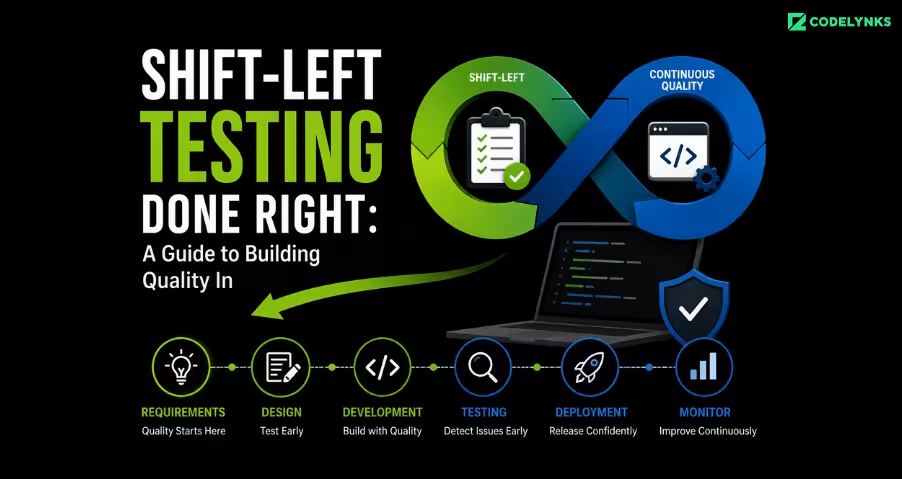
Most teams get shift-left testing wrong. They take the tests they already run and schedule them earlier. Same suite, new start time. That is not shift-left. It moves the pain forward without reducing it, and it teaches the organization that the initiative failed. Real shift-left changes how quality gets built into the code, not just when the tests fire.
The idea itself is simple. “Left” points to the early side of a delivery timeline. Shift-left means catching defects while the code is still being written, ideally before it ever reaches a shared branch. The hard part is not the definition. It is the execution.
Why late defects cost so much
The economics are settled. Research from the IBM Systems Sciences Institute found that a defect costs roughly six times more to fix in testing than during construction, and fifteen times more once it reaches production. At the macro level, the Consortium for Information and Software Quality estimated poor software quality cost the U.S. economy $2.41 trillion in 2022. These numbers are why boards ask about quality now.
Three forces drive the cost curve. Reproduction gets harder as test cases grow larger, so isolating a single fault takes longer. Context decays as developers move on, so a bug found weeks later lands on someone who no longer remembers the code. And blast radius expands, because a design flaw caught early is one fix, while the same flaw caught late is baked into every layer built on top of it.
The Biggest Shift-Left Testing Mistake
The common failure is treating shift-left as a scheduling change. A team takes its heavy integration suite and runs it earlier in the pipeline. The result is a wall of red that no one has the context to diagnose. Developers learn to ignore it. QA inherits a backlog of noise. The program stalls.
Here is the point that gets missed. The goal of shift-left is to reduce the number of defects introduced in the first place, not just to detect them faster. Success looks like finding fewer bugs overall, not finding the same bugs a week sooner. If your defect count is flat and only your detection time moved, you have not shifted anything left. You have rescheduled it.
How Successful Teams Shift Testing Left
Static analysis during development: Static analysis reads source code without running it. It flags coding-standard violations, common defect patterns, security weaknesses, and structural problems while the developer is still in the file. The strong tools separate bug-finders, which trace real data dependencies to surface reproducible defects, from predictive checkers, which flag conditions that could become problems. In regulated sectors like automotive, aerospace, and medical devices, static analysis also enforces standards such as MISRA C, AUTOSAR C++14, and DO-178C. The findings arrive in the IDE with full context, so fixes happen in minutes.
Unit testing as a habit, not a phase: Genuine shift-left treats unit tests as something engineers write while building a feature, not a task QA performs afterward. The testing pyramid holds here. Unit tests form the base: cheap, fast, and specific. Functional and API tests sit in the middle. Slow, brittle UI tests stay at the narrow top. Teams that invert this pyramid pay for it in flaky pipelines and slow feedback.
Service virtualization: Real dependencies are rarely ready when you need them. Third-party APIs, legacy systems, mainframes, and services still under construction all block testing. Service virtualization simulates those dependencies so functional, performance, and security testing can run on a developer desktop instead of waiting for an integration environment to line up.
Keeping Developers Productive
There is a real risk here. Push testing responsibility onto developers without support and you slow them down. The answer is automation and tool integration, not manual effort. Tools have to deliver fast feedback, low noise, and findings a developer can act on without becoming a testing expert. If a check is slow or noisy, it gets bypassed, and the whole program erodes. Quality that adds friction does not survive contact with a deadline.
How to Measure Shift-Left Testing Success
Counting static-analysis findings tells you little. Counting how many bugs reach the field tells you everything. Track defect escape rate, the time from when a defect is introduced to when it is detected, and the cost per defect at each phase. Those metrics show whether quality is actually improving. Shift-left also pairs with shift-right, which observes software in production using real user behavior. Mature teams run both.
None of this eliminates QA. It sharpens it. When development catches more defects early, QA stops chasing basic breakage and moves to higher-value work: functional verification, edge-case exploration, and acceptance testing. The team gets faster and more confident at the same time.
How Codelynks Helps Build Shift-Left Quality
Building this capability in-house takes tooling, process discipline, and people who have done it before. That is the gap Codelynks closes. Our QA and Testing-as-a-Service teams embed shift-left practices directly into your delivery pipeline: static analysis wired into the IDE and CI, unit and API test automation built to the right shape of the pyramid, and service virtualization so your teams stop waiting on environments. We layer in security testing, including VAPT and API security, and integrate the whole program into your existing DevOps workflow so quality becomes a property of how you build, not a stage you bolt on at the end.
If your defects are being caught late and your release confidence is low, the fix is not more testing at the end. It is better testing from the start. Talk to Codelynks about a shift-left assessment for your engineering organization, and turn quality into a measurable advantage instead of a recurring cost.
More Blogs: E-commerce Sale Season SRE Reliability Audit Checklist Items



