Back
#Cloud Computing #Technology
7 Essential Steps for Migrating to Microservices: Ensure a Smooth DevOps Transition


Contents Overview
Migrating to microservices is now the central tenet of modern software development. The shift from a monolithic architecture to migrating to microservices is now the central tenet of modern software development. It allows organizations to build scalable and modular systems with flexibility, making feature delivery faster with less uncertainty. Excitement over this development is tempered by the continuing challenges that stand in the way, especially from the viewpoint of DevOps, which involves continuous integration, deployment, and automation important factors.
A DevOps architect should approach the migration with a mindset on scalability, automation, and observability. This article examines seven key strategies to ensure that this transition from monoliths to microservices goes smoothly.
Assess and Plan the Migration Strategy
Migration to microservices is something that requires careful analysis and planning. Most direct lift-and-shift monolithic applications do not survive; instead, developers need to prioritize based on dependencies, risks, and value.
- Core services to be decoupled first.
- Service decomposition map in order to understand how the components interact
- DevOps Roadmap involving tools, workflows, and timelines
- The proper planning ensures smooth migration, structured migration, and focus migration is all in accordance with business goals.
Leverage Containerization for Service Deployment
Containerization is a significant component of migrating to microservices. Containers support isolated, lightweight deployments of services that run the same application across environment development, testing, and production.
- Containerize individual services through Docker.
- Use kubernetes for orchestration and scaling of containers
- Ensure that container images are optimized and secure to avoid vulnerabilities.
- Containers make deployments faster, more reliable, and consistent across environments—which is essential for devops practices.
CI/CD Pipeline Implementations for Continuous Delivery
The introduction of automation in build-test-deployment works as a bridge to smoothly move to a microservices architecture.
CI/CD pipeline key principle:
- The CI/CD pipeline ensures that any code change needs to be validated and deployed, and this should be done fast, and manual intervention should not be present.
- Setup CI/CD pipelines to automate testing and deploy.
- Tools for implementation: Jenkins, GitLab, CircleCI, etc.
- Automate unit, integration, and load testing to ensure quality.
With CI/CD pipelines your team will be able to update faster; hence, migration risk and downtime are greatly reduced.
Use API Gateways for Services that Need to Communicate
Another important thing that needs to be dealt with when services are separated from the monolithic structure into distinct microservices is their communication. Here API gateways will act as intermediaries for efficient service requests.
- API gateways (NGINX, Kong, etc. are applied for managing service calls
- Use rate limiting and caching to enhance performance.
- Layering protocols for authentication and authorization for secure communication of services
- API gateways manage traffic by enabling scale and secure service communication of microservices.
Infrastructure as Code (IaC)
Infrastructure should be agile because it supports the rapid deployment and scaling mechanism in the use of microservices. IaC deals with infrastructure configuration to be defined programmatically in order for the DevOps team to maintain consistency across environments
- Use tools like Terraform or AWS CloudFormation to automate the infrastructure provisioning.
- Version control your IaC scripts to see changes.
- Use cloud-native platforms that automatically scale infrastructure
- IaC allows rapid deployments with consistent and repeatable infrastructure.
Observability and Monitoring
Observability is the degree of a system’s ability to be known internally and monitored externally. Also, since a microservices architecture offers flexibility, then one may be in a position to know quickly which service is causing the failure or who’s hanging. Otherwise, there are some traditional monitoring tools that can’t be used to track issues in the distributed system.
- Use real-time monitoring using tools like Prometheus and Grafana for observability.
- Use distributed tracing tools like Jaeger to trace the flow of requests across microservices.
- Implement alerts and dashboards for quick identification of failures.
- A robust observability framework ensures that DevOps teams can monitor the health of microservices.
Scalability and Fault Tolerance
Microservices should be designed to scale. The individual microservices should tolerate failure so that the failure in the system will not bring down the entire system.
One of the most significant paybacks of migrating to microservices is scalability. DevOps practices should concentrate on building services that scale on their own and fail without affecting the rest of the system.
Ensure scalability by
- Apply horizontal scaling to increase or decrease instances based on load.
- Implement circuit breakers to prevent cascading failures.
- Implement auto-scaling policies for seamless traffic spikes
- Your microservices architecture will have the ability to handle erratic workloads without compromising performance.
Conclusion
Successfully migrating to microservices brings significant benefits in flexibility, scalability, and faster development cycles, but careful planning is required along with containerization, automation, and monitoring to make it successful. Thus, from the setup of CI/CD pipelines to an API gateway and building IaC, each step helps make the migration successful.
A DevOps architect’s effort should be for the achievement of scalability, observability, and automation in the migration process. The following seven key strategies are beneficial for the successful adoption of microservices by the businesses and unlock new dimensions of innovation and growth.
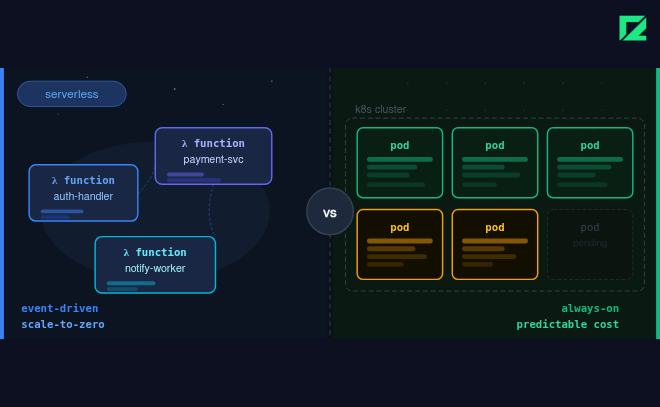
Read more : Serverless Computing: Advantages and Challenges for Developers and Enterprises