Revolutionary TaaS: How Testing as a Service is Transforming QA

Testing as a Service model for software QA

Introduction

Quality assurance has always been one of the crucial pillars to deliver products meeting functional and performance standards in the fast-changing world of software. As technology develops further, new development methods have evolved, and pure traditional software testing services are no longer sufficient.

What is Testing as a Service (TaaS)?

Testing as a Service (TaaS) is an outsourced model in which third-party providers offer different types of testing. Compared to traditional in-house QA teams, which consume resources, this on-demand QA model is extremely flexible and scalable. As businesses pay as they go, firms only pay for testing services when they need them without maintaining permanent QA infrastructure. In addition, on-demand QA mode allows companies to have the benefit of multiple superior tools that the company cannot afford in-house.

The Growing Demand for TaaS

With Agile and DevOps gaining influence, the ability to deliver software at speed and agility are quite important. Outsourced testing solution makes it easy for companies to integrate testing into their development pipeline. Scalability will be very valuable as organizations scale towards cloud-based environments and remote work models. The result is that it can execute tests anywhere and can scale up or down resources as necessary; this can make on-demand software testing solution a solution that is needed by modern businesses.

How TaaS is Changing the Role of QA Teams

TaaS changes the traditional profile of QA as focus shifts from manual testing activities to automated, on-demand services. By outsourcing mundane, time-consuming tasks, internal QA teams are now free to focus on strategic testing, innovation, and continuous improvement. Testing cycles also become faster with TaaS, reducing time-to-market while maintaining high quality — a critical advantage in today’s competitive software landscape.

Advantages of TaaS for Businesses

TaaS offers significant cost savings to business organizations. The pay-per-use model allows companies to access testing services only when needed, reducing operational costs. It also gives clients access to specialized testing expertise without hiring full-time staff. Additionally, these on-demand QA providers ensure superior security and compliance by offering testing environments that meet strict regulatory standards.

Challenges and Considerations

Advantages aside, there are many challenges in embracing adopting an outsourced QA model. A technical challenge is there in terms of integrating outsourced testing services with existing systems. Data security and privacy aspects could also be a concern when the third party is involving QA to get access to sensitive data. Proper supervision is therefore necessary to maintain third-party relations and keep up with the consistency in service quality.

The Future of TaaS in QA

Further down the road in TaaS, one will see even more adoption of AI and machine learning in pushing for even more efficient testing processes. The future of QA lies in smart and automatic solutions that can adapt to an ever-changing technological landscape. Here, again, is where on-demand software testing providers are poised to lead, offering more tailored and scalable services to meet growing business needs in the digital age.

Conclusion

Flexible QA solution is disrupting the traditional QA and is opening the way for the future of QA by providing a flexible and cost-effective solution the business client needs to meet its software testing requirements. To meet always-insatiable demands in development, companies that adopt scalable testing service will always be better equipped to compete while delivering higher-quality products earlier than ever before.

Codelynks offers holistic testing as a service tailored for the new era of business. Scalable, on-demand testing significantly improves your development pipeline, allowing faster product releases while reducing errors. Whether through automated testing, security compliance, or specialized QA capability, our flexible QA solution ensures you reach your software goals without worrying about in-house overheads. Our pay-as-you-go model lets you focus on innovation while we handle the critical QA steps to prevent product flaws

More Blogs: 7 Game-Changing Examples of How AR and AI Integration is Revolutionizing Industries

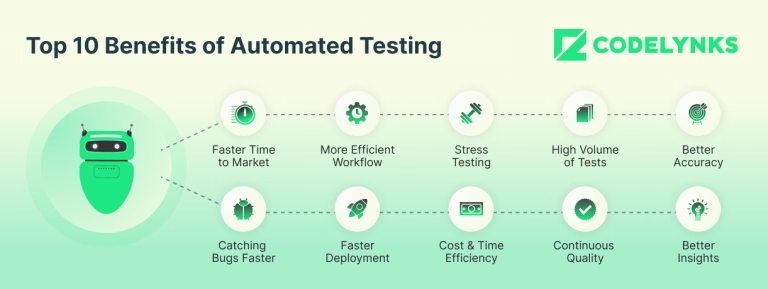
Unlocking Business Success: Top 10 Benefits of Automated Testing for Efficiency and Growth

Automated testing process in software development

Introduction

Businesses are constantly looking to streamline processes to get high-quality products out the door quickly in a fast-paced software development environment. Automated testing has emerged as a game-changer that helps companies ensure the quality of the software is up to par while improving efficiency. Here are the top 10 benefits that automated testing offers, unlocking success for businesses across industries.

How Automated Testing Enhances Software Quality

Enhanced Accuracy and Consistency: Manual testing is effective but tends to allow room for human errors, especially in repetitive steps. Automated testing eliminates the risks associated with such errors as the same steps will be performed over and over again, without any deviation. This means that you will get results that are both reliable and repeatable, hence increasing the general accuracy of your software testing.

Better Test Coverage: With automated testing, businesses will have better test coverage within a fraction of the time which would have taken to manually execute that same number of tests. Automated tests can immensely simplify the task of testing complex scenarios, edge cases, and large datasets. Automated tests ensure that even the most complicated workflows are valid, thereby offering even stronger and deeper quality of software.

Continuous Testing in DevOps: Automated testing will also fit right into DevOps with seamless integration in Continuous Integration/Continuous Deployment (CI/CD) pipelines so that the software remains under test throughout all stages of development, making issues catch as early as possible and giving developers faster feedback. Continuous testing smoothes the bottlenecked nature of release cycles and cuts through the seams of natural bottlenecks.

Testing Effort Scalability: The more projects scale up, the more the testing requirements rise. Automated testing is highly scalable; hence, it makes things easier for businesses to deal with large-scale projects and multiple environments simultaneously. Be it testing on different platforms or browsers or even devices, automated testing guarantees your software to fit quality standards across all boards.

Increased Confidence in Software Quality: Hence, with the readily available feedback that automated tests provide, teams can proceed confidently with new features and updates, knowing well that their software is working in the expected manner. This gives an increase in confidence about the product’s quality levels, lessening the chances of critical slips into the released product and ultimately leads to improved customer satisfaction levels.

Faster Time-to-Market: Automated testing accelerates the whole testing process by running scripts faster than manual testing. This will enable developers to catch bugs quickly and correct them, thus reducing cycle time to release the final software product. Many test cases in large applications will, therefore, take less time to test due to automated testing.

Businesses can, therefore, stay ahead in market competition and products released to the market are released sooner than before.

Cost-Efficiency in the Long Term: The apparent high initial investment in automated test tooling and infrastructure saves incredibly in the long run. Automated testing reduces both the time and effort resources allocated to their manual counterparts. This equates to huge cost savings over time as much fewer resources are required for similar or superior performance.

Reusability of Test Scripts: The most significant advantage of automation lies in the reuse of the test script. These scripts once developed can be reused across projects and testing cycles with minimal changes. Besides saving time, this type of reusability also ensures that all tests are run identically each and every testing cycle, thereby becoming an asset for long-term use by any business.

Optimal Resource Utilization: The good news is that with automated tools freeing the QA teams from repeated testing activities, they have the freedom to focus on strategic and creative activities, such as exploratory testing, test case designing, finding edge cases, and more. This optimal utilization of resources has the teams working more efficiently while contributing to innovation rather than getting bogged down by routine tasks.

Early Bug Detection: It reduces headache related to bugs through early defects, and one of the most remarkable benefits of automated testing is its ability to catch defects early on in the development process. With this in mind, automated tests integrated into the development pipeline can help businesses identify bugs that arise early enough to save time and cut down costs. Early bug detection results in a smooth, more efficient software development lifecycle and higher-quality products.

Conclusion

Automated testing is not just a tool, but also a strategic investment because it strives to offer clear benefits to businesses looking to improve the quality of software, reduce time-to-market, and optimize resource usage. Adopting automation means companies can tap into new levels of success and compete in this rapidly changing, really fast-moving digital scenario.

More Blog: https://codelynks.com/appium-for-ios-simulator-setup-macos/

  • Copyright © 2024 codelynks.com. All rights reserved.

  • Terms of Use | Privacy Policy