Smart Meter Data Cost Optimization Under India’s RDSS Rollout

Smart Meter Data Cost Optimization

Introduction

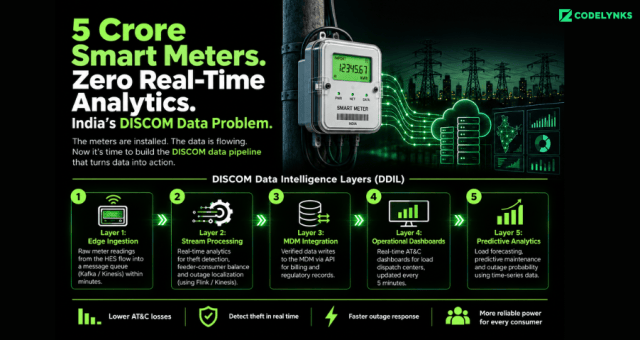
Smart Meter Data Cost Optimization is becoming a top priority for utility providers managing large-scale AMI deployments under India’s RDSS program.

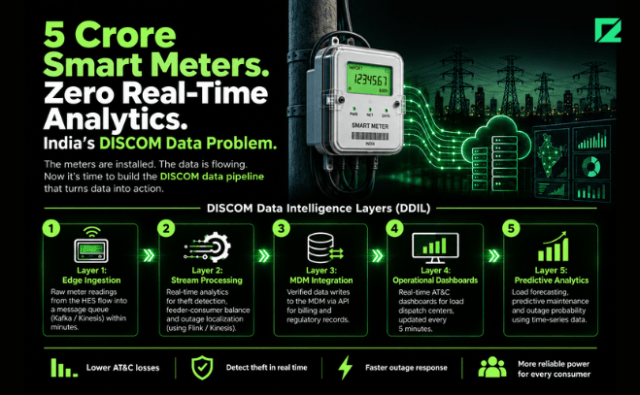
India’s Revamped Distribution Sector Scheme has committed approximately $36.4 billion to deploy 250 million smart meters across the country. The engineering work of installing meters, provisioning SIM cards, and standing up head-end systems is visible and trackable. The cloud infrastructure cost that follows those meters is less visible until it arrives on a monthly invoice that the original project budget did not anticipate.

A composite-state electricity distribution company we worked with deployed its first 500,000 smart meters in 2024 and found its cloud spend growing at roughly three times the rate its planning team had modeled. The head-end system was generating interval reads every 15 minutes per meter. The data pipeline was ingesting that data into a cloud data warehouse with no tiering, no compression strategy, and no separation between hot operational data and cold historical data. Queries were scanning full history on every billing run. Storage and compute costs were rising in lockstep with meter count rather than flattening as the architecture scaled.

Without proper Smart Meter Data Cost Optimization, utilities will see cloud storage and compute expenses rise faster than meter deployment itself.

This post on Smart Meter Data Cost Optimization covers the cost architecture decisions that determine whether your smart meter data platform gets cheaper per meter as you scale or more expensive.

Smart Meter Data Cost Optimization Best Practices:

The Data Volume Math That Surprises Every Program Manager : Before any architecture discussion, the numbers need to be clear.

A single smart meter on a 15-minute interval reading generates 96 data points per day. At 1 million meters, that is 96 million rows per day, roughly 35 billion rows per year. At 250 million meters, the daily ingestion rate is 24 billion rows, and the annual accumulation is approximately 8.7 trillion rows.

No relational database was designed for this access pattern. No standard cloud data warehouse pricing model accounts for queries that scan years of interval data across millions of accounts unless you have tiered your storage and compute correctly.

The data also arrives unevenly. Morning and evening demand peaks create ingestion spikes where head-end systems attempt to retrieve reads from millions of meters in narrow windows. A cloud architecture that does not buffer this ingestion will either drop reads or incur spike-pricing compute charges.

Why Legacy MDMS on Cloud Is Not Modernization

The first response from most utility digital teams when facing smart meter scale is to take their existing Meter Data Management System (MDMS) and move it to a cloud-hosted environment. Vendors market this as cloud migration. It is not.

Legacy MDMS platforms, including Siemens EnergyIP, Oracle Utilities, and several regional alternatives, were architected for the read volumes of electromechanical meters with monthly reads, not AMI meters with 15-minute intervals. Their data models use normalized relational schemas with row-level storage that performs well at thousands of meters per query and poorly at millions.

Moving a legacy MDMS to a cloud-hosted VM reduces the physical infrastructure cost. It does not change the query performance characteristics or the storage model. At AMI scale, a cloud-hosted legacy MDMS frequently costs more than the on-premises version because the compute required to compensate for poor query performance is unbounded in the cloud.

Legacy MDMS vendors will sell you their cloud-hosted product as modernization. It is not. It is the same data model with a different hosting invoice.

The Meter Data Pipeline Cost Tiers (MDPCT) :We use a four-tier cost model to design smart meter data platforms. Each tier has a distinct storage technology, query pattern, data age range, and cost target. Data moves between tiers automatically based on age and access frequency.

Tier 1: Hot Operational Data (0 to 7 days): Storage: A time-series database (TimescaleDB, InfluxDB, or Amazon Timestream). Optimized for high-frequency ingest and recent-window queries. Billing runs, demand response, and real-time outage detection all operate here. This tier costs the most per gigabyte. Keep it small. Target: last 7 days of interval data for all active meters.

Tier 2: Warm Analytical Data (7 days to 13 months): Storage: A columnar cloud data warehouse (BigQuery, Redshift, or Snowflake). Optimized for billing period aggregations, month-over-month usage comparisons, and regulatory reporting. This is where your billing engine queries. Compression and partitioning by account ID and date reduce query costs by 40 to 70% compared to an unpartitioned row store at this volume.

Tier 3: Cold Historical Data (13 months and above): Storage: Object storage (S3, GCS, or Azure Data Lake) in Parquet format, partitioned by year and region. Queries here are infrequent: regulatory audits, long-term demand forecasting, academic research. Cost per gigabyte is 10 to 20 times cheaper than Tier 2. Do not keep historical data in a live data warehouse.

Tier 4: Aggregated Reference Data (permanent): Storage: Any relational database. Pre-computed daily, monthly, and annual aggregates per account, per feeder, and per zone. This is what your customer portal, your billing UI, and your demand planning dashboard actually display. Pre-aggregation eliminates the need to scan raw interval data for display queries.

The state utility we worked with had all four conceptual tiers collapsed into a single Redshift cluster with no partitioning. Moving to the MDPCT architecture reduced their monthly cloud spend by 58% at the same meter count, primarily by eliminating full-history scans on billing queries and moving 18 months of cold data to S3.

Ingestion Architecture: Where Cost Problems Start: The ingestion layer is where most smart meter platform costs originate, and it is the least visible layer because it runs continuously in the background.

Head-end systems push meter reads in batches or streams. The most common mistake is routing all reads directly to the analytical data warehouse. This creates write amplification on the warehouse’s indexing and compaction processes, which generates significant compute charges that do not appear as obvious line items.

The correct architecture places a streaming buffer between the head-end system and the storage tiers. Apache Kafka or AWS Kinesis handles this reliably at AMI scale. The buffer decouples ingestion rate from storage write rate, absorbs demand peak spikes, and provides replay capability for failed or delayed reads.

he most expensive line item in most utility data platforms is not the compute. It is the data transfer between services that was never intended to move that much data.*

Reads flow from the buffer into the Tier 1 time-series database first. A micro-batch process (AWS Lambda, Apache Flink, or Dataflow) aggregates and compresses data before writing to Tier 2. Tier 3 migration runs as a scheduled job, moving data older than 13 months from the data warehouse to Parquet files on object storage.

Data transfer costs between services also require specific attention. Reads flowing from Tier 2 to a reporting tool in a different cloud region will incur egress charges that scale directly with query volume. Co-locate your analytical warehouse and your reporting tools in the same region, or use a query federation approach that brings the compute to the data.

What This Means for Utility Leaders

The RDSS deployment program has engineering complexity on the meter installation side that is receiving most of the budget and management attention. The data platform side is being planned with cost assumptions that will not survive contact with actual AMI data volumes.

Three decisions to make before your meter count crosses 100,000:

Audit your current MDMS for its storage model. If it is row-based relational storage without partitioning, your Tier 2 costs at 1 million meters will be 10 to 15 times higher than they need to be. That is a migration conversation to have now, not at scale.

Check whether your ingestion pipeline routes reads directly to your analytical warehouse. If yes, add a streaming buffer before you cross 500,000 meters. The buffer cost is small. The compaction costs on a direct-write warehouse at AMI scale are not.

Utilities that invest early in Smart Meter Data Cost Optimization can reduce long-term operational costs while improving billing and analytics performance.

About the author: The Codelynks engineering team has designed and optimized data pipelines for regulated utilities, IoT platforms, and high-volume time-series workloads across India and the Middle East.

FAQ’s

Why does smart meter data cost so much on the cloud?

Smart meters generate interval reads every 15 minutes, creating 24 billion rows per day at 250 million meters. Storing and querying this data without tiering, partitioning, and compression means full-history scans on every billing run. The compute and storage costs from unoptimized queries scale with meter count rather than flattening as you grow.

What is the Meter Data Pipeline Cost Tiers (MDPCT) framework?

MDPCT organizes smart meter data into four tiers: hot operational data in a time-series database for the last 7 days, warm analytical data in a columnar warehouse for the last 13 months, cold historical data in Parquet files on object storage, and pre-aggregated reference data in a relational database for dashboards and portals.

Is a legacy MDMS on cloud the same as cloud modernization?

No. Moving a legacy MDMS to a cloud-hosted VM reduces physical infrastructure costs but does not change the underlying data model or query performance characteristics. At AMI scale, a cloud-hosted legacy MDMS can cost more than the on-premises version because the compute required to compensate for poor query performance is unbounded.

What streaming technology handles smart meter ingestion at scale?

Apache Kafka and AWS Kinesis both handle AMI ingestion reliably at scale. The buffer sits between the head-end system and the storage tiers, absorbs ingestion spikes, decouples read rate from write rate, and provides replay capability for failed reads.

How much can MDPCT reduce cloud costs for a utility?

The distribution company that implemented MDPCT saw a 58% reduction in monthly cloud spend at the same meter count, primarily from eliminating full-history scans on billing queries and migrating cold historical data from Redshift to S3-based Parquet storage.

6 API Security Best Practices: Protect APIs with mTLS, JWT, and Positive Security

api-security-best-practices

Introduction

There is more concern about API security now that systems increasingly rely on APIs. With APIs fast becoming an integral component of many business activities, connecting mobile apps, IoT devices, and also cloud-based services, APIs have also increased the scope and thus risks associated with security. Following API Security Best Practices is now essential to ensure that every API remains protected against emerging cyber threats. Following API Security Best Practices is now essential to ensure that every API remains protected against emerging cyber threats.

We will discuss how full-fledged security, from API discovery to mutual TLS and OWASP Top 10 security, guards against all kinds of threats against the security of API security framework.

API Security Best Practices: API Discovery and Endpoint Protection

Knowing what you are protecting is the first step towards solving the problem of protecting an API. Generally, organizations do not know all their API endpoints, and thus, there is always a potential for security blind spots. API discovery tools automatically identify your API endpoints and schemas with machine learning and simple heuristics. By combining discovery tools with API Security Best Practices, teams can prevent unauthorized access before it impacts systems. Without this visibility, it would be impossible to ensure that both documented and undocumented APIs are accounted for and secured.

Using the patterns of network traffic, API discovery systems can identify previously unknown endpoints so the security teams can proactively manage and protect these entities. This capability is critically important in large application scenarios having complex microservice architectures.

Implementing OWASP Top 10 for API Security Best Practices

OWASP Top 10 enumerates most common security risks against APIs, including improper authentication, data exposure, DDoS attacks, among other things. 

Cloud-based API security tools will prevent such attacks because they guard against:

  1. Authentication failure: Strong identity verification
  2. Data loss: Protects sensitive information from unauthorized access
  3. Abuse: Blocks unwanted API calls and brute-force attacks
  4. DDoS: Detects volumetric attacks that overwhelm a system.

With security practices integrated into organizations’ systems that align with the OWASP API Top 10, an organization minimizes its risk from critical threats. Security platforms can protect against common vulnerabilities but also automatically block suspicious traffic, thus acting as a preventive measure against exploitation.

Mutual TLS (mTLS) and JWT: API Security Best Practices

Mutual TLS (mTLS) provides yet another layer of security because it actually mandates mutual authentication by both the client and the server of each other through digital certificates, thus filtering only the legitimate devices, in this case, mobile applications or IoT connected appliances.

To further add security, mTLS is used in combination with JSON Web Tokens (JWT) to prevent the illegitimate clients from making API requests. Thus, even though the systems authenticate requests, they also validate those requests to ensure that APIs are accessed only by the proper parties: be it for sending data or for retrieving data.

For example, a healthcare provider who is using APIs to manage personally identifiable patient data should employ mTLS so that only authenticated devices, such as secure mobile applications, can access that system.

Positive API Security: Best Practices for Secure APIs

Block the threats, but ensure that only valid traffic is received through APIs. Good API security relies heavily on OpenAPI schemas predetermined and set which defines what kind of traffic your API should receive. This way the systems can block malformed requests, HTTP anomalies, and untrusted inputs by enforcing these rules.

This approach limits the unknown threats and reduces the attack surface of the API, since they only allow requests that fit your OpenAPI specifications. Positive security models reject all requests that are not put together as if they would behave according to the expected behavior of your API, thus putting up a very good defense against sophisticated attacks.

API Abuse Detection and Sensitive Data Protection as Part of API Security Best Practices

APIs are increasingly being targeted for abuse, the primary aspect of which would be volumetric-that is to say, targeting a large volume of malicious requests that can overwhelm the system-or in a sequential API abuse where attackers try to exploit API calls in some logical sequence.

Security platforms employ heuristics and anomaly detection to identify and stop suspicious activity through various APIs, such as XML, RESTful, or GraphQL. In this way, such systems can prevent abuse of APIs before it negatively impacts services or compromise data through identification of unusual request patterns.

For example, an online shop using GraphQL APIs for product searches may detect attempts by bots doing scraping from the website by sensing high frequency or unusual query patterns different from the actual behavior of legitimate users making queries on the website.

Sensitive Data Detection: Prevention of Data Leaks

The API responses will expose many forms of sensitive data including PII, financial data, or health records. Therefore, ensuring that such information stays behind proper protection and does not come out will be vital to staying in compliance and avoiding breach.

Sensitive data detection tools are always scanning payloads generated in the response from the API to detect and block sensitive information transmission. In case sensitive information is detected, a system can mask or block the data from its release into the open public space. Such an automated approach will help lower the chances of data leakage and will ensure that APIs comply with privacy regulations such as GDPR or HIPAA.

For example, sensitive data detection would ensure credit card numbers are not leaked in the response of the API while processing transactions by an institution engaged in financial activities.

Conclusion

A Holistic Approach to API Security

With today’s globalization, it is very important to defend your infrastructure from the threats coming through APIs, while assuring security, privacy, and performance. All these range from API discovery, OWASP Top 10 security, mTLS authentication, to positive API security. All these implementations will mean that the access methods of the organization through APIs will be secure and deliver flawless performance to the users.

API abuse detection with sophisticated attacks and sensitive data protection are more critical than ever with such sophistication in attacks.

Adopting API Security Best Practices ensures robust protection, compliance, and smooth API performance for modern applications.

More Blogs: Achieving DORA Compliance with Data Protection: A Comprehensive Guide

Powerful Strategies for Zero Trust Security to Boost Productivity and Protect Data in 2026

Zero Trust Security protecting business data

Introduction

Across every industry, digital transformation is accelerating business cycles — and with it, the attack surface that cybercriminals exploit. Today’s organizations face sophisticated threats that can compromise sensitive data, disrupt operations, and erode customer trust overnight. Traditional perimeter-based security models, built on the assumption that everything inside the network is safe, are simply no longer adequate against modern adversaries.

Zero Trust Security rejects that assumption entirely. Rooted in the principle of “never trust, always verify,” it treats every user, device, and application as a potential threat — regardless of whether they are inside or outside the network perimeter. The result is a security framework that is both more resilient and more adaptive than its predecessors.

In this article, we explore how adopting a Zero Trust model strengthens your security posture, reduces financial and reputational risk, ensures business continuity, and — perhaps surprisingly — actively improves team productivity through AI-powered tools.

Zero Trust Builds a Stronger Security Posture

Unlike traditional security architectures that assume implicit trust for anyone inside the network, Zero Trust verifies every access request continuously — regardless of origin. Every user, device, and application is treated as a potential threat until proven otherwise. This identity-centric approach drastically reduces risk by enforcing least-privilege access at every layer.

In practice, Zero Trust achieves this through a combination of strict Multi-Factor Authentication (MFA), real-time behavioral monitoring, and micro-segmentation of the network. These controls ensure that organizations have a clear, continuous view of who is accessing what — and can act instantly when something looks wrong. Even if an attacker obtains a set of valid credentials, the granular access controls in a Zero Trust environment prevent them from moving laterally across systems, dramatically limiting the blast radius of any breach.

Reducing Financial and Reputational Risk: The financial consequences of a cyberattack can be severe. According to IBM’s 2024 Cost of a Data Breach Report, the average cost of a data breach reached $4.88 million — a figure that encompasses data recovery, legal fees, regulatory fines, and lost business. Reputational damage compounds these costs, with long-term impacts on customer trust and brand equity that are difficult to quantify but impossible to ignore.

Zero Trust addresses both dimensions. By proactively narrowing the attack surface and containing threats before they spread, organizations that adopt Zero Trust consistently report fewer high-severity incidents and faster recovery times. For security-conscious leaders, this translates directly into lower insurance premiums, reduced legal exposure, and stronger stakeholder confidence.

Zero Trust Security: Proactive Cybersecurity for Business Continuity

A reactive approach to cybersecurity is no longer sufficient. The volume and sophistication of threats — from ransomware to supply chain attacks — demand a proactive, always-on defense strategy. Zero Trust is designed precisely for this environment.

Continuous Verification for Better Data Protection: Zero Trust enforces continuous verification of every access request, whether the user is on-premises or remote. This is especially critical in regulated industries such as healthcare, finance, and retail, where a data breach can trigger HIPAA, PCI-DSS, or GDPR violations in addition to significant business losses. For example, if an employee attempts to access sensitive financial records outside of their normal role or hours, a Zero Trust system flags the anomaly and requires re-verification — preventing both accidental and malicious data exposure.

Containing Threats to Ensure Business Continuity: One of the most dangerous business continuity risks is the spread of a security incident across interconnected systems. Ransomware attacks, for instance, have forced major organizations to shut down operations for days or even weeks. Zero Trust’s micro-segmentation capability directly addresses this: by isolating network segments, it prevents a compromised node from infecting the broader environment. A real-world example is Google’s BeyondCorp initiative, one of the earliest and most cited Zero Trust implementations, which allowed Google employees to work securely from any network without a traditional VPN — maintaining continuity without sacrificing control. For most organizations, micro-segmentation means that even during an active incident, core operations can continue while the security team contains and remediates the threat.

Impact of Zero Trust Security on Team Productivity with AI Tools

Security is a top priority, but it should not come at the cost of team productivity. This is where Zero Trust excels: it delivers robust protection without creating friction in everyday workflows.

Seamless Security through AI-Powered Access Decisions: Traditional security mechanisms — such as manual approval workflows and blanket VPN access — slow teams down. Zero Trust replaces this friction with intelligent, automated access decisions driven by AI. Tools like Microsoft Entra ID (formerly Azure AD), Zscaler Zero Trust Exchange, and CrowdStrike Falcon continuously analyze user behavior patterns, device health, and location context to make real-time access decisions. When an anomaly is detected — such as a login from an unfamiliar geographic location or an unrecognized device — the system does not simply lock the user out. Instead, it prompts for an additional authentication factor (such as MFA) and grants adaptive access. This keeps legitimate users productive while still enforcing strict security controls.

AI-Powered Automation: Faster Incident Response: Zero Trust environments also leverage AI-driven automation to dramatically accelerate incident response. Rather than requiring security teams to manually triage every alert — a process that is both slow and error-prone — AI tools can automatically initiate containment actions in real time. For example, if a device is flagged as compromised, the system can isolate it from the network instantly, without waiting for human intervention. This reduces mean time to respond (MTTR), minimizes downtime, and frees IT teams to focus on strategic priorities rather than reactive firefighting.

How to Start Implementing Zero Trust in Your Organization

Adopting Zero Trust is not an overnight project — it is a phased journey. Here are the foundational steps organizations can take to get started:

1. Identify and classify your sensitive data and assets. You cannot protect what you cannot see. Begin by mapping your most critical data, applications, and systems. Understanding what needs the most protection is the starting point for any Zero Trust strategy.

2. Enforce strong identity verification. Deploy MFA across all users and systems. Adopt an Identity and Access Management (IAM) platform — such as Okta, Microsoft Entra ID, or Ping Identity — to centralize and enforce identity policies.

3. Apply least-privilege access. Ensure users and systems can only access what they strictly need. Regularly audit and revoke excess permissions. Role-based access control (RBAC) is a core building block here.

4. Segment your network. Implement micro-segmentation to isolate workloads and limit lateral movement. Solutions like Illumio, VMware NSX, or Zscaler can help enforce this at scale.

5. Monitor continuously and automate response. Deploy behavioral analytics and SIEM/SOAR tools (e.g., Splunk, Microsoft Sentinel) to maintain real-time visibility and automate threat response. Zero Trust is not a set-and-forget model — continuous monitoring is essential.

For reference, the NIST Special Publication 800-207 provides a comprehensive framework for Zero Trust Architecture that organizations of all sizes can use as a blueprint.

Conclusion: The Case for Zero Trust Security

As cybersecurity threats continue to grow in volume and sophistication, organizations can no longer afford to rely on perimeter-based defenses built for a different era. Zero Trust Security offers a modern, proactive framework that strengthens data protection, reduces financial and reputational risk, and ensures business continuity — all without sacrificing team productivity.

With AI-powered tools and phased implementation strategies, Zero Trust is more accessible than ever for organizations of any size. Whether you are just beginning your Zero Trust journey or looking to mature an existing program, the investment pays dividends in both security resilience and operational efficiency.

Ready to build a Zero Trust strategy tailored to your organization? Contact our security team to explore how we can help you get started.

More Blogs: The Ultimate 7 Transformative Advantages of Multi-Cloud Strategies Empowering Modern Enterprises

  • Copyright © 2026 codelynks.com. All rights reserved.

  • Terms of Use | Privacy Policy