Contents Overview
Building for the Bima Vahak: What Offline-First Really Means for Rural Insurance Apps
IRDAI’s Bima Vahak channel enrolled its first agents in April 2025. A women-led insurance distribution network, Bima Vahaks sell the bundled Bima Vistaar product combining life, health, and property coverage through a mobile app connected to the Bima Sugam marketplace backend. An InsurTech operating across Kerala and Karnataka that we work with had 3,800 enrolled Vahaks by mid-2026. In the first 90 days of operation, they received 2,100 support tickets. Eighty-three percent of those tickets described the same problem: eKYC data entered during a customer visit was lost before submission, requiring the Vahak to revisit the customer to recapture it.
The app was built by a competent team. It integrated correctly with the Bima Sugam API. It passed QA in the office. It failed in the field because it stored form state in memory rather than persistent local storage and every network interruption during the 4 to 6 minute eKYC flow wiped the session.
This is not an edge case. It is the design gap that appears in nearly every insurance agent app built for urban assumptions and deployed to rural realities.
The Distribution Problem Bima Vahak Is Solving
India’s insurance penetration sits at approximately 3.2% for life insurance and 1% for non-life well below the global average of 7% across both categories. The structural gap is not product pricing or product awareness in metros. It is reach in rural and semi-urban India, where the existing distribution channels corporate agents, bancassurance, POSP networks either do not operate profitably or do not carry the trust of the community they are serving.
Bima Vahak is a structural fix for the trust problem. Women from the local community, trained to sell a simplified bundled product through a digital workflow, serve as the credible distribution intermediary that no corporate agent can replicate.
The technical challenge this creates is significant: the distribution workforce is not insurance professionals, will not use the app in an office environment, and in 40 to 60% of customer interactions will have 2G-tier connectivity or intermittent signal. The app must eliminate product knowledge requirements from the sales flow, handle all regulatory compliance (eKYC, consent logging, policy issuance) without requiring the Vahak to understand what those processes mean technically, and complete the entire enrollment without requiring stable connectivity at any mandatory step.
Phase 2 of Bima Sugam (2026) adds claims intimation, health data API integration for health underwriting, and policy portability workflows. Each of these features is more connectivity-sensitive than basic policy enrollment which means the offline architecture decisions made in Phase 1 are the foundation Phase 2 is built on. Getting them wrong now means rearchitecting under operational pressure later.
Bima Vahak App Development: Why Standard Insurance Apps Fail Rural Agents
The standard insurance app development lifecycle assumes: 4G connectivity during use, Android 10 or above on a mid-range device (3 to 4GB RAM), and a user completing the enrollment flow in a single continuous session. These assumptions describe an urban bancassurance or corporate agent, not a Bima Vahak in a village in Vidarbha.
The failure modes in the field:
Session memory loss on network interruption.The most common failure, as described above. eKYC flows require 4 to 6 minutes of continuous data entry Aadhaar number, customer consent, biometric capture, nominee details. If any step requires an API call to proceed, and the API call fails on a dropped signal, a form-state-in-memory design loses everything entered before the failure.
eKYC API timeout on 2G. Biometric verification APIs have timeout thresholds that are calibrated for 4G latency. A fingerprint or face liveness API that expects a response in under 3 seconds will time out on 2G connections where round-trip time is 500ms to 2,000ms. The timeout is not logged as a connectivity failure it is logged as an eKYC failure, which is confusing to the Vahak and creates incorrect compliance records.
App crash on low-memory devices. Android Go devices (512MB to 2GB RAM) are the dominant device category among Vahaks in rural markets. Apps built and tested on developer workstations or mid-range test devices (4GB RAM) have memory allocation patterns that cause crashes on Go-class devices when background processes compete for RAM during a camera or biometric capture flow.
English-only error messages. When the app encounters an error, the message is in English. The Vahak reads Tamil or Marathi. She sees an incomprehensible error, restarts the app, loses her data, and files a support ticket.
An insurance app that drops eKYC data on network loss is not an offline-first app. It is an online app that silently fails offline.
The Rural Insurance App Readiness Score (RIARS)
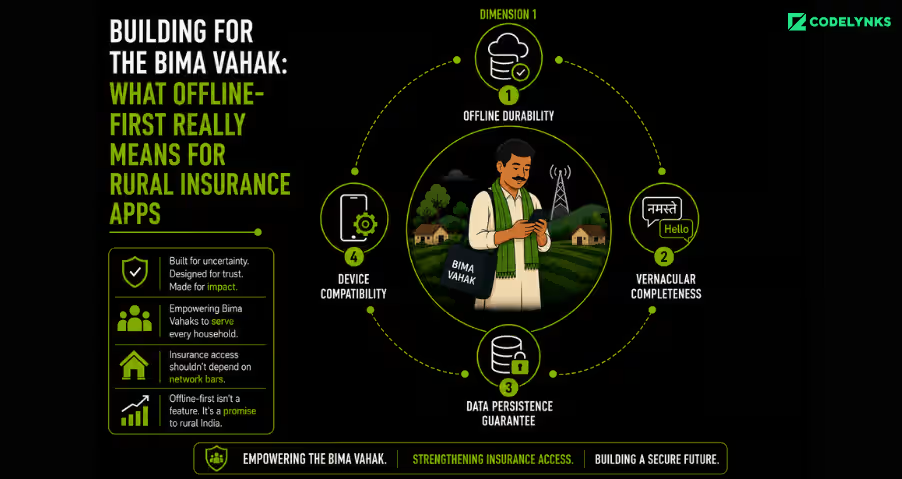
RIARS is a four-dimension assessment that evaluates whether a Bima Vahak app is actually deployable to rural distribution networks. Each dimension has a clear pass criterion. An app must pass all four before field deployment. Partial passes create the failure modes described above.
Dimension 1: Offline Durability. The entire policy enrollment flow eKYC capture, customer details, product selection, consent recording, nominee capture completes without any live network dependency after the app has loaded. API calls for data submission happen in the background after the session is complete, not as blocking steps within the flow. Pass criterion: a complete enrollment can be captured in airplane mode, stored locally, and submitted when connectivity restores with no data loss and no re-entry required.
Dimension 2: Vernacular Completeness. Every screen, every error message, every field label, and every customer-facing document is available in the Vahak’s configured language. No English fallback appears in the primary enrollment or claims flow. Pass criterion: a complete end-to-end flow test in Tamil, Marathi, or Bengali produces zero English-language strings visible to the user. Error messages from the Bima Sugam API are translated before display, not passed through raw.
Dimension 3: Data Persistence Guarantee. Every form entry is written to local persistent storage (SQLite or Hive) before any network submission is attempted. Biometric captures are stored as encrypted local files, not as in-memory blobs. If the app is force-closed at any point during an enrollment, restarting the app resumes from the last persisted state without data loss. Pass criterion: kill the app process during eKYC capture, restart, and verify that all entered data is present and the Vahak can continue from the last completed step.
Dimension 4: Device Compatibility. The app has been profiled and tested on an Android Go Edition device with 2GB RAM under 2G network simulation. Camera and biometric capture flows complete without OOM crashes. The P90 screen render time under these conditions is under 2 seconds. Pass criterion: run a full enrollment flow on a Redmi Go or Nokia G11 on a 2G-simulated connection (use Chrome DevTools network throttling at the Android proxy level). If the flow completes without crash and all screens render in under 2 seconds P90, the app passes Dimension 4.
The Architecture: Offline-First with Bima Sugam Integration
Flutter is the right implementation choice for Bima Vahak apps, for three reasons: single codebase for Android deployment (the primary platform for rural India), strong localization infrastructure with ARB-based string management that scales to 12 to 15 Indian language variants without architectural changes, and efficient rendering on low-end Android hardware.
The offline-first architecture has four components:
Local data store (Hive or SQLite with encryption). Every enrollment session is a local record. The record schema mirrors the Bima Sugam API request body, so no transformation is needed at submission time. Encryption at rest is mandatory a device loss exposes customer PII without it. Hive with AES-256 encryption at the box level satisfies this requirement without complex key management.
Background sync queue. Completed enrollment records are queued for submission. The queue manager runs as a background isolate, submitting records when connectivity is available and retrying on failure with exponential backoff. Idempotency keys on all Bima Sugam API endpoints prevent duplicate policy issuance when the same record is submitted more than once due to sync interruptions.
Connectivity-aware eKYC flow. Aadhaar-based eKYC via DigiLocker requires connectivity. Biometric eKYC via a fingerprint or liveness API requires connectivity. Design the flow so that connectivity-dependent steps are isolated and have explicit offline fallback paths: if connectivity is not available, capture the customer’s Aadhaar number and consent locally, defer the OTP-based verification to a background step when connectivity restores, and notify the Vahak when eKYC is complete rather than blocking her during the wait.
Conflict resolution policy. When the same enrollment record is modified on-device and then compared against a server-side record at sync time, the conflict resolution rule must be explicit. For policy enrollment records: server wins (the Bima Sugam confirmation is authoritative). For biometric data captured offline: device wins (do not discard biometrics already captured). This distinction matters most when a Vahak completes enrollment offline and then the server returns a validation error for a field that was valid offline.
Claims Intimation: The Feature That Cannot Fail Offline
Phase 2 of Bima Sugam adds claims intimation the workflow where a Vahak helps a customer notify the insurer of a claim event: a crop loss, a health hospitalization, a property damage incident.
Claims intimation is the moment that matters most to the customer and requires the most offline reliability. Most insurers test it last.
A Vahak helping a farmer document a flood damage claim is standing in the affected field. Signal may be intermittent. The claim evidence photographs, GPS coordinates, incident details, policy number must be captured completely before the Vahak leaves the site. If the app cannot guarantee that captured evidence is persisted locally with the same reliability as an enrollment record, the claim is at risk of being incomplete or lost.
The architectural requirement: claims intimation uses the same offline-first framework as enrollment. Evidence captured as local files (photographs as compressed JPEG in the Hive store, GPS coordinates as a structured record) before any API call is attempted. Submission is background-queued. The Vahak receives a local confirmation (“claim documented”) immediately, and a connectivity-dependent confirmation (“claim registered with insurer”) when sync completes.
Phase 2 also adds health data API integration for underwriting Abha ID linkage and health record fetch. These are connectivity-required flows, and they must be clearly distinguished from the offline-capable flows so the Vahak knows when she must ensure connectivity before proceeding.
What This Means for InsurTech Leaders
Three things to test this week, before your next field deployment:
Open your Bima Vahak app on an Android Go device and enable airplane mode 2 minutes into an enrollment flow. Note what happens to the data you entered. If it is gone when you re-enable connectivity, Dimension 3 is failing.
Attempt a full enrollment in the native language of your highest-density Vahak geography. Note every English string you encounter. Each one is a Dimension 2 failure in that specific geography.
Check your claims intimation test protocol. Does it include an offline simulation capturing evidence with no connectivity and verifying that the evidence is persisted after an app restart? If the claims intimation test only runs on a connected device, you have not tested the scenario that matters most for a rural Vahak.
The highest-fidelity test of a Bima Vahak app is not a demo in Bangalore. It is a Vahak completing a full policy enrollment in a village in Vidarbha on a 2G connection. Build that test into your QA process before Phase 2 features are added. Retrofitting offline architecture onto a connected-first codebase costs 3 to 4 times more than building it in from the start.
More Blog : OT Cybersecurity for Indian PLI Manufacturers: Why IT-First Zero Trust Fails