Content Overview
Introduction: E-commerce Sale Season SRE Reliability Audit Checklist
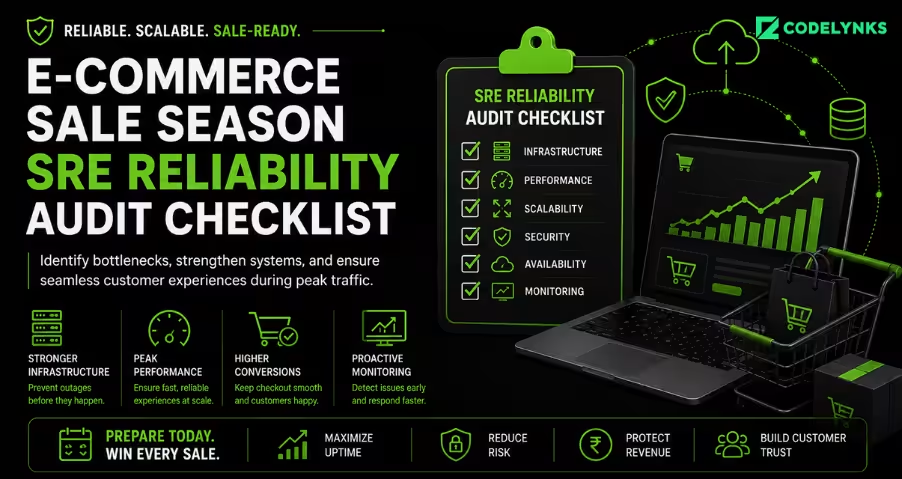
The E-commerce Sale Season SRE Reliability Audit Checklist helps retailers identify infrastructure bottlenecks before major flash sale events. By auditing database capacity, payment gateways, inventory systems, and CDN performance, teams can improve reliability and prevent revenue-impacting outages.
The problem is not whether your platform will receive peak traffic. The problem is whether you have found your bottlenecks before the traffic finds them.We work with a mid-market Indian D2C brand in fashion and home décor with 2 million monthly active users and three annual flash sale events. Before their first Diwali sale, their infrastructure team had scaled the application tier to handle 15x traffic. On sale day, the checkout success rate at peak was 38%.
The application servers were sitting at 40% CPU utilization. The bottleneck was the database connection pool provisioned for their normal daily load, unchanged since the platform was built in 2023, which was exhausted within the first four minutes of peak traffic. Every checkout attempt that could not acquire a connection timed out silently. The orders were lost, not queued.
This is the pattern that repeats across Indian e-commerce every sale season. The bottleneck that kills a flash sale is almost never where the team was looking.
How to Use an E-commerce Sale Season SRE Reliability Audit Checklist Before Flash Sales
Not all peak failures look the same. Six failure modes account for the majority of Indian e-commerce outages during high-traffic sale events:
Database connection pool exhaustion. Application tier autoscaling adds more application instances. Each new instance opens connections to the database. The connection pool limit often a default set at deployment is hit when the number of application instances multiplied by per-instance connection count exceeds the database maximum. Writes start failing. Checkout breaks. Application servers report as healthy.
Inventory reservation race conditions. When 500 users add the same low-stock item to cart simultaneously, the inventory reservation logic that worked fine under normal load starts producing oversell. The fix database-level row locking or a Redis-backed reservation cache must be designed before the sale, not patched during it. Issuing cancellations to customers who completed checkout is a brand problem, not a database problem.
Payment gateway saturation. Your payment gateway SLA covers availability, not throughput. A 99.9% uptime guarantee does not specify response behavior when 40,000 concurrent checkout requests arrive within two minutes. Indian payment gateways Razorpay, PayU, Cashfree, Paytm each have throughput limits that vary by account tier and time of day. Platforms that have never tested their gateway at peak load discover these limits on sale day.
Notification pipeline backup. Order confirmation emails, SMS OTPs, and WhatsApp notifications are processed through queues. Under normal load, queue lag is milliseconds. Under flash sale load, the notification queue can back up by minutes or hours, causing customers to experience delayed confirmations and triggering support escalations that overwhelm the team during the event.
CDN cache miss storm: Sale launches involve new promotional assets banners, sale pricing, updated product pages that often bypass CDN cache due to aggressive cache invalidation at launch time. The origin server receives direct traffic for assets that would normally be served from cache. If the origin is not sized for direct asset traffic at peak, page load times spike and conversion rates fall.
Third-party script failures. Analytics tags, A/B testing scripts, chat widgets, and loyalty program widgets are synchronous or semi-synchronous JavaScript that loads on every page. When any one of them degrades under load their own servers overwhelmed by your spike it can block page rendering or break checkout flows in ways that are nearly impossible to diagnose in real time.
The Pre-Peak SRE Readiness Scorecard (PPRS)
Six dimensions, assessed nine weeks before the sale date and again three weeks before. Any red dimension at the three-week mark requires immediate engineering action or a sale scope reduction.
Dimension 1 Connection Pool and Database Capacity. Audit the configured connection pool limit for every database in your transaction path: primary RDS or PostgreSQL, Redis, and any third-party databases. Calculate the maximum connection count at your projected peak application instance count. Add 20% headroom. If the calculation exceeds the database maximum connections, you have a problem to solve before autoscaling is configured.
Dimension 2 Inventory Reservation Architecture. Test the concurrent add-to-cart and checkout flow at 10x, 20x, and 50x your normal peak concurrency. Count oversell events in the test run. If any oversell is produced, the reservation architecture needs a fix before the sale. Acceptable solutions: database-level optimistic locking with retry, Redis-backed atomic reservation with TTL, or a dedicated inventory reservation service with a queue.
Dimension 3 Payment Gateway Load Testing. Contact your primary payment gateway and request throughput documentation for your account tier. Then run a load test at 120% of that throughput limit using a synthetic checkout flow (test card numbers, real gateway sandbox). Measure error rate and response time. If the error rate exceeds 1% at this load level, discuss throughput tier upgrades with the gateway or add a secondary gateway as a fallback.
Dimension 4 Notification Pipeline Capacity. Calculate the expected notification volume for the first 30 minutes of the sale: order confirmations, OTPs, WhatsApp messages. Check your current queue throughput against that projected volume. If queue throughput is less than twice the projected volume, the pipeline will back up. Configure queue scaling policies to pre-provision workers before the sale, not reactively after the backup is detected.
Dimension 5 CDN and Asset Strategy. Create a pre-warming plan for all sale assets: promotional banners, updated product pages, new category landing pages. Cache-warm these assets on the CDN at least 2 hours before sale launch, not at launch time. Set cache TTLs on sale assets to a minimum of 15 minutes. Aggressive invalidation at launch time is the most common cause of origin server overload at sale start.
Dimension 6 Third-Party Script Audit. List every third-party JavaScript loaded on your product pages and checkout flow. For each: confirm it loads asynchronously. If any script loads synchronously in the page head, evaluate whether it can be deferred. For scripts that cannot be deferred, test the page behavior if the script endpoint is unavailable (simulate with a browser network block). Checkout must complete even when analytics or chat scripts are unavailable.
“Every outage during a flash sale is a planning failure, not a technical failure.”
Chaos Engineering Before the Sale, Not After the Outage
The most reliable platforms run targeted chaos experiments in the 4 to 6 weeks before a major sale. Not full-system chaos surgical fault injection against the specific failure modes listed above.
Chaos test 1: kill 30% of application instances during a sustained load test. Verify autoscaling brings them back within your defined recovery time, and that the database connection pool does not saturate during the scale-out period.
Chaos test 2: inject a 2-second latency on your primary payment gateway endpoint during load testing. Confirm the checkout flow fails gracefully, routes to the secondary gateway, and returns an accurate error message (not a generic 500) to the customer.
Chaos test 3: pause the notification queue workers for 10 minutes during load testing. Confirm messages queue correctly, no messages are dropped, and consumers catch up within 15 minutes of workers resuming. This validates your queue backpressure handling.
The counterintuitive chaos engineering finding: the chaos test that produces the most unexpected results is almost always Dimension 6. Third-party scripts fail in ways that are not captured in monitoring dashboards, because the failure is on the client side in the browser. Browser-side chaos testing blocking specific third-party domains in a realistic browser environment reveals script dependencies that nobody documented. Run a 10-minute load test at 5x your normal peak using tools like k6 or Locust.
What This Means for E-commerce Leaders
August is nine weeks away. The Big Billion Days follow in October. If you are running a Diwali sale, the preparation window for that event is also now the engineering debt that causes Diwali outages is visible in the August sale if you know where to look.
Three things you can do this week without engaging Codelynks:
First, pull your current database maximum connections configuration and your application instance autoscaling policy. Calculate the maximum connection count at peak instance count. Compare it to the database limit. Do this calculation today, before any other preparation work, because it is the highest-impact single number in your peak reliability posture.
Second, run a 10-minute load test at 5x your normal peak using a tool like k6 or Locust against your checkout flow. Do not stop at application-tier metrics. Pull database connection utilization during the test. If utilization exceeds 70% at 5x load, you will hit the limit before 20x.
Third, check whether your payment gateway account has a throughput limit below what you expect to see on sale day. Most platforms have never asked this question. The answer is in the gateway’s developer documentation or your account manager’s standard rate limits. If you cannot find it, open a support ticket asking for your account’s peak TPS limit. Get the answer in writing before August.
Conclusion
An E-commerce Sale Season SRE Reliability Audit Checklist should be reviewed before every major flash sale event. The E-commerce Sale Season SRE Reliability Audit Checklist helps teams validate database capacity, payment gateway readiness, inventory reservation systems, and CDN performance. By following an E-commerce Sale Season SRE Reliability Audit Checklist, retailers can reduce outages and improve checkout reliability during peak traffic periods.
More Blogs: e-commerce-sale-season-sre-reliability-audit-checklist