Content Overview
Introduction
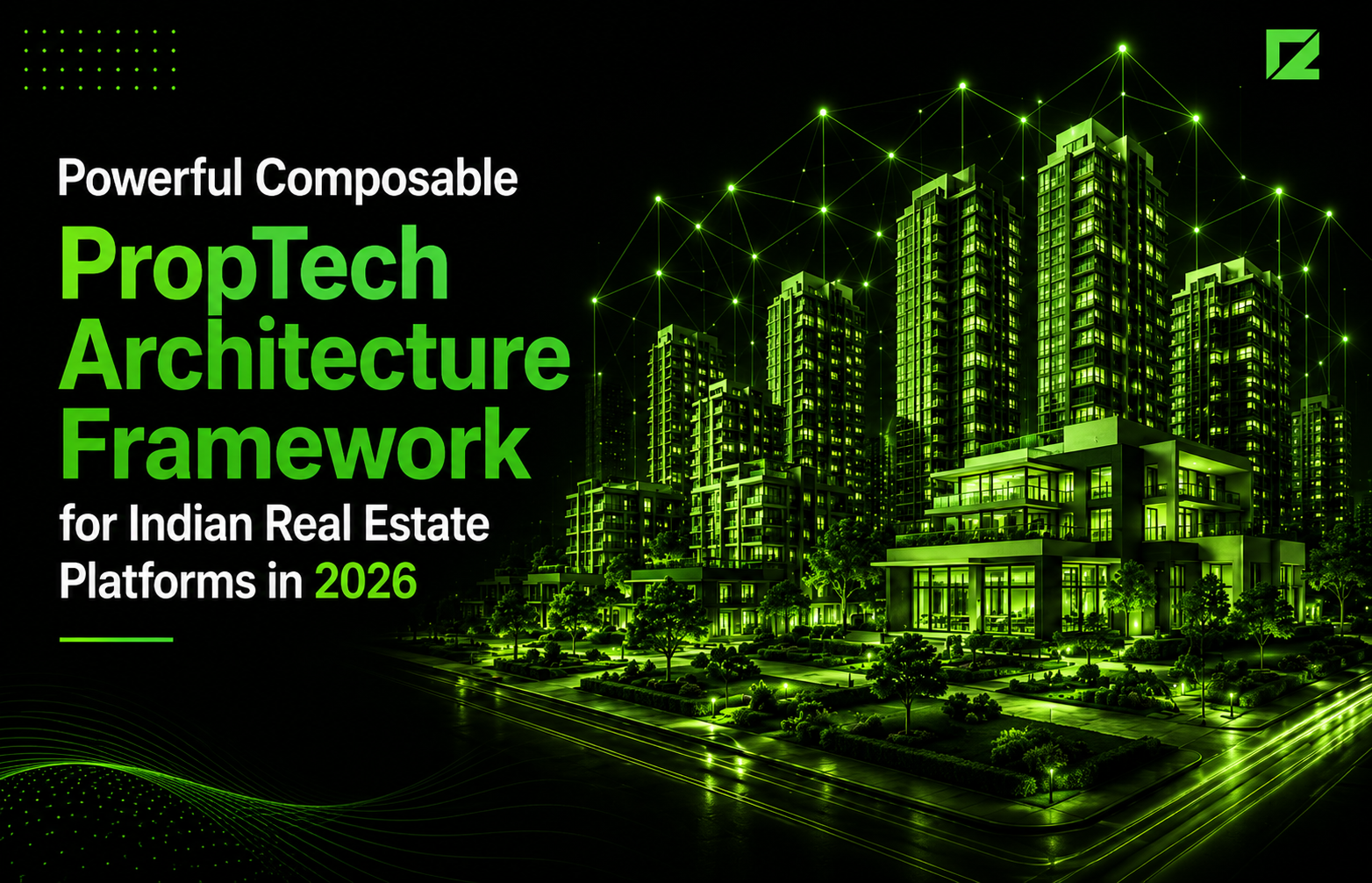
Composable PropTech Architecture is rapidly becoming the foundation of modern Indian real estate platforms. Indian real estate buyers now interact with between 7 and 11 digital touchpoints before signing a sale agreement. They research on Google, browse property portals, watch YouTube walkthroughs, ask questions on WhatsApp, revisit listings on social media, compare floor plans on developer apps, and eventually engage with brokers or sales teams.
The India PropTech market is growing at a 16.95% CAGR toward USD 4.29 billion by 2031. The investment is going primarily into AI-powered search, virtual tours, and chatbot lead capture. These are user experience improvements that address the early discovery phase of the buyer journey. None of them address the part that actually converts: document verification, payment routing, agreement execution, and RERA-compliant disclosure.
SEBI’s SM-REIT framework, which activated fractional real estate ownership as a regulated product class, made this architectural gap acute. A fractional unit sale is not a listing plus a site visit. It is a financial product transaction with KYC, payment allocation, unit registry, and compliance disclosure requirements. The platforms built to serve traditional developer sales are not equipped for it.
This post covers what composable PropTech architecture looks like in practice, where Indian real estate platforms typically break under transaction load, and a framework for assessing where your platform currently sits.
Why Monolithic PropTech Fails at the Transaction Layer
Most Indian real estate platforms were built in two tiers: a listing CMS (managing property content, photos, pricing) and a lead management system (capturing inquiries and routing them to sales teams). The sale itself happens offline, through a broker or sales executive, using physical agreements and bank-transfer payment instructions.
This model worked when buyers expected to visit a site office before signing. It breaks when:
– NRI buyers expect to complete the entire transaction digitally, from a different timezone, in their preferred language, with their preferred payment method (wire transfer, NRE account, or international card).
– Fractional ownership buyers are purchasing units of a regulated financial product, not a physical property, and require KYC, investment account integration, and prospectus disclosure at the transaction point.
– Broker ecosystems need real-time inventory status, commission tracking, and deal registration on mobile devices, without requiring a laptop and a site visit.
– Multiple channel surfaces (web, app, WhatsApp Business API, kiosk at a project site) need to present consistent inventory, pricing, and unit availability without a developer manually synchronizing four systems.
Each of these requirements is a backend architecture problem, not a UI problem. Adding an AI chatbot to a monolithic CMS does not create an NRI transaction flow. It creates a chatbot that collects contact details and routes them to a broker who then calls the NRI on WhatsApp anyway.
The PropTech Composability Maturity Model (PCMM)
PCMM defines four stages of architecture maturity for real estate commerce platforms. Stages are cumulative: a platform cannot reliably operate at Stage 3 without completing Stage 2.
Stage 1: Monolith The platform is a single application: CMS, listing engine, lead form, and (if it exists) a payment link generator are all in the same codebase. Frontend and backend are tightly coupled. Changing the listing page layout requires a backend deployment. Adding a new channel (WhatsApp) requires building a new standalone integration that reads from a different data source than the web platform.
Most mid-size Indian developer websites are operating at Stage 1. They are functional for inbound lead generation. They are not functional as transaction platforms.
Stage 2: Decoupled The frontend is separated from the backend. A headless CMS (Contentful, Sanity, or a custom GraphQL layer) serves content to a React or Next.js frontend. The listing data and the content are fetched from separate APIs. Lead capture posts to a CRM API.
Stage 2 is an improvement in developer productivity and content management flexibility. It is not yet composable commerce. The backend is still a single service. Adding a new payment method or a new document verification provider requires changes to the central backend.
Stage 3: Composable: At Stage 3, the platform follows a MACH architecture: Microservices, API-first, Cloud-native, Headless. Each functional domain is a separate service with its own API:
– Inventory service: unit availability, hold management, real-time unit count
– Pricing service: base price, GST calculation, payment plan options, broker commission
– Identity and KYC service: Aadhaar eKYC, PAN verification, NRI documentation check
– Document service: sale agreement generation, stamp duty calculation, e-registration flow
– Payment service: payment gateway routing, installment scheduling, receipt generation
A composite Tier-1 residential developer in Kerala we worked with was building a fractional ownership platform for SM-REIT-compliant units. Their existing monolithic platform had a 72-hour turnaround from expression of interest to unit allotment, with three manual handoffs between sales, legal, and accounts. At Stage 3, the same flow completed in 4 hours, with identity verified at booking, payment routed at confirmation, and a digital allotment letter generated automatically. The manual handoffs dropped to one: final legal sign-off before registry.
Stage 4: Orchestrated: At Stage 4, the composable backend serves all channels from a single source of truth. The same inventory service, pricing service, and KYC service power the developer’s web platform, their mobile app, their WhatsApp Business API integration, and the kiosk terminal at the project site office.
Channel-specific frontend concerns (Malayalam language UI on the site kiosk, Arabic-language WhatsApp messages for UAE-based NRI buyers, and a high-contrast interface for investors accessing from a slow 4G connection in a tier-3 city) are handled entirely at the presentation layer. The backend does not know or care which channel the transaction arrives from.
Stage 4 requires API contract stability and versioning discipline. A channel that breaks because an inventory service API was changed without a version bump is a Stage 3 problem pretending to be a Stage 4 problem.
Three Architecture Decisions That Determine PropTech Outcomes
Decision 1: Build the inventory service before the listing CMS. Most real estate platform builds start with the property listing UI because it is visible and demonstrable. The inventory service, which tracks unit hold status, allotment, payment-linked availability, and real-time count, is the transactional core. Build the listing UI on top of the inventory service, not alongside it.
Decision 2: Treat KYC as a first-class service, not a form. Indian PropTech platforms frequently treat identity verification as a lead form field that gets manually checked by a sales executive. Under RERA and SEBI SM-REIT requirements, KYC is a compliance event with audit trail requirements. The KYC service needs to log verification method, verification timestamp, verification result, and the document hash, and retain that record for regulatory review.
Decision 3: Plan for ONDC integration before building a payment gateway. ONDC’s Open Network for Digital Commerce is expanding into real estate transaction flows. Platforms that build their payment integration as a tight coupling to a single gateway will face a significant re-engineering cost when ONDC compatibility becomes a distribution requirement.
What This Means for Real Estate Leaders
The most concrete step a developer or PropTech platform can take this week is a channel audit: list every digital channel through which you currently serve buyers and brokers, and check whether they read from the same inventory data source. If your web platform and your WhatsApp integration pull unit availability from different systems (or if WhatsApp availability is manually updated by a sales coordinator), you are at Stage 1 regardless of how modern your frontend looks.
The transaction layer is the constraint. It is not AI search, not virtual tours, and not chatbot engagement. The platforms that close the gap between digital discovery and digital transaction will capture the NRI buyer, the SM-REIT investor, and the digital-native millennial buyer who has no interest in visiting a site office.
About the author: The Codelynks engineering team has delivered composable commerce platforms for real estate developers and property technology companies across India and the Middle East. Connect on LinkedIn .