10 Proven Platform Engineering Strategies for Logistics Software

10 Proven Platform Engineering Strategies for Logistics Software featuring a digital logistics network, cargo truck, shipping containers, cargo vessel, cloud platform, and global supply chain connectivity.

Platform Engineering for Logistics Software Best Practices

Indian logistics-tech platforms typically start with one or two carrier integrations and grow to 12 or more over 18 months as they expand geographic coverage. Each new carrier arrives with a different API contract, a different webhook format, a different error code vocabulary, and a different SLA. By the time a Series B logistics-tech company has 12 active carrier integrations, the hidden engineering cost is substantial. Engineers spend an estimated 30 to 40% of sprint capacity on carrier API incidents, version changes, and integration-specific debugging rather than building product features. This is the multi-carrier integration debt problem, and it does not get better as you add carriers. It compounds.

Why Every Carrier Integration Becomes Its Own Codebase

The root cause is structural. Carrier APIs in India are not standardized. Delhivery’s tracking webhook carries a different schema than DTDC’s. Ecom Express uses different status codes than Shiprocket’s aggregated carrier feed. Blue Dart has an enterprise SOAP API that predates REST and is still the only integration path for their enterprise tier.

Each of these carriers was onboarded when a specific business need arose, often by the team that needed the carrier, using the patterns that team knew. The first integration used polling. The second used webhooks. The third used a message queue because the engineer who built it had just come from a company that used Kafka for everything. None of these decisions were wrong in isolation. Together, they produce a codebase with 12 different integration patterns, 12 different retry strategies, and 12 different places where a carrier API change can break a customer-facing tracking page.

> A carrier API is not an integration. It is a dependency with a 6-hour SLA and no versioning contract.

When a carrier updates their API without prior notice, you find out through customer support tickets, not through a changelog notification. The time from carrier API breakage to customer-visible impact is measured in hours. The time to fix it depends entirely on how well-isolated and documented the specific integration is. In a 12-carrier codebase with 12 different patterns, the answer is usually “longer than the incident SLA.”

What Platform Engineering Changes

Platform engineering addresses the multi-carrier integration problem by replacing the carrier-specific pattern with a carrier-agnostic interface. Instead of 12 integration implementations, you build one carrier adapter framework. Each carrier gets an adapter that conforms to a standardized interface.

The framework defines:

Canonical data models: A single data model for shipment status, tracking events, label formats, and error conditions. Every carrier adapter translates from the carrier’s native format to the canonical model before data leaves the adapter. Downstream systems never see carrier-specific formats.

Standard retry and circuit breaker policies: One retry policy applied uniformly. If a carrier’s API returns 503s, the circuit breaker opens and routes to a fallback carrier, rather than cascading errors into the order management system.

Webhook normalization: A centralized webhook receiver accepts payloads from every carrier and normalizes them to the canonical event format before emitting them to downstream consumers. Adding a new carrier means adding one adapter, not one webhook endpoint with unique parsing logic.

Health monitoring per integration: Each carrier adapter exposes a standardized health check. The platform’s observability layer aggregates these into a carrier health dashboard, so on-call engineers see “Ecom Express webhook lag: 12 minutes” rather than “tracking updates are slow.”

This is the adapter pattern applied consistently at the platform level rather than ad hoc at the integration level. The difference between a company that does this well and one that does not is not intelligence. It is discipline applied early enough that the pattern can be enforced.

> When your 11th carrier integration is built by a different team than your first, you do not have a platform. You have 11 separate platforms that share a database.

The Internal Developer Platform Layer

Gartner estimates that 80% of large engineering organizations will have dedicated platform engineering teams by 2026, up from 45% in 2022. For logistics companies, the IDP delivers the carrier integration framework as a self-service capability.

When a carrier integration team onboards a new carrier, they should not need to make decisions about retry policies, webhook schemas, or monitoring setup. Those decisions live in the platform. The team makes decisions about the carrier’s specific API behavior, error codes, and edge cases. The platform handles everything else.

In practice this means: a carrier adapter template with required interface implementations, a test harness that validates adapter conformance against a suite of canonical scenario tests before production deployment, automated monitoring registration when a new adapter is deployed, and a runbook template that every adapter ships with.

We worked with a Series B logistics-tech company in Mumbai operating a 9,000-pin multi-carrier delivery network. At the time we engaged, they had nine carrier integrations implemented by four different teams over three years. The carrier webhook handler was a 2,800-line file that processed payloads from all nine carriers with nested if-else blocks keyed on carrier ID. Every carrier API change required a full regression test across all nine carriers before deployment, because no one was confident a change for one carrier would not break another.

We rebuilt the integration layer as a carrier adapter platform with a canonical event model and per-adapter isolation. The webhook handler was replaced with a router that dispatched to individual adapter parsers. Adding carrier 10, 11, and 12 each took two to three days, compared to two to three weeks for the previous integrations. Carrier API incidents that previously required senior engineer involvement now resolve at Tier-1 support level using runbooks.

The Logistics Platform Maturity Index (LPMI)

We use this four-level model to assess platform maturity and sequence the remediation work:

Level 1: Ad-hoc integration

Each carrier integration is a standalone implementation. No shared data models, no shared retry policies. Carrier API changes require engineering archaeology to isolate and debug. Integration incidents are unpredictable in scope.

Level 2: Shared utilities, inconsistent application

A shared HTTP client or retry utility exists but is not enforced. Some integrations use it; others do not. The canonical data model exists in a shared library but individual integrations map to it inconsistently.

Level 3: Platform with adapter pattern

A carrier adapter framework exists with a canonical data model. New carrier onboarding follows a template. Webhook normalization is centralized. Monitoring is per-adapter and aggregated to a carrier health dashboard.

Level 4: Self-service IDP with governance

The carrier integration platform is a self-service capability. Teams onboard new carriers without platform team involvement beyond a code review. Adapter conformance is enforced by automated conformance tests. SLA performance is tracked per carrier per service level tier and feeds into carrier allocation decisions.

Most Series A and B logistics-tech companies in India are at Level 1 or Level 2. Level 3 is achievable in 3 to 4 months for a team with a dedicated senior platform engineer. Level 4 requires 6 to 9 months of deliberate platform investment.

Why AI-Powered Carrier Allocation Needs a Clean Platform First

The next wave of logistics intelligence, AI-powered carrier allocation that optimizes for cost, SLA, and pin-code serviceability simultaneously, cannot be built on a Level 1 integration layer. Dispatch management engines that ingest carrier availability, warehouse stock, and order management data to inform route planning decisions need clean, consistent, real-time carrier availability signals. Dispatch systems now consider 250 or more variables simultaneously for carrier selection.

If your carrier availability data comes from nine different polling jobs with different latencies and inconsistent error handling, your allocation model will make decisions on stale and inconsistent inputs. The model is only as reliable as the data layer underneath it.

> The cost of maintaining carrier webhooks in a 9,000-pin network exceeds the cost of operating the routing engine itself.

The platform investment is a prerequisite for the intelligence investment, not a parallel track. Building AI-powered allocation on a Level 1 integration layer produces an allocation model that performs well in controlled demos and degrades under real carrier API instability.

Packaging the Platform Investment for Leadership

The business case for carrier adapter platform investment is not difficult to build if you have the right data. The inputs are: current engineer hours per sprint spent on carrier incident resolution and integration-specific debugging, average customer escalation cost for carrier-related tracking issues, and sprint velocity lost to carrier API regression testing before releases.

In our Mumbai client engagement, those three numbers together justified the platform investment in under eight months of recovered engineering capacity. The platform team of two engineers reduced carrier incident load across a nine-person engineering team by an estimated 35% of sprint capacity. That capacity went back into product development that generated measurable revenue.

What this means for Logistics and Supply Chain leaders

If you are a CTO or Head of Engineering at a logistics-tech company with 8 or more carrier integrations, your integration layer is already a bottleneck. The symptom is rarely visible on dashboards. It shows up as delayed feature releases, because every new feature touches carrier data. It shows up as engineering attrition, because senior engineers burn out on integration maintenance. It shows up as customer escalations during carrier API changes, because there is no clean isolation between carriers.

The step you can take this week: count the number of distinct error handling patterns across your carrier integrations. If the answer is more than two, you are at Level 1. That number is the leverage point for the business case for a platform investment.

More Blogs : Bima Sugam Phase 2 (2026): 7 Best Modernization Steps

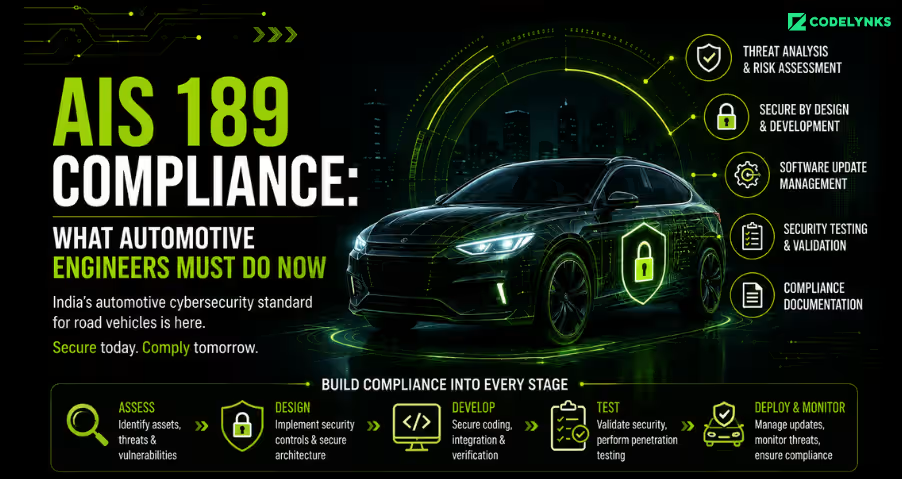
AIS 189 Compliance: What Automotive Engineers Must Do Now

AIS 189 Compliance: What Automotive Engineers Must Do Now banner showing automotive cybersecurity and software compliance.

Introduction 

AIS 189 Compliance Is Coming. Your Automotive Software Team Has 18 Months to Build a System That Doesn’t Exist Yet.

India’s Automotive Industry Standards Committee published AIS 189 and AIS 190, the country’s cybersecurity and software update management standards for road vehicles, and by 2026-2027 they enter vehicle type approval scope. For a Tier-2 electronics supplier building telematics units, infotainment controllers, or ADAS ECUs, this is not a distant regulatory event. It is an engineering constraint already affecting procurement decisions from OEM partners who are themselves under compliance pressure. As of April 2026, no L-category two-wheeler in India meets the AIS 189 scope. Four-wheelers are not far ahead. The window to build a compliant Cybersecurity Management System is narrow, and it is closing.

What AIS 189 Actually Requires (and What Most Teams Think It Requires)

AIS 189 maps to UNECE R155 and ISO/SAE 21434. AIS 190 maps to UNECE R156 for software update management systems. Both are drafted by ARAI under the Ministry of Road Transport and Highways.

Most engineering teams read these standards and arrive at the same conclusion: they need better penetration testing. This is the wrong conclusion. The standards require a Cybersecurity Management System (CSMS), a documented, auditable process that covers:

Risk assessment across the full vehicle lifecycle, not just at design time

Supplier cybersecurity controls and their documentation

Incident monitoring and response procedures

Processes for issuing, verifying, and rolling back OTA updates securely

A penetration test produces a list of vulnerabilities. A CSMS produces evidence that your organization has a repeatable process for finding and managing vulnerabilities before, during, and after production. These are not the same deliverable.

AIS 189 is not a certification you acquire. It is an engineering process you must operate continuously.

The gap most suppliers have is not in their firmware. It is in their process documentation and their supplier chain controls.

The OTA Security Problem Is Harder Than the Update Problem

AIS 190 specifically governs Software Update Management Systems (SUMS). The engineering challenge here is distinct from the CSMS work under AIS 189.

A secure OTA update system for connected vehicles requires the following:

Code signing infrastructure: Every firmware package must be signed by the developer and verified by the receiving ECU before installation. This requires a Hardware Security Module (HSM) in both the signing pipeline and the vehicle endpoint.

Rollback protection: An ECU that accepted a compromised update and rolled back to a previous version is still a security incident. The SUMS must log the rollback and trigger an investigation workflow.

Campaign management with integrity checks: The update delivery pipeline must verify package integrity at every step, from the update server to the CDN to the vehicle’s telematics unit.

Multi-domain coordination: Modern vehicles carry 80 to 150 ECUs across multiple domains, sometimes from different Tier-1 suppliers. An OTA update to one domain can create compatibility issues in another if the SUMS does not manage dependencies explicitly.

Qualcomm and Google expanded their Android OTA partnership in January 2026 specifically to address multi-domain software complexity in production vehicles. The problem they are solving is the same one Indian suppliers are facing: OTA update systems designed for one ECU at a time cannot handle the software-defined vehicle architecture.

The global automotive OTA compliance market sits at USD 5.41 billion in 2026. By 2036, that number is projected at USD 18 billion. The compliance investment is not discretionary for OEMs selling into markets where type approval depends on it.

Where Indian Suppliers Are Getting Stuck

We worked with a Tier-2 automotive electronics supplier in Pune that produces telematics control units for three Indian OEMs. They had strong engineering on the firmware side, a mature CI/CD pipeline, and a reasonably secure TLS implementation on their update channel.

Their gap was not in the code. It was in the process.

They had no documented Threat Analysis and Risk Assessment (TARA) for their product portfolio. They had no supplier questionnaire for the component vendors who provided modules to them. They had no incident response playbook for a compromised update campaign. Their CSMS existed in the heads of three engineers who had each worked on ISO 21434 projects at previous employers.

When their OEM partner’s audit team asked for compliance documentation, there was nothing to hand over. The OEM did not cancel the relationship, but they required the supplier to produce a compliant CSMS within six months or face de-listing from their preferred supplier list.

Six months is not enough time to build a CSMS from scratch. It is barely enough time to document one.

The Vehicle Cybersecurity Compliance Ladder (VCCL)

Based on our work with automotive electronics teams, we use a five-rung model to assess readiness and sequence remediation:

Rung 1: Asset Inventory and TARA

List every software component, interface, and communication channel in your product portfolio. Complete a Threat Analysis and Risk Assessment per ISO/SAE 21434 Section 15. Output is a TARA document per product line, reviewed and signed off by engineering leadership.

Rung 2: CSMS Process Documentation

Document your cybersecurity policies, roles, incident response procedures, and supplier assessment process. This is the organizational layer that auditors look for first. Without it, Rungs 3 through 5 have no formal context.

Rung 3: Secure Development Lifecycle Integration

Embed security requirements into design reviews, integrate SAST and DAST into your CI pipeline, and define acceptance criteria for security test reports before milestone gates. Security testing becomes a release gate, not an audit activity.

Rung 4: OTA Security Infrastructure

Stand up your HSM-backed code signing pipeline, define your SUMS architecture per AIS 190, and build campaign management with rollback protection and integrity verification at every delivery stage.

Rung 5: Continuous Monitoring and Incident Management

Establish vulnerability monitoring for your product families, build the incident response runbook, and define your PSIRT (Product Security Incident Response Team) process. Post-production monitoring is a permanent CSMS obligation, not a project phase.

Most suppliers we assess are between Rung 1 and Rung 2. Rung 5 is required for full AIS 189 compliance. The gap is structural, not technical.

What Zero Trust Actually Means for OTA

Zero trust in an OTA context is often misunderstood as “always verify the update server.” That is table stakes. The zero trust model for OTA means the vehicle ECU does not implicitly trust any update, regardless of where it originates, unless it can independently verify the cryptographic signature against a root of trust stored in hardware.

This has three specific engineering implications:

The root of trust is in silicon. An HSM or Trusted Execution Environment (TEE) in the ECU holds the public key used to verify signatures. This key cannot be extracted or overwritten by software. The verification chain is end-to-end. Signature verification happens at the ECU, not at the gateway or the telematics unit. An intermediary device cannot re-sign on behalf of the ECU. Failed verifications trigger defined behavior. A rejected update does not leave the ECU in an undefined state. Your SUMS must specify the fallback behavior, and it must be tested against adversarial scenarios, not just network failure scenarios.

> Zero trust for OTA does not mean you distrust your update server. It means your vehicle ECU cannot trust it either.

The SAE technical paper 2026-26-0621, published in Q1 2026, provides implementation guidance for this architecture in multi-domain vehicle environments. It is worth reviewing before your next hardware design review, particularly the sections on ECU-level verification in Automotive Software Stores.

What this means for Automotive and Ride-Hailing Mobility leaders

If you are a CTO or VP Engineering at an Indian OEM or Tier-1/2 supplier, AIS 189 compliance is now a procurement filter, not a future concern. Your OEM partners are themselves under compliance pressure and will pass it down the supply chain through supplier audits and preferred supplier list criteria.

The concrete steps you can take this week: pull your current product list and identify which ones have a TARA document. For those that do not, assign an owner and a four-week timeline to produce one. Separately, identify who in your organization owns incident response for a potential OTA security event. If the answer is no one specifically, that is the highest-priority gap in your CSMS.

You do not need to complete the VCCL in six months. You need to be able to demonstrate to an auditor that you are actively climbing it, with evidence at each rung.

More Blog: Your Shopify Store Cannot Serve an ONDC Buyer App. Here Is What Can.

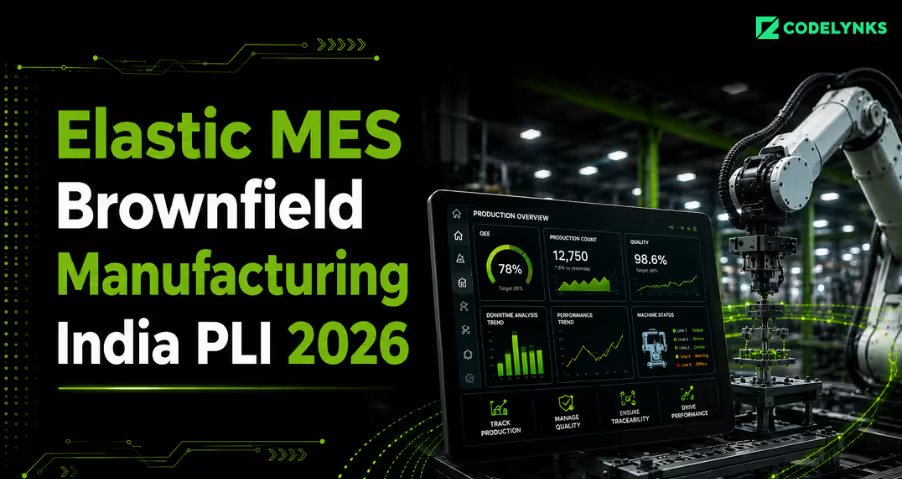
Elastic MES Brownfield Manufacturing India PLI 2026

Elastic MES Brownfield Manufacturing India PLI 2026 smart factory

Elastic MES Brownfield Manufacturing India PLI projects are becoming essential as Indian manufacturers expand production under the Production Linked Incentive (PLI) scheme. Traditional manufacturing execution system (MES) implementations often require long deployment cycles and production downtime, making them unsuitable for brownfield factories operating under tight PLI timelines. An elastic MES architecture enables manufacturers to connect legacy machines, integrate ERP systems, and improve production visibility without disrupting existing operations.

An EV battery pack assembly plant in Pune was awarded PLI incentives in 2024 for producing 800,000 packs per year by FY2027. By January 2026, three of five assembly lines were operational…A state-government procurement agency in South India asked Codelynks to solve a specific problem: 14,000 MSMEs registered under a state PLI program needed to sell on GeM and ONDC simultaneously, but neither platform shared a product catalog standard, consent model, or order management schema. The agency was six months from a parliamentary deadline. They had a vendor who claimed the integration would take eight weeks. It took fourteen months across two previous attempts.

The problem is not unique. As India Stack v2 expands its API surface and ONDC scales past 630 cities and 1.16 lakh active sellers, government agencies are becoming integration operators by accident. They inherit the technical liability of bridging platforms that were never designed to speak to each other. This post lays out what a production-grade India Stack API platform looks like and why most first attempts fail.

What Government Agencies Are Actually Building

The phrase “India Stack integration” is usually shorthand for something far more complex. A procurement agency connecting MSMEs to the public e-marketplace ecosystem typically needs to touch five separate API domains: ONDC (seller onboarding, catalog sync, order events), GeM (product registration, bid submission, contract workflows), Account Aggregator (financial consent for MSME credit decisioning), DigiLocker (document verification for GST, Udyam, PAN), and UPI (payment settlement and mandate management).

Each domain has a different authentication model. ONDC uses a Beckn protocol with ED25519 key signing per request. GeM runs on OAuth 2.0 with certificate-based API gateway authentication. Account Aggregator flows require the operator to become a Financial Information User (FIU) with RBI registration. DigiLocker uses Aadhaar-linked OAuth with a 30-minute token TTL.

The point is not that these are hard. The point is that no single developer or team holds the full knowledge surface. Most integration projects understaff the auth and consent design phase, then discover the gap when staging tests begin.

Why the First Integration Always Fails

India Stack is not a single API. It is a network of networks, each with different auth models, rate limits, and data contracts. Most teams treat it as a unified platform and design a single integration layer. That is the wrong model.

The failure pattern is consistent. A team builds a synchronous REST wrapper over the ONDC seller node. Product catalog sync works in testing. In production, ONDC sends asynchronous order callbacks via webhook with a 5-second acknowledgment SLA. The synchronous wrapper cannot handle the callback pattern. Orders are missed. The ONDC network flags the seller node for non-compliance after 72 hours of missed callbacks, triggering a suspension workflow.

The second failure pattern is consent state management. Account Aggregator consent flows have three states that can change independently: approved, revoked, and expired. A system that only checks for approval at the point of data request fails when a consent is revoked mid-session. This is not a bug you catch in unit tests. It surfaces in production when an MSME owner revokes a consent from the AA mobile app while a credit check is in progress.

Both failures are predictable. Neither requires novel engineering to prevent. They require a clear mental model of the integration surface before a line of code is written.

The ONDC Integration Tiering Model

Codelynks uses a four-tier model to classify integration depth and set client expectations before architecture begins.

Tier 1: Catalog Bridge. The seller’s existing product database syncs to ONDC via scheduled batch jobs. No real-time order handling. Suitable for government agencies managing low-volume, high-value procurement — construction materials, uniform supply. Latency acceptable at 4-hour sync cycles. No consent flows required.

Tier 2: Live Seller Node. Real-time order handling with webhook receivers, order state machines, and seller acknowledgment logic. Requires async architecture — message queues, not REST polling. Suitable for agencies managing commodity procurement at volume. Consent flows required only for financial products.

Tier 3: Multi-Domain Integration. Live seller node plus Account Aggregator consent flows for MSME credit decisioning, DigiLocker document verification, and UPI collection mandates. This is the tier the South India procurement agency needed. Requires a dedicated integration platform, not application-layer code.

Tier 4: Agentic Delegation Layer. Built on the patterns proposed in the Doot whitepaper: an AI agent acts on behalf of a citizen or MSME, making routine procurement decisions using delegated identity and scoped consent. No production deployment of this tier exists in India as of June 2026, but the API design decisions made at Tier 3 determine whether Tier 4 is achievable later.

What a Production Integration Platform Looks Like

The South India agency’s platform has three components that most vendor proposals leave out.

First, an event ledger. Every API call, callback, consent event, and order state change is written to an immutable append-only log before any business logic runs. This is not a logging system. It is the system of record. When the ONDC network disputes an order acknowledgment timestamp, the ledger wins.

Second, a rate limit budget manager. ONDC’s production network enforces per-seller-node rate limits that differ from the sandbox. GeM’s API gateway has burst limits not published in documentation. The platform maintains per-domain token buckets with a configurable safety margin and exposes a real-time budget dashboard to the agency’s operations team.

Third, a consent lifecycle service. Every AA consent is tracked with its own state machine: requested, approved, active, expiring-soon, expired, revoked. The system sends proactive renewal requests 72 hours before expiry. Revocation events trigger immediate downstream notifications to any in-flight credit processes.

The most expensive mistake in government integration work is designing for the current API version instead of the deprecation schedule. ONDC has published three major protocol versions since 2022. GeM deprecated its v1 product registration API in March 2026 with 90 days’ notice. A platform without version management becomes a firefighting operation within 18 months.

Anti-Patterns That Appear in Every RFP

Four patterns appear in government IT RFPs that reliably predict project failure.

A single middleware layer for all integrations. Different India Stack domains have incompatible processing models. Forcing ONDC’s async callbacks through the same middleware as GeM’s synchronous RFP submission creates a reliability dependency between two unrelated workflows.

Schema mapping in application code. Product catalog field mappings between a state government database, GeM’s product schema, and ONDC’s catalog model change with every platform update. These mappings belong in a configuration layer, not embedded in application code.

Testing against sandbox only. ONDC’s production network behaves differently from its sandbox in three documented ways: callback timing, rate limits, and error response schemas. Budget for production integration testing before go-live.

Ignoring the deprecation calendar. The most experienced teams maintain a 12-month view of API version deprecation schedules across all integrated domains. Without it, a single vendor deprecation can ground an entire procurement platform.

What This Means for Government and Public Sector Leaders

An ONDC seller node that works in your staging environment and fails at 11 AM on a flash-sale day is not an integration. It is a liability. The same applies to a GeM catalog sync that silently drops SKUs when a category schema update is released without notice.

If your agency is building or procuring an India Stack integration this year, three things are worth doing before the architecture is finalized. Ask your vendor what their consent lifecycle management approach is, specifically. Ask how they handle ONDC’s asynchronous callback model under load. Ask what their protocol version migration playbook looks like. If the answers are vague, the integration will be renegotiated in six months.

Organizations implementing Elastic MES Brownfield Manufacturing India PLI strategies should prioritize incremental deployment over large-scale replacements. A phased rollout minimizes production downtime, accelerates ERP integration, and enables manufacturers to achieve PLI milestones while maintaining operational continuity.

More Blogs: Comprehensive Guide to API Testing Using Postman

LLM Clinical Documentation India: Production Checklist

Introduction: LLM Clinical Documentation India Explained

LLM Clinical Documentation India is becoming a strategic priority for hospitals, healthcare networks, and digital health platforms. As AI medical scribes gain adoption across India, healthcare organizations must move beyond pilot projects and build production-ready clinical documentation systems that integrate with EMRs, ABDM infrastructure, and hospital workflows.

The problem is that compelling pilot results are not the same as production deployments. We work with a multi-specialty hospital chain in South India, 12 facilities, approximately 4,000 OPD visits daily across nine specialties. When we reviewed their clinical AI deployment plan, the model evaluation process was thorough. The integration architecture was not. Six months of pilot success had produced a system that worked for one doctor, in one language, connected to one EMR instance, with no monitoring, no retraining trigger, and no doctor-in-the-loop escalation path. That is a demo, not a production system.

This post covers the five architectural stages that separate a clinical LLM pilot from a production deployment, why the integration layer is where most Indian hospital implementations break, and the framework we use to assess readiness before go-live. LLM Clinical Documentation India is rapidly evolving from pilot projects to production deployments across hospitals, healthcare networks, and digital health platforms.

Why EkaScribe’s Architecture Matters Beyond EkaScribe

The design decisions Eka Care made in building Parrotlet reveal the engineering requirements for any clinical LLM in India. Parrotlet a-en-5b is trained specifically on Indian medical speech; it knows drug brand names sold in India, understands code-switching between English and regional languages, and handles the clinical shorthand that trained Western models miss. The v2 release adds real-time Hindi and Indian English transcription at clinical-grade accuracy.

Three things Parrotlet’s architecture communicates to the market:

First, generic ASR models fail in Indian OPD settings. AWS Transcribe Medical and Google Speech-to-Text are trained predominantly on Western clinical speech. Code-switching between Tamil and English, or Marathi and English, breaks their word error rates at the clinical threshold. Any Indian hospital deploying a clinical LLM on top of a generic ASR layer is building on sand.

Second, safety validation is non-negotiable. EkaScribe’s production stack includes localized training data, RAG-based processing against medical knowledge bases, secondary LLM review of generated notes, and a doctor-review gate before any note is finalized. The doctor-in-the-loop design is not a regulatory hedge. It is the only architecture that sustains clinician trust past the first month.

Third, EMR integration is the hard part. A clinical LLM that produces a note as a PDF for manual re-entry into the EMR is not a documentation tool. It is an extra step. The value is in structured output that maps to the EMR’s field schema: chief complaint, history, examination, diagnosis with ICD-10 or ICD-11 codes, prescription with Indian brand names, and follow-up instructions. Getting that mapping right for HL7 FHIR against a legacy hospital information system is a 6 to 10 week integration project.

The future of LLM Clinical Documentation India depends on secure healthcare data access, ABDM integration, and clinically validated AI workflows.

ABDM Is the Competitive Moat Nobody Is Building For:

The Ayushman Bharat Digital Mission’s Unified Health Interface (UHI) and Health Facility Registry give clinical LLMs access to something no Western model has: longitudinal Indian patient records at population scale. An ABDM-linked clinical LLM can retrieve a patient’s prior visit records from other facilities before the current consultation, pull existing diagnoses and medications, and flag drug-drug interactions in the context of the patient’s actual history.

“ABDM is not a compliance checkbox. It is the only path to training a clinical LLM on Indian disease profiles at the scale needed to make it defensible.”

Most hospital IT teams treat ABDM integration as a compliance task: generate ABHA IDs, link health records, check the box. The engineering opportunity is different. ABDM’s longitudinal records, structured under FHIR R4, are the training substrate for fine-tuning clinical LLMs on Indian disease presentations, comorbidity patterns, and prescription practices. A model fine-tuned on ABDM-consented records from Indian patients outperforms any imported foundation model on Indian clinical tasks. That fine-tuning advantage compounds over time. It is the defensible moat.

The counterintuitive finding from our work: ABDM integration latency is the primary production bottleneck for most clinical AI features, not model inference time. ABDM API response times under load average 800ms to 1.4 seconds. A clinical LLM pipeline waiting on ABDM record retrieval before generating the note will feel slow to the doctor.

The fix is pre-fetching patient records at check-in, not at consultation start. A successful LLM Clinical Documentation India strategy requires much more than model accuracy. Integration, monitoring, and governance determine long-term success.

The Clinical LLM Production Readiness Checklist (CLPRC)

Five stages, each with a binary pass/fail gate before advancing to the next.

Stage 1: ASR Validation. Test your chosen ASR model against a sample of 200 real consultation recordings from your OPDs, across the languages and specialty vocabularies you need to support. Minimum acceptable word error rate for clinical use: below 8% for medical terminology. If you cannot pass Stage 1 with your chosen model, stop and re-evaluate ASR before building the LLM layer.

Stage 2: Structured Output Mapping. Map the LLM’s output schema to every field in your EMR that the note will populate. Build the connector. Test round-trips with 50 synthetic cases. If the EMR requires manual correction of more than 15% of fields across the test set, the output mapping is not production-ready.

Stage 3: Doctor-in-the-Loop Design. Define the escalation path for low-confidence outputs. Every clinical LLM should produce a confidence score or flag ambiguous sections. Build the UI for doctor review: a single-screen diff showing the AI-generated note against the patient record, with one-click accept, one-click modify, and mandatory acknowledge before note finalization. Measure review time. If review adds more than 90 seconds per consultation on average, the workflow has failed.

Stage 4: ABDM Integration and Pre-fetch. Connect to ABDM for patient record retrieval. Implement pre-fetch at check-in, not at consultation trigger. Test under realistic concurrent load for your peak OPD hours. Define fallback behavior when ABDM is unavailable (build with graceful degradation, not hard dependency).

Stage 5: Monitoring and Drift Detection.  Define your production quality metrics: weekly word error rate on a sample of flagged notes, EMR field acceptance rate (unmodified accepts divided by total notes), and doctor satisfaction score on a 2-question weekly pulse. Set retraining triggers. A model whose EMR acceptance rate drops below 75% in any two-week window should trigger a retraining evaluation, not a support ticket.

Where Indian Deployments Break Down in Months 2 to 6

Pilot success creates a specific risk: the pilot doctor is self-selected, motivated, and working with the vendor’s support team on hand. Production deployment removes all three of those conditions simultaneously.

The failure modes we see most often:

Language mix at scale. A pilot validated for English-speaking specialists breaks when rolled out to the general medicine OPD where conversations are 60% regional language. Stage 1 ASR validation must cover every language and code-switching pattern in your facility, not just the pilot specialty.

EMR version drift. Hospital EMR updates change field schemas. The clinical LLM’s output mapping silently starts failing after an EMR patch. This goes undetected for weeks because doctors quietly correct the errors rather than reporting them. Build automated output validation that alerts when field acceptance rates drop.

No retraining budget. The model was trained on data from 18 months ago. New drug formulations, updated clinical guidelines, and changed ICD coding practices are not reflected. Build retraining into the annual clinical IT budget, not as an optional future item.

What This Means for Healthcare Leaders

The clinical LLM market in India is moving fast. Eka Care has production deployments with 3,000+ doctors. Apollo, Fortis, and Manipal groups are in active evaluations. The window for early-mover advantage in physician productivity and patient throughput is roughly 18 months before the tooling becomes table stakes.

Three things you can do this week without engaging Codelynks:

First, run a language audit of your top five OPD specialties by volume. List every language combination that appears in consultations. Check whether your candidate ASR model has been validated on each. Eliminate any model that hasn’t been validated on Hindi and your primary regional language pair.

Second, ask your EMR vendor for the FHIR R4 API documentation and field mapping guide. If they cannot produce it within a week, your clinical LLM integration timeline needs to add four to six weeks for custom field extraction engineering.

Third, check your ABDM integration status. Specifically: is your platform enrolled to consume ABDM health records via the HIE-CM API, or only to create ABHA IDs? The former enables pre-fetch. The latter does not. The enrollment and sandbox testing process takes four to six weeks.

Conclusion:

Organizations investing in LLM Clinical Documentation India today will gain significant advantages in physician productivity, documentation quality, and patient experience.

More Blogs : RBI DPIP Fintech Data Pipeline Integration Guide 2026

Boost Forecast Accuracy: 7 Essential AI-Powered Business Analytics Tools

Introduction

AI-Powered Business Analytics is deemed a necessity for better decision making and forecasting. Current conventional techniques in forecasting can no longer be followed aptly to stay atop the volatile markets’ shrunken scenario. Organizations increasingly rely on AI in Business strategies to make data-driven decisions.

As an AI & Business Analyst, using the most advanced analytics tools and techniques that improve accuracy in terms of forecasting is the most fundamental. For this article, therefore, we shall discuss seven must-use AI-enabled tools which can transform your business’s ability to forecast and, thereby, plan better. We begin with

Predictive Analytics in AI-Powered Business Analytics

Predictive analytics is one of the most powerful tools when talking about AI powered business analytics, based on historical data fed into machine learning models and statistical algorithms which have the potential to forecast future outcomes in order to enable businesses to prepare for future fluctuations in demand. This is a core application of AI in Business for forecasting.

  • Apply machine learning models in analyzing sales trends and seasonality.
  • Identify customer behavior patterns to know the demanded quantity of products
  • Integrate predictive analytics with supply chain systems in optimizing inventory levels.
  • Accurate demand forecasting helps reduce wastage, meet the needs of customers promptly, and move ahead of the competition.

Time Series for Financial Planning

Time series forecasting is an analysis where data points collected at a particular interval are used to predict the upcoming trends. It mostly deals with financial forecasting, where one has to predict revenues, expenses, and cash flows.

  • Use ARIMA models or Prophet algorithms to forecast the revenue trend.
  • Apply moving averages to filter out unconnected noise present in financial data.
  • Monitor current data to update correct predictions based on the latest change in the current market condition
  • Time-series prediction thus ensures that businesses take more effective finance decisions that will be long-lived in the future.

Machine learning enables businesses to analyze trends independent of historic events. Such data is more beneficial when a long-term strategy or market forecast has to be made on particular decisions, a common practice in AI in Business applications.

  • Use supervised learning models for trend prediction.
  • Use unsupervised learning to identify the emerging trends in customer preferences.
  • Integrate machine learning with business intelligence dashboards to provide real-time analytics
  • The application of the trend analysis can enable companies to respond rapidly to market shifts thus gaining a competitive advantage

Data Visualization in AI-Powered Business Analytics

Data visualization changes intricate data into intuitive charts and graphs so that stakeholders may comprehend better the trends and insights that come out of them. AI powered visualization tools will enable businesses to create dynamic reports updated in real-time.

  • Tableau, Power BI, or Looker are essential AI-Powered Business Analytics tools for forecasting, enabling faster, data-driven decision making.
  • Interactive dashboards that give an all-round view of business performance.
  • Automate the generation of reports for saving time and ensuring accuracy of data.
  • Clear visuals allow business decision-makers to take faster action on better insights.
AI-Powered Business Analytics data visualization dashboard showing real-time forecasting insights

NLP in forecasting reports

NLP- Enabled tools will make companies extract actionable insight from unstructured data, such as customer reviews and market news. The tools would analyze the text-based data and sentiment trends of the market to help in demand forecasting and customers’ preferences

  • Use sentiment analysis tools to understand the opinions of the customers about any product.
  • Introduce NLP-based algorithms into competitive analysis to get enhanced quality of market forecasts.
  • Automate reports that encompass critical forecasting insights.
  • NLP, because it expands the qualitative realm of data, improves the accuracy of forecasts created.

Automation in Forecasting Workflows

AI-based business analytics is also at work toward automating forecasting workflows to make the process more timely and error-free. With automations done in repetitive tasks, businesses can potentially focus on strategic decision-making and innovation.

  • Automate the process of data collection and data preprocessing from various sources.
  • Schedule auto-forecasts that automatically refresh when new data is generated.
  • Implement AI-powered chatbots for direct real-time forecasting with the ability to get forecast insights on a whim
  • Automation saves time and effort from making forecasting which will allow the company to react quickly to scenario changes

Business Intelligence Tools for 360-Degree Forecasting

Business intelligence (BI) tools offer an integration of data from different sources, and could give business an all-rounded view of their businesses. AI-enabled BI solutions integrate data both in and out of organizations to offer holistic forecasts.

  • The centralization of data can either be in SAP Analytics Cloud or Microsoft Power BI.
  • Trends in the market and even other economic indicators that will aid in the forecasting will be sourced from external data.
  • The alignment of KPIs to the business objectives will continue to be checked in real time while making the forecasts.
  • By using AI business intelligence, a firm will, therefore be able to align its attempt in forecasting with its strategic.

Conclusion

By adopting AI-Powered Business Analytics and embracing AI in Business practices, businesses can improve forecasting accuracy and decision-making efficiency. Predictive analytics, time-series forecasting, machine learning, and automation can help make forecasts more accurate, agile, and efficient. Advanced tools such as data visualization platforms, NLP-based insights, and BI solutions guarantee that insight will be at the fingertips of the decision-maker, enabling data-driven decision making and enhancing AI in Business Forecasting.

An AI & Business Analyst must embrace these tools and techniques in order to navigate the competitive market of today. Regarding forecasting demand, revenue, or customer trends, AI-powered analytics enables businesses to make smarter, data-driven decisions that lead to sustainable growth, while leveraging AI in Business for more precise planning.

Related blogs: The AI-Induced Industrial Renaissance: Revolutionizing the Future of Industry

The Ultimate 7 Transformative Advantages of Multi-Cloud Strategies Empowering Modern Enterprises

multi-cloud strategies

The multi-cloud strategies allow businesses to develop greater flexibility, scalability, and resilience in fast-changing digital landscapes. The workloads can be balanced, risks reduced, and costs optimized by utilizing multiple cloud platforms rather than relying solely on a single cloud provider. This policy will help customize the utilization of the cloud according to special needs, building the right infrastructure to support growth and innovation.

At Codelynks, we are the leading company that is specialized in the application of multi-cloud architectures for organizations, and the company advises on how to fully exploit the advantages brought by the strategy; in this blog, let us discover how businesses are embracing multi-cloud strategies and how it may lead them to long-term success.

1. Greater Flexibility and Avoiding Lock-in with a Vendor

A primary benefit of the multi-cloud strategies is its flexibility. This allow businesses to align workloads with the best provider, improving performance, reducing latency, and optimizing resources. With a multi-cloud environment, any organization should be able to pick the best cloud services available for each application or workload, such that they’re using the right infrastructure for their unique needs.

While at Codelynks, we guide clients through the process to appropriately select their mix of cloud services, we make sure they always have the agility to switch providers or adjust their cloud strategy with changing businesses.

2. Performance and Resource Optimization

The strength variations differ in cloud providers, whether performance, price, or services. Implementing multi-cloud strategies enables organizations to strategically allocate workloads according to their performance requirements, maximizing resource efficiency. For example, some may perform better on the high-performance computing resources available on one of the cloud providers, while others may require specific low-cost storage solutions that could be found on another platform.

Hence, it is possible for organizations to have improved performance, lower latency, and ensure that end users do not experience throughput or performance bottlenecks by distributing their workloads across more than a single provider. Codelynks can help businesses calculate their precise workload requirements and strategically manage all cloud-based resources with proper management of multiple cloud environments in order to maximize performance.

3. More Resilience and Reliability

The reliance on a single cloud provider can introduce vulnerabilities when its platforms are out or experience service disruptions. Multi-cloud strategies enhance business continuity by implementing redundancy architecture and fault-tolerant ecosystems, spreading workloads across multiple providers. If one goes down or becomes inoperable, other systems can still function, reducing the risk of an overall service failure.

It helps ensure continuity in business-critical operations even in the event of a black-out. Codelynks supports its customers in designing fault-tolerant multi-cloud environments providing the utmost level of reliability and business continuity.

4. Dynamic Cloud Cost Management and Multi-Cloud Optimization Strategies

There are differences in the pricing structures of storage, compute, and networking services from a variety of cloud providers. Multi-cloud strategies enable businesses to perform dynamic cost arbitrage, leverage pricing elasticity, and exercise fiscal prudence, choosing the most cost-effective services while dynamically adjusting workloads.

In addition, workloads can easily be switched between providers in line with real-time fluxes in cost so that there’s always optimization of expenses. Codelynks assists businesses in navigating through different cloud pricing models, thereby enabling them to optimize their cloud spend across varied platforms with massive cost savings.

5. Bespoke Multi-Cloud Architectures for Domain-Specific and Mission-Critical Workloads

Different applications and workloads are of different natures with different needs. While some may be high-performance computing, others must accommodate a huge amount of data or advanced security features. Multi-cloud strategies are exactly what businesses need to ensure that the unique requirements of each application are met, rather than using a one-size-fits-all approach.

For instance, an organization will employ a provider with strong AI and machine learning capabilities for data analytics and utilize another provider with robust security features for sensitive data. Codelynks works collaboratively with businesses to develop personalized solutions aligned with the strategic needs of a business to provide the best performance, security, and scalability.

6.Fortified Cloud Security and Regulatory Compliance in Multi-Cloud Strategies

Cloud security will always be one of the top concerns for businesses. Different cloud providers offer different security features and compliance certifications, and multi-cloud strategies help businesses take advantage of these diverse offerings. Companies can bolster their security posture by taking advantage of the kind of security tool and protocols that each cloud provider offers. This, therefore means protection of data, adherence to compliance requirements, and safeguard from cyber attacks.

More than this, sensitive workloads can be hosted on a provider who has specifically tailored security measures, while less sensitive applications can be hosted on a more cost-effective platform. Codelynks will ensure robust security and compliance measures in all of its cloud environments, which will reduce risk and increase protection.

7. Future-Proof Multi-Cloud Architectures for Business Agility and Technological Innovation

With growing technology, multi-cloud strategies help businesses avoid the hassle of being tied to a single provider, while cloud platforms stay updated with the latest features and innovations. So, it is clear that a multi-cloud strategy puts businesses in an efficient position to take advantage of the advancements as they will not be held bound by the confines of a particular provider. It also allows integration of cutting-edge technologies like AI, machine learning, and IoT across multiple platforms and gives future-proofing protection to the operations.

At Codelynks, work is a collaboration with companies on designing scalable and agile multi-cloud environments that can respond to any kind of innovation or technological development in the future and thus maintain its competitive advantage for long periods.

Conclusion: 

Codelynks Multi-Cloud Solutions for Cloud Optimization, Security, and Resilience”

There is solid evidence to suggest the benefits of multi-cloud strategies in today’s dynamic business environment. Improved flexibility and performance, optimized cost, and enhanced security will give businesses the abilities and best practices of multiple cloud providers to better meet changing demands and push forward their business. Escape vendor lock-in, take advantage of the strengths of various platforms, be resilient, reduce costs, and future-proof your cloud infrastructure.

We specialize in designing, building, and operating multi-cloud architectures that maximize value. Business will, based on our expertise, scale and optimize their cloud strategy according to your scalability, security, and efficiency requirements. This includes implementation of a new multi-cloud or fine-tuning your existing strategy – Codelynks, therefore, becomes your partner on the journey to the cloud.

Learn more about Top Cloud Computing Trends to Watch Over the Next Decade

Explore our Cloud Computing: 5 Game-Changing Benefits for Business Operations

AI in Industry: How the AI-Induced Industrial Renaissance is Revolutionizing Manufacturing

AI in Industry enhancing manufacturing efficiency

Introduction

AI in industry is driving an AI-Induced Industrial Renaissance in 2025, transforming manufacturing, innovation, and global productivity. Industry is said to be the merging of tool and system applications imbued with AI capabilities into every sector, thereby changing how businesses function, manufacture, or innovate. AI not only helps companies become more productive and efficient but also transforms their respective industries by bringing about production techniques that are smarter and nimbler. All of this finally culminates into a profound change in the global industrial scenario with AI at the forefront of this shift.

AI in industry is driving an AI-Induced Industrial Renaissance in 2025, transforming manufacturing, innovation, and global productivity.

AI in Industry: Automation Redefines Manufacturing

Most apparent is the automation of manufacturing processes by AI in the industry. Evidence of this can be seen in robotic assembly lines and machine-driven machinery, which produce much higher output with greater accuracy and speed. The smart systems work day and night without tiring, thereby increasing output while minimizing human errors. The use of AI in robotics has streamlined such industries as automotive, electronics, and pharmaceuticals to produce goods according to ever-growing consumer needs.

Robotic Assembly Lines and Predictive Maintenance

AI automation enables real-time monitoring and predictive maintenance. AI will predict equipment failure before it occurs, lessen downtime, and maintenance costs by collecting and analyzing sensor data embedded in machines. This proactive approach to industrial management ensures that production lines continue uninterrupted; thus, there is increased efficiency and cost savings.

Accelerating Innovation and Product Development

The AI-driven industrial renaissance is also encouraging innovation through better processes of product development. AI algorithms can process vast volumes of market and consumer data to allow for the determination of trends and opportunities. Based on such insights, companies can either innovate new products or improve existing ones. For example, in the fashion industry, AI is used to predict trends and design novel collections that resonate with consumer preferences.

Faster R&D Cycles with AI

The innovation cycles of R&D are accelerated significantly by AI. With machine learning algorithms, companies develop virtual designs of their products and optimize materials to print out actual prototypes in 3D printing. This shortens the lead time from the generation of ideas for products until they hit the market, allowing companies to have an upper hand competitively within faster-paced industries.

Smart Factories and Industry 4.0

Industry 4.0, commonly referred to as the fourth industrial revolution, has been led by the introduction of AI to manufacturing. It is characterized by the smart factory where machines are able to communicate through IoT and make decisions for themselves on how best to drive the productive processes. The AI allows for automation workflow in real-time, a smoother supply chain and even better quality control processes in those factories.

Digital Twins and IoT Integration

The use of AI in smart factories is revolutionary. Through AI-powered data analytics, manufacturers can find inefficiencies in their production processes and adjust them almost in real-time for the highest output generation. Besides this, digital twins, which refer to a virtual duplicate of a physical system, enable manufacturers to run otherwise impossible experiments on the trials and error process, thereby optimizing production without interfering with actual operations.

AI-Driven Supply Chain Optimization

The industrial renaissance does not end here on the manufacturing floor; it goes to revolutionizing the supply chain through AI. AI algorithms help companies better predict demand, manage inventory at a lower cost of shipment, and at a reduced propensity of shipping interruptions. Analyzing many data sources, which include weather patterns, consumer behavior, and reliability of suppliers about possible hiccups that may arise in the chain and surmises alternative strategies that could be put in place for seamless operations.

Route optimization by AI in logistics enhances the delivery times and conserves fuel for business firms. The possibility of AI being able to aggregate analysis of real-time traffic data and weather conditions ensures that the delivery is made within a short period with minimum operational expenses.

Enhanced Workforce and Human-Machine Collaboration

Automation saw its rise to the world, but Artificial Intelligence was not here to displace jobs of humans; on the contrary, AI was enhancing it. Industrial renaissance powered by AI brought a new era in collaboration between humankind and machine. The routine work pattern as part of the job could be relegated to machines if AI systems supplant it while workers focus on more challenging, added-value work. For instance, in manufacturing, AI could assist technicians in real-time insight and recommendations for improvement in decision-making and problem-solving.

AI-based training systems are also enhancing the upskilling and reskilling capabilities of workers for the changing industrial landscape. Through the application of machine learning algorithms on training programs customized to individual performances, companies will ensure that its people remain relevant in the new world of AI.

Sustainability and Energy Efficiency

AI does have a significant role to play in giving industries a solid sense of sustainability through optimum energy consumption and the lowest percentage of waste that can be generated. AI-powered systems can help monitor their energy usage throughout factories by fine-tuning operations to minimize energy waste. For example, AI will be able to predict the most energy-efficient times at which machinery can be run. This will automatically reduce the environmental footprint of industrial operations.

With AI also employed in research on sustainable materials and recycling processes, it explores newly found technologies that allow industries to reduce their effects on the environment while improving the efficiency of resources-being increasingly demanded by consumers.

Conclusion

All sectors of the globe are transformed under this industrial renaissance powered by AI, leading to sheer innovation, efficient growth, and more productivity. Smart factories, automated supply chains, AI-enhanced workforce collaboration, and other such similar effects of AI will define a new industrial landscape and ensure survival only those industries which take these evolutions forward. Industry’s future has just arrived, and it runs on AI.

More Blogs: The Amazing Ultimate 2025 Guide to AI in eCommerce Trends and Predictions

  • Copyright © 2026 codelynks.com. All rights reserved.

  • Terms of Use | Privacy Policy