5 Powerful Reasons to Choose Transparent VAPT Services for Cybersecurity

Transparent VAPT services strengthening organizational cybersecurity infrastructure

Introduction

Transparent VAPT services play a crucial role in strengthening organizational infrastructure security in this digital age. The present world has made vulnerability assessment and penetration testing an indispensable tool for protection against external threats. However, due to the increase in cyber threats, it is essential to have transparent VAPT services that maintain openness and trust.

Transparency among VAPT service providers ensures a relationship of trust between the clients and providers, which improves security and enhances the effectiveness of better decision-making processes and compliance.

Why Transparent VAPT Services Matter?

Transparency in transparent VAPT services means clients know what is being assessed, what tools are used, what findings are presented, and what remediation strategies are being followed.

Building Trust and Confidence: Building trust and confidence is the foundation of transparent VAPT services, ensuring clients fully understand how vulnerabilities are detected and mitigated. if the type of testing being conducted, which vulnerabilities are found, and what remediation will look like-all this kind of openness brings forward an association based on trust and integrity.

Better Decision-Making: In the light of detailed reports and insights from VAPT vendors, organizations can make better decisions. Knowing vulnerabilities and possible risks enables an organization to focus on security measures based on the most urgent threats.

Continuous Improvement in Security: An open mentality aids a collaborative work between the business and VAPT vendors in finding ways of ameliorating security strategies over time. This leads to constant improvement and a more robust cyber framework in the fight against threats.

Regulatory Compliance: Most industries have stringent data protection regulations. Clear VAPT services ensure that the business will be meeting industry standards with minimal legal consequences in case of any litigation.

How to Assess Transparency in VAPT Providers

How to test for transparency and openness while selecting a VAPT service provider?

Detailed Reporting: Comprehensive reporting is the hallmark of transparent VAPT services, ensuring actionable insights and remediation steps.

Here is a checklist of major criteria to check:

1. Clarity in Methodologies: A provider offering transparent VAPT services explains testing methodologies, tools, and techniques clearly. Behind-the-scenes knowledge helps clients understand better what to expect and if the approach has been effective.

2. Detailed Reporting: Comprehensive reporting is the hallmark of transparent VAPT services, ensuring actionable insights and remediation steps. Such a report should, therefore, be both concise and actionable in its detail so that the client knows exactly what to do next to enhance their security posture.

3. Clear Communication: Communication should be effective during the VAPT process. Providers should not have a single moment’s hesitation in responding to questions or clarifying the findings and recommending those findings. A responsive provider at the beginning of engagement would be a reflection of commitment toward transparency and teamwork concepts.

4. Client References and Case Studies: Client testimonials, case studies, or references are good sources of insight into a VAPT provider’s transparency. Positive feedback from other organizations suggest that the provider has managed to deliver clear, understandable, and actionable security assessments.

5. Follow Up and Support: Transparency does not end with a final report. A reliable VAPT service provider should show readiness in providing continued support to the businesses regarding the vulnerabilities identified during the assessment. They should be readily available for remediation, questions, and ensure solutions are effectively in place.

Steps toward a Transparent VAPT Process: Steps for Providers

Providers offering transparent VAPT services build secure, trustworthy relationships with clients.

Clear communication, ongoing collaboration, and post-assessment support make transparent VAPT services more effective and reliable for long-term cybersecurity resilience.

Initial Consultation and Needs Assessment: There ought to be an in-depth consultation by providers with regard to the specific needs of the client’s infrastructure. Tailoring services to ultimately align the aspect of alignment with organizational objectives and risks becomes essential.

Clear Tool and Techniques Communication: What tools have been used and what techniques have been applied in conducting the VAPT process needs to be clearly communicated to the client. Technological details concerning the design of vulnerability scanning and penetration testing should be explained to the client for their awareness every step of the way.

Ongoing Collaboration: An open provider is not closed to feedback and works collaboratively with the client when testing. Such continuous input builds a partnership atmosphere, and both work towards mutual security goals.

Post-Assessment Follow-Up: The report, in itself, should not only be presented post the testing phase but also act as a guidance for the client to help her devise the remediation process. Ongoing support, check-ins, and other additional services help implement change effectively for the client.

Benefits of Transparent VAPT Services for Businesses

Increased trust and accountability: A transparent service provider creates trust through self-accountability. The client is likely to have faith in a provider who allows it to understand their processes as well as findings.

Optimization resource allocation: With the detailed reports, combined with clear insights, businesses can make effective decisions about resource allocation on security issues. Knowing that some vulnerabilities are major and should be addressed, others minor, helps a company make effective prioritization decisions on fixes and minimize potential risks.

This helps businesses achieve a better security posture as they have full visibility of their vulnerabilities along with a clear path for remediation, thus enabling businesses to strengthen their cybersecurity framework. Since continuous improvement is such an activity that involves mechanisms in terms of security responses to emerging threats, there will be less paperwork and easier compliance, as depicted as follows –

Simplified Compliance: VAPT services are transparent by nature, making compliance easy for organizations who need to set industry-specific standards. Documentation of various vulnerabilities and remediation processes become well-documented and ready for audits and reviews from the concerned regulatory bodies.

Why Choose Codelynks for Transparent VAPT Services?

Codelynks is one place that genuinely believes transparency is the key to a long-lasting relationship. Be it vulnerability identification, remediation, or finalization, we are transparent about every step that goes into our VAPT services. Here’s what sets us apart:

Comprehensive Reports: We present clear, well-written reports showing vulnerabilities identified, related risks, and suggested remediation efforts.

Tailored Solutions: Every one of our services of VAPT is tailored according to your infrastructure and industry.

Expert Advisory: After the assessment, our cybersecurity experts work closely with you to ensure effective installation of such security measures implemented.

Regulatory Compliance: We support you in attaining the necessary industry regulations, and your business remains compliant.

Ongoing Support: We offer continuous follow-up assistance in helping you break through these complexities of vulnerability remediation and further security improvements.

To learn more about our transparent VAPT services, visit our website or get in touch with us today.

Conclusion

In the fast-paced world of cybersecurity, nothing can replace a transparent practice by engendering trust and rich defenses. When choosing the right VAPT provider that always focuses on open and transparent reporting, companies can always rest assured of informed decisions, compliance, and constant improvement of their cybersecurity strategies.

Codelynks is all set to guide the organization through transparent customized VAPT services that are all set to empower the business houses in maintaining security as well as be better prepared for emerging threats.

More Blogs: Setting Up Appium for iOS Automation on macOS: Beginner’s Guide

Setting Up Appium for iOS Automation on macOS: Beginner’s Guide

Appium for iOS Simulator running Xcode project on macOS

Introduction

Appium for iOS simulator is essential for mobile test automation on macOS, but setting it up can feel overwhelming. Setting up Appium for iOS automation on macOS can feel a bit overwhelming – there are so many tools, environment variables, and hidden gotchas. But don’t worry – we’ve got you covered. 

Whether you’re a QA engineer, SDET, or just starting out with mobile test automation, this guide will walk you through everything you need to run Appium tests on an iOS simulator.

Steps with real examples and tips from the trenches. 

First, Check Your Shell for Appium for iOS Simulator Setup

Your shell controls how environment variables are loaded, and this matters when setting things up.

To find out which shell you’re using, run this in Terminal:

echo $SHELL

You’ll probably see either:

/bin/zsh (Zsh – the default on newer Macs)

/bin/bash (Bash – common on older versions)

Now, Open the Right Config File for Appium for iOS Simulator

Depending on your shell:

For Zsh (most common now):
nano ~/.zshrc

For Bash:
nano ~/.bash_profile

Add Java Path to Run Appium for iOS Simulator

Paste this into your file:

export JAVA_HOME=$(/usr/libexec/java_home) export PATH=$PATH:$JAVA_HOME/bin

Then save and reload your shell config:

source ~/.zshrc  or ~/.bash_profile if you’re using Bash

Step-by-Step Setup

Install Homebrew for Appium for iOS Simulator Dependencies

Homebrew is the package manager that makes everything easier on macOS.

/bin/bash -c “$(curl -fsSL https://raw.githubusercontent.com/Homebrew/install/HEAD/install.sh)”

Install Node.js and npm

Appium runs on Node.js, so let’s install that next:

brew install node

Check that it worked:

node -v

npm -v

Install Appium for iOS Simulator on macOS

Now that Node is ready, install Appium globally:

npm install -g appium

And confirm it’s installed:

appium -v

Use Appium Doctor to Verify Appium for iOS Simulator Setup

This handy tool checks if your system is Appium-ready:

npm install -g appium-doctor

appium-doctor

Follow the suggestions it gives you – this step saves a lot of future headaches.

Configure Xcode for Appium for iOS Simulator

Install Xcode: Grab the latest version from the Mac App Store and launch it once.

Install Command Line Tools: xcode-select –install

Accept the License Agreement: sudo xcodebuild -license accept

Check Xcode Path

Run: xcode-select -p

You should see: /Applications/Xcode.app/Contents/Developer

If not, fix it: sudo xcode-select -s /Applications/Xcode.app/Contents/Developer

Install iOS Simulators for Appium for iOS Simulator Testing

You’ve got options here:

Via Xcode:
Open Xcode → Settings → Components → Download simulators

Via Terminal:
xcodebuild -downloadPlatform iOS

Open Simulator manually:
open -a Simulator

Confirm iOS SDK is Installed

Check that the SDK is in place:

xcrun –show-sdk-path –sdk iphonesimulator

You should see something like:

/Applications/Xcode.app/…/iPhoneSimulator.sdk

Install Extra iOS Tools for Appium for iOS Simulator

These tools help with device communication and testing – even if you’re only using simulators, it’s good to have them:

brew install carthage brew install ios-deploy brew install libimobiledevice

Troubleshoot Common Issues in Appium for iOS Simulator

Even with a solid setup, things can go sideways. Here are some common problems – and how to fix them.

Problem: “Node Not Found” in Eclipse or IntelliJ

What’s going on? macOS GUI apps don’t load your terminal environment variables.

Fix it:

Open Run > Run Configurations in your IDE

Select your test config

Go to the Environment tab

Add the following:

PATH – Use the value from echo $PATH

NODE_HOME – Path to your Node install

ANDROID_HOME – (Only needed if you’re also testing Android)

Problem: npm ERR! EACCES

This happens when you install npm packages using sudo, which messes up permissions.

Fix it:

sudo chown -R $(whoami):$(id -gn) ~/.npm npm install -g appium

You’re Ready to Automate!

With this setup, your Mac is now fully prepped for running Appium tests on iOS simulators

If you’d like to go further:

Build your first test script

Set up real device automation

Or configure Android automation

More Blogs : Key Factors to Consider When Choosing a QA Testing Partner

Key Factors to Consider When Choosing a QA Testing Partner

QA Partner

Introduction

Product quality is the key to success in a competitive business environment. Be it software or hardware, consumer goods, flaws in the product significantly affect customer satisfaction and brand reputation and profitability. The involvement of quality assurance (QA) significantly reduces this risk. The right QA partner can make a big difference for the following reasons: their quality directly impacts the performance of your products.

8 Essential Factors to Choose the Right Testing Team

Industry-Specific Expertise: There is great value in having a QA partner who understands your industry, as there are different sets of requirements for a financial service or a manufacturer, and so forth. It is important to choose the right QA provider-one well-versed in regulatory frameworks, customer expectations, and the technological landscape your industry faces to make testing right for your business.

For instance, if your business is in the healthcare domain, it should have a QA partner that is aware of HIPAA and ISO compliances. Similarly, for the e-commerce domain, having knowledge of load testing and security is essential. The appropriate vendor can foretell the problems likely to come up in that industry and develop customized testing approaches.

Technical Competency and Tools: The other critical area is the technical capability of the QA partner. Quality assurance is not merely an exercise in defect identification but a systematic reduction of risk in producing a superior product that delivers optimal performance in overall use of the product. Ensure that your QA partner has experience working with the new testing methodologies, tools, and technologies relevant to your project.

Automated testing, for example, is one of the excellent tools in regression testing and saving time over the long term. A quality QA partner must also offer performance, security, and functional testing. All access to modern testing tools such as Selenium, JIRA, TestRail, or proprietary platforms should be provided, as they can efficiently track defect management, and continuous testing.

Flexibility and Scalability: The dynamics of project demands change in any QA engagement. Therefore, your QA partner needs to be flexible with regard to accommodating changes in the scope of a project, timelines, and resources. Whether your business is scaling up rapidly or dealing with a shorter release cycle, the partner must provide scalable services.

Scalability should sensibly be a partner of flexibility. Essentially, you’ll want to identify a QA provider who can increase their testing teams and resources aligned to fluctuating needs. They should not have to sacrifice quality for small projects or larger, more complex engagements. That becomes very important if you know your testing needs are going to spike around the time of product launches or during peak development periods.

Good Communication and Collaboration: Communication is one of the main building blocks of a successful QA partnership. You should always ensure that there is transparency and cooperation in planning, requirements gathering through all stages of reporting and feedback. Further, your QA partner should be very open to having feedback and respond promptly to any issues arising in good time.

A good QA provider should integrate into in-house development and testing teams smoothly. This way, they build a collaborative environment that yields problem-solving techniques. Clear channels of communication lead to the regular sharing of project milestones, test cases, and results for review.

Test Coverage and Methodology: Test coverage refers to the extent to which a testing process covers every aspect of your product, whereby aspects such as functionality, performance, security, and usability are tested. The QA provider is expected to expose a deep understanding of the full product development cycle so that it covers all features, such as hardware, software, databases, and user interface.

Testing methodology should also mirror your development process. So if you are embracing agile development then the QA partner should be expected to provide agile testing services with frequent loops for feedback, continuous integration and iterative cycles. If your approach to development is more conservative then they will adapt into a waterfall or V-model process.

Proven Track Record and References: To select a QA partner, experience counts. Ask for case studies, client testimonials, and references that speak to the provider’s ability to deliver on promises. Do they have experience working with businesses like yours? What types of projects have they handled? What are some results that they achieved in those engagements?

A good record of success with demonstrable output, such as defect detection rate, test efficiency, and customer satisfaction, are strong indicators of a reliable QA partner.

Data Security and Compliance: One of the areas of industry to be considered is data security. Especially in healthcare, finance, and e-commerce would generally require data security. Therefore, for your QA partner, it is also significant that at any stage of testing, they ensure how safe the data has been while undergoing the process. Data can be part of the storage while putting it up for the testing process to occur. Further significant protection for data would be data protection regulations, such as GDPR or CCPA, to be followed along with other necessary security features.

A good provider is one that adheres to secure testing best practices. Good data encryption, code security practices, and vulnerability assessments are just a few examples. Having appropriate certifications, like ISO 27001, can also be an assurance for you in their level of security.

Cost-Effectiveness: Cost will always be a factor, but quality must supersede. In the selection process of QA providers, emphasize value more than cost. A better partner will offer competitive pricing without denting the quality of services they will provide.

This calls for transparency in pricing. One should explain the methodology that a provider uses to calculate his cost whether based on time, number of test cases, or fixed milestones. He should avoid hidden charges; everything about the QA service should be clear in the scope of work.

Conclusion

Therefore, a right QA partner can make or break a product. Consider experience in the industry as well as technical competency, flexibility, communication practices, test coverage, and security protocols; then, you will find a proper QA provider. A proper partner will ensure your product is of high standard quality, and it will also help grow the company in every other respect.

More Blog: VAPT: Why Vulnerability Assessment and Penetration Testing Matter

Achieving DevOps Excellence: How QA Improves CI/CD Pipelines

Introduction

In today’s fast-paced software development environment, DevOps has emerged as a popular methodology to accelerate delivery and enhance quality within software. But at the heart of DevOps lies the CI/CD pipeline, whereby code integration as well as deployment is automated, therefore making it achieve a much faster release. Still, if Quality Assurance practices are unbalanced, even the most efficient pipelines will likely face defects and performance issues as well as deadlines missed.

It’s quintessential to integrate QA into your DevOps CI/CD pipeline to hold code quality, catch defects early on, and have a smooth user experience. Having had over two decades of experience as a QA Manager, I walk you through some more important practices-from continuous testing to team collaboration-that will help you ensure QA is included in the CI/CD processes.

Continuous Testing in QA in DevOps: Automated Testing at Every Stage

One of the key QA practices in DevOps is continuous testing—automate your tests through all of the stages of the CI/CD pipeline. Running tests as early and consistently as possible will allow teams to catch problems early in the development cycle, so fewer problems pop up later in the release process.

Why Continuous Testing Matters: Continuous testing helps the QA teams to review the quality of code effectively with every integration or deployment. For rapid tests of new code against predefined test cases, automation tools such as Selenium, JUnit, or Cypress are in great demand.

Example: A large online mall uses automated tests in the CI/CD pipeline for early detection of performance issues and security vulnerabilities as soon as the developers push the code. This would ensure every iteration that is built is quality tested, saves much time and builds much less buggy code that is shipped into production.

Shift-Left Approach in QA in DevOps: Embedding Quality Early

Testing is moved left of the development cycle. Instead of waiting until the end, QA teams start engaging from day one and cooperate with developers to ensure quality is embedded in the code from day one. Such rework catches the defects before deploying the code: indeed, such rework is costly.

Benefits of Shift Left Approach: By including QA early enough in the pipeline, developers and testers can identify potential issues in the design and coding phases. This consequently decreases the ability of critical defects to creep in late in the pipeline with streamlined overall development processes.

Example: A financial services company adopts a shift-left testing approach by embedding QA engineers in the development team. This way, testers review each feature as it is developed so that no defects find their way into later stages of the pipeline.

Automated Regression Testing in QA in DevOps for Stability

Every time you modify or introduce a new feature in the project, there’s a risk of breaking existing functionality. The reason automated regression tests ensure that recent updates do not introduce new bugs into your code when new code is introduced to an area of your application that was right before stable. QA teams can then carry out continuous regression tests that would ensure recent changes do not adversely affect the general stability of the system.

How to Implement Automated Regression Tests: Real regression testing is indeed the lifeblood of an active DevOps process where most of the code changes take place. Test cycles with tools such as TestNG and QTest run very quickly so that change does not progress to cause any defects in the production environment.

Example: A SaaS company continuously pushes updates in the cloud-based application hosted by it. The automated regression tests running in its CI/CD pipeline quickly ascertain that no new deployment does or can break anything existing in the system thus providing stability to the system.

QA in DevOps Metrics: Tracking Key Quality Indicators

In any successful DevOps, collaboration among the development, testing, and operations teams has to be effective. QA has to ensure that, during all phases of development, other teams work with it in order to stress upon the quality factor. This can be achieved through proper channels of communication, continuous feedback loops, and shared responsibilities for the quality of the product.

Collaborative Tools and Practices: All these DevOps platforms- Jira, GitLab, Slack enable effective collaboration by providing a unified development platform for developers, testers, and operation teams. Stand-up meetings and retrospectives should be the essence of regular interaction so that issues do not come up in the last moment, and the team is perfectly aligned with the quality targets.

Example: A healthcare provider with global presence utilizes Slack channels for real-time communication between its development and QA teams. This allows testing issues found in the CI/CD pipeline to be addressed promptly.

Performance Testing in QA in DevOps: Optimizing App Behavior

Performance testing is critical in ascertaining how the application behaves in real-world conditions, for example, high traffic or heavy user load. Performance tests help to integrate tests into the CI/CD pipeline during the process of improving system performance, reducing latency, and ensuring scalable responsiveness under pressure.

Performance Testing Tools: Tools such as JMeter and LoadRunner can be included in your pipeline for simulating user loads on the application with the measurement of the performance under stress. Such testing is highly essentially required for applications that are active much by the users-that is, applications like an online shopping platform or streaming services.

Example: A streaming service has integrated performance testing into its CI/CD pipeline to simulate thousands of concurrent users. According to the results of this test, bottlenecks in performance are identified and resolved before the new features are rolled out to the public.

Test Metrics: Tracking Key Quality Indicators

Teams should follow important quality metrics by constantly improving the QA process. These types of metrics shed light on the pipeline’s general health and help a team recognize which stages might need some improvement.

Some typical metrics for QA are as follows:

  1. Defect rates
  2. Test coverage
  3. Build success rates

Using Test Metrics for Continuous Improvement: The defect rate and test coverage, observed by the QA managers, can point out recurring problems, test case refinement, and adaptation of their testing approach to meet the quality goals. It is one of the most important metrics to ensure whether the QA processes and quality delivery from the teams are optimized or not.

A logistics company could track defect rates and code coverage inside their CI/CD pipeline using SonarQube. Regular analysis of these metrics helps improve the QA team’s test case refinement so that the tested process will be more accurate.

Conclusion

Integrating QA into the DevOps CI/CD pipeline is essential for maintaining software quality throughout the development process. Therefore, a smooth, well-performing CI/CD pipeline along with high-quality, on-time outputs can be attained through left shifts, automation of regression tests, and robust collaboration from teams and continuous testing.

As QA and DevOps mature, the integration of performance testing with key quality metrics will enhance your ability to identify defects early, optimize performance, and ensure that your applications meet both business and user expectations.

More Blogs: Key Factors to Consider When Choosing a QA Testing Partner

VAPT: Why Vulnerability Assessment and Penetration Testing Matter

Vulnerability Assessment and Penetration Testing

Introduction

Given the fast-evolving nature of a digital world, cybersecurity has become more paramount than ever. With the escalation of cyberattacks, businesses are at an increased risk and remain vigilant about such potential vulnerabilities found in their systems. One major security feature has emerged to help organizations discover vulnerabilities even before malicious actors can seize them, and this is called Vulnerability Assessment and Penetration Testing, or VAPT, for that matter. What is VAPT? Why is it crucial in cybersecurity? How does it work in practice? All of this and more will be discussed in this blog post.

VAPT: Vulnerability Assessment and Penetration Testing

These are two types of security testing activities, similar yet different from each other, which, when combined, identify as well as remediate the system vulnerabilities in a comprehensive manner.

Vulnerability Assessment: Scans the system, network, and application to detect possible vulnerabilities in the form of misconfiguration, deprecated software, or security oversight. Vulnerability assessment provides a general view of the risks an organization is exposing itself to.

Penetration Testing: Unlike a vulnerability assessment, penetration testing is a form of testing that actually simulates a real-world attack. Ethical hackers use penetration testers, who try to exploit vulnerabilities detected in the assessment so that they can estimate their impact in case of such breaches.

Combining both the above processes, VAPT provides organizations with awareness of its security posture, encompassing identified risks as well as relevant solutions to abate them.

Difference Between Vulnerability Assessment and Penetration Testing

Vulnerability assessment and penetration testing both have the objective of improving security; however, there is a difference in their purposes. Here’s the difference:

Vulnerability Assessment (VA)

  1. VAPT is applied to provide a report on the vulnerabilities within a system including their levels of severity.
  2. Primarily focuses on identifying weaknesses rather than exploiting them.
  3. Automated tools are used for scanning networks, systems, and applications.

Penetration Testing (PT)

  1. This approach is applied when simulating an attack to exploit identified vulnerabilities.
  2. Both the process is automated and manual-based, which helps give an overview of the vulnerability of the real-world risks involved.
  3. It can be used to identify vulnerabilities that are most critical in need of immediate attention on the basis of the exploitability.

Importance of VAPT in Cyber Security

VAPT is amongst those measures that increase the overall security defenses of any organization. Here are some reasons why VAPT holds such a key role in cyber security.

Vulnerability Identification Proactively: VAPT allows organizations to detect vulnerabilities before attackers do. In other words, it prevents the attacker from exploiting the vulnerability in advance so that companies avoid a potential breach or system disruption.

Comprehensive Security Testing: Compared with a basic vulnerability scan that provides an overview of weaknesses in a system, penetration testing shows how those weaknesses may be exploited. This comprehensive approach makes businesses fully aware of their security posture.

Compliance Requirements: Almost all such industries-from healthcare to finance-have specific compliance norms, such as GDPR, HIPAA, or PCI-DSS. Since VAPT finds all the vulnerabilities that can eventually cause non-compliance, it will help organizations achieve the norms set by these regulations.

Risk Prioritization: Not all vulnerabilities carry an equal risk. VAPT enables firms to prioritize them according to their exploitability and resultant impact so that IT teams can work on the most critical threats first.

How VAPT Works: The Process

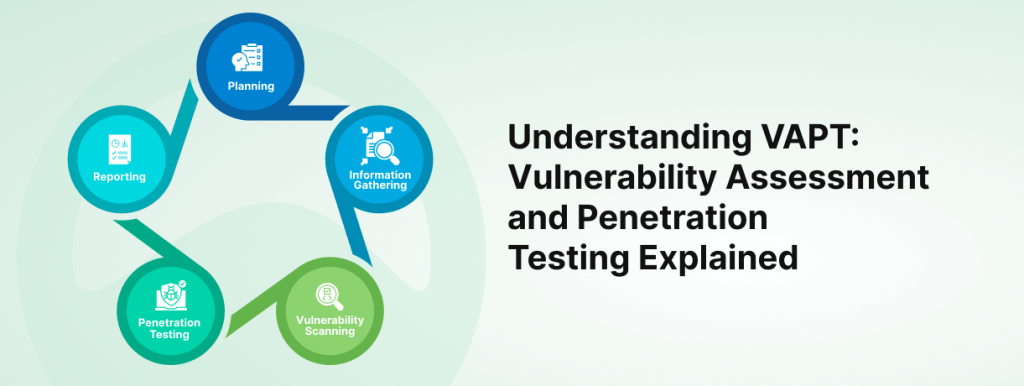
Planning and Scoping: The first step of VAPT is determining the scope of the test. This includes the systems, applications, or networks that you are going to assess. Besides that, identify the objectives of the testing process, such as finding critical vulnerabilities or general appraisal of security posture.

Vulnerability Assessment: Automated scans can be performed using tools in the vulnerability assessment phase, scanning for potential weaknesses in your target systems. Famous tools include Nessus, OpenVAS, and Qualys, often using their capabilities to identify areas within the system that have outdated software, ports opened, or misconfigurations that make it very easy to gain access. The result of such a scan is a report summarizing all detected vulnerabilities along with their assigned severity level.

Consider a scenario where you are performing a vulnerability scan for an e-commerce site owned by a retail chain. The scan suggests the CMS running on the platform is the oldest version and, hence, a known weak spot that can be exploited. All this information is communicated to the IT team and patched at once.

Penetration Testing: Once identified, vulnerabilities go through the stage of penetration testing. In penetration testing, white-hat hackers simulate an attack to capitalize on the identified vulnerability. Such is important to determine the extent to which an attacker could go if an attack successfully exploits a weakness.

For instance, in the example  of  e-commerce, an attack has vulnerable the outdated CMS by having inserted malicious code. This illustrates that an attacker could have easily taken credit card numbers and other sensitive customer data information.

Reporting and Remediation: Once the testing is completed, the VAPT team hands in a detailed report detailing all identified vulnerabilities, attempted exploits, and gives an overview of the security assessment. Remediation recommendations are provided with prioritization of which vulnerabilities to address first.

Tools Used in VAPT

There are several tools that can be used for both vulnerability assessments and penetration tests. Of these, some of the most widely used VAPT tools include:

  1. Nessus: This is one of the commonly used vulnerability assessment tools to scan networks for weaknesses.
  2. Metasploit: Penetration tool used by ethical hackers to exploit well-known vulnerabilities.
  3. Burp Suite: Used generally for web application security testing; it assists users in identifying SQL injection vulnerabilities and cross-site scripting (XSS).
  4. Wireshark: Network protocol analyzer used to capture data traffic and inspect such activities, which could help identify suspicious ones.

Best Practices in VAPT

The best practices meant to ensure your process of VAPT goes through smoothly include the following:

  1. Clear Goals: Define clearly what you want to achieve through VAPT. Decide if it is compliance testing or finding the most critical vulnerabilities.
  2. Choose Relevant Tools: It is a combination of automated tools and manual testing for the best results.
  3. Test Periodically: Cyber threat evolves in real time, so companies need to perform VAPT periodically.
  4. Prioritizing remediation: Remediate the most critical vulnerabilities first, especially those easiest to exploit.
  5. Engage ethical hacking experts: Apply skilled ethical hackers and security professionals to ensure that your VAPT process is effective and comprehensive.

Conclusion

Vulnerability Assessment and Penetration Testing: An integral part of the overall cybersecurity strategy of any organization, it brings the power of vulnerability assessments and penetration testing in one entity. VAPT seamlessly shows a complete view of vulnerabilities of a system and offers actionable insight to prevent attacks before they happen. The implementation of VAPT helps enhance security, comply with business organizations’ requirements, and prioritize risks effectively.

With the growth of cyber threats, VAPT testing remains in vogue within the organizations that have a great desire to protect their assets and data. The techniques and tools of VAPT safeguard your business with the right devices and professional expertise.

More Blog: How Cloud Computing Reduces the Carbon Footprint of Data Centers

QA’s Crucial Role in Agile Development: Best Practices Explained

QA in Agile Development

Introduction

Agile now becomes the accepted method for high quality of software delivery fast and efficiently. Agile is all about iterative development, flexibility, and continuous feedback. So how do we make sure that, in the end, our product will meet the quality requirements? That is exactly where Quality Assurance steps in. Inclusion of QA in the entire Agile process will make it easy for the team to identify issues early, maintain quality, and meet deadlines. In this blog, we would be discussing the role played by QA in Agile development, best practices, and strategies that lead to the best output.

Role of QA in Agile Development

In traditional software development methodologies, such as Waterfall, quality assurance typically occurs only after development is complete and the product is ready. But in Agile development, it is integrated throughout the lifecycle of the project. Unlike a traditional waterfall approach where the testing would have taken place after the development process was over, in Agile, teams of QA work together with developers on every sprint or iteration. Instead of having issues that crop up only towards the end stages of development, such large-scale bugs could be identified and resolved early on, and such efficiency enhances efficiency further.

In this, the QA team does much more than just mere testing. In Agile, they collaborate with the developers as well as the product owners and develop test cases and ascertain clearly stated requirements along with continuous validation of the product. Continuous testing provides quality at every step of the way and ensures that the final product will meet the requirements of the client.

Best Practices for QA in Agile Development

Team Collaboration Early and Often: The essence of Agile development is the feeling of collaboration. Thus, QA teams must be brought into the scheme of things from the initial stages of planning and an adequate understanding of the requirements of the project. Involvement in sprint planning meetings will ensure that QA gets on board early the challenges likely to arise and ascertains that testing objectives are well communicated to the development team. The early involvement will also enable the QA team to design test cases covering all aspects of functionality and performance right from the very beginning.

Continuous Testing: One of the pillars of Agile development is continuous testing. Testing should be done throughout the project with QA teams, not at the very end. Automated testing tools can speed this process up because the team can run a test on every single code commit or build. Issues catched earlier, which means the amount of rework needed is decreased and stays on track for the original schedule.

The favorite tools for automation in Agile environments include Selenium, JUnit, and TestNG. Use a CI/CD pipeline to further increase the efficiency of continuous testing, with integration, testing, and deployment of code.

Introduce TDD: Test-Driven Development is the process of developing where tests are written before developing the actual code. In Agile, TDD plays a very important role in ensuring the quality of the code from the beginning. It requires developers to focus on fulfilling the requirements and deliver bug-free code by writing test cases beforehand.

One of the best features in TDD is collaboration between developers and QA; both collaborate to clearly define how the feature should behave before there has been any development. This process gives better coverage, less technical debt, and easier code maintenance.

Automate Repetitive Tasks: Agile development wants to achieve speed in iteration, and repeating testing activities can easily make tasks time consuming. The acceleration of such processes requires test automation. One can apply automated tests for regression testing, functional testing, as well as performance testing. Automation of such routine work allows the QA teams to focus on more complex, exploratory testing that brings more added value to a project.

Some of the popular automation tools for Agile QA are Selenium, Cypress, Appium, and Postman for API testing. Consistency and repeatability in automated testing also improve test result accuracy.

Regular retrospectives: Retrospectives are an integral part of Agile development so that teams can reflect on what went well and where there is room for improvement. QA teams need to be actively participating in retrospectives so that feedback in the testing process may be allowed and possible areas of opportunity for improvement may be identified.

The whole team can discuss testing challenges and successes in order to learn and adjust their approach for subsequent sprints. Retrospectives will allow continually improvement not only of the quality of the product but also of the effectiveness of the QA process.

Prioritize Defect Management: Agile QA involves integrating defect management. Almost all traditional methods allow defects to pile up in the course of the project being completed while Agile encourages teams to address those bugs and issues as soon as they can identify them. This is done by incorporating the integration of bug tracking into the process of a sprint so that teams are able to focus their attention on which defect fixes should be prioritized and related issues could be addressed in due course.

Many software track defects in Agile teams using various tools like Jira and Bugzilla. Then the defects are documented and tracked through clear communication channels between developers and QA for solution.

Customer’s Feedback: The last aim of Agile is to deliver software that meets or exceeds the expectations of customers. Feedback from customers is then key in enhancing the quality of the product and fine-tuning the same. QA teams need to interact closer with product owners and other stakeholders as well as get end-user feedback for the development process.

By involving real user testing in each sprint and implementing the learnings from there, Agile teams can make correct decisions to enhance functionalities as well as enrich the user experience of the product.

Best QA Practices for Agile Development

Effective QA strategies are necessary to bring up the quality bar of Agile development. Given below are some of the important strategies.

Shift-Left Testing: In Agile, testing is a “shift-left” process-one conducts testing as early as one possibly can. Testing shifted to the left of the cycle helps teams catch defects early. This, in turn, saves not only costs but also time for correction.

Behavior-Driven Development (BDD): BDD encourages the developer, tester, and business stakeholders to collaborate. A clean definition of the desired behavior in a definition rather than less readable test cases directly improves communications and ensures that the result produced will meet business requirements.

Risk-Based Testing: Risk-based testing is useful for the prioritization of test cases considering the respective risks associated with each feature or functionality. Thus, by concentrating first on high-risk areas, the QA teams ensure that the most critical parts of the software are adequately tested and reduce the chances of major problems.

Conclusion

For delivering really high-quality software with real efficiency from agile development teams, QA stands out among all other important factors. Continuous testing, collaboration, automation, and customer feedback all do indeed become best practices used by QA teams in Agile projects to keep them on track and achieving quality. Agile is constantly in a state of change, but QA integration with all elements of the development process will always be the component that will be continuously key to developing reliable, scalable, and successful software products.

More Blog: 5 Powerful Reasons to Choose Transparent VAPT Services for Cybersecurity

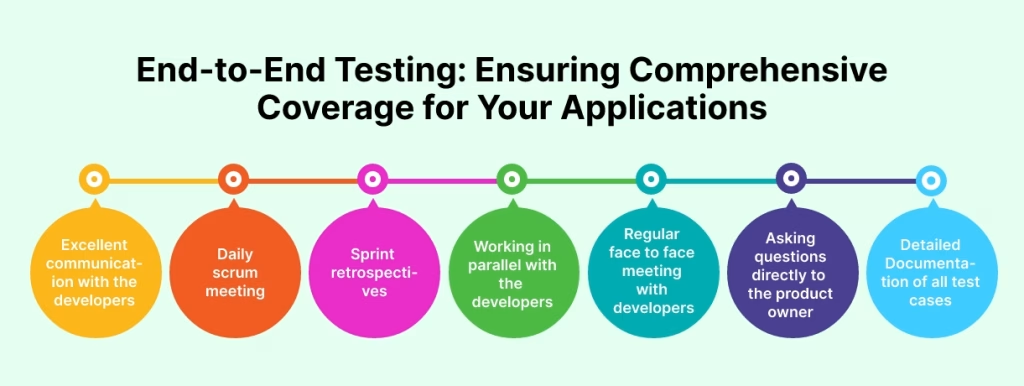
End-to-End Testing: Ensuring Comprehensive Coverage for Your Applications

End-to-End Testing illustration showing full workflow coverage

Introduction

In the modern software lifecycle, ensuring the quality of the application is a priority. This is not achieved when relying solely on unit or functional tests in an application that has complex systems and multiple integrations. A form of solution in this can be as simple as end-to-end (E2E) testing, where the test verifies that all workflows in an entire application’s chain, from the beginning to the end, work as expected.

We will discuss in this blog what end-to-end testing actually is, why it is an essential cover for a holistic aspect, and how best practices should be applied to ensure software reliability.

What are End-to-End Tests?

Testing methodology is defined by end-to-end testing, designed to test the application’s overall workflow wherein all components are working in harmony with each other. Instead of just testing individual units of code, it also involves the testing of interaction between different modules and external systems and databases.

In an E2E test, a tester simulates real-user scenarios from the initial steps of a workflow till its end. For example, in an e-commerce application, end-to-end testing may include adding an item to the cart and then proceeding with checkout, processing payment, and finally confirming the order. The rationale is that the system should be reliable, and all functionality should be strongly covered.

Why is End-to-End Testing Important?

While unit and integration tests do play their part, they only test parts of the application. End-to-end testing, however, means testing all parts of the system to ensure that everything works seamlessly together.

Here are a few reasons why E2E testing is crucial:

Real-World Functionality: Most of the errors caught are those that the user may encounter in a live environment. It allows having confidence that an application will work under real conditions.

Includes Coverage of Many Systems: Most applications today integrate with third-party services such as payment gateways, APIs, databases. E2E testing should help ensure that all those third-party services work properly with your application by providing complete coverage.

Reduces the Risk of Failure: Since end-to-end tests verify workflows from start to end, they catch defects that would otherwise be overlooked by unit or functional testing. That’s fewer bugs reaching the production level and thus less expensive failures post-deployment.

E2E testing is specifically very helpful for intricate workflows involving various types of user actions. It ensures all elements-the front-end, back-end, and external services-work together as expected.

Key Steps in Implementing End-to-End Testing

The following should be implemented in order to make end-to-end testing as effective as possible:

Clear Test Scenario Definition: Before you start testing, define clear test scenarios on the basis of your users’ journey. That is to say, define the key workflows through which your users are going to go. Logging in, making a purchase, or submitting a form are all examples. Clarity about which of the user interactions is more important and hence take up a more prominent space of attention in a testing effort.


For every scenario you design for the test, take it down to a detail of what one individual will do from start to end, including every system and component that interfaces in this process. The greater the detail you have in your test scenarios, the better your coverage will be.

Automate Where Possible: End-to-end tests tend to consume a lot of time mainly when it is designed for a large application with more workflows. This has to be improved by automating as many of your E2E tests as possible. This can be achieved using test automation tools such as Selenium, Cypress, or TestComplete so that the efforts put on the manual side can be reduced and consistent results exist for tests running across different environments.


You can also include automated E2E tests in your CI/CD pipeline to be executed automatically after every code commit or build, providing immediate feedback on the stability of the application.

Test Across Multiple Platforms and Devices: E2E tests should be run on various platforms and devices so that thorough testing is assured. Applications today are accessed on various devices: desktop, mobile phone, and tablets. The requirement is to test how your application behaves in different screen sizes, operating systems, and browsers.
Cross-platform testing tools like BrowserStack and Sauce Labs, help validate your application’s performance across multiple devices and configurations, simulating different environments.

Monitor and Maintain Test Suites: E2E testing is far from being a “set-and-forget it” process. Your test cases will need updates as your application evolves with the inclusion of new features, integrations, and workflows. Therefore, E2E test suites must be regularly reviewed and maintained so that they stay relevant and updated in line with the new features, integrations, and workflows included in the application.
Track test performance metrics, including test execution time, pass/fail rates, flakiness. Identify and debug the cause of test unreliability and “flakiness” so that tests fail consistently; otherwise, two efficiencies or bugs slip through and are missed.

Speed Up Using Parallel Testing: For big applications, a test run can be tremendous and slow down your releases. Running multiple test cases simultaneously to complete the test suite in the minimum amount of time that takes is made possible by parallel testing. Among the tools that support parallel execution are Cypress and Selenium Grid, which would guarantee faster feedback as well as efficient testing.

Habits That Make E2E Testing Successful

So, for now, here are the best practices on how your end-to-end testing will then be made to be as effective as possible:

  1. Prioritize Key Flows: Concentrate on important user journeys and core functionality.
  2. Automate repetitive tests; wherever possible, this reduces effort and guarantees consistency; manual effort is reduced.
  3. Validate integrations with third parties; check third-party systems such as payment gateways or APIs to see whether they are working seamlessly with your application.
  4. Run Tests Repeatedly: Ensure to add E2E tests to the CI/CD pipeline and get run after each code change.
  5. Results Analysis and Rework: Very often look at test results, correct problems, and then revise your test approach.

Summary

Testing from the beginning to the end is a critical activity to be performed so that you have ensured full coverage of your entire application and so it functions flawlessly. As an end-to-end test with applications tested right from beginning to end, E2E tests enable you to ensure that every unit of your system works perfectly. End-to-end testing may, therefore, reduce the risk of failure and help produce more successful software releases, thus helping to boost user satisfaction, when effectively implemented. This would be possible by incorporating best practices such as clear definitions of test scenarios and automating tests, and maintaining your test suite, thus getting your application ready for the real world.

More Blog: Key Factors to Consider When Choosing a QA Testing Partner

Regression Testing: A Vital Practice for Bug-Free Software

Illustration representing regression testing process to ensure bug-free software after updates.

Introduction

In today’s digital world, a very good significance is placed on seeing that the final product will be bug-free and without errors. Thus, the important quality assurance practice somehow known as regression testing helps maintain software integrity even when new features are added or updates are implemented. Whereby regression testing continuously verifies that prior functionality remains unaffected by code changes, it plays a vital role in keeping your software bug-free.

What is regression testing?

Regression testing is the process of regression or re-execution of functional and non-functional tests to ensure that, after some change, previously developed and tested software continues to work. Such changes can consist of code modifications, bug fixes, or the inclusion of new functionality. The primary purpose of regression testing is to identify any side effects of these changes, so the rest of the software remains unchanged and works as expected.

Whether it is the release of new versions or the roll-out of some new features, Software verification acts like a safety net so that nothing new bugs crept in due to the update.

Why Regression Testing Important?

The process of software development is iterative. Code is, at all times, being modified and extended. Any small change or update could potentially introduce new bugs or disrupt functionality previously built. Thus, QA testing is a must for any software project.

Prevents Incidental Issues: With every alteration in the code, some unknown side effect of that change can always arise. Functional revalidation will ensure that updates or new features made do not inadvertently affect existing functionality. This method prevents, long after, the possibility of issues being created in the software after deployment.

Keeps the Core Functions Stable: Running regression tests often means that even with new code addition, the core functions of your software will remain stable. This is an extremely important aspect for the overall functions of complicated applications with numerous modules, since even a small change in one area may sometimes cause changes in other areas.

Saves Time and Money: Identification of bugs early in the development cycle using regression testing saves time as well as resources. Otherwise, bugs after deployment could be costly to fix and, at times, even time-consuming. Regression testing catches the bugs early to reduce the possibility of all those costly post-release fixes.

Supports Continuous Integration: Poor quality software will result in a poor user experience, loss of reputation, and customers. Regression tests running constantly ensure that your software is free from bugs, which gives a good user experience thereby increasing the chances of satisfaction and retention.

It leads to a good user experience: Regression testing supports the practices of continuous integration and continuous delivery, which have now become the norms in the software development world. Every code change is integrated with the existing codebase with minimum disruption for software quality to be maintained throughout the development lifecycle.

Types of Retesting

There are different types of regression testing, each aiming at a different objective. Based on the complexity of your software and the changes implemented, you will need to use one, a few, or all of the types:

Corrective Regression Testing: It is followed in cases wherein the software specifications change not at all. It mainly focuses on the retesting of already prepared test cases to ensure that they are still working as initially expected after the code change has been done.

Retest-All Regression Testing: This method re-runs all the test cases in the system for verifying that new code had not affected any other part of the software. Though intensive, this type can be extremely resource and time-consuming.

Selective Regression Testing: This method selects only a fraction of the test cases to be executed based on which parts of the software might have been most likely changed. It’s useful if applied on larger codebases.

Progressive Regression Testing: This method is used when the software specification has been changed. It essentially seeks assurance that the changes being made will not interfere with already existing features.

Full Regression Testing: This approach is applied when there are many changes that have been made on the software, or where there’s a great likelihood that the new code will interfere with previous features. It necessitates a full test for the whole system.

Best Practices for Regression Testing

To make sure your regression testing strategy works effectively, follow these best practices:

Automate When Possible: Regression testing could be very dull – especially if the software is big and complex. Automation helps quicken your test execution and makes it more precise. The most commonly used automation tools are Selenium, JUnit, and TestNG, which may be utilized to run regression tests.

Not All Test Cases Must Be Executed Every Time: All the test cases need not be executed every time there is a change in the code. Focus on those test cases that are most business critical and high-impact so that core functionalities are working fine.

Have an Excellent Test Suite: Ideally, as your software changes, so also your test suite must change. Update your regression test suite regularly with new test cases and decouple the obsolete ones.

Run Regression Tests Frequently: In many organizations, regression testing is often done just before the final release, hoping to catch as much buggy code as possible in a single batch. However, it’s much better to integrate regression tests into your continuous integration process so that you can identify bugs early on and have an idea of how costly post-release fixes could be.

Track and Analyze Test Results Over Time: Track the results of your regression tests over time. These results can give insights that might indicate trends and parts of the codebase that are more prone to bugs, and how such areas should be given closer attention in future updates.

Conclusion

Regressing tests are the identification of all sorts of threats to software in terms of required repetition of testing on existing features after each update. This will ensure that the stability of software is maintained, time and money are saved, and a general user experience is achieved in return. Whether small projects or large complex systems, successful regression testing in the QA strategy is what keeps the software bug-free and provides top-quality products to end-users.

More Blogs : 10 Ways Performance Testing Can Enhance User Experience

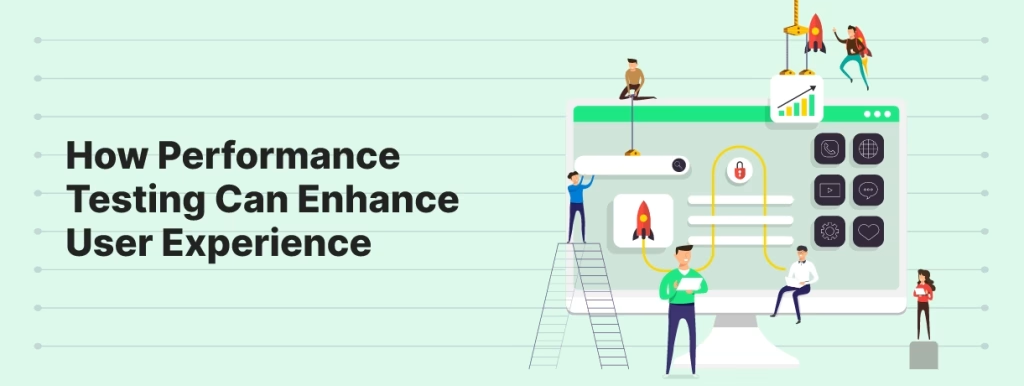
10 Ways Performance Testing Can Enhance User Experience


Introduction

Today, in the competitive world of digital, it is user experience that makes a company great. Whether launching a website, launching a mobile app, or developing a very complex enterprise solution, users expect performance to be seamless and fast with no breakdowns at all. Performance testing can guarantee the same.

What is performance testing? Performance testing evaluates the performance of how an application would work in different conditions to identify bottlenecks, thereby optimizing the load capacity and improving the response times. Direct impact on user satisfaction and retention: With a responsive, scalable, and stable software application, you can definitely ensure the happiness and retention of your users.

In this blog, we are going to discuss 10 ways performance testing may improve the user experience and why it should be in your quality assurance strategy.

The first and most important advantage of performance testing is that it identifies bottlenecks before they reach the end-user. Bottlenecks in software are simply points of failure because of resource constraints, be it memory or CPU usage.

Top Benefits of Performance Testing for Application Performance

Identifying Bottlenecks: Load/stress testing helps to provide a close approximation of real-world operation against actual thresholds-the thresholds at which the system begins to slow down or fail. Thus, through proactive noticing, potential issues can be identified and solved long before users do or experience performance degradation, thus sustaining user-experience satisfaction.

Fast Response Time: Perhaps the most important factor in user experience is speed. Studies demonstrate that even when there’s a one-second delay in page loading, users experience a significant deterioration in usability and conversion rates. The service actually ensures that during heavy traffic instances, the software responds fast to user interactions.

Load testing simply means performance testing applied to measure how your application goes in the face of different volumes of user traffic. You, therefore, test various scenarios by tuning response times to ensure that no matter how high demand gets, users experience a smooth and fast encounter.

Improving scalability to grow on ever-increasing user demands: As the user count grows so does the workload to your system. Lousy scalability will diminish performance amazingly with slow response times, crashes, and the worst-case scenario-wretched user experience. Performance testing, especially scalability testing ensures that the software developed can accommodate a growing number of users without suffering from the decaying performance of performance.
Simulating various user loads is one way that QA teams may understand how the system would behave with increased traffic. This would enable the developers to make the correct infrastructure or code adjustments in order for the software to scale well with demand.

Preventing Downtime with Stress Testing: The ultimate UX killer is downtime. When users cannot access your application because it is crashed or overloaded, then the trust in your software will reduce. Stress testing, a key constituent of performance testing, basically simulates extreme conditions to determine how your system would behave under peak loads or when it is pushed beyond its normal limits.
Stress testing reveals weaknesses of the system that may induce failures when under heavy load. Thus, developers can fix these issues and prevent downtime, ensuring your application remains reliable in the most demanding scenarios.

Optimizing Resource Usage: Performance testing can help understand where resources are being consumed inefficiently. That would be in terms of memory leaks, excessive CPU usage, or inefficient database queries, which may thus slow your application and even cause it to crash with a poor user experience.

Performance testing allows the teams to optimize code, perfect the configuration of servers, and hone your infrastructure by specifying which parts of your resource are being wasted. Your software thus runs more efficiently, implying faster performance with a better experience for the user.

Mobile User Experience: Mobile traffic is nowadays higher than desktop traffic, so mobile performance is very important. Mobile performance testing basically measures how your application will perform across a range of mobile devices, under multiple network conditions as well as various operating systems.

Mobile users demand that apps and websites open rapidly, work flawlessly, and do not lag despite any network speed or device-related constraints. Mobile performance testing will assure the seamless experience of your app for mobile users. Mobile users are often less forgiving than desktop users when it comes to issues with performance.

Reduce Abandonment Rates: High abandonment rates are the most common because of poor performance. If users do not find pages to load quickly or applications do not function as expected, the abandonment rate is bound to shoot up as people will look for an alternative. The art of performance testing prevents all such risks as it makes sure that software is both fast and reliable.

Performance problems can thus be caught by QA teams through regular performance tests causing abandonments and then fixed so that they do not start having a negative impact on users. This also leads to increased user satisfaction along with increased chances of retaining them and driving conversions.

Support for a global user base: For applications that are internationally based, performance testing will ensure that the software performs at peak levels in different geographies. Latency testing measures time in between servers and users traveling over multiple places, where data needs to travel. For example, such businesses will be needed to become gigantic globally.

Optimizing global performance for software thus ensures maximal expected speed to users regardless of their location, thus not encumbered by minimal delay and consistency in performance. This will definitely enhance user experience and help you keep a fantastic global presence.

Ensuring Compatibility Across Platforms: Modern software needs to work seamlessly on multiple platforms such as web browsers, operating systems, and devices. Performance testing includes cross-browser and cross-platform testing ensuring that your application offers the same experience across different environments.

You can test your application on many platforms and devices to determine different performance variations and make the necessary adjustments. It will ensure that, irrespective of the user’s device or browser, users get fast and reliable performance.

Building Trust Through Reliable Performance: In fact, trust lies at the heart of user experience. The user wants to know that your application will always perform, never slow down or crash. Performance testing builds this kind of trust in your application, ensuring to deliver reliable performance under all conditions.

Hence, by conducting good test runs often and developing a solution to the issues that arise, you prove your commitment toward the experience for delivering top-class service. That in turn helps increase the loyalty among the users and a better reputation for your brand in the competition of the market of software.

Conclusion

Performance testing is highly critical in ensuring that the user experience will actually be great: it’s about finding bottlenecks, optimizing response times, making sure the application scales well, and preventing downtime. This way, you can make sure your software solution is reliable, fast, and efficient for your users.

This will just enhance the user satisfaction but also support long-term success of your software. Mobile performance testing, global scalability, or cross-platform compatibility testing – whether it is related to any other form of test, performance testing will ensure that your application will be ready for the real users’ demands.

Implementation of these 10 essential practices in your performance testing will enable enhancing user experience, thereby getting assured that your software remains sought after in this competitive digital world.

More Blog: Key Factors to Consider When Choosing a QA Testing Partner

How to Perform Security Testing to Protect Your Applications

How to Perform Security Testing to Protect Your Applications

Introduction

In today’s digital world, security testing is highly essential because of the increasing cyberattacks on applications. Security testing is one of the critical processes that would help identify vulnerabilities in software applications and protect the data, users, and systems from malicious activities by an organization. Without a robust security testing strategy, applications are exposed to serious threats with possible financial loss and reputational damage, and compliance failures may occur.

This section discusses why one may need application regulatory compliance, some of the methods of testing, and then best practices regarding protection of applications against severe cyber threats.

What is Security Testing and Why It Matters

Security testing determines whether an application will protect the data it works on, maintain its functions in a compromised malicious state, or find some vulnerabilities and weaknesses that an attacker may exploit.

  1. It ensures confidentiality, integrity, and availability of data.
  2. It prevents unauthorized access, data breaches, and leaks.
  3. Ensure industry norms and regulations are followed.

Security testing is the process carried out at all stages of SDLC ensuring that security is incorporated from the beginning stages of development to final deployment.

Major Categories of Security Testing for Application Security

Some of the security testing techniques applied for the protection of an organization’s application are as follows:

Vulnerability Scanning: This is scanning of known application vulnerabilities through automated use of tools. They scan an application, noticing flaws in security, say obsolete software, weak configurations, or unpatched systems.

Penetration Testing: Pen testing, or penetration testing, simulates real-world attacks to discover weaknesses before malicious hackers do. This method involves hacking the application with good intent into potential attack vectors to understand what kinds of defense mechanisms an application possesses.

Static Application Security Testing (SAST): SAST is a testing method that is a direct type of white box. It is cheaper and easier to apply by a developer in tracking potential vulnerabilities in source codes that do not have running mode or physical execution, and consequently, happen early in the development phase.

DAST: Dynamic Application Security Testing:DAST is a technique for testing where an outsider attacking methodology is used for outside detection of running applications’ vulnerabilities. Among other common web vulnerabilities, DAST offers runtime detection of SQL injection and cross-site scripting, or XSS.

Security Audits and Reviews: Application security audits evaluate security architectures of applications, policies, and procedures designed. Regular audits ensure that security practices are in place according to industry norms, thus making the identification of risks which most of the time is missed during development easier.

Importance of Security Testing for Data Protection and Compliance

It is important for the following reasons

Protect Sensitive Information: Most applications contain sensitive information such as sensitive customers’ data, financial records, and intellectual property. Security breach refers to theft of data that will unveil users’ private and security details to the public domain.

Regulatory Compliance: It ensures that the organization complies with all kinds of data protection regulations such as GDPR, HIPAA, and PCI-DSS to avoid the penalties and legal implications attached with the non-compliance.

Avoid Financial Loss: It would prove financially devastating due to loss of revenue, lawyers’ fees, and harm to the brand because these risks are minimized by regular security testing which identifies problems before they get out of hand.

Sustaining customer trust: Customers trust a business to keep their information safe. Data breaches can easily erode this trust, thus losing customers and damaging perceptions of the brand. It helps the security of the application stay intact and the users don’t lose faith in the business.

Best Practices for Security Testing in Software Development

The best practice subsequent thereto includes comprehensive and useful security testing:

Early Security Integration In the Development Process Shift Left: Using shift-left means, on one hand, that security testing is introduced much earlier than at the very end of the cycle, ensuring security is front-run in the SDLC and there is little or no chance of critical vulnerabilities slipping through.

Automate wherever possible: Leverage automated security testing tools to accelerate the process and catch what might be missed otherwise in manual testing. Automated tools can easily and efficiently scan, for example, perform code analysis, or any other task typically done manually.

Conduct Regular Penetration Tests: Regular penetration testing will put us way ahead of this evolving threat. Penetration tests simulate actual real-world attack scenarios and therefore reveal hidden vulnerabilities that other automated tools may well miss.

Online monitoring and updating: While security testing does not stop once the application is deployed, it would be useless without continuous monitoring for new vulnerabilities and regular update patches for security flaws, which will keep your application secure over a long term.

Educate and Teach Developers: The developers form the first line of defense in the application security space. Training developers in secure coding and ensuring that developers stay abreast of the latest security trends at all times can avoid some vulnerabilities introduced at the development phase.

Top Security Testing Tools for Developers

There are numerous testing tools for security. Some of the better-known ones include the following:

  1. OWASP ZAP is an open-source tool that detects vulnerabilities on web applications.
  2. Burp Suite: Extremely popular. It is used for penetration testing against web applications.
  3. Nessus: A Vulnerability Scanner Scans your Network and Applications for Vulnerabilities. 
  4. Veracode: Static and dynamic security testing via the cloud.
  5. SonarQube: Constant code quality inspection that has been extended to involve security vulnerabilities.

Preparation of a prudent security testing approach requires the selection of suitable tools for purposes.

Conclusion

At present, a growing cyber threat needs more security testing. If they are actually integrated and carried out throughout the lifecycle of the software, with the best practices followed at large, organizations will have their applications protected and sensitive data ensured to be completely secure and well within governmental regulations. The goal of Protecting Applications extends beyond the protection of applications themselves and directly addresses the protection of your business and your ability to build trust with customers within this connected world.

More Blogs : Setting Up Appium for iOS Automation on macOS: Beginner’s Guide

  • Copyright © 2024 codelynks.com. All rights reserved.

  • Terms of Use | Privacy Policy