
Contents Overview
The eCommerce industry is changing quite rapidly in today’s digital-first world. Online shopping is gaining traction fast, creating pressure on businesses to ensure the heightening of customer experiences and growth aligning with exponentially increasing shopper expectations. AI in eCommerce is reshaping this space with smarter, faster, and more intuitive solutions By tapping into AI capabilities, companies can personalize shopping experiences while streamlining operation and driving greater customer engagement.
This article looks at how AI is transforming eCommerce, making online shopping more intuitive and, of course, more efficient, the next thing after customer-centricity.
Personalization at Scale: Improving Customer Journeys
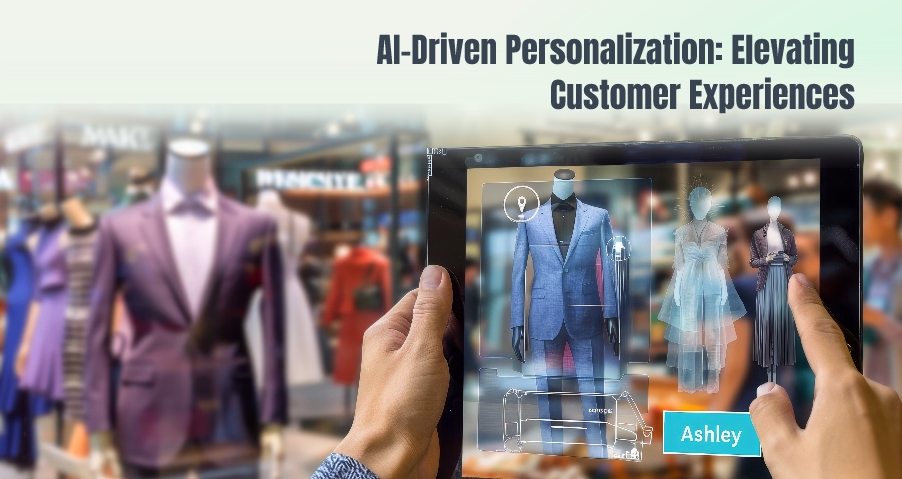
Personalization is the most significant way artificial intelligence is transforming eCommerce. Consumers today expect a tailored shopping experience, which suits their unique preferences and requirements. AI enables companies to provide personalization at scale by analyzing vast amounts of data-about browsing behavior through to a customer’s purchase history and interactions. This level of personalization defines how AI in eCommerce drives engagement and loyalty.
AI-Powered Product Recommendations: This enables the algorithm to forecast the customer preferences and provide products that could be interested in, based on his requirements. For instance, while browsing through an online store, AI can suggest items based on a consumer’s previous behavior, search history, and even trending products. This degree of personalization not only increases the chances of purchase but also enhances the overall shopping experience since it is more relevant to every user.
Dynamic Pricing and Offers: AI can also help businesses optimize their pricing strategies in real-time. AI can gauge market trends, competitors’ prices, and customer behavior to help firms institute dynamic pricing; thus, prices may change to maximize conversions and profitability. Furthermore, specially tailored discounts and offers can be targeted at specific sets of customers, which enhances engagement and loyalty.
AI-Powered Customer Service and Support
Online retail is a fast-paced industry and timely efficient customer service differs. When AI-based chatbots or virtual assistants change the way businesses communicate with their customers, this helps them be available 24/7, answer instantaneously, and even present automated solutions. The growth of AI in eCommerce has made 24/7 assistance and automated resolution the new standard.
Chatbots for Instant Assistance : AI-powered chatbots can help respond to the most diverse types of customer queries ranging from a particular product, returns, and even order follow up. The chatbots developed are capable of understanding the natural language, giving it a more human touch. Even though AI chatbots manage routine work, human agents are said to concentrate on the highly complex issues of customers, ensuring a seamless experience in efficient support.
With eCommerce technology, such virtual assistants become increasingly common, as virtual assistants powered by AI could provide customers with product recommendations, answer questions, and even help with checkouts while assisting them on their buying journey. This would increase ease of purchase, satisfaction rates, and help decrease the cart abandonment rate on one’s way to smoother buying processes.
Visual Search: Closing the Gaps between In-Store and Online Shopping
The most fascinating area where AI is being applied to eCommerce is in visual search technology. Here, customers will upload pictures of products they are interested in, and the algorithm of AI will scan through the retailer’s inventory for similar items. This enhances the online shopping experience and mirrors how people shop in physical stores. Visual cues drive most purchases and therefore reflect how people really shop.This feature is another sign of how AI in eCommerce bridges the gap between in-store and online shopping.
Improved Search Accuracy: AI-powered visual search engines help make queries more accurate by identifying detail, patterns, and colors in images that customers upload. If the customer uploads a picture of piece of furniture or a cloth, then AI technology (AI in eCommerce) scans the image so that it can then suggest the nearest available matches in the online store. This innovation is changing how customers find products online, as online shopping is now more intuitive and more effective.
AI in Inventory and Supply Chain Optimization
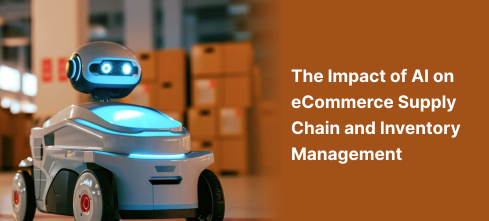
Besides these, AI is creating scenarios that are changing the backend operations of eCommerce companies as well. Here, in artificial intelligence (AI in eCommerce), a game-changer emerge by keeping an eye on inventory management and necessary supply chain logistics so that a business may efficiently operate. Predictive models and logistics automation reflect the future of AI in eCommerce operations.
Predictive Inventory Management: AI algorithms can consider historical sales data, customer demand patterns, and seasonal trends to provide forecast data on the inventory requirements to be generated for the future time period. With this, the uncertainty of stockouts or overstocking would thus be avoided, hence avoiding costs such as unsold inventory and losses on unsold items. AI-powered inventory management keeps the products at the right time, with the overall customers’ satisfaction improved.
Supply Chain Efficiency Improvement: AI can optimize supply chains by determining inefficiencies present, reducing lead times, and delivering with higher accuracy. Through this automation of the supply chain parts, order processing, and route optimization, AI enables companies to make deliveries faster and cheaper. It enhances operational efficiency and brings out an improvement in the whole customer experience for timely deliveries.
Fraud Detection and Prevention
As online shopping continues to spread, so do the risks of fraudulent activities. This is where AI-powered fraud detection systems have been really beneficial in helping eCommerce businesses identify and prevent fraudulent transactions before they cause harm.
AI-Powered Fraud Detection Systems: These systems analyze behavior or transaction data in real-time and detect anomalies that may be indicative of fraud. For example, if a customer is making an unusual purchase at a high value from a new location, the AI system might flag the transaction for closer examination. The proactive nature of fighting fraud is crucial in order to protect businesses and their customers from the emotional drain of financial losses.
Conclusion
The Future of eCommerce is AI-Driven: The integration of AI into eCommerce is transforming the landscape of online shopping-from personalized product recommendations and AI-powered chatbots through visual search and inventory optimization, the functionality of AI will help businesses provide a more personalized, efficient, safe, and secure shopping experience. As technology evolves, AI in eCommerce will continue to redefine how people shop and how businesses deliver value. Its future application will be truly innovative and only continue its surging trend toward transformation in online shopping with yet more updates to come in line.
Read more about The Future of AR in Omnichannel Retail
Posts