The Amazing Ultimate 2025 Guide to AI in eCommerce Trends and Predictions

AI in eCommerce trends and predictions for 2025

The eCommerce industry is changing quite rapidly in today’s digital-first world. Online shopping is gaining traction fast, creating pressure on businesses to ensure the heightening of customer experiences and growth aligning with exponentially increasing shopper expectations. AI in eCommerce is reshaping this space with smarter, faster, and more intuitive solutions By tapping into AI capabilities, companies can personalize shopping experiences while streamlining operation and driving greater customer engagement.

This article looks at how AI is transforming eCommerce, making online shopping more intuitive and, of course, more efficient, the next thing after customer-centricity.

Personalization at Scale: Improving Customer Journeys

Personalization is the most significant way artificial intelligence is transforming eCommerce. Consumers today expect a tailored shopping experience, which suits their unique preferences and requirements. AI enables companies to provide personalization at scale by analyzing vast amounts of data-about browsing behavior through to a customer’s purchase history and interactions. This level of personalization defines how AI in eCommerce drives engagement and loyalty.

AI-Powered Product Recommendations: This enables the algorithm to forecast the customer preferences and provide products that could be interested in, based on his requirements. For instance, while browsing through an online store, AI can suggest items based on a consumer’s previous behavior, search history, and even trending products. This degree of personalization not only increases the chances of purchase but also enhances the overall shopping experience since it is more relevant to every user.

Dynamic Pricing and Offers: AI can also help businesses optimize their pricing strategies in real-time. AI can gauge market trends, competitors’ prices, and customer behavior to help firms institute dynamic pricing; thus, prices may change to maximize conversions and profitability. Furthermore, specially tailored discounts and offers can be targeted at specific sets of customers, which enhances engagement and loyalty.

AI-Powered Customer Service and Support

Online retail is a fast-paced industry and timely efficient customer service differs. When AI-based chatbots or virtual assistants change the way businesses communicate with their customers, this helps them be available 24/7, answer instantaneously, and even present automated solutions. The growth of AI in eCommerce has made 24/7 assistance and automated resolution the new standard.

Chatbots for Instant Assistance : AI-powered chatbots can help respond to the most diverse types of customer queries ranging from a particular product, returns, and even order follow up. The chatbots developed are capable of understanding the natural language, giving it a more human touch. Even though AI chatbots manage routine work, human agents are said to concentrate on the highly complex issues of customers, ensuring a seamless experience in efficient support.

With eCommerce technology, such virtual assistants become increasingly common, as virtual assistants powered by AI could provide customers with product recommendations, answer questions, and even help with checkouts while assisting them on their buying journey. This would increase ease of purchase, satisfaction rates, and help decrease the cart abandonment rate on one’s way to smoother buying processes.

Visual Search: Closing the Gaps between In-Store and Online Shopping

The most fascinating area where AI is being applied to eCommerce is in visual search technology. Here, customers will upload pictures of products they are interested in, and the algorithm of AI will scan through the retailer’s inventory for similar items. This enhances the online shopping experience and mirrors how people shop in physical stores. Visual cues drive most purchases and therefore reflect how people really shop.This feature is another sign of how AI in eCommerce bridges the gap between in-store and online shopping.

Improved Search Accuracy: AI-powered visual search engines help make queries more accurate by identifying detail, patterns, and colors in images that customers upload. If the customer uploads a picture of piece of furniture or a cloth, then AI technology (AI in eCommerce) scans the image so that it can then suggest the nearest available matches in the online store. This innovation is changing how customers find products online, as online shopping is now more intuitive and more effective.

AI in Inventory and Supply Chain Optimization

Besides these, AI is creating scenarios that are changing the backend operations of eCommerce companies as well. Here, in artificial intelligence (AI in eCommerce), a game-changer emerge by keeping an eye on inventory management and necessary supply chain logistics so that a business may efficiently operate. Predictive models and logistics automation reflect the future of AI in eCommerce operations.

Predictive Inventory Management: AI algorithms can consider historical sales data, customer demand patterns, and seasonal trends to provide forecast data on the inventory requirements to be generated for the future time period. With this, the uncertainty of stockouts or overstocking would thus be avoided, hence avoiding costs such as unsold inventory and losses on unsold items. AI-powered inventory management keeps the products at the right time, with the overall customers’ satisfaction improved.

Supply Chain Efficiency Improvement: AI can optimize supply chains by determining inefficiencies present, reducing lead times, and delivering with higher accuracy. Through this automation of the supply chain parts, order processing, and route optimization, AI enables companies to make deliveries faster and cheaper. It enhances operational efficiency and brings out an improvement in the whole customer experience for timely deliveries.

Fraud Detection and Prevention

As online shopping continues to spread, so do the risks of fraudulent activities. This is where AI-powered fraud detection systems have been really beneficial in helping eCommerce businesses identify and prevent fraudulent transactions before they cause harm.

AI-Powered Fraud Detection Systems: These systems analyze behavior or transaction data in real-time and detect anomalies that may be indicative of fraud. For example, if a customer is making an unusual purchase at a high value from a new location, the AI system might flag the transaction for closer examination. The proactive nature of fighting fraud is crucial in order to protect businesses and their customers from the emotional drain of financial losses.

Conclusion

The Future of eCommerce is AI-Driven: The integration of AI into eCommerce is transforming the landscape of online shopping-from personalized product recommendations and AI-powered chatbots through visual search and inventory optimization, the functionality of AI will help businesses provide a more personalized, efficient, safe, and secure shopping experience. As technology evolves, AI in eCommerce will continue to redefine how people shop and how businesses deliver value. Its future application will be truly innovative and only continue its surging trend toward transformation in online shopping with yet more updates to come in line.

Read more about The Future of AR in Omnichannel Retail

7 Revolutionary Ways Visual Search in eCommerce is Transforming Online Shopping

Visual search in eCommerce showing how AI is revolutionizing online shopping with image recognition and personalized product discovery.

Introduction

In the fast-evolving world of online retail, Visual Search in eCommerce is emerging as one of the most transformative innovations shaping the shopping experience. Traditional text-based search is giving way to AI-driven tools that allow consumers to search for products using images.  Probably, the most innovative and transformative technology changing the eCommerce landscape is visual search. From old school text-based searching, the tools are now surfacing because of AI-driven tools where consumers can now search for products using images. This isn’t just a more streamlined way to shop but creates a more engaging experience with intuitive usability. Companies like Codelynks are initiating the technological leap through the use of artificial intelligence that changes how customers relate to the online mark

What is Visual Search in eCommerce?

The visual search in eCommerce (Visual Search in eCommerce) of an eCommerce site enables the users to find products by uploading an image rather than writing out descriptions. The eCommerce site based on the uploaded picture tracks the visuals and returns similar or identical products available on the platforms of an eCommerce site. For example, when a user likes a pair of shoes seen in a social media post, they can use the visual search to find the exact or similar item in an online store instead of doing complicated keyword searches.

Codelynks deals with the integration of AI-powered eCommerce solutions like visual search on online retail platforms. This provides users with a better experience while also making product discovery fast and intuitive.

Essentially, AI is the foundation of Visual Search in eCommerce technology.. Algorithms are involved in this respect to allow both machine learning and deep learning on images. Such algorithms are allowed to read even the minute details concerning the pattern, color, and form of the details of images. Then, these features are matched against the retailer’s inventory catalog.

Using cutting-edge AI technologies, Codelynks builds those intelligent systems, and retailers are empowered to offer highly accurate and relevant product recommendations. Through continuous learning and fine-tuning its potential, AI constantly improves the accuracy of visual search, ensuring that this will be something truly a must for eCommerce’s future.

Advantages of Visual Search in eCommerce Improved User Experience

Here are seven key ways visual search and AI are changing the eCommerce experience:

1. Improved User Experience: Visual Search in eCommerce is easier than asking or describing, and customers find what they want exactly without having to put it into words. It increases satisfaction and engagement rates.

2. Increased Conversion Rates: Visual search is more intuitive as far as the discovery process of a product is concerned. So, customers convert faster from being interested in a particular product to buying it. Codelynks used this technology for various eCommerce brands and provided them with a sharp conversion rate lift.

3. Enhanced Product Recommendations: AI-powered Visual Search for Enhanced Product Recommendations can learn about the user preferences built from their search behavior of the retailer. In that manner, retailers can further enhance the personalized recommendations for the users, which increases opportunities to buy and builds trust with the customer.

4. Advantage Over Others for Retailers: With the increasing adoption of visual search facility, the retailers adapting this facility first would create an upper hand than other retailers who use only the classical search facility.

5. Increased Mobile Use: The mobile shopping trend also helps visual search to fit the retailer’s mobile-first strategy. Users can take a picture with their phone and immediately find similar products.

6. Business-ready Product Management: Visual search helps better classify and manage the millions of items in a large inventory. Thus, there is navigation ease for vast product selections by customers.

7. Omnichannel Consistency: Visual search does not require separate channels on desktop, mobile, or even through social media. The high-quality experience across all channels is guaranteed by Codelynks because of its strong AI offerings.

At Codelynks, we recognize that Visual Search in eCommerce powered by AI is now a present business imperative for companies that want to stay ahead in the eCommerce playing field. We offer an integrated solution that allows retailers to tap into the force of visual search technology. We have assisted companies in streamlining their operations so much better while increasing customer satisfaction.

To this end, we provide customized AI-based solutions tailored to the needs of each retailer, so as to support uniform integration within the retailer’s or existing platforms. Our experts are set up to continuously improve AI models in order to deliver faster and more accurate searches.

Why Visual Search Matters for eCommerce Retailers

Visual Search in eCommerce is no longer a fad; it is going to increasingly become a central element that successfully execute their eCommerce. Ground for this requirement would be customers look for quicker and more intuitive method of going shopping. For this reason, retailers have to accept technologies enhancing the user experience. Typically, it doesn’t result in being an effective search technique when buyers do not know what to say to describe exactly what they want. This barrier has been removed with the visual search by enabling the customer to search with an image instead, thereby making the process quicker and much more efficient in totality.

Visual search, being armed with the AI capabilities of Codelynks, can help retailers to meet and exceed customer expectations as they increase engagement and sales.

The future of Visual Search in eCommerce seems bright, with AI likely to continue improving the result accuracy and speed. Integrations with other technologies such as AR and VR will ensure that customers have an even more immersive shopping experience.

At Codelynks, we have always continued to innovate, creating new ways through which AI and visual search can be improved so that our clients are still ahead of the curve in eCommerce innovation.

Conclusion

Further developments in AI will follow more emergence of Visual Search in eCommerce as it moves forward. Another giant step forward, looking from a text-based search to discover products by images is also the discovery of products using images. The kind of technological changes pushed by companies like Codelynks changes eCommerce landscape with AI-enabled solutions. Such technology can be utilized to make online shopping more relevant, streamlined, and engaging for the mass market, preparing retailers for a world that will only grow more digital with each passing day.

More Posts: Navigating Social Media Algorithms: 7 Tips

Revolutionary AI in eCommerce: Transforming Customer Service in 2024

Introduction

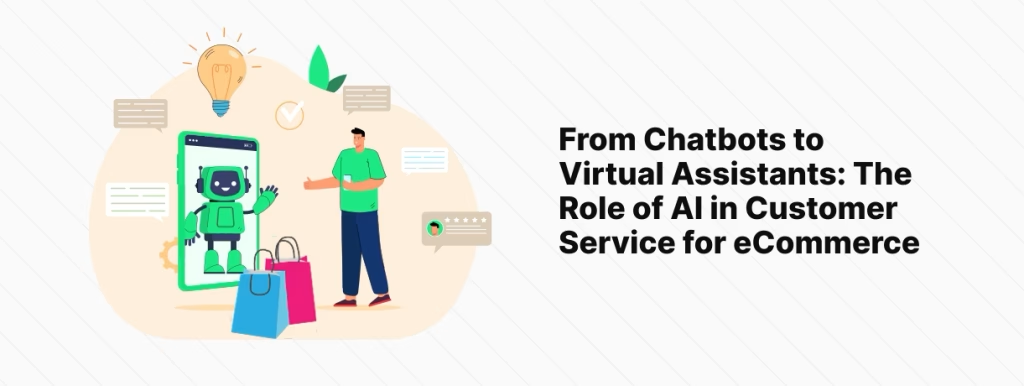
Recently, the eCommerce industry has experienced tremendous change due to the evolution of consumer behaviors and technology. In fact, innovations within artificial intelligence at the level of customer service would be a tremendous part of how online retailers relate to customers because AI-powered chatbots and virtual assistants transform the front-end service delivery.

For eCommerce Businesses, it is of utmost importance to understand how AI-driven technologies like chatbots and virtual assistants can optimize customer interactions.

In this blog, we will try to look into the role of AI within the customer service of eCommerce and discuss some benefits, challenge points, and future trends related to the role of AI.

The Evolution of AI in eCommerce Customer Service

First and foremost, AI stands out as an important technological tool for the automation and betterment of customer service in eCommerce business. Starting from simple rule-based chatbots to virtual assistants with more complex functionalities, AI can manage various customer interactions—whether answering questions, resolving issues, or providing personalized recommendations on what to buy.

Bots: The Great Foundation: Computer programs that mimic the mode of human communication and chatbots have today become the first port of call for most customers facing difficulties in getting appropriate answers. They’re fantastic for giving fast answers to standard questions such as tracking, information on products or services, and FAQs. Since then, they were upgraded from what can be described as question-and-answer tools into a full system that uses NLP in responding to complex customer queries.

Virtual Assistants: The New Generation: Basically, while chatbots may solve some problems, virtual assistants go that extra mile beyond AI customer service in that they offer more complexity in the service offered and apply machine learning to learn over time to give a more personalized, conversational experience when dealing with customers. Virtual assistants are suitable for complex requests-for instance, advising on purchase based on the history of looking or even taking customers through any multiple step procedures such as processing returns, or managing loyalty programs.

Benefits of AI-based Customer Service to e-commerce Businesses

Customer support through chatbots and other virtual assistants has several fundamental benefits to eCommerce businesses:

Timely Availability of Customer Support: One of the most significant benefits of AI-driven customer support is the possibility to operate 24/7. Customer service teams could be tied to a 9-to-5 schedule, but online chat and virtual assistants offer support at any time, allowing customers to answer their questions or get help anytime it’s convenient for them. That is not only good for customer satisfaction, but also a shopping experience, overall.

Instant Responses and Faster Resolution: Since being in the fast-paced world of eCommerce, the customer expects prompt solutions to issues. AI-powered chatbots can deliver instant answers, without a wait time in place and resolves customer concerns in real-time. Whether it is answering questions about products or guiding customers through the checkout process, the chatbot can ensure interactions are both seamless and efficient.

Personalized Customer Interactions: AI is particularly effective when applied to tailor the interaction with customers. The AI-powered virtual assistant gets to know customers through data, such as purchase history and patterns of browsing. This allows the virtual assistant to make personalized recommendations, product suggestions, and promotions based on a customer’s interest. Such a level of personalization makes the shopping experience better and can lead to higher conversion rates because the content being engaged with is one that speaks to their interests.

Cost Efficiency

The AI-based customer service system reduces much of the cost of operations by automating most of the interactions of customers. Thousands of customer queries can be handled by the chatbots at one go, thereby leaving minimum space for an enormous customer support team. Therefore, scalability is very handy in terms of this technology to expand eCommerce businesses which consider their rising customer inflow as a burden requiring much overhead.
Though offering many benefits, AI-powered customer service systems for eCommerce businesses also present some challenges in terms of implementation:

Lack of Human Touch: Many customers still want to interact with human agents, especially when an issue is complicated or emotive in nature. Chatbots excel at the tasks they are designed for: routine requests, but may lack the sensitivity and critical thinking needed to get past a more complex scenario. To this end, many businesses opt for hybrid: chatbots for routine inquiries and human agents when things get complicated.

Language and Context Understanding: Although AI has really taken big strides concerning language understanding, there is still room for improvement in terms of the interpretation of context or ambiguous questions. NLP-based chatbots may misinterpret some phrases or be unable to understand slang, thus confusing or frustrating the customer. The need for continued improvements in AI algorithms is to improve awareness and deepen comprehension of language.

Installation and Operating Costs: While ultimately saving money for businesses in the long run, the short-term cost of implementing such AI-driven customer service systems might be high. Developing a chatbot or virtual assistant which seamlessly integrates well with prevalent systems, like CRMs and eCommerce platforms requires a lot of time as well as resources. Apart from the initial setup cost, AI systems require regular maintenance as well as updates to continue functioning in the same excellent way when changes occur in the customer’s needs.

As AI technology advances, the prospects for the future of AI in eCommerce customer service look bright. A glance at major trends to watch for includes the following:

More Human Like Conversational AI: Future and ongoing developments in AI could ensure that chatbots and virtual assistants become much more conversational, bringing communication much closer to nature. Emotion recognition at higher levels and better integration of contexts will mean AI handling complex customer interactions sympathetically and with accuracy.

Multilingual Support Through AI: E-commerce companies long ago extended globally. The number of visitors also increased, and AI-based chatbots will enable multilingual support largely. Retailers will be free to target a lot more diversified customers. However, through an organization, it would be possible to have standardized and high-quality customer service across multiple languages. It would break the communication barrier and increase the reach.

Interoperability with Augmented Reality (AR): Virtual assistants through AI may, in the near future, come up with interfaces with AR to present customers with even more immersive experiences of customer service. For instance, a virtual assistant can step a customer through virtual stores or real-time product demonstrations using AR while enhancing engagement and satisfaction.

Conclusion

AI in eCommerce customer service is already shifting the paradigm about how businesses interact with their customers. From simple chatbots taking care of routine questions to sophisticated virtual assistants providing personalized experiences on shopping, AI is increasingly being associated with driving efficiency at the same time improving customer satisfaction and reducing operational costs.

Therefore, as AI continues to scale and evolve, it is those companies investing in AI-powered customer service solutions that will best position themselves to deliver a superior customer experience, differentiate themselves from the competitive landscape, and scale efficiently in the ever-evolving eCommerce world.

More Blogs: 6 Essential Secrets Management in Platform Engineering to Secure Multi-Cloud Infrastructures

  • Copyright © 2026 codelynks.com. All rights reserved.

  • Terms of Use | Privacy Policy