AR in Retail: 5 Success Stories That Prove AR Boosts Sales

AR in retail virtual try-on example

Introduction

The retail landscape has seen a sea of change in recent years, motivated by technological advancement and by the changing expectations of customers. One of the most game-changing innovations in the field is Augmented Reality (AR). Seamlessly blending digital content with the physical world, AR has given retailers new ways to interact with customers, personalize their shopping experience, and thus subsequently make sales.

In this article, we will find five retail success stories that prove how AR bumps up retail sales, increases customer satisfaction, and keeps them agile in an increasingly digital world.

IKEA: AR in Retail Revolutionizes Furniture Shopping

The furniture giant IKEA has been at the forefront of the adoption of AR to enrich customer experience. For instance, the company introduced the IKEA Place app, which could essentially help customers see what furniture would look like in their homes before they purchased it. It offers AR capabilities where customers will be able to see how a different piece of furniture would fit into their space; thus, making better decisions without visiting a store.

The IKEA app provides real-scale, high-resolution 3D models of all products available in the stores for the users to have realistic views of size and design in real-time before making a purchase. This has greatly reduced hesitation from customers about large purchases online, thus highly increasing sales in IKEA’s e-commerce.

IKEA has learned by success how precious it is to develop an immersive experience in shopping: so a customer who trusts himself through an immersive experience creates better conversion rates and lower return rates.

Sephora: AR in Retail Personalizes Beauty with Virtual Try-Ons

The beauty trade is personalization and visual appeal, and for all its latest successes, Sephora has successfully well-positioned its AR technology to maximize the engagement and sales it gets from customers. Using its Virtual Artist app, Sephora lets customers test out various makeup products completely virtually using just a smartphone or, for maximum immersion, through the company’s AR mirrors found in select stores.

This sales strategy, driven by the adoption of AR, can enable the ability of a customer to try various lipstick and eyeshadow looks without even getting up to reach for the testers. Sephora thusly can afford to deliver its modern shopper convenience and personalization – two needs that most modern shoppers have. Therefore, it has recorded increased customer satisfaction, improved sales conversion rate, and in-app engagement time.

The best example of this is the fact that enabling virtual try-ons through AR makes a setting like the customer even more loyal, reduces decision fatigue and enhances product discovery factors towards driving retail sales.

Nike: AR in Retail Ensures Perfect Shoe Fit

The company had, for a long time, been a front-runner for innovation. In using AR for the retail space, it is no exception. Using Nike Fit within its mobile app, the company addressed one of the most common challenges to online shoe shopping—finding the correct size.

This AR-enabled solution scans a customer’s feet and then gives recommendations for the most appropriate shoe size based on their measurements. Nike resolved uncertainty over fitting shoes for customers through its improvement of the online shopping experience, increasing sales, and lowering the incidence of returns that are expensive for the retailer while proving costly for the customer.

Through AR integration, the shopping journey will be personalized, data-driven, and enhanced for shoe buying: thereby giving its customers a bit of assurance when purchasing their product, hence raising conversion rates.

L’Oréal: AR in Retail Enhances Product Discovery

Another that is doing better in beauty using AR is L’Oréal, which has been widely activating the use of augmented reality across various media and touchpoints to discover products more effectively and increase sales. It therefore acquired AR company Modiface and developed apps that permit users to ascertain exactly how they will look with hair colors, skin treatments, and cosmetics before they are bought.

Besides their virtual try-on, L’Oréal also armed in-store experiences with AR that enable customers to scan products for personalized recommendations or more information on related products. It is such immersive experiences that have helped succeed in both in-store and online sales.

In this way, L’Oréal demonstrates how convenience, personalization, and immersive engagement can help empower a firm in the beauty industry to make it easier for customers to make quick, confident choices.

Home Depot: AR in Retail Simplifies DIY Product Visualization

What home improvement and DIY enthusiast wants to know what the product will look like in their environment before they purchase it? That’s when Home Depot realized and therefore developed an AR feature on its mobile app to enable the customer to see how a faucet, appliance, or decoration will look in the homes.

The tool, AR, provides real-time scaling and accurate placement. Thus, customers can easily ensure that the items they choose fit into their space. This has given rise to increased customer satisfaction owing to purchase confidence.

Home Depot has made AR product visualization successful, which reduced product returns and increased overall sales. This supports the argument that even in industries where customers are accustomed to a tactile shopping experience, AR can bridge the gap between digital and physical shopping needs.

Conclusion:

How AR Improves Retail Sales: Through these examples, there is seen a face of change in how retailers will interact with customers and sell. AR in retail immersive experiences bring so many benefits to businesses and consumers, including the following:

Increased Customer Confidence: AR in retail lets shoppers try before buying or see what the product looks like in their space; therefore, no guesswork happens, and customers are more confident about purchasing.

Improve Personalization: AR in retail can be quite a very potent tool for retailers to give customers more personalized shopping experiences. This can greatly lead to increased customer satisfaction and loyalty.

Boosted Engagement: Features on AR in retail , such as virtual try-on or product visualization, come in a fun, interactive experience that keeps the customer engaged for a longer time and therefore boosts sales.

Increase Fewer Returns: By helping customers better understand the fit or look of a product, AR in retail minimizes returns-a real hurdles, particularly in e-commerce.

Increased conversion rates, better customer engagement, and higher sales productivity are some of the benefits gained from retailers that utilize AR in retail.

As cited from these retail success stories, some of the biggest advantages one can acquire from using AR in retail is through improving customer experience as well as the generation of better sales. Whether it’s a virtual try-on, a tailored recommendation, or real-time visualization of products, AR is supporting business needs in the form of evolving demands required by the modern customer.

Codelynks is committed to unlocking business outcomes for companies through AR in retail. We develop customized AR solutions for retailers so they can create immersive and engaging shopping experiences that lead to customer loyalty and revenue growth. Let us help your business grow with AR, so you can dominate the competitive retail landscape.

More Blogs : 7 Game-Changing Examples of How AR and AI Integration is Revolutionizing Industries

6 Powerful Steps for AR Implementation in Retail: Transform Customer Experience

AR Implementation in Retail – customer using augmented reality try-on mirror

Introduction

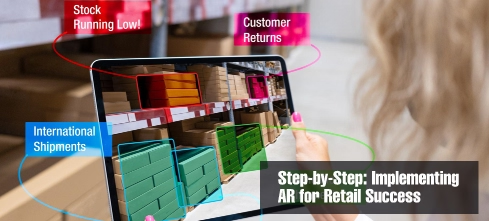
AR Implementation in Retail is transforming the shopping experience, enabling customers to try products virtually and interact with digital displays. This way, retailers use AR to enable interaction and increase sales with the customer, from virtual try-ons to interactive product displays, enhancing the customer experience, streamlining operations in an increasingly digital world.

In this guideline, we will break down the main steps of setting up AR in retail-the technical, integration approach, and best practices for a successful launch.

Benefits of AR Implementation in Retail

Before going into the nitty-gritty of the implementation, let’s discover the benefits you can anticipate from your retail business. With augmented reality, you get to enjoy several advantages, such as

  1. Engagement of More Customers: A key advantage of AR Implementation in Retail is increased customer engagement and reduced product returns.
  2. Personalization: AR lets retail companies provide recommendations to customers based on what a customer likes and what a customer is doing by using the device.
  3. Lower Return Rate: Virtual try-ons and product visualization tools make customers less likely to return the products because they will see what they are going to look like.
  4. Higher Sales: An engaging, convenient experience will translate to conversion rates and, thus sales.

These advantages will allow you to harmonize your AR strategy with other business goals.

Choosing Technology for AR Implementation in Retail

There are numerous AR technologies in the market today and hence the proper one needs to be chosen for proper utilization. Some of the most common types of AR technologies that retailers use are:

  1. Marker-Based AR: This method applies a marker like QR codes for the creation of digital overlays once scanned using a smartphone or tablet. Interactivity in product display and marketing campaigns is usually created by this technique.
  2. Markerless AR: Also known as location-based AR, the user does not require special markers to interact with AR content. The application is ideal for virtual try-ons, navigating shops, and viewing products.
  3. Projection-based AR: It allows projecting virtual images into real-world surfaces to be perceived by the customers as digital displays in actual environments. The most popular usage would be on interactive store displays and pop-up experiences.
  4. Superimposition-based AR: Superimposition AR automatically replaces part of the user’s view with an augmented image, widely used in virtual fitting rooms and furniture visualization.

The right AR technology will rely upon your business model, the type of customer experience you would like to create and how it meets the needs for your retail environment.

Define Your AR Use Case

One of the key factors in using AR effectively in retail is to define your specific use case. Identify what aspects of your retail operations or customer experience can benefit from AR. Some of the most prevalent use cases in retail include:

  1. Virtual Try-Ons: Through AR, customers are now able to try out on their outfits, accessories, or makeup before purchasing them. This is a very popular concept in the fashion and beauty industries.
  2. Product Visualization: AR allows customers to see furniture, appliances, or home decor in a customer’s space, helping them make informed decisions before they buy.
  3. Interactive In-Store Displays: AR can transform static in-store displays into interactive experiences that may offer product information, reviews, and offers.
  4. Inside-Store Navigation: By implementing AR, vast retail areas can offer a real-time navigation support to customers; that is, they are directed towards the products or the exact areas in the store efficiently.

You can adjust your implementation strategy and the right technology based on your well-defined use case of AR to achieve your desired goals.

Invest in Right Hardware and Software

What determines the success of AR is proper hardware and software selection in a retail environment. For most retail companies, smartphone-based AR might be the closest convenience available, considering that the customers can share AR experiences by accessing the same through the mobile device. Depending on your use case, however, you may also have to invest in more specialized hardware components like:

  1. AR-Enabled Mirrors or Displays: These devices enable the customers to collaborate with AR content in-store, such as trying out clothes or previewing the products.
  2. Smart Eyewear or Headsets : Some retail companies have explored the implementation of AR headsets or smart glasses which can offer customers an even more interactive, hands-free experience with digital content.
  3. Custom AR Applications or Platforms: Developing a custom AR app or using an existing AR platform such as Snapchat’s Lens Studio or Shopify AR enables you to engineer unique experiences particularly well-suited to your brand and products.

Your AR system also must be compatible with your existing retail technology and infrastructure. This is where you would want your current integration process to be smooth.

Development of AR Integration Strategy

AR is best planned and coordinated across all departments- marketing, IT, and customer service. For developing a successful AR integration strategy, here are some of the key steps that lead to an effective integration process:

It demonstrates cross-team collaboration, such that any AR implementation would reflect both customer-experience goals as well as technical capabilities.

  1. Test it, then iterate: Prepare a pilot program for smaller-scale AR to get feedback and improve experience before its larger rollout. This will help identify technical issues or improvements related to customer experience.
  2. Seamless Omnichannel Availability: Ensure that your AR experience is seamlessly integrated with online and in-store retail channels. Customers should find an easy way to access AR features from mobile, kiosk in-store, or even through your website.
  3. Empowering the Front Line Support: Preparing the staff with the appropriate skills and knowledge to support AR-related interactions with customers, for instance, when helping out in interaction at displays inside the store or addressing technical issues in AR apps.

And by doing so, you will be able to achieve the maximum value of your AR implementation for the customers and your business.

Measuring Success of AR Implementation in Retail

After your AR solution is in operation, there ought to exist a mechanism of measuring its effectiveness. Some of the key KPIs tracked include

  1. Customer Engagement: One major benefit of AR Implementation in Retail is higher customer engagement. Track the frequency with which customers engage with your AR experiences, tracking engagement levels by quantifying app usage, time spent, and repeat visits.
  2. Sales Impact: Track conversions, increases in average order value, as well as decrease in product returns that AR experiences deliver.
  3. Customer Satisfaction: Collect customer feedback regarding whether or not AR enhances their shopping experience and if their expectations are met.

By checking on these metrics from time to time, you will be able to refine your AR strategy so that it keeps on delivering value to your business over time.

Conclusion

Businesses that embrace AR Implementation in Retail will stay ahead in customer experience innovation. Retail is one brilliant opportunity to increase consumer experiences, encourage customer engagement, and sell more with AR. You will succeed in the integration of AR into your retail environment by selecting the right technology, defining your use case clearly, and developing a clear plan of integration. As AR continues to advance, retailers and their customers will be well prepared to stand out in a very competitive marketplace and deliver value to your customer sets. Retailers focusing on AR Implementation in Retail will enhance customer experience and drive measurable sales growth.

Related blog : Personalized Shopping with AR: 5 Ways It’s Transforming Retail Experiences

  • Copyright © 2026 codelynks.com. All rights reserved.

  • Terms of Use | Privacy Policy