Content Overview
Introduction
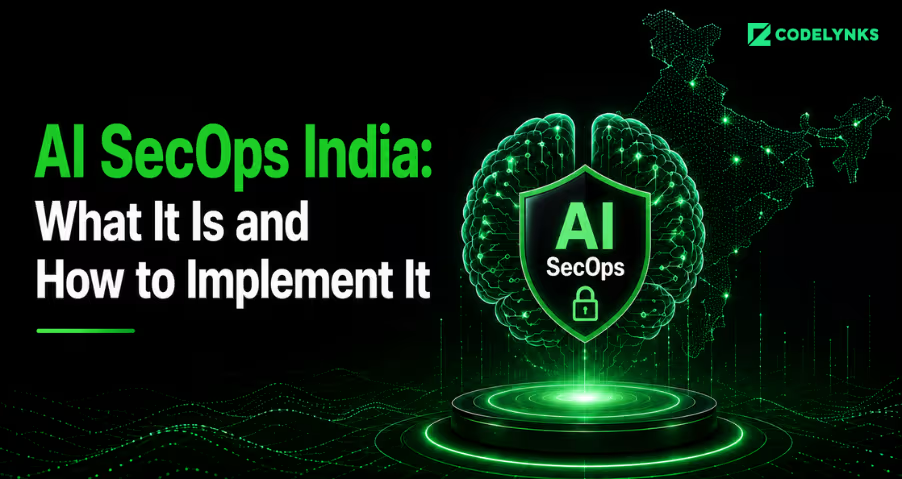
AI SecOps India is becoming a critical strategy for organizations facing rising cyber threats, strict compliance requirements, and a growing cybersecurity talent shortage. Indian security teams are losing a race they were never staffed to win.AI SecOps India is rapidly becoming a strategic priority for enterprises that need faster threat detection, automated response, and regulatory compliance.
AI SecOps is the response to that gap. This article explains what it is, why it matters specifically in the Indian regulatory context, and how to roll it out without creating new risk. The guidance here reflects how we at Codelynks approach security operations for Indian clients: foundation first, compliance mapped in early, automation layered on top.
What AI SecOps actually mean
Start with the building blocks. A Security Operations Center (SOC) is the team that monitors systems, detects threats, and responds to incidents. SecOps is the wider set of strategy, processes, and technology that makes the SOC work. The core platforms are SIEM (Security Information and Event Management) for log collection and correlation, and SOAR (Security Orchestration, Automation, and Response) for automated playbooks.
AI SecOps adds machine intelligence to that stack. It is not a copilot bolted onto an analyst’s screen. A real AI-driven SOC uses agentic AI to triage alerts, investigate them, and remediate threats across the full incident lifecycle, from first signal to closed case.
The distinction matters. Point tools and copilots make analysts marginally faster. They do not change how operations run. A true AI SOC automates the grunt work so humans handle complex investigations and judgment calls. Some vendors now report auto remediation of the majority of cases in minutes, with analysts reclaiming hours each day.
Humans are not removed from the loop. They move up the value chain. AI handles volume and repetition. People handle ambiguity, escalation, and decisions that carry business or legal weight. The goal of AI SecOps India is to reduce manual workloads while improving security outcomes through intelligent automation.
Why AI SecOps India Matters in 2026
Three forces make AI SecOps less of a nice-to-have and more of an operational floor for Indian organizations.
The threat landscape turned industrial. 2026 marks the shift to factory-scale cybercrime, where attacks are mass-produced rather than handcrafted. India is among the most aggressively targeted markets globally. A 2025 analysis found that 47% of Indian adults had experienced or knew someone hit by AI voice-cloning or deepfake scams, nearly double the global average. As UPI volumes pass 15 billion transactions a month, the attack surface keeps widening into rural areas and small merchants.
The talent math does not work. India needs over 150,000 new cybersecurity professionals every year and runs a structural workforce gap above 400,000 roles. You cannot hire your way to 24×7 coverage at that deficit. Automation is the only way most teams reach round-the-clock detection and response without burning out the staff they have.
The market is already moving. The India cybersecurity market is projected to grow from USD 8.58 billion in 2025 to USD 16.86 billion by 2030. Spending is shifting from traditional tools toward AI-powered, cloud-native, and managed security services. Log management and SIEM lead the market today, and services are growing faster than products. The direction of travel is clear.
The compliance layer that makes India different : One of the biggest advantages of AI SecOps India is its ability to streamline compliance reporting workflows across multiple regulators. This is where generic AI SecOps advice falls short. India runs parallel, overlapping reporting obligations, and your security operations have to satisfy all of them at once.
CERT-In, six hours. The CERT-In Directions of April 2022 require organizations to report 20 categories of cyber incidents within six hours of becoming aware of them. The clock starts at “noticing,” which is not limited to the CISO’s desk. An MSSP alert, a P1 SOC ticket, or a credible third-party disclosure can all start the timer. Non-compliance attracts penalties under Section
70B of the IT Act, including fines and possible imprisonment.
DPDP Act, separate channel and clock. The Digital Personal Data Protection Act does not replace CERT-In. A personal data breach requires notification to the Data Protection Board and to affected individuals, on its own timeline. Penalties run up to ₹250 crore. The same incident may have to be filed twice, to two regulators, on two different clocks, through two different channels.
Sectoral regulators stack on top. RBI, SEBI, and IRDAI each impose cyber resilience and incident reporting duties on regulated entities. RBI explicitly encourages automation for alert triaging, incident response, and reporting, provided governance, auditability, and control are maintained. These regulators share a common control baseline but apply it in their own sector context.
Logs and timestamps are mandatory. Entities must retain ICT system logs for 180 days, with accurate timestamping against Indian NTP servers. If your SIEM cannot reconstruct an intruder’s path, you cannot file a defensible report inside the deadline. Log fidelity is a legal requirement, not an engineering preference.
Two consequences follow for anyone building AI SecOps in India. First, your incident response playbook must fan a single internal trigger out to both CERT-In and DPDP channels with the right detail for each. Second, automation has to preserve a clean audit trail, because regulators will ask you to prove what happened and when.
How to implement AI SecOps India: A Practical Sequence
Do not start by buying an autonomous SOC. Start by fixing the foundation, then layer intelligence on top. Here is a workable order.
Get your data and logging right first: AI is only as good as the telemetry it sees. Centralize log collection across cloud and on-prem. Make critical source logs immutable. Lock NTP configuration to Indian time servers and alert on drift. Build an asset inventory of internet-facing systems. Run data discovery to find where personal and sensitive data lives, so you can assess DPDP exposure during an incident. This step alone improves both detection and your ability to report.
Map your compliance obligations into the workflow: Before automating anything, write down which incidents trigger which reports, on which clocks, to which regulators. Build the “reportable incident” tag into your SIEM or XDR with one-click export packs. Map obligations across CERT-In, DPDP, and your sector regulator so a single incident does not generate inconsistent or duplicated filings. Bake the notification workflow into the response playbook, not into someone’s memory.
In our experience running this for regulated clients, this step is where most rollouts go wrong. Teams treat reporting as an afterthought, then scramble when the six-hour clock starts. Do the mapping while the system is calm, not during an incident.
Add automation where volume is highest: Target the work that buries analysts: alert triage, enrichment, and routine containment. SOAR playbooks accelerate investigation and response on known patterns. This is where you free up the most analyst time fastest, and where errors are lowest risk because the actions are well understood. Organizations adopting AI SecOps India often see significant reductions in alert fatigue and investigation times.
Introduce agentic AI with humans in the loop: Once automation is stable, add AI agents that investigate and recommend. Keep approval gates on actions that carry real consequence, such as isolating a production server or notifying a regulator. The goal is machine speed on detection and triage, human judgment on decisions that affect customers, money, or legal exposure. Give junior analysts AI-driven context so they resolve complex cases with the guidance of a seasoned expert.
Measure outcomes, not tool count: Track mean time to detect (MTTD) and mean time to respond (MTTR). Buyers and boards
increasingly care about these numbers over how many tools you own. Co-managed models, where you share operations with a provider, are gaining ground precisely because they tie tomeasurable response metrics.
Build, buy, or co-manage: Most Indian organizations cannot staff a full 24×7 AI SOC in-house given the talent gap. You have three realistic paths.
Build in-house if you have the scale, budget, and ability to retain senior SOC engineers. This ives maximum control and is often necessary for large regulated entities with strict data residency needs.
Buy SOC-as-a-Service or MDR from a managed provider. You rent 24×7 detection and response capacity instead of constructing it. This is the fastest route to coverage for mid-sized firms and startups facing CERT-In and DPDP duties without a security team to match.
Co-manage by splitting operations with an MSSP. You keep ownership of strategy and sensitive decisions while the provider runs continuous monitoring and tier-one work. This hybrid is growing fastest because it balances control against the staffing reality.
Whichever path you choose, confirm the provider can produce CERT-In and DPDP-ready reporting on your timelines, and that contracts extend data protection obligations to them. Under the DPDP Act, the data fiduciary keeps ultimate responsibility even when a processor handles the data.
Common mistakes to avoid: Treating AI as a replacement for analysts rather than a force multiplier. The teams that succeed redeploy people to higher-value work; they do not cut headcount and hope.
Automating before the data foundation is solid. Garbage telemetry produces confident, wrong AI decisions at scale.
Ignoring auditability. If you cannot show a regulator the reasoning and timeline behind an automated action, that automation becomes a liability during an investigation.
Building for one regulator. India’s obligations are parallel. A playbook that satisfies CERT-In but forgets the DPDP notification leaves you exposed.
Conclusion
AI SecOps India is the practical answer to three challenges facing modern enterprises: industrialized cyberattacks, cybersecurity talent shortages, and complex compliance obligations.
The organizations that get value treat it as a disciplined rollout, not a purchase. Fix the data layer. Map the compliance obligations into the workflow. Automate the volume. Add agentic AI with human judgment on the decisions that matter. Then measure MTTD and MTTR, and improve from there.
Start with one well-instrumented workflow and prove the model. Scale from what works. If you want a second set of eyes on where to start, that’s the kind of groundwork the Codelynks teamdoes with Indian clients every week.
FAQ’s
What is AI SecOps India?
AI SecOps India combines AI, automation, SIEM, SOAR, and human expertise to improve threat detection and incident response while meeting Indian compliance requirements.
How does AI SecOps help with CERT-In compliance?
AI-powered workflows accelerate incident detection, investigation, and reporting, helping organizations meet CERT-In’s six-hour reporting requirement.
Can AI SecOps replace SOC analysts?
No. AI handles repetitive tasks while analysts focus on investigations, decision-making, and regulatory reporting.
Is AI SecOps suitable for mid-sized businesses?
Yes. Many organizations adopt managed SOC or MDR services to gain AI-driven security capabilities without building a full in-house SOC.