How to Build a DevSecOps Pipeline With Autonomous Security Enforcement

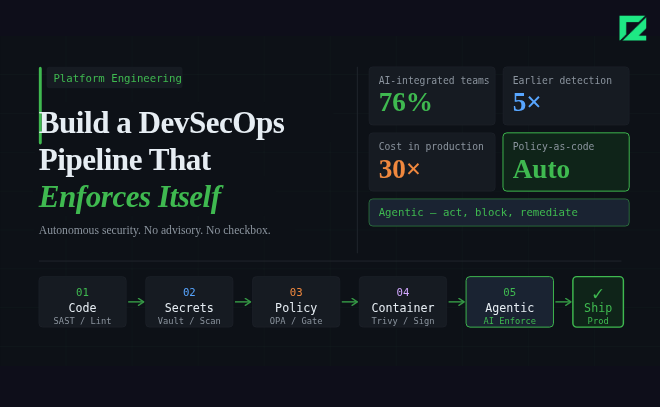
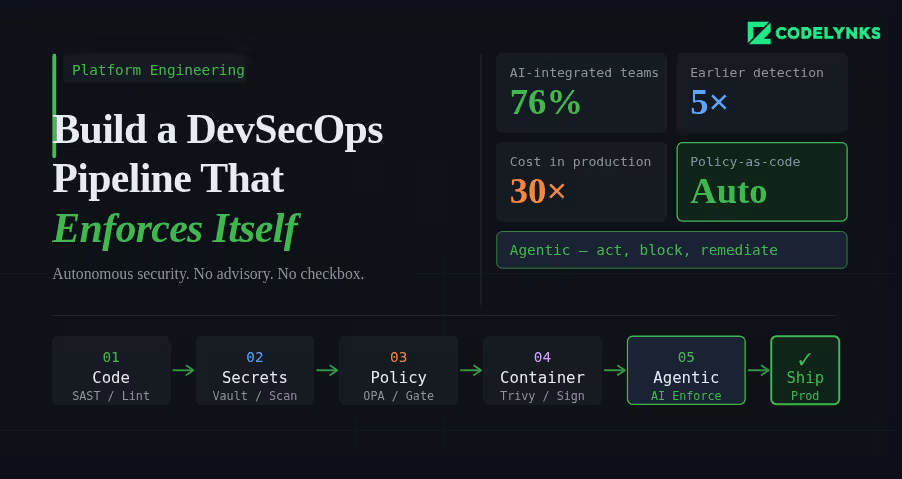
DevSecOps pipeline architecture with autonomous security enforcement

A security scan that runs after your build is not a DevSecOps pipeline. It is a security checkbox that runs after your build. The distinction matters because one approach catches vulnerabilities before they reach production, and the other hopes someone reads the report.

According to industry data from N-iX and DZone’s 2026 DevOps surveys, 76% of DevOps teams have already integrated AI into their CI/CD pipelines. The shift happening now is not just more tooling in the pipeline. It is tooling that can act, enforce, and remediate, not just report. This guide explains how to build a pipeline where security is a hard constraint, not an advisory. A modern DevSecOps pipeline integrates automated security checks into every CI/CD stage.

The Architecture of a Secure Pipeline

A DevSecOps pipeline has security controls at four stages: before the commit, during the build, before deployment, and in production. Each stage catches different classes of vulnerability. Skipping any stage creates a gap that will eventually be exploited.

Stage 1: Pre-Commit Hooks

Pre-commit hooks are the first line of defense. They run on the developer’s machine before code reaches the repository.

What to run at pre-commit:

  • Secrets scanning: Detect API keys, credentials, and tokens before they are committed. Tools: detect-secrets (Yelp), gitleaks, or truffleHog. Configure with a deny-list that matches your organisation’s credential patterns.
  • Linting and formatting: Enforce code style standards. Not strictly security, but a consistent codebase is easier to audit.
  • Infrastructure-as-code validation: If developers write Terraform or Kubernetes manifests, run a lightweight policy check (tflint, kubeval) to catch obvious misconfigurations before the commit reaches the pipeline.

Use the pre-commit framework (pre-commit.com) to manage hooks declaratively in a .pre-commit-config.yaml file, committed to the repository. This ensures every developer runs the same set of checks.

Stage 2: Build-Time Checks (Pull Request Gate)

Every pull request should trigger a suite of automated security checks that must pass before the branch can be merged. These are the pipeline gates.

  • Static Application Security Testing (SAST): Analyse source code for known vulnerability patterns without running the code. Tools: Semgrep (best open-source option), Checkmarx (enterprise), SonarQube with security rules. Configure severity thresholds: CRITICAL and HIGH findings block the merge, MEDIUM and LOW generate tickets.
  • Software Composition Analysis (SCA): Check every open-source dependency against known CVE databases. Tools: Snyk, OWASP Dependency-Check, GitHub Dependabot. Flag dependencies with CVE scores above your threshold. The biggest advantage of a DevSecOps pipeline is continuous security enforcement during development and deployment.
  • Infrastructure policy validation: Run Checkov or Terrascan against all Terraform and CloudFormation changes in the PR. Policy violations block the merge.
  • SBOM generation: Generate a Software Bill of Materials for the build artifact. Tools: Syft, CycloneDX. Store it as a build artifact. This is becoming a procurement requirement for enterprise and government customers.

Stage 3: Pre-Deployment Checks

Before any artifact reaches staging or production, validate the complete deployable unit, not just the source code.

  • Container image scanning: Scan the built container image, not just the application code. Base images carry their own vulnerabilities. Tools: Trivy (open source, fast), AWS ECR scanning, Google Artifact Analysis. Block deployment of images with HIGH or CRITICAL CVEs in base image packages.
  • Image signing and verification: Sign built images with cosign (Sigstore) and enforce signature verification at deployment time using a Kubernetes admission controller. This prevents tampering between build and deployment.
  • Kubernetes manifest validation: Validate deployment manifests against your security policies using Kyverno or OPA/Gatekeeper as an admission controller. Block pods running as root, containers without resource limits, and images from unauthorised registries.

Stage 4: Runtime Security Monitoring

Deployment is not the end of the security pipeline. Production has a different threat surface than the build environment.

  • Runtime threat detection: Tools like Falco (open source) or Sysdig detect anomalous behaviour in running containers: unexpected outbound connections, process executions that are not in the image, file system writes to unexpected locations. Alert on these immediately.
  • Periodic image rescanning: A CVE-free image today may be vulnerable tomorrow. Schedule weekly rescans of all images in your container registry. Automatically open tickets for newly discovered vulnerabilities in deployed images.
  • API anomaly detection: Unusual API call patterns, authentication failures above baseline, and privilege escalation attempts in production need automated detection and response. Define your baseline, set alerting thresholds, and create automated response playbooks for the highest-severity patterns.

Where Agentic AI Fits In

The 2026 evolution in DevSecOps is not just more tools. It is tools that can reason about context, suggest remediations, and act autonomously on low-risk findings.AI-powered monitoring is becoming a core capability in every enterprise DevSecOps pipeline.

AI-powered SAST tools can understand the data flow context of a vulnerability, not just its pattern signature. A SQL injection vulnerability in a function that only receives internally-validated input has a different risk profile than one receiving raw user input. Contextual analysis produces fewer false positives and more accurate severity ratings.

AI remediation suggestion at the pull request stage has demonstrated significantly higher fix rates than traditional vulnerability reporting. When a developer sees a suggested code change alongside the vulnerability finding, they fix it immediately. When they receive a ticket in Jira, it joins the queue.

Getting Started: The Minimum Viable DevSecOps Pipeline

If you are starting from zero, do not try to implement all four stages simultaneously. Build in this order:

  1. Add secrets scanning as a pre-commit hook and as a pipeline check. This is the highest-severity gap in most pipelines and takes less than a day to implement.
  2. Add SCA for dependency vulnerability scanning on every PR. Use Snyk or Dependabot. Configure automated PRs for patch-level updates.
  3. Add SAST with Semgrep. Start with the community rulesets, tune the false positive rate for your codebase over the first month.
  4. Add container image scanning with Trivy. Block deployment on CRITICAL CVEs, alert on HIGH.
  5. Add infrastructure policy checks with Checkov. Define your top-10 must-enforce policies first.
  6. Add runtime monitoring with Falco. Define alert rules for your most sensitive workloads first.

Steps 1-4 can be implemented within two weeks. Steps 5-6 require more planning but are achievable within a quarter.

Need Help With This?

Codelynks builds DevSecOps pipelines for engineering teams in regulated industries. If you need a security posture assessment or want to design a CI/CD pipeline with autonomous security enforcement, talk to our team at contact us

7 Reasons Why DevSecOps is the Future of Secure Software Development

DevSecOps workflow showing integration of development, security, and operations for continuous secure software delivery

Introduction

The faster the digital transformation, the more critical the matter of software security. Given that such cyberattacks and security vulnerabilities take place ever more frequently, it is no longer feasible to deal with security concerns late in the development cycle. As a result, there has come into existence the concept of DevSecOps-a practice wherein developers have come to be expected to integrate security directly into the development pipeline to ensure that security is treated as a core component of software delivery.

We are going to explore why DevSecOps is the future of secure software development and how organizations can implement it well to safeguard their applications.

What’s DevSecOps?

DevSecOps is the evolutionary next step of DevOps that brings security at every step of the SDLC. Traditionally, security has been considered only after the development phase, causing delay and vulnerability problems. DevSecOps brings a change to this posture with incorporating security into the development and operations lifecycle from the very beginning.

DevSecOps makes possible, therefore, the ability for development teams to spot and fix security risks in real-time, minimizing possible vulnerabilities through the cracks, by incorporating automated security checks, continuous monitoring, and rapid feedback loops.

The Importance of Bringing Security in Early

The traditional way of doing security audits and assessments at the end of the cycle is no longer possible in such a fast pace of developments in the present environment. In DevSecOps, security is introduced right from design, coding, testing, to deployment. It thus reduces the time taken to identify important vulnerabilities late in the release process, expensive, and time consuming, too, to cure.

When security integration occurs early in the SDLC, it has various benefits, such as:

Early Detection Minimizes Vulnerabilities: Vulnerabilities are minimized because an earlier detection of a security issue also means an early fix, less likely to cause a significant problem.

Faster Time-to-Market: The automation of security testing and continuous monitoring improves speed in development. DevSecOps can deliver secure code faster.

Lower Costs: It’s cheaper to fix security issues in development than after deployment or after a breach.

The main advantages of DevSecOps is the automation of security tasks. Continuously testing for vulnerabilities by adding automated security tools in the CI/CD pipeline does not have to hamper the development process. Automation ensures that security testing is not only consistent but also repeatable and scalable.

Key Security Automation Tools:

SAST – Static Application Security Testing: Automated scanning of source code for known vulnerabilities during the coding phase.

DAST: This simulates the attack of an application while it is running in order to find vulnerabilities.

IAST: This combines static and dynamic testing since an application’s run-time behavior is what is put under analysis.

These tools enable continuous security checks, and any found vulnerability sends immediate feedback to the developer.

DevSecOps and Continuous Monitoring

In the DevSecOps model, security does not end at deployment. There is always live applications and infrastructure that needs to be continuously monitored, so detection can occur early enough for reacting against real-time security threats. This approach proves to be highly effective when identifying vulnerabilities within an organization soon after they emerge in the marketplace.

Monitoring applications for strange behavior, performance lags, and security breaches will allow the development teams to deploy patches and updates in time before such attacks can cause considerable damage.

SIEM systems and log monitoring solutions enable the efficient detection, analysis, and response of security incidents.

Development, security and operations teams collaborate

One of the basic tenets of DevSecOps is cross-functional collaboration between development, security, and operations teams. In traditional models of development, security was considered an adjunct function that only reviewed the product at its last stages of development. With this approach of DevSecOps, close interaction and collaboration between security experts and developers and operations teams streamline the entire lifecycle so that security requirements are always incorporated in the developmental process from day one.

Best Practices on Collaboration:

Shared responsibility: Security should be everyone’s responsibility in an organization-from developers to operations personnel.

Security as code: Security policies and controls should be codified and managed like application code with control of versions and automation.

Cross-functional training: Developers should be trained for secure coding practices, and vice versa-security professionals should have a sound understanding of development processes and tools.

Best practices in implementing DevSecOps

The concept of adopting DevSecOps must first base the culture, automation, and collaboration. Some of the best practices to guide the adoption of DevSecOps are listed below: 

Shift Left with Security 

Implement this by conducting regular code reviews, automated vulnerability scans, and threat modeling during design and coding phases. 

Automate Security Testing: Proper application security testing could be automated through tools like SAST, DAST, and IAST so that security checks didn’t delay the development pipeline while real-time feeds were provided to developers about their vulnerabilities and how to deal with them on the spot.

Security First Culture: Train all teams to have a security first mindset, so they are more aware of risks and best practices in security. Empower developers to write secure code from day one with the right tools and training.

Continuous Integration and Deployment: Integrate security testing in the CI/CD pipeline to ensure automatic testing for every code change against the security vulnerability. This style of code develops rapidly with no compromise on speed while still securing its release.

The Future of DevSecOps

As technology continues to advance, so do the threats that organizations will face. “DevSecOps is no longer optional as future-proofing, ensuring security is embedded into every phase of the lifecycle of software development,” and “the future of security testing is AI and machine learning. DevSecOps will be less manual and low friction with these advancements.”.

The future of secure software development will be DevSecOps. This is further implemented in the organization when security is included as a part of the development process, automation of security tasks, and cross-functional collaboration. Organizations need to deliver applications at the speed of modern business but release secure applications by adopting the right approach to DevSecOps. In the constantly changing and more aggressive nature of cyber threats, it has become a must to incorporate a DevSecOps approach towards being above the security risks to deliver safe and reliable software to users.

More Blogs: Powerful Strategies for Zero Trust Security to Boost Productivity and Protect Data in 2025
DevOps Security and Compliance: 7 Best Practices for Modern Organizations

DevOps Security and Compliance

Introduction

In today’s fast-evolving digital landscape, DevOps security and compliance is no longer optional but essential for modern organizations. The move, especially in this fast-paced digital era, seems to make alignment of DevOps and compliance a necessity rather than an option. Organizations increasingly embrace DevOps methodologies. Integrating security and compliance into DevOps increases agility while reducing risk and meeting stringent regulations.

In this article, we will be discussing seven key practices in ensuring security as well as regulatory compliance for a DevOps environment.

7 Best Practices for DevOps Security and Compliance in 2025

Adopt DevSecOps: Security as a Built-in Component : Traditionally, these security practices usually cause bottlenecks in these development cycles. DevSecOps incorporates security into the pipeline of DevOps. This way, each step, be it writing code or even in production, will adhere to regulations. It means that security is shared between both the development and operations teams.

Security can be put in place very early in the development lifecycle where vulnerabilities are detected early, and subsequently, the final product is compliance-compliant. Organizations improve performance significantly by adopting strong DevOps security and compliance practices.

Compliance through Security Tools Automation: Automation has significant impacts on how management is approached to secure either security automation or compliance. Automated tools will indeed enforce policies, thus checking the codes against predefined standards at every step of the build process.

All of these tests use automated security testing and compliance tools: this ensures continuous scanning for potential compliance issues, reducing the chance of non-compliance. For example, usage of a CI/CD pipeline might make it possible to utilize automated vulnerability scanning tools that quite simplify compliance checks.

Continuous Integration and Continuous Compliance Monitoring : Continuous monitoring helps maintain DevOps security and compliance and reduces regulatory risk. Combining that with continuous compliance monitoring enables all the code changes to be in tune with security policy and regulatory frameworks.

With these best practices in place, organizations ensure a trail of auditability of compliance-related actions that further ease reporting for the regulators.

Prevention of Attacks through Proactive Monitoring: A DevOps team proactively monitors threats so that the right action can be taken at the right time to rectify a security issue before it becomes a critical problem. Thus, threat mitigation solutions such as SIEM systems could monitor infrastructure incessantly and notify of suspicious activities.

Implementation of threat mitigation strategies ensures that not only is the code protected from vulnerabilities but also ensures that the organization is in compliance by identifying and pre-emptively solving security issues.

Implement Role-Based Access Control (RBAC): Security and Compliance frameworks often necessitate robust access controls. RBAC ensures employees and systems only get what is needed to perform those roles. This limits the attack surface but also keeps an organization in compliance with relevant regulatory exposures to sensitive data.

Auditing such access control policies ensures compliance with data privacy laws such as GDPR or HIPAA

Secure Cloud Environments Considering Compliance: When cloud-native applications become increasingly adopted, what would be the primary concern when it comes to keeping the cloud secure? In most cases, organizations rely on public cloud services for their processes related to DevOps, but these need to adhere to the relevant compliance standards, such as ISO 27001 or SOC 2.

A multi-layered approach to cloud security- considering encryption, identity management, and ongoing audit-be sure that not only the cloud infrastructure but also the application is actually compliant.

Compliance-First Culture: A compliance-first culture ensures DevOps security and compliance becomes part of the organizational mindset, Training and collaboration between the DevOps, security, and compliance teams will naturally ensure cooperation over compliance responsibility from the outset.

When people understand how compliance contributes to long-term business success, they are likely to follow best practices to ensure security along with adherence to regulatory standards.

Conclusion

As such, compliance in the DevOps world is closely linked to robust security as well as industry regulations. Striving for DevOps security and compliance through automation, monitoring, and a culture of accountability reduces risks and ensures regulatory alignment

At Codelynks, we ensure the DevOps practice of our clients aligns both with security and compliance requirements. With our cyber security expertise, we enable organizations to outperform future threats while simultaneously achieving success in regulatory compliance. Adopting automation, DevSecOps, and a compliance-first mindset ensures long-term DevOps security and compliance for your organization.

More Blogs: AR and AI in Customer Experience: 5 Powerful Case Studies Driving Engagement

  • Copyright © 2026 codelynks.com. All rights reserved.

  • Terms of Use | Privacy Policy