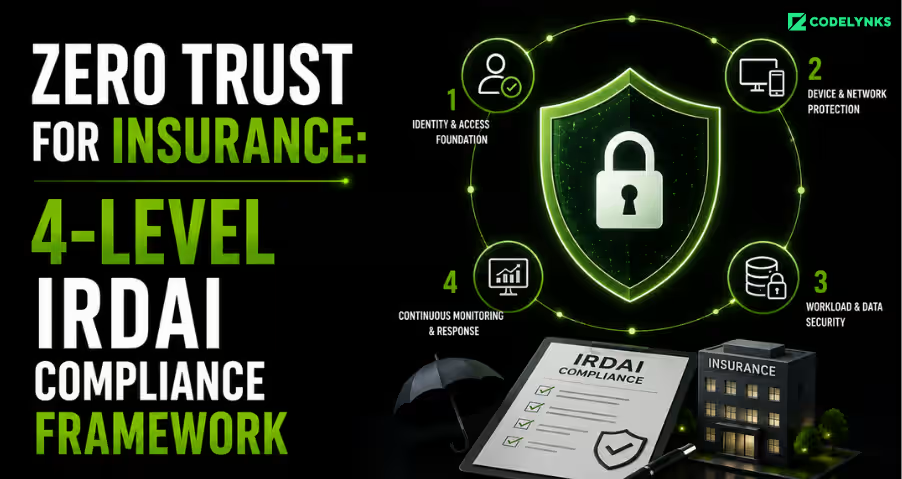
Zero Trust for Insurance: 4-Level IRDAI Compliance Framework

Zero Trust for Insurance: 4-Level IRDAI Compliance Framework illustrating Zero Trust security architecture, IRDAI compliance controls, identity verification, device protection, workload security, and continuous monitoring for insurers.

Zero Trust for Insurance: A 4-Level IRDAI Compliance Framework (2026)

On April 6, 2026, IRDAI notified revised information and cybersecurity guidelines that apply to every insurer, reinsurer, intermediary, and TPA operating in India. The guidelines mandate board-level oversight, an independent CISO reporting line, 6-hour breach notification to IRDAI and CERT-In, 180-day log retention, and comprehensive vendor risk management. Penalties for failure to implement reasonable security safeguards reach ₹250 crore under the DPDP Act.

For a life insurer with 8 million policyholders and 14 regional offices, this is not a checkbox exercise. It is a rearchitecting problem.

What Changed in April 2026

IRDAI’s April 2026 guidelines replace the 2023 circular and introduce three structural requirements that most insurers cannot satisfy with their current architecture.

The 6-hour breach notification requirement is the most operationally demanding. To notify CERT-In within 6 hours, you must detect the breach within roughly 4 hours, which means your SIEM must have ingested and correlated the relevant logs before the incident was confirmed. Most insurers in India run SIEM with 24 to 48-hour log ingestion delays from branch systems. That architecture cannot meet a 6-hour clock.

The independent CISO requirement specifying that the CISO shall not report to the Head of IT forces an organizational change that triggers an architecture review. CISOs who previously lived inside the IT cost center now have board visibility and procurement authority. The security controls they could not justify previously are now their mandate.

The vendor risk management requirement extends security obligations upstream. Before engaging any vendor with access to policyholder data, insurers must conduct cybersecurity due diligence and confirm compliance with IRDAI guidelines. This covers cloud providers, TPAs, broking platforms, and health data aggregators.

Why Zero Trust Is the Right Response

Traditional perimeter security cannot satisfy these requirements. Perimeter security assumes that traffic inside the network is trusted. Modern insurance environments have no meaningful perimeter: branch offices connect over public internet, TPAs access policy systems from their own networks, and cloud-hosted customer portals interact with on-premise policy administration systems.

Zero trust security assumes that no traffic, user, or device is trusted by default, regardless of network location. Every access request is authenticated, authorized against policy, and logged. This architecture produces the continuous monitoring and log completeness that IRDAI’s 6-hour notification requirement demands.

IRDAI’s 6-hour breach notification requirement is not a reporting problem it is a detection architecture problem. Zero trust solves the detection problem.

The Insurance Zero Trust Implementation Ladder (IZTIL)

IZTIL is a four-level maturity model for Indian insurers implementing zero trust against the April 2026 guidelines. Each level is a stable operating state, not a transition phase. An insurer can operate at Level 2 and meet most of the mandatory controls. Level 4 is the target for insurers with more than 5 million policyholders or significant digital distribution channels.

Level 1: Data Classification and Identity Foundation

No zero trust implementation can start without knowing where personal data lives. An insurer that cannot identify which systems hold personal data cannot implement zero trust. The data classification comes before the network segmentation.

At Level 1: classify all data stores by sensitivity (policyholder PII, health data, financial data, claims records); deploy identity provider with MFA enforced on all privileged accounts; disable shared service accounts and replace with machine identities; complete an asset inventory covering on-premise systems, cloud workloads, and third-party integrations.

Completion criterion: every system with personal data is tagged, owned, and accessible only via individual authenticated identities.

Level 2: Microsegmentation and SIEM Baseline

At Level 2: implement network microsegmentation between personal-data systems and general administrative networks; deploy SIEM with log ingestion from all systems hosting personal data at under 2-hour latency; establish 180-day log retention with immutable storage; and configure alerting thresholds for anomalous access patterns (off-hours access to claims systems, bulk record downloads, and new device access to underwriting systems).

This is the minimum level at which an insurer can credibly meet the 6-hour notification requirement. It is achievable in 4 to 6 months for a mid-sized insurer with a dedicated security engineering team.

Level 3: Continuous Verification and Vendor Governance

At Level 3: implement device posture checks on all endpoint access to policyholder systems; deploy privileged access management (PAM) with session recording for all administrative access; implement vendor risk assessment workflow covering IRDAI compliance confirmation, security questionnaire, and annual audit rights; extend SIEM ingestion to vendor-operated systems accessing insurer data.

The vendor governance component is frequently underestimated. Most mid-tier Indian insurers work with 40 to 80 vendors with some form of data access. Conducting due diligence across that vendor population takes 3 to 5 months even with automation.

Level 4: Adaptive Access and Automated Response

At Level 4: implement risk-based adaptive access policies that adjust authentication requirements in real time based on user behavior, device posture, and data sensitivity; deploy automated incident response playbooks for common breach scenarios (ransomware containment, credential compromise, and unauthorized data export); and integrate security telemetry with the board-level Cybersecurity Committee reporting dashboard.

Level 4 is where zero trust becomes a genuine business capability rather than a compliance posture.

The Legacy Policy Administration System Problem

Most insurers treat their legacy policy administration system as untouchable. Zero trust architecture disagrees.

The policy administration system (PAS) in most Indian life insurers is an on-premise Oracle or custom-built system running on hardware that is 8 to 15 years old. It holds the most sensitive data in the enterprise every policyholder record, every claim, every beneficiary designation. It also has the weakest security controls: broad shared database credentials, no MFA, minimal audit logging.

IZTIL Level 2 does not require replacing the PAS. It requires wrapping it. Deploy an API gateway between the PAS and all consuming systems. Enforce authentication at the gateway layer. Log all PAS access through the SIEM via the gateway. Implement network segmentation that blocks direct database access from outside the PAS VLAN.

This is less elegant than a modern microservices architecture, but it is achievable in 8 to 12 weeks without touching the PAS codebase. Attempting a full PAS modernization as part of a zero trust project doubles the risk and adds 18 to 24 months to the timeline. Separate the concerns.

DPDP Act Interaction: What Changes in May 2027

The DPDP Rules notified in November 2025 bring substantive compliance requirements into effect in May 2027. For insurers, the relevant obligations compound the IRDAI guidelines: consent for processing health data, data localization requirements for personal data stored in cloud, right-to-erasure workflows for lapsed policyholders.

The zero trust data classification work done under IZTIL Level 1 directly accelerates DPDP compliance. An insurer that has tagged every personal data store, assigned ownership, and inventoried all data flows is 60 to 70 percent of the way to DPDP readiness. Run both programs under the same data governance team.

What This Means for Insurance Leaders

The April 2026 guidelines give the CISO organizational authority that was previously unavailable. Use it now. The three decisions with the highest compliance leverage in the next 90 days are: deploy MFA on all privileged accounts (days 1 to 14, no architecture change required), standing up SIEM with 2-hour log ingestion from PAS and customer data systems (weeks 4 to 8), and completing vendor data access inventory (weeks 6 to 12).

These three steps get you to IZTIL Level 2 and put you in a defensible position for IRDAI examination. Everything else, like microsegmentation, PAM, and adaptive access, can follow in priority sequence. Do not attempt all four levels simultaneously. The implementation risk of a big-bang security rearchitecture in a regulated insurer exceeds the compliance risk of a phased approach.

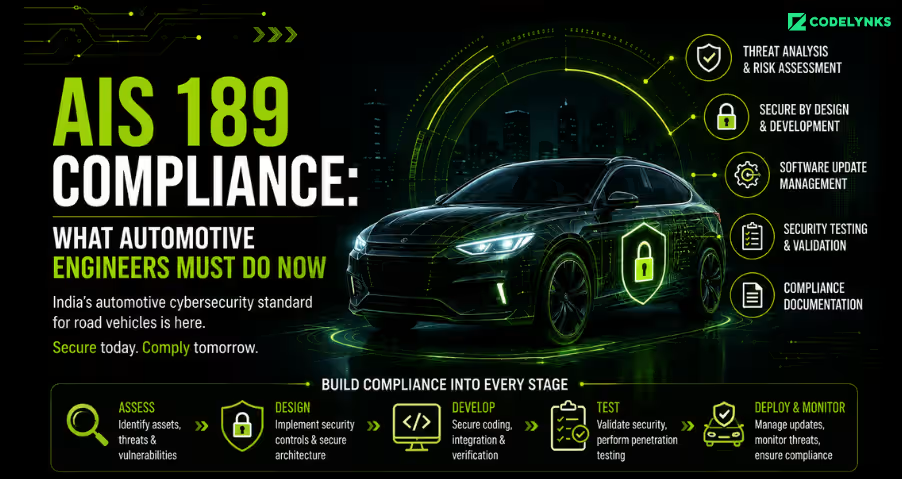
More Blog: AIS 189 Compliance: What Automotive Engineers Must Do Now

Automotive CI/CD: A 5-Level SDV DevOps Framework (2026)

Automotive CI/CD: A 5-Level SDV DevOps Framework (2026) illustrating a software-defined vehicle, CI/CD pipeline, automated testing, OTA deployment, and DevOps workflow for automotive software development.

Automotive CI/CD Is a Different Engineering Discipline. Build It That Way.

The engineering teams building this software need an Automotive CI/CD platform that does not exist in a standard DevOps toolkit. A software-defined vehicle runs on 100 to 150 million lines of code. It must satisfy functional safety standards (ISO 26262), cybersecurity requirements (ISO 21434, AIS 189 in India), and regulatory type approval while shipping OTA updates to vehicles in the field every 6 to 8 weeks. The engineering teams building this software need a CI/CD platform that does not exist in a standard DevOps toolkit.

An automotive engineering services firm in Pune managing embedded software delivery for a German OEM’s body control and ADAS module programs learned this the hard way. Their initial approach adapting a Jenkins and GitHub Actions pipeline from a prior cloud software project collapsed at the hardware-in-the-loop testing stage. Build validation times ran 14 hours. Safety certification traceability was manual. OTA staging had no rollback automation.

The problem was not their engineers. The problem was a web DevOps mental model applied to an automotive software problem.

Why Standard DevOps Fails in SDV Programs

SDV development has three properties that break standard web DevOps toolchains.

Safety lifecycle integration. ISO 26262 requires traceable links from system requirements through software design, implementation, unit test, integration test, and verification for every safety-critical function. This traceability cannot be an after-the-fact audit activity it must be captured as part of the build pipeline. Standard CI tools have no native concept of functional safety classification or ASIL (Automotive Safety Integrity Level) tagging.

Compilation and build complexity. An ECU software stack built on Classic AUTOSAR or Adaptive AUTOSAR compiles against hardware-specific tool chains (usually from Vector, ETAS, or Green Hills Software). These tool chains are not containerized, are often Windows-only, require hardware dongles for licensing, and take 30 to 90 minutes per full rebuild. Treating them like a Node.js or Python build system produces pipelines with 8 to 14-hour cycle times.

Hardware-in-the-loop (HIL) testing. Software validation in automotive requires running code on physical hardware rigs or certified simulation environments. HIL rigs cannot be spun up on demand like cloud VMs. They are physical assets, expensive to procure, and shared across teams. Managing HIL rig scheduling, utilization, and queuing is a platform engineering problem as important as the CI pipeline itself.

Automotive CI/CD is not web CI/CD with ISO 26262 annotations added at the end. The safety lifecycle has to be embedded in the pipeline, not bolted onto it.

Automotive CI/CD Maturity Model (SDMS)

SDMS is a five-level maturity model for automotive software CI/CD programs. Each level adds a specific capability that the previous level’s infrastructure supports. Moving from Level 1 to Level 5 typically takes 18 to 30 months for a program with 30 to 100 embedded software engineers.

Level 1: Version Control and Build Reproducibility

Automotive CI/CD enables automated safety traceability, OTA package creation, and rollback validation. Every software component lives in a version control system (Git with large-file storage for binary artifacts). Every build is reproducible from a pinned toolchain version and dependency lockfile. AUTOSAR tool chain versions are managed as team assets, not as individual developer installations.

Many automotive programs in India are still at this level or below. Individual engineers maintain tool chain installations on local Windows machines. Build reproducibility depends on which machine the build ran on. This is not a DevOps problem it is a configuration management problem that blocks all subsequent automation.

Level 2: Automated Build and Static Analysis

At this stage, Automotive CI/CD automates builds, static analysis, and artifact management for safety-critical software. At Level 2: automated builds trigger on every commit; static analysis tools (MISRA C compliance, Polyspace, QAC) run in the build pipeline against every changed component; build artifacts are stored in a binary artifact repository (Artifactory or Nexus) with ASIL classification tags.

The safety classification tagging at Level 2 is the investment that pays dividends at Level 4 and 5. Teams that skip it discover at certification time that they cannot produce the required tool qualification evidence for their CI system. Add it now.

Level 3: HIL Scheduling and Software-in-the-Loop Integration

At Level 3: software-in-the-loop (SIL) testing runs automatically in the CI pipeline using simulation environments (dSPACE HIL simulators, MATLAB/Simulink test automation, or CARLA for ADAS); HIL rigs are inventory-managed with a rig scheduling system that queues test jobs and reports utilization; test results flow into a test management system (qTest, TestRail, or custom) with links to requirements.

The build time problem in automotive is not a Jenkins configuration problem. It is a hardware-in-the-loop test farm scaling problem. Level 3 forces the program to treat HIL rigs as shared infrastructure with SLA commitments, not as lab equipment that someone books via email.

Level 4: Safety Traceability Automation and OTA Pipeline

At Level 4: requirements traceability is automated CI pipeline links every build artifact to the requirements it covers, the tests that verified it, and the ASIL level it satisfies; OTA update packages are generated, signed, and staged automatically from successful CI builds; rollback capability is tested as part of every OTA pipeline execution.

An OEM that cannot do OTA rollback in under 15 minutes does not have a software-defined vehicle program it has a very expensive field-service liability. Level 4 makes rollback a tested, documented capability, not an emergency procedure.

Level 5: Continuous Deployment to Vehicles and Telemetry Loop

At Level 5: validated updates flow automatically to a shadow fleet of instrumented test vehicles; vehicle telemetry feeds back into the CI system, triggering regression builds when anomalous behavior patterns are detected in the field; deployment ring management (alpha vehicles, beta fleet, general release) is automated with automatic hold triggers based on error rate thresholds.

Level 5 is the operational definition of software-defined. Most programs reach it at month 24 to 30 of a sustained SDMS improvement program.

The Adaptive AUTOSAR Transition Makes This Urgent

Classic AUTOSAR the dominant ECU software architecture for the past 15 years runs on microcontrollers with fixed scheduling and no operating system abstraction. Adaptive AUTOSAR, introduced for high-compute ADAS and infotainment domains, runs on Linux/QNX with a service-oriented architecture, dynamic service discovery, and containerized components.

The DevOps implications are significant. Adaptive AUTOSAR components can be containerized, which means they can be built and tested in standard CI infrastructure, not just on proprietary hardware-specific tool chains. This is the architectural change that makes automotive CI/CD tractable with modern DevOps tooling.

Programs still on Classic AUTOSAR should plan the SDMS progression as described above. Programs migrating to Adaptive AUTOSAR have an opportunity to build the CI infrastructure on a more modern foundation but they still need HIL rig management and safety traceability; the architecture change does not eliminate those requirements.

India’s SDV Engineering Opportunity

India has the strongest embedded software engineering pool for SDV outside of Germany. Tata Elxsi, Tata Technologies (with the recent WHIS partnership), and Tech Mahindra are building SDV engineering practices that compete with traditional Tier-1 suppliers. The constraint is not engineering talent it is DevOps tooling maturity.

Programs that build SDMS Level 3 and 4 capabilities now will win the SDV outsourcing contracts that are moving out of German and Japanese OEM in-house teams over the next 3 years. OEMs evaluating Indian engineering services partners will audit CI/CD maturity as a qualification criterion before awarding embedded software programs.

The SDV Summit in Bangalore this October will be the most important automotive engineering event in India in 2026. The firms presenting SDV DevOps capabilities at Level 4 or above will win the conversations that follow.

What This Means for Automotive Engineering Leaders

If you are running an embedded software program whether inside an OEM or as an Tier-1 or Tier-2 engineering services supplier assess your current SDMS level before committing to new program bids. The assessment takes one day and produces a concrete gap list.

Three decisions to make this month: identify your current tool chain installation management practice and determine whether it can support Level 1 reproducible builds; confirm whether your HIL rigs are scheduled via a management system or via ad hoc team coordination; and determine whether your OTA pipeline has automated rollback tested on a representative vehicle configuration.

If any of the three answers are “no” or “we don’t have that,” your program has SDMS Level 1 or 2 gaps. Closing them before the next OEM program review is worth more than any tooling investment you make elsewhere.

More Blog: Bima Sugam Phase 2 (2026): 7 Best Modernization Steps

Offline-First Logistics Apps: 7 Proven Strategies (2026)

Offline-First Logistics Apps for Last-Mile Delivery in India

Your Driver App Is Offline. Your Business Is Not.

Offline-First Logistics Apps enable delivery executives to continue completing deliveries, capturing proof of delivery, and updating shipment status even when network connectivity is unavailable. A 3PL operator with 4,500 delivery executives across 11 states was losing, on average, 340 failed deliveries per day. Not because drivers were absent or packages were missing — because the delivery app was showing a blank screen. The drivers were in areas with intermittent connectivity — industrial zones, market areas in Tier-2 cities, lift lobbies in apartment complexes — where the app lost its server connection and became unusable.

The failed deliveries were not a network problem. They were a software architecture problem.

What Are Offline-First Logistics Apps?

Offline-first is not a feature. It is a contract between the app and the delivery executive that says: you will never lose work because of a bad signal.

A delivery app that is “offline-friendly” stores the delivery list locally when connectivity is available and allows deliveries to be marked in some degraded mode when offline. This is what most logistics platforms claim when they say “offline support.”

A genuinely offline-first app does something different: it treats local storage as the primary data store and the server as a sync target. The app writes delivery status changes, proof of delivery photos, OTP confirmations, and exception notes to local storage first, every time, regardless of connectivity. Sync to the server happens opportunistically when connectivity is available, with conflict resolution logic that handles cases where the server state changed during the offline period.

The difference matters at 3G signal strength in a Tier-2 city. An offline-friendly app stalls or errors. An offline-first app continues working. This architectural approach is what separates Offline-First Logistics Apps from conventional delivery applications that depend on continuous network connectivity.

The Architecture Decisions That Cannot Be Deferred

Building offline capability as a phase-2 deliverable is the most common mobile logistics mistake we see. It requires data model decisions that cannot be retrofitted without a full rewrite.

The success of Offline-First Logistics Apps depends on making these architectural decisions before development begins rather than treating offline capability as a future enhancement.

The specific decisions that must be made before line one of code is written:

Local data model. What data structures live on the device? The delivery manifest, POD data, customer contact details, and map geometry must be serialized to the device at manifest assignment time. Their schema must match the server schema exactly, or sync conflicts are guaranteed. A well-designed local database is the foundation of reliable Offline-First Logistics Apps, enabling uninterrupted delivery operations even in low-connectivity environments.

Sync conflict resolution strategy. The sync conflict problem in logistics apps is a business problem disguised as a technical problem. Which system wins when the driver marks a delivery complete and the customer simultaneously marks it undelivered? When the dispatch system reroutes a delivery while the driver is offline? These cases must be enumerated and resolved as business rules before the conflict resolution code is written. Writing the code first and determining the rules later produces a system where conflict resolution behavior is neither intentional nor explainable.

A well-designed local database is the foundation of reliable Offline-First Logistics Apps, enabling uninterrupted delivery operations even in low-connectivity environments.

Proof of delivery (POD) storage. POD photos and customer signatures must be stored locally and synced separately from transactional records. Photos are large (500KB to 2MB per photo). Syncing them over 2G on a 40-delivery manifest would exhaust the driver’s data plan. Use a background sync queue for POD attachments with quality downscaling (600px width is sufficient for POD verification) and background upload when on WiFi or strong 4G.

Manifest staleness handling.What happens when a driver has been offline for 3 hours and the manifest has changed server-side? Deliveries rerouted, removed, or added while the driver was offline need to surface to the driver when connectivity resumes — without overwriting the delivery status changes the driver made while offline. This is a three-way merge problem: server state, local state, and the driver’s in-progress work must be reconciled.

Organizations planning to deploy Offline-First Logistics Apps should evaluate every platform using structured criteria instead of relying solely on vendor demonstrations.

The Logistics App Offline Readiness Matrix (LAORM)

LAORM evaluates a logistics driver app across four dimensions. Use it to evaluate a SaaS platform before procurement, or to assess a custom build before committing to launch.

Dimension 1: Manifest and route availability offline

Score this dimension against three criteria:

– Can the driver view their full delivery manifest (all stops, addresses, customer contact) without connectivity? (Pass/Fail)

– Is the route geometry available offline for turn-by-turn navigation? (Pass/Fail — note that Google Maps offline requires pre-downloaded regions; HERE Maps and Mapbox support offline tile downloads via SDK)

– Is the manifest updated with rerouting changes when connectivity resumes without driver action? (Pass/Fail)

A platform that fails any of these is online-first, not offline-first.

Dimension 2: Status update and POD capture offline

– Can the driver mark delivery status (attempted, delivered, failed, rescheduled) without connectivity? (Pass/Fail)

– Does the app capture customer signature or OTP confirmation offline and sync on reconnect? (Pass/Fail)

– Does the app capture and store POD photos locally with background sync? (Pass/Fail)

Dimension 3: Conflict resolution and data integrity

– Does the platform have a defined conflict resolution strategy for delivery status conflicts? (Defined/Undefined)

– Are conflict resolutions logged for audit and dispute resolution? (Pass/Fail)

– Does the sync process handle partial connectivity (requests that start on connectivity and lose it mid-flight)? (Pass/Fail)

Dimension 4: Device compatibility and storage management

– Does the app function on Android Go devices with 2GB RAM and 16GB storage? (Critical for Indian market)

– Does the app implement storage limits on local manifest data to prevent device storage exhaustion? (Pass/Fail)

– Does the app handle storage permission revocation gracefully (POD photo storage requires WRITE_EXTERNAL_STORAGE or scoped storage on Android 10+)? (Pass/Fail)

Indian 3PL operators should not adopt a SaaS last-mile platform without evaluating its offline behavior in a 2G/3G test environment first. Platform demos always run on the engineer’s 5G phone, not on the delivery executive’s entry-level Android in Nagpur.

Flutter as the Build Choice for Indian Logistics Apps

Flutter is the correct framework for Indian logistics driver apps for three reasons specific to this market.

Flutter has become a preferred framework for developing Offline-First Logistics Apps because it combines native performance with a mature ecosystem for offline databases and background synchronization.

**Single codebase for Android-heavy fleets.** Indian delivery executive fleets are 90 to 95 percent Android. Flutter’s Android support is production-grade, and a single Flutter codebase eliminates the maintenance overhead of a native Android plus iOS build. In a fleet of 4,500 devices, iOS is a management exception — it should be handled as a thin wrapper over the same business logic, not a separate codebase.

**Offline plugin ecosystem.** Flutter’s `drift` package (formerly Moor) provides a type-safe SQLite wrapper for local manifest storage. `hive` is appropriate for simple key-value session state. The `workmanager` plugin handles background sync tasks on both Android and iOS. These are mature libraries with production use cases in logistics applications.

**Low-end device performance.** Flutter compiles to native ARM code. On Android Go devices (the ₹7,000 to ₹12,000 price range that makes up a significant portion of Indian delivery executive fleets), Flutter apps perform consistently better than React Native apps, which run in a JavaScript runtime with non-trivial overhead on constrained RAM. Reliable performance on entry-level Android devices is essential for Offline-First Logistics Apps operating across Tier-2 and Tier-3 cities.

The build choice matters most at Dimension 4 of LAORM. Apps that fail on 2GB RAM Android Go devices cause the same problem as poor offline architecture — the delivery executive cannot work.

ONDC Integration for Offline-First Logistics Apps

ONDC’s expansion into logistics — with the Department of Posts joining as a Logistics Service Provider in January 2026 — means that logistics app architecture increasingly needs to support ONDC network participant APIs. For a 3PL operator integrating with ONDC buyers, the driver app’s delivery status events (out for delivery, delivered, failed delivery) must be translatable into ONDC-standard fulfillment state machine events. As India’s digital commerce ecosystem expands, Offline-First Logistics Apps will become increasingly important for maintaining seamless fulfillment updates across ONDC participants.

This is not a difficult integration, but it requires the local status model to be mapped to ONDC’s fulfillment state schema at design time. Apps designed with proprietary status enums that do not map cleanly to ONDC states require bridge logic that introduces sync delay between driver actions and buyer-visible status updates. Choosing Offline-First Logistics Apps is no longer just a technology decision—it is an operational strategy that directly impacts delivery success rates and customer satisfaction.

What This Means for Logistics Leaders

If you are evaluating a last-mile delivery platform for Tier-2 and Tier-3 India, run the LAORM evaluation before the procurement decision. The vendor will have scored their platform optimistically on all four dimensions — your job is to run a structured test in a controlled 2G environment and verify the claims.

If you are building a custom driver app, the three decisions that must happen before development starts: define the conflict resolution strategy as a business rule document signed off by operations, not just by engineering; confirm your Android device distribution and establish whether Android Go support is required; and specify the POD sync architecture including maximum photo size, sync queue behavior on low-storage devices, and audit log requirements.

These decisions do not take long to make. Changing them after launch takes months..

More Blogs: 10 Proven Platform Engineering Strategies for Logistics Software

Proven Modernizing OTT Platforms After a Media Merger (2026)

Modernizing OTT Platforms After a Media Merger (2026) featuring a unified streaming platform across TV, laptop, tablet, and mobile devices with digital media modernization.

Proven Modernizing OTT Platforms After a Media Merger

Modernizing OTT Platforms A media merger has become a top priority for media companies as streaming platforms consolidate, content libraries merge, and user expectations continue to grow. On March 8, 2026, JioHotstar delivered a live stream to 821 million simultaneous viewers without measurable service degradation. That number will appear in conference decks for a decade. The part that will not appear in conference decks is the 13 months of platform modernization work that followed the February 2025 JioCinema and Disney+ Hotstar merger consolidating two apps, two content management systems, two billing engines, two CDN architectures, and 800+ microservices into a single operating platform.

For a South Indian regional OTT operator with 12 million MAU, acquired into a larger streaming group with two separate apps and content management systems, this is not an abstract case study. It is a preview of the next 18 months.

The Four Integrations That Determine Merger Success

An OTT merger has four technical integration workstreams. They interact in ways that make sequencing critical. Attempt them in the wrong order and you spend engineering time undoing integration decisions made before dependencies were understood.

Workstream 1: Subscriber Identity Unification

Subscriber identity unification is the hardest technical problem in an OTT merger. Every other problem depends on solving it first.

The right question after an OTT acquisition is not “which app do we keep?” it is “which data model do we migrate to?” Two OTT platforms have two subscriber schemas, two subscription state machines, two entitlement models, and two payment provider integrations. Unifying them requires deciding: which schema becomes canonical, how existing subscriptions map to the new model, how trial periods, promotional entitlements, and partner-bundled subscriptions translate, and what the migration path is for subscribers on legacy plans that do not exist in the target model.

In the JioHotstar case, JioCinema subscribers were migrated to JioHotstar with a transition period, and existing subscriptions were preserved through their billing cycle. The technical complexity behind that single product decision matching subscriber records across two identity systems, preserving payment method tokens across two payment processors, and maintaining uninterrupted entitlement checks during the transition is a 3 to 4 month engineering program on its own.

Start here. Everything else is downstream of having a single source of truth for who a subscriber is and what they have paid for.

Workstream 2: Content Catalog Consolidation

Two OTT platforms have two content metadata schemas. Merging them requires: a canonical metadata model, deduplication logic for content that appears on both platforms, rights metadata reconciliation (content licensed to platform A may not be licensable on platform B), and search and recommendation system migration.

The deduplication problem is routinely underestimated. A film that appears in different qualities (HD vs. 4K), different audio tracks (stereo vs. Dolby Atmos), and different license windows on two platforms generates multiple conflicting records that cannot be automatically merged without human editorial review.

For a 12 million MAU regional OTT with a catalog of 5,000 to 20,000 content items, the catalog migration and quality review cycle takes 6 to 10 weeks with a dedicated editorial and engineering team.

Workstream 3: Billing and Subscription Engine Unification

Two platforms have two billing systems. The short-term option run both billing systems and route subscribers based on which platform they came from creates a technical debt that compounds every month. Pricing changes, promo code systems, and finance reconciliation all have to be run twice. The moment a subscriber migrates from the legacy app to the new app, their billing history becomes a reconciliation problem.

The right target state is a single subscription management platform (Chargebee, Recurly, or custom) with a single payment gateway integration. Migration from the legacy billing system requires exporting all active subscription states, mapping them to the canonical subscription model, freezing price changes during a migration window, and confirming payment method tokenization with the payment gateway.

For a platform with fewer than 1 million paid subscribers, billing migration takes 8 to 12 weeks. For a platform with 5 to 10 million paid subscribers, plan for 16 to 20 weeks including parallel running and reconciliation.

Workstream 4: CDN and Streaming Infrastructure Consolidation

821 million concurrent viewers on a single stream is an infrastructure achievement. The engineering story behind it is a platform modernization story specifically, the consolidation of JioCinema’s CDN architecture (Jio’s proprietary CDN) with Hotstar’s multi-CDN setup (Akamai, Cloudflare, and AWS CloudFront) into a unified delivery architecture with automated failover under 250 milliseconds.

For a regional OTT operator, the CDN consolidation question is simpler: which CDN contracts survive the merger, and how do you migrate video origin storage from one cloud provider to another without a playback disruption window?

The migration pattern that works: replicate video origin to the target cloud provider before cutting over DNS, run 72 hours of parallel CDN delivery with traffic comparison, then cut over. Origin replication costs money (egress from the old provider, ingress to the new one), but the cost is far lower than the subscriber churn from a playback outage during cutover.

The Media Platform Modernization Sequencer (MPMS)

MPMS is a five-phase sequencing model for OTT platform modernization post-acquisition. The phases are ordered by dependency, not by business priority.

Phase 1: Identity and entitlement unification. Build a single subscriber identity store. Migrate all subscriber records to the canonical identity schema. Establish a single entitlement check service that both apps call during the migration period. Completion criterion: every subscriber can be authenticated and their subscription state retrieved from a single system.

Phase 2: Catalog consolidation. Migrate all content metadata to the canonical schema. Deduplicate content records. Resolve rights conflicts. Complete search index migration. Completion criterion: every content item is retrievable by a single content ID across both apps.

Phase 3: App rationalization. Decide which app is the primary and which is deprecated. Release the primary app with unified auth, catalog, and content delivery. Begin the subscriber migration campaign from the legacy app. Completion criterion: more than 80 percent of MAU on the primary app.

Phase 4: Billing engine consolidation. Migrate all active subscriptions to the single billing system. Decommission the legacy billing system. Complete payment method token migration. Completion criterion: all subscriber billing events flow through a single system.

Phase 5: Infrastructure consolidation. Migrate video origin to the primary cloud provider. Consolidate CDN routing. Decommission legacy infrastructure. Completion criterion: no subscriber-facing traffic touches the legacy infrastructure.

The most common sequencing mistake is starting with Phase 3 releasing the unified app before completing Phase 1. Subscribers who download the new app and find their subscription history missing, their saved content gone, or their payment method invalid churn at disproportionately high rates. The app release is a marketing moment. Ensure the underlying data is unified before the marketing moment happens.

What Regional OTT Operators Get Wrong About Being Acquired

Regional OTT platforms being absorbed into larger streaming groups should not aim to run as a separate brand with a separate tech stack indefinitely. The operational cost of maintaining two platforms always exceeds the revenue benefit of brand preservation past the 18-month mark.

The negotiation that matters most is not brand preservation it is data portability. Ensure that subscriber data, content metadata, and engagement analytics are exportable in standard formats before the acquisition closes. Platforms that cede data portability in acquisition negotiations have no leverage in the MPMS Phase 1 through 4 decisions that follow.

What This Means for Media and Entertainment Leaders

If you are managing an OTT platform integration, whether as the acquirer or the acquired, the three questions to answer in the first 30 days are: What is the canonical subscriber identity model and which system wins? Which content metadata schema is the target and how many content records require manual editorial review? Which billing system is the target and what is the timeline for payment method migration?

These three questions have technical answers that require data audits, not architectural debates. The data audit comes before the architecture decisions. Teams that skip the data audit build integration plans that collapse when they encounter the actual state of subscriber records, content metadata, and billing histories in two production systems.

More Link : The Complete Guide to Agent-Ready APIs for Travel Booking Platforms in 2026

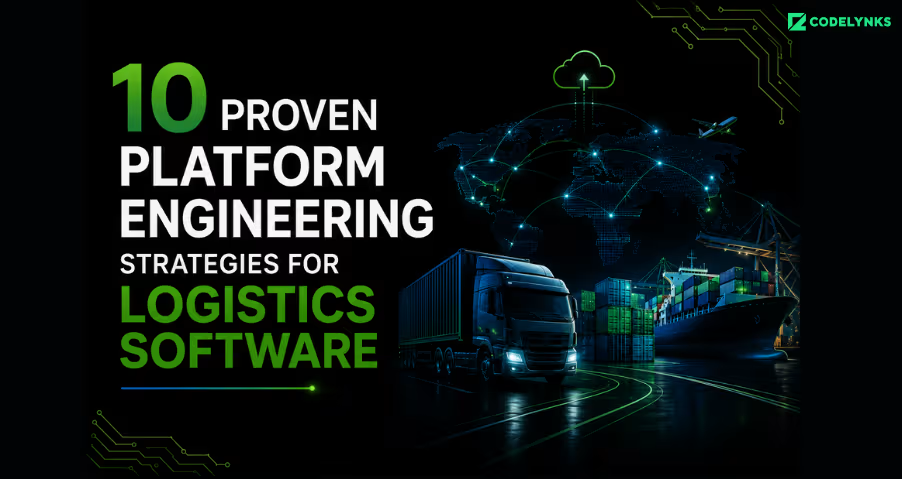
10 Proven Platform Engineering Strategies for Logistics Software

10 Proven Platform Engineering Strategies for Logistics Software featuring a digital logistics network, cargo truck, shipping containers, cargo vessel, cloud platform, and global supply chain connectivity.

Platform Engineering for Logistics Software Best Practices

Indian logistics-tech platforms typically start with one or two carrier integrations and grow to 12 or more over 18 months as they expand geographic coverage. Each new carrier arrives with a different API contract, a different webhook format, a different error code vocabulary, and a different SLA. By the time a Series B logistics-tech company has 12 active carrier integrations, the hidden engineering cost is substantial. Engineers spend an estimated 30 to 40% of sprint capacity on carrier API incidents, version changes, and integration-specific debugging rather than building product features. This is the multi-carrier integration debt problem, and it does not get better as you add carriers. It compounds.

Why Every Carrier Integration Becomes Its Own Codebase

The root cause is structural. Carrier APIs in India are not standardized. Delhivery’s tracking webhook carries a different schema than DTDC’s. Ecom Express uses different status codes than Shiprocket’s aggregated carrier feed. Blue Dart has an enterprise SOAP API that predates REST and is still the only integration path for their enterprise tier.

Each of these carriers was onboarded when a specific business need arose, often by the team that needed the carrier, using the patterns that team knew. The first integration used polling. The second used webhooks. The third used a message queue because the engineer who built it had just come from a company that used Kafka for everything. None of these decisions were wrong in isolation. Together, they produce a codebase with 12 different integration patterns, 12 different retry strategies, and 12 different places where a carrier API change can break a customer-facing tracking page.

> A carrier API is not an integration. It is a dependency with a 6-hour SLA and no versioning contract.

When a carrier updates their API without prior notice, you find out through customer support tickets, not through a changelog notification. The time from carrier API breakage to customer-visible impact is measured in hours. The time to fix it depends entirely on how well-isolated and documented the specific integration is. In a 12-carrier codebase with 12 different patterns, the answer is usually “longer than the incident SLA.”

What Platform Engineering Changes

Platform engineering addresses the multi-carrier integration problem by replacing the carrier-specific pattern with a carrier-agnostic interface. Instead of 12 integration implementations, you build one carrier adapter framework. Each carrier gets an adapter that conforms to a standardized interface.

The framework defines:

Canonical data models: A single data model for shipment status, tracking events, label formats, and error conditions. Every carrier adapter translates from the carrier’s native format to the canonical model before data leaves the adapter. Downstream systems never see carrier-specific formats.

Standard retry and circuit breaker policies: One retry policy applied uniformly. If a carrier’s API returns 503s, the circuit breaker opens and routes to a fallback carrier, rather than cascading errors into the order management system.

Webhook normalization: A centralized webhook receiver accepts payloads from every carrier and normalizes them to the canonical event format before emitting them to downstream consumers. Adding a new carrier means adding one adapter, not one webhook endpoint with unique parsing logic.

Health monitoring per integration: Each carrier adapter exposes a standardized health check. The platform’s observability layer aggregates these into a carrier health dashboard, so on-call engineers see “Ecom Express webhook lag: 12 minutes” rather than “tracking updates are slow.”

This is the adapter pattern applied consistently at the platform level rather than ad hoc at the integration level. The difference between a company that does this well and one that does not is not intelligence. It is discipline applied early enough that the pattern can be enforced.

> When your 11th carrier integration is built by a different team than your first, you do not have a platform. You have 11 separate platforms that share a database.

The Internal Developer Platform Layer

Gartner estimates that 80% of large engineering organizations will have dedicated platform engineering teams by 2026, up from 45% in 2022. For logistics companies, the IDP delivers the carrier integration framework as a self-service capability.

When a carrier integration team onboards a new carrier, they should not need to make decisions about retry policies, webhook schemas, or monitoring setup. Those decisions live in the platform. The team makes decisions about the carrier’s specific API behavior, error codes, and edge cases. The platform handles everything else.

In practice this means: a carrier adapter template with required interface implementations, a test harness that validates adapter conformance against a suite of canonical scenario tests before production deployment, automated monitoring registration when a new adapter is deployed, and a runbook template that every adapter ships with.

We worked with a Series B logistics-tech company in Mumbai operating a 9,000-pin multi-carrier delivery network. At the time we engaged, they had nine carrier integrations implemented by four different teams over three years. The carrier webhook handler was a 2,800-line file that processed payloads from all nine carriers with nested if-else blocks keyed on carrier ID. Every carrier API change required a full regression test across all nine carriers before deployment, because no one was confident a change for one carrier would not break another.

We rebuilt the integration layer as a carrier adapter platform with a canonical event model and per-adapter isolation. The webhook handler was replaced with a router that dispatched to individual adapter parsers. Adding carrier 10, 11, and 12 each took two to three days, compared to two to three weeks for the previous integrations. Carrier API incidents that previously required senior engineer involvement now resolve at Tier-1 support level using runbooks.

The Logistics Platform Maturity Index (LPMI)

We use this four-level model to assess platform maturity and sequence the remediation work:

Level 1: Ad-hoc integration

Each carrier integration is a standalone implementation. No shared data models, no shared retry policies. Carrier API changes require engineering archaeology to isolate and debug. Integration incidents are unpredictable in scope.

Level 2: Shared utilities, inconsistent application

A shared HTTP client or retry utility exists but is not enforced. Some integrations use it; others do not. The canonical data model exists in a shared library but individual integrations map to it inconsistently.

Level 3: Platform with adapter pattern

A carrier adapter framework exists with a canonical data model. New carrier onboarding follows a template. Webhook normalization is centralized. Monitoring is per-adapter and aggregated to a carrier health dashboard.

Level 4: Self-service IDP with governance

The carrier integration platform is a self-service capability. Teams onboard new carriers without platform team involvement beyond a code review. Adapter conformance is enforced by automated conformance tests. SLA performance is tracked per carrier per service level tier and feeds into carrier allocation decisions.

Most Series A and B logistics-tech companies in India are at Level 1 or Level 2. Level 3 is achievable in 3 to 4 months for a team with a dedicated senior platform engineer. Level 4 requires 6 to 9 months of deliberate platform investment.

Why AI-Powered Carrier Allocation Needs a Clean Platform First

The next wave of logistics intelligence, AI-powered carrier allocation that optimizes for cost, SLA, and pin-code serviceability simultaneously, cannot be built on a Level 1 integration layer. Dispatch management engines that ingest carrier availability, warehouse stock, and order management data to inform route planning decisions need clean, consistent, real-time carrier availability signals. Dispatch systems now consider 250 or more variables simultaneously for carrier selection.

If your carrier availability data comes from nine different polling jobs with different latencies and inconsistent error handling, your allocation model will make decisions on stale and inconsistent inputs. The model is only as reliable as the data layer underneath it.

> The cost of maintaining carrier webhooks in a 9,000-pin network exceeds the cost of operating the routing engine itself.

The platform investment is a prerequisite for the intelligence investment, not a parallel track. Building AI-powered allocation on a Level 1 integration layer produces an allocation model that performs well in controlled demos and degrades under real carrier API instability.

Packaging the Platform Investment for Leadership

The business case for carrier adapter platform investment is not difficult to build if you have the right data. The inputs are: current engineer hours per sprint spent on carrier incident resolution and integration-specific debugging, average customer escalation cost for carrier-related tracking issues, and sprint velocity lost to carrier API regression testing before releases.

In our Mumbai client engagement, those three numbers together justified the platform investment in under eight months of recovered engineering capacity. The platform team of two engineers reduced carrier incident load across a nine-person engineering team by an estimated 35% of sprint capacity. That capacity went back into product development that generated measurable revenue.

What this means for Logistics and Supply Chain leaders

If you are a CTO or Head of Engineering at a logistics-tech company with 8 or more carrier integrations, your integration layer is already a bottleneck. The symptom is rarely visible on dashboards. It shows up as delayed feature releases, because every new feature touches carrier data. It shows up as engineering attrition, because senior engineers burn out on integration maintenance. It shows up as customer escalations during carrier API changes, because there is no clean isolation between carriers.

The step you can take this week: count the number of distinct error handling patterns across your carrier integrations. If the answer is more than two, you are at Level 1. That number is the leverage point for the business case for a platform investment.

More Blogs : Bima Sugam Phase 2 (2026): 7 Best Modernization Steps

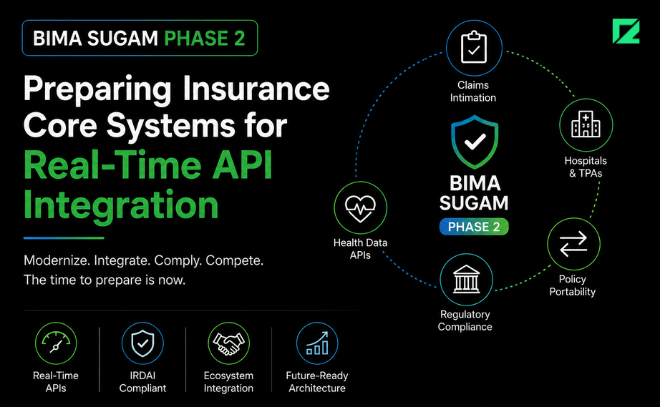
Bima Sugam Phase 2 (2026): 7 Best Modernization Steps

Bima Sugam Phase 2: Preparing Insurance Core Systems for Real-Time API Integration infographic showing real-time insurance APIs, IRDAI compliance, claims intimation, and policy portability.

Introduction

Bima Sugam Phase 2 is expected to go live in 2026, adding claims intimation, third-party integrations with hospitals and TPAs, health data APIs via ABDM, and policy portability workflows to the platform that IRDAI is positioning as India’s “UPI moment” for insurance. For a private life insurer, Tier-2 by premium volume, this is not a product decision. It is a systems architecture decision, because the question is not whether to integrate with Bima Sugam but whether your policy core can expose the APIs that Phase 2 requires. For more than 70% of Indian insurers still running legacy policy administration systems, the answer today is no, and the time to address that gap is now, not when Phase 2 audits begin.

What Bima Sugam Phase 2 Actually Requires from Your Backend

The first phase of Bima Sugam handled policy issuance and KYC through standardized APIs against India Stack. Phase 2 goes further and exposes the latency limitations of legacy batch architectures:

Claims intimation API: Accept a claim notification from a policyholder through the Bima Sugam interface, validate the policy, and return a claim acknowledgment with a reference number. The latency expectation is real-time, not batch.

TPA and hospital integration: For health insurance, route claim pre-authorization requests to TPAs via the platform’s standardized interface and receive approval or rejection within a defined SLA.

Portability workflows: Allow policyholders to initiate porting of a policy from one insurer to another through the platform, requiring your system to expose policy data in IRDAI-specified formats on request.

Health data APIs: Integrate incoming health records from ABDM-connected providers as supporting evidence for claims, requiring your system to receive structured health data and associate it with the correct policy record.

Each of these requires your policy core to respond to external API calls synchronously. If your core system runs on batch processing cycles, a claims intimation call at 11:47 AM may not be processed until the next batch window at 2:00 PM.

> Bima Sugam does not care about your batch claims processing cycle. It expects an API that returns in under two seconds.

This is the architectural mismatch that Phase 2 exposes. Legacy policy administration systems were designed around overnight batch cycles and internal screen-based access. Bima Sugam’s API model assumes real-time, event-driven policy data availability.

The Layered Modernization Trap

The standard advice for insurers who cannot afford a five-to-seven-year core replacement is layered modernization: build a digital experience platform on top of the legacy core and expose APIs from the DXP layer that translate between Bima Sugam’s expectations and the core’s batch processing reality.

This approach works for Phase 1. Phase 2 tests its limits directly.

A DXP sitting above a legacy core can make the core’s data available through an API. It cannot change the underlying processing model. If the legacy core writes a claims record to the database at the end of a batch job, the DXP can surface that record via API, but it cannot surface it before the batch job completes.

For claims intimation under Phase 2, this creates a visible SLA gap. Insurers who respond slowly will face customer complaints that aggregate on the Bima Sugam platform, visible to IRDAI. The platform’s design, like UPI, is intended to create transparent competitive pressure through published performance data across all participants.

> Layered modernization is not a strategy. It is a temporary architectural position with a deadline.

The deadline, in this case, is the first Bima Sugam compliance audit cycle after Phase 2 launch. Phase 1 compliance will not exempt you from Phase 2 performance requirements.

What Event Sourcing Changes

The modernization path that extends the useful lifetime of a layered approach is event sourcing at the core. Instead of a legacy system that writes final state to a policy record, an event-sourced system records every state transition as an immutable event. The current policy state is derived by replaying the event log.

This matters for Bima Sugam integration because: claims intimation triggers a state transition event that is written synchronously, so the claim acknowledgment can be returned immediately before downstream processing completes. Portability requests become a stream of events that can be replayed on the receiving insurer’s system to reconstruct policy history without a direct database export. IRDAI audit requirements for data lineage are satisfied by the event log itself, rather than requiring separate audit trail tables or retrofitted logging.

We worked with a private life insurer, Tier-2 by premium volume, preparing for Bima Sugam Phase 2 with approximately 3.4 million active policies on a legacy policy administration system from 2009. A full core replacement was budgeted for 2028. The Phase 2 requirement exposed a gap they could not bridge with layered modernization alone, specifically the claims processing latency SLA.

The approach: introduce an event streaming layer (Apache Kafka) between the legacy core and the DXP, instrument the legacy core to emit events on every write operation through a change data capture connector, and build the Bima Sugam integration against the event stream rather than directly against the legacy database. Claims intimation calls write to Kafka synchronously. The legacy core consumes events and updates its records in the background. The DXP reads from the event stream.

Claims acknowledgment latency dropped from batch-cycle hours to under 800 milliseconds. The legacy core continued to operate unchanged. The core replacement project continued in parallel on its original timeline.

This is not a permanent solution. It is a structural bridge that achieves Phase 2 compliance while the replacement program runs in parallel.

The Insurance Core Modernization Sequence (ICMS)

This is the four-phase sequence we use with insurance clients facing simultaneous Bima Sugam compliance pressure and longer-term core replacement plans:

Phase 1: API Façade (2 to 4 months): Build a managed API gateway above the legacy core. Expose policy inquiry, claim status, and KYC verification endpoints that Bima Sugam Phase 1 requires. No changes to the core system. This phase delivers Phase 1 compliance and provides the integration surface that Phase 2 will extend.

Phase 2: Event Bridge (3 to 6 months): Introduce an event streaming layer. Instrument the legacy core to emit events on write operations, using change data capture where direct instrumentation is not feasible. Build the Bima Sugam Phase 2 integration against the event stream for low-latency claims intimation and portability flows. This phase achieves Phase 2 API latency compliance without core replacement.

Phase 3: Strangler Fig Migration (12 to 36 months): Migrate core policy administration capabilities to a modern system, one product line or functional domain at a time. Route traffic to the new system as each domain is validated. The event stream becomes the integration backbone between old and new systems during migration.

Phase 4: Legacy Decommission

Retire the legacy core when all traffic has migrated. The event log becomes the long-term archive for historical policy data, satisfying IRDAI record retention requirements.

> A core replacement takes five to seven years. A Bima Sugam integration built on a legacy core can be rendered obsolete in the first Phase 2 audit.

The ICMS delivers immediate Bima Sugam compliance through Phases 1 and 2 while building toward decommission through Phases 3 and 4, rather than treating them as programs that compete for budget and attention.

IRDAI Data Governance Requirements Add Compliance Pressure

Beyond Bima Sugam, IRDAI’s data governance mandates are tightening in parallel. The “Insurance for All by 2047” vision requires standardized data across rate regulation, claims governance, and coverage design. IRDAI mandates around data storage, consent, and auditability require insurers to adopt compliant digital architectures with unified data foundations.

For legacy system insurers, this translates to a concrete requirement: every policy operation must be auditable, with a record of who made what change, when, and why. Legacy systems built for internal screen-based access do not always produce the audit trail granularity that IRDAI digital compliance requires. Retrofitting audit logging to a legacy core is expensive and often incomplete.

The event sourcing layer in the ICMS serves double duty: it enables real-time Bima Sugam integration and produces the immutable audit trail that IRDAI compliance requires, as a structural property of the architecture rather than a separate logging system bolted on.

Reading the Bima Sugam Phase 2 Rollout for Engineering Signals

Bima Sugam Phase 2 is adding third-party integrations with hospitals and TPAs, health data API connections through ABDM, and policy portability workflows. Each of these integration categories has specific technical implications:

Hospital and TPA integration requires your claims routing logic to map procedure codes to the correct TPA based on policy type and network agreements. If this logic lives in a legacy system with no API surface, it cannot be called in real time from the Bima Sugam platform.

ABDM health data integration requires your system to accept structured health records in the FHIR format that ABDM-connected providers generate. Legacy systems that store claims supporting documents as scanned PDFs have no mechanism to ingest structured health data without a purpose-built integration layer.

Policy portability requires your system to export a complete, structured policy history in IRDAI-specified formats within a defined response time. This is not a report that runs overnight. It is an API call that must complete in seconds.

What this means for Insurance and InsurTech leaders

Bima Sugam Phase 2 is not the last API surface IRDAI will require. It is the first one with a hard latency test that legacy batch architectures fail by design.

The step you can take this week: ask your policy administration team how long it takes your system to acknowledge a claims intimation request, from the moment a policyholder submits to the moment your system returns a reference number. If the answer is measured in minutes or hours, or if no one knows the precise answer, that gap is the ICMS Phase 2 problem stated in concrete terms.

More Blogs: DIKSHA 2.0 Added Offline Downloads Last Week. Building What Comes Next Takes More

DIKSHA 2.0 Added Offline Downloads Last Week. Building What Comes Next Takes More Than a Feature Flag

Offline-First EdTech Apps illustration showing DIKSHA 2.0 offline downloads and resilient offline learning architecture.

Introduction

Offline-First EdTech Apps are becoming the new standard for digital education in India. On June 17, 2026, DIKSHA released its latest Android update with “Download Course & Complete while Offline” as a primary feature. NCERT’s national learning platform now lets students download content and continue learning without an internet connection. For state-government EdTech platforms serving millions of students, this marks a major shift. Offline functionality is no longer a premium feature—it is an expectation. Building production-grade Offline-First EdTech Apps that support reliable synchronization, multilingual content across 36 Indian languages, and varying connectivity conditions requires a fundamentally different architecture than simply adding download capabilitie

What Offline-First Actually Means in Architecture Terms

Most EdTech teams describe their offline solution as “we cache the content.” Caching is not offline-first. Caching is network-first with a fallback.

Offline-first means your data layer treats the device as the primary source of truth. The application reads from local storage unconditionally. Network sync happens asynchronously when connectivity is available, and the outcome of that sync is handled explicitly, not silently resolved.

The distinction matters because the failure modes are different. A cached app fails gracefully when there is no connectivity. An offline-first app must also handle the more complex case: the student answered quiz questions offline, the teacher updated the same module content while the student was offline, and now both versions need to reconcile. Without explicit conflict resolution, the sync step produces corrupted data that looks correct to the app and wrong to the student’s grade report.

> Offline-first is not a feature. It is a data architecture decision you cannot reverse after launch.

Flutter’s official architecture documentation, updated in 2026, defines the offline-first design pattern using a repository layer that abstracts the data source. The local database (SQLite via Drift, Hive, or Isar depending on query complexity) is the read target. A background sync service handles reconciliation asynchronously. The repository exposes a single data interface. The app does not know or care whether data came from the local store or a remote sync.

The India-Specific Connectivity Problem

DIKSHA 2.0 serves students across 36 Indian languages in 28 states and 8 Union Territories. The connectivity profile is not uniform and cannot be treated as one.

A student in South Delhi with a 5G device and a student in a rural school in Alwar, 150 kilometers away, are both DIKSHA users. Their connectivity patterns are incomparable. The specific problems teams encounter when they treat India as a single connectivity tier:

Partial sync failures. A student downloads 60% of a module over a 2G connection and closes the app. On next open, should the app resume the download, start over, or mark the module as incomplete? Each answer has implications for data consistency and user experience. Most implementations do not define this behavior explicitly.

Content version drift. A teacher updates assessment content in the CMS. Students who downloaded the module before the update have the old version. Students who sync after have the new version. Your system must track which version a student completed, not just whether they completed it.

Language-specific asset sizes. A Hindi narrated video of 8 minutes is a different file size from its Gujarati equivalent. Offline storage budget planning must account for per-language asset sizes. You cannot use an average.

> A 4G signal at the school gate is not the same as a 4G signal in the classroom two floors up.

We built a custom offline sync layer for a state-government EdTech platform in Rajasthan. The platform serves 4.2 million students across primary and secondary school, with 60% of active users in districts classified as having poor broadband coverage. The first offline implementation they shipped used a download-and-cache approach. Completion rates for offline sessions were 34% lower than online sessions, because students encountered sync errors when reconnecting and abandoned sessions rather than wait for resolution.

Rebuilding the data layer on an offline-first architecture with explicit conflict resolution and a local-first repository pattern brought offline completion rates within 8 percentage points of online rates. That 8-point gap represents students who lost connectivity during sync itself, not students who failed because of the architecture.

The Conflict Resolution Layer Is the Product

Most EdTech mobile architecture discussions focus on the choice of local database, sync transport, and state management library. These are important decisions. They are not the hard problem.

The hard problem is defining conflict resolution semantics for every entity the app manages. For an EdTech app:

Progress records: If a student completes lesson 3 on a device offline and their teacher marks the same lesson as incomplete in the CMS while the student is offline, which state wins on sync? Last-write-wins produces a wrong answer for either the student or the teacher in every case.

Assessment responses: Can a student resubmit an assessment offline? If yes, and they submit twice before syncing, which submission is used for grading? The answer is a product decision, not a default.

Content metadata: If a content editor changes the assessment passing score in the CMS while students have the old score cached locally, how long is the cached value valid before the app forces a sync for that module?

> Your caching layer handles no-connectivity. Your conflict resolution layer handles what happens when a student does the same exercise offline three times and then syncs.

These decisions must be made explicit before they become code. The most common failure mode is teams leaving them implicit. The sync layer resolves conflicts by last-write-wins. This produces incorrect completion records that corrupt grade reports at scale, and the error is not visible until the next reporting cycle.

The Offline-First EdTech Architecture Checklist (OFAC)

We use this five-item checklist to audit offline readiness before a Flutter EdTech app ships:

Repository pattern with local-first reads: All data access goes through a repository. The repository reads from local storage first, always. Network calls happen through a background service, not inline with reads. This is testable: you should be able to test every screen in the app with no network.

Conflict resolution policy per entity type: Document the resolution strategy for every entity the app stores locally: progress records, assessments, content metadata, and user profile data. Decision recorded in code comments and architecture decision records, not verbal agreement. Each entity should have one clear owner: device wins, server wins, or explicit merge.

Sync queue with retry and dead-letter handling: Local writes go into a sync queue. The queue runs on a background isolate with exponential backoff on failure. Entries that fail after a defined retry count go to a dead-letter store and trigger an alert, rather than silently disappearing. Engineers see the dead-letter count in dashboards.

Storage budget enforcement per device class: Set an explicit storage budget per device tier. Low-end Android devices (the dominant class for Indian public school users) have 32GB storage, often with only 4 to 8GB available. Your offline content strategy must work within a 500MB to 1.5GB budget per student. Test on a ₹7,000 Android device, not your development machine.

Version-aware content delivery: Every content asset carries a version identifier. The app tracks which version of each module a student completed. Sync must preserve version attribution on completion records. When the CMS publishes a new version, the app knows whether to invalidate cached content for a given student or preserve their completed state.

DIKSHA API Integration: What State Platforms Need to Prepare For

DIKSHA 2.0’s offline mode opens an API surface that state-government EdTech platforms can build on rather than replace. The DIKSHA content API serves NCERT curriculum content across all 36 Indian languages with structured metadata. A state platform can supplement core curriculum with state board content, regional assessments, and teacher tools as a layer above.

For offline integration, this means your local store must merge content from two sources with consistent versioning. DIKSHA and your state CMS will not version their content the same way. Your sync layer must normalize version identifiers before writing to local storage, or students will see duplicate content that the app treats as two different modules.

The DIKSHA 2.0 launch tweet from NCERT confirmed the adaptive learning and AI-enabled features in the 2.0 architecture. Offline content is one layer; personalized content delivery in offline mode is the next layer most state platforms are not yet ready for.

What this means for Education and EdTech leaders

The DIKSHA 2.0 offline feature sets a new minimum expectation for EdTech apps in the Indian public sector. Users, teachers, and procurement officers will now evaluate your app against a baseline that works offline by default. If your offline implementation delivers inconsistent progress tracking, incomplete language support, or sync errors that erase student work, you will lose state tenders to competitors who have solved the architectural problem correctly.

The step you can take this week: audit your sync conflict resolution semantics. Pull your architecture documents and identify whether conflict resolution strategy is explicitly defined for each data entity your app stores locally. If the answer is “we use last-write-wins everywhere,” that is the highest-risk item in your offline stack before your next major release.

More Blog: Agentic AI in Media Production: Beyond the NAB 2026 Announcements

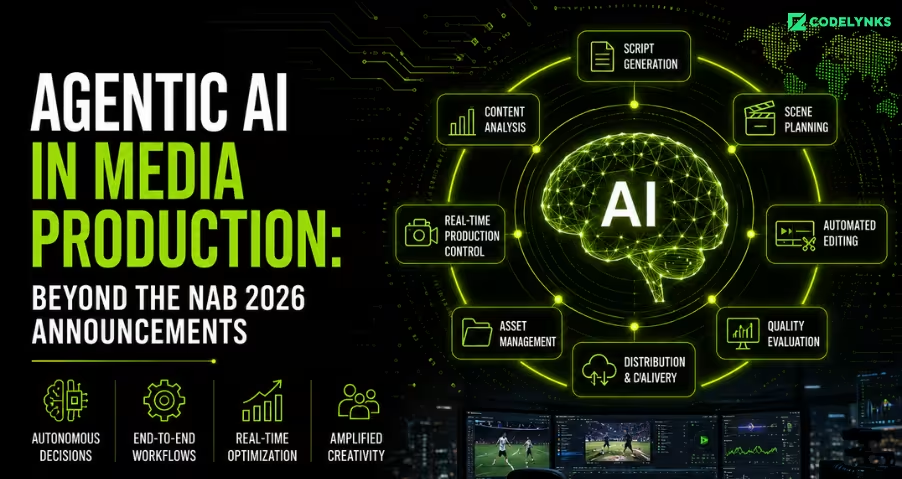
Agentic AI in Media Production: Beyond the NAB 2026 Announcements

Agentic AI in Media Production: Beyond the NAB 2026 Announcements banner showing AI-powered media production and intelligent workflows.

Agentic AI in Media Production is rapidly changing how broadcasters, OTT platforms, and post-production teams manage content. Beyond the NAB Show 2026 announcements, enterprises are adopting AI agents to automate metadata, orchestrate workflows, and accelerate content delivery.

What Agentic AI in Media Actually Does (Versus What the Demos Show)

The NAB 2026 announcements were built on top of clean, well-structured content libraries with consistent metadata foundations. Production environments in Indian media companies rarely look like that. The practical agentic AI capabilities in media production in 2026 split into two distinct categories.

Category 1: Metadata and search agents. These run against your content library and generate structured metadata automatically. Scene descriptions, speaker identification, emotion tags, topic classification, language detection, content moderation flags. The Iconik platform from Backlight has demonstrated 50% shorter production cycles from this category alone. The work is parallelized. You run it once on ingestion. Every clip in your library becomes findable without a human logging each one manually.

Category 2: Workflow orchestration agents. These coordinate complex multi-step tasks, such as receiving a finished cut, generating social clips for each platform format, creating language-specific subtitle files, triggering a compliance review, and filing the output package in the correct archive location. Each step is a tool call for the agent. A human approves the final output, not each intermediate step.

> The industry debate about AI replacing editors is a distraction. The first ROI is in metadata, not in timelines.

Category 1 delivers ROI without touching the creative workflow. Category 2 compresses the post-production pipeline without changing what editors do. Neither category replaces editors. Both categories make the entire content supply chain faster and more auditable.

> 50% shorter production cycles do not come from AI touching the edit. They come from AI making every clip findable before an editor opens the project.

The Real Gap: Content Libraries That AI Agents Cannot Work With

Indian OTT platforms building agentic AI workflows face a problem the NAB demos do not show: most legacy content libraries are not AI-ready. The specific blockers we encounter consistently:

Inconsistent file naming and folder structure. Content operations teams develop their own conventions over time. A 2019 archive uses one structure; a 2022 acquisition uses another. An AI metadata agent cannot work reliably on a library where the same concept is represented in 14 different folder naming patterns.

Missing or incorrect language metadata. An AI agent routing content to language-specific subtitle workflows needs the primary language of each asset. If language is missing from metadata for 40% of the library, routing fails silently for those assets. Silent failures are worse than loud ones in a content supply chain.

Unmanaged duplicate assets. A typical OTT library has 3 to 5 copies of each final cut: delivery format variants, resolution variants, watermarked review versions. Without a clean master/derivative relationship in the asset metadata, AI agents cannot identify the authoritative source for downstream processing. They process the wrong file.

We worked with a Mumbai-based OTT platform, 28 million subscribers, producing 120 to 150 hours of original content per year across 8 regional languages. Their content operations team spent 35 to 40% of weekly capacity on manual metadata entry, delivery packaging, and archive filing. When we assessed their library against AI agent readiness requirements, 62% of assets failed at least one data quality check.

The three months before deploying the metadata agent involved: consolidating 14 naming conventions into 2, backfilling language metadata for 47,000 assets, and establishing a master/derivative relationship model in the MAM. The metadata agent, once deployed against clean inputs, reduced manual logging time by 68% and eliminated the category of errors caused by misrouted subtitle jobs entirely.

Building the Agent Pipeline: Architecture Decisions That Matter

An agentic media workflow is not a single AI model. It is a directed graph of tool calls, each with its own latency, cost, and failure mode. The key decisions for production-grade agentic media pipelines:

Model selection per task. A metadata tagging agent does not need frontier reasoning capability. Scene categorization on video thumbnails can run on a lighter, faster, cheaper vision model. A compliance flagging task where false negatives have legal implications needs a model with documented false negative rates and a human review queue for borderline cases, not the fastest available model.

Human-in-the-loop placement. Automated metadata generation should have a review queue for content flagged as ambiguous or potentially sensitive. Building the human review interface is as important as building the agent pipeline. Without it, you have automated confidence with no correction mechanism.

MAM integration as the system of record. Every agent output must write to the Media Asset Manager (MAM) as the system of record, not to a separate database. If the agent runs and the MAM does not reflect the result, you have created a secondary data store that will diverge from the canonical library. This is the failure mode that makes agents dangerous rather than useful.

Cost and token accounting per content type. A 45-minute documentary episode costs 4 to 6 times more to process through a video analysis model than a 90-second social clip. Your agent pipeline must track processing cost per asset type to avoid budget surprises at scale. The cost accounting tells you which content types justify automated processing and which should queue for batch runs during off-peak hours.

The Media Agentic Workflow Readiness Matrix (MAWRM)

We assess media companies on four dimensions before recommending an agent architecture:

| Dimension | Not Ready | Foundational | Production-Ready |

| Content library data quality | Under 50% of assets pass basic metadata checks | 50 to 80% pass, gaps documented | Over 80% pass, remediation plan for remainder |

| MAM integration | No MAM or shadow databases in active use | MAM is system of record but API coverage is partial | MAM API covers all asset operations and webhooks for events |

| Human review workflow | No review process defined for agent outputs | Review queue exists, no SLA defined | Review queue with defined SLA and escalation path |

| Cost governance | No per-task AI cost tracking | Total AI spend tracked, not broken down per asset type | Per-asset-type cost tracked and budgeted quarterly |

A company at “Not Ready” on content library data quality should not deploy a metadata agent. The agent will process bad inputs and write bad outputs to the MAM at agent speed. The remediation cost exceeds the productivity gain by a factor that is uncomfortable to explain to a board.

The Avid-Google Cloud Partnership and What It Signals for Indian OTT

The Avid-Google Cloud partnership, announced April 16, 2026 at NAB, integrates Gemini models and Vertex AI into two specific products: Media Composer, the industry-standard non-linear editing system for film and TV, and Content Core, Avid’s cloud-native SaaS MAM platform for managing global media assets.

The specific capabilities being integrated: AI-assisted metadata management that understands narrative context, intelligent content search, and workflow automation for media discovery. Avid described it as transforming video editing from a mostly manual process into an intelligent, AI-assisted experience.

For Indian OTT platforms not running: With Avid tools, the signal is the direction of travel for the entire industry toolchain, not the specific product. Google’s Cloud for Media and Entertainment ecosystem guide, published in April 2026, explicitly frames agentic AI as the next standard layer in media production, not a future option.

> An AI that watches your 4K rushes and writes searchable metadata is not a feature. It is the new cost baseline for staying competitive in content production.

What this means for Media and Entertainment leaders

The Avid-Google Cloud partnership signals where the major toolchain vendors are investing. For Indian OTT platforms, the question is not whether to build this capability. It is whether your content library is ready for an AI agent to work on, and whether your MAM is the right integration point.

The step you can take this week: pick one content type, one genre or one language track, and run a data quality audit on 100 assets from that library. Count how many fail a basic metadata completeness check: title, language, duration, content type, and creation date all present and correctly formatted. If more than 30% fail, the first investment is remediation, not agents. The 30% threshold is not arbitrary. It is the point where false positive agent outputs exceed the productivity gain from correct ones.

More Blogs: Your Shopify Store Cannot Serve an ONDC Buyer App. Here Is What Can.

AIS 189 Compliance: What Automotive Engineers Must Do Now

AIS 189 Compliance: What Automotive Engineers Must Do Now banner showing automotive cybersecurity and software compliance.

Introduction 

AIS 189 Compliance Is Coming. Your Automotive Software Team Has 18 Months to Build a System That Doesn’t Exist Yet.

India’s Automotive Industry Standards Committee published AIS 189 and AIS 190, the country’s cybersecurity and software update management standards for road vehicles, and by 2026-2027 they enter vehicle type approval scope. For a Tier-2 electronics supplier building telematics units, infotainment controllers, or ADAS ECUs, this is not a distant regulatory event. It is an engineering constraint already affecting procurement decisions from OEM partners who are themselves under compliance pressure. As of April 2026, no L-category two-wheeler in India meets the AIS 189 scope. Four-wheelers are not far ahead. The window to build a compliant Cybersecurity Management System is narrow, and it is closing.

What AIS 189 Actually Requires (and What Most Teams Think It Requires)

AIS 189 maps to UNECE R155 and ISO/SAE 21434. AIS 190 maps to UNECE R156 for software update management systems. Both are drafted by ARAI under the Ministry of Road Transport and Highways.

Most engineering teams read these standards and arrive at the same conclusion: they need better penetration testing. This is the wrong conclusion. The standards require a Cybersecurity Management System (CSMS), a documented, auditable process that covers:

Risk assessment across the full vehicle lifecycle, not just at design time

Supplier cybersecurity controls and their documentation

Incident monitoring and response procedures

Processes for issuing, verifying, and rolling back OTA updates securely

A penetration test produces a list of vulnerabilities. A CSMS produces evidence that your organization has a repeatable process for finding and managing vulnerabilities before, during, and after production. These are not the same deliverable.

AIS 189 is not a certification you acquire. It is an engineering process you must operate continuously.

The gap most suppliers have is not in their firmware. It is in their process documentation and their supplier chain controls.

The OTA Security Problem Is Harder Than the Update Problem

AIS 190 specifically governs Software Update Management Systems (SUMS). The engineering challenge here is distinct from the CSMS work under AIS 189.

A secure OTA update system for connected vehicles requires the following:

Code signing infrastructure: Every firmware package must be signed by the developer and verified by the receiving ECU before installation. This requires a Hardware Security Module (HSM) in both the signing pipeline and the vehicle endpoint.

Rollback protection: An ECU that accepted a compromised update and rolled back to a previous version is still a security incident. The SUMS must log the rollback and trigger an investigation workflow.

Campaign management with integrity checks: The update delivery pipeline must verify package integrity at every step, from the update server to the CDN to the vehicle’s telematics unit.

Multi-domain coordination: Modern vehicles carry 80 to 150 ECUs across multiple domains, sometimes from different Tier-1 suppliers. An OTA update to one domain can create compatibility issues in another if the SUMS does not manage dependencies explicitly.

Qualcomm and Google expanded their Android OTA partnership in January 2026 specifically to address multi-domain software complexity in production vehicles. The problem they are solving is the same one Indian suppliers are facing: OTA update systems designed for one ECU at a time cannot handle the software-defined vehicle architecture.

The global automotive OTA compliance market sits at USD 5.41 billion in 2026. By 2036, that number is projected at USD 18 billion. The compliance investment is not discretionary for OEMs selling into markets where type approval depends on it.

Where Indian Suppliers Are Getting Stuck

We worked with a Tier-2 automotive electronics supplier in Pune that produces telematics control units for three Indian OEMs. They had strong engineering on the firmware side, a mature CI/CD pipeline, and a reasonably secure TLS implementation on their update channel.

Their gap was not in the code. It was in the process.

They had no documented Threat Analysis and Risk Assessment (TARA) for their product portfolio. They had no supplier questionnaire for the component vendors who provided modules to them. They had no incident response playbook for a compromised update campaign. Their CSMS existed in the heads of three engineers who had each worked on ISO 21434 projects at previous employers.

When their OEM partner’s audit team asked for compliance documentation, there was nothing to hand over. The OEM did not cancel the relationship, but they required the supplier to produce a compliant CSMS within six months or face de-listing from their preferred supplier list.

Six months is not enough time to build a CSMS from scratch. It is barely enough time to document one.

The Vehicle Cybersecurity Compliance Ladder (VCCL)

Based on our work with automotive electronics teams, we use a five-rung model to assess readiness and sequence remediation:

Rung 1: Asset Inventory and TARA

List every software component, interface, and communication channel in your product portfolio. Complete a Threat Analysis and Risk Assessment per ISO/SAE 21434 Section 15. Output is a TARA document per product line, reviewed and signed off by engineering leadership.

Rung 2: CSMS Process Documentation

Document your cybersecurity policies, roles, incident response procedures, and supplier assessment process. This is the organizational layer that auditors look for first. Without it, Rungs 3 through 5 have no formal context.

Rung 3: Secure Development Lifecycle Integration

Embed security requirements into design reviews, integrate SAST and DAST into your CI pipeline, and define acceptance criteria for security test reports before milestone gates. Security testing becomes a release gate, not an audit activity.

Rung 4: OTA Security Infrastructure

Stand up your HSM-backed code signing pipeline, define your SUMS architecture per AIS 190, and build campaign management with rollback protection and integrity verification at every delivery stage.

Rung 5: Continuous Monitoring and Incident Management

Establish vulnerability monitoring for your product families, build the incident response runbook, and define your PSIRT (Product Security Incident Response Team) process. Post-production monitoring is a permanent CSMS obligation, not a project phase.

Most suppliers we assess are between Rung 1 and Rung 2. Rung 5 is required for full AIS 189 compliance. The gap is structural, not technical.

What Zero Trust Actually Means for OTA

Zero trust in an OTA context is often misunderstood as “always verify the update server.” That is table stakes. The zero trust model for OTA means the vehicle ECU does not implicitly trust any update, regardless of where it originates, unless it can independently verify the cryptographic signature against a root of trust stored in hardware.

This has three specific engineering implications:

The root of trust is in silicon. An HSM or Trusted Execution Environment (TEE) in the ECU holds the public key used to verify signatures. This key cannot be extracted or overwritten by software. The verification chain is end-to-end. Signature verification happens at the ECU, not at the gateway or the telematics unit. An intermediary device cannot re-sign on behalf of the ECU. Failed verifications trigger defined behavior. A rejected update does not leave the ECU in an undefined state. Your SUMS must specify the fallback behavior, and it must be tested against adversarial scenarios, not just network failure scenarios.

> Zero trust for OTA does not mean you distrust your update server. It means your vehicle ECU cannot trust it either.

The SAE technical paper 2026-26-0621, published in Q1 2026, provides implementation guidance for this architecture in multi-domain vehicle environments. It is worth reviewing before your next hardware design review, particularly the sections on ECU-level verification in Automotive Software Stores.

What this means for Automotive and Ride-Hailing Mobility leaders

If you are a CTO or VP Engineering at an Indian OEM or Tier-1/2 supplier, AIS 189 compliance is now a procurement filter, not a future concern. Your OEM partners are themselves under compliance pressure and will pass it down the supply chain through supplier audits and preferred supplier list criteria.

The concrete steps you can take this week: pull your current product list and identify which ones have a TARA document. For those that do not, assign an owner and a four-week timeline to produce one. Separately, identify who in your organization owns incident response for a potential OTA security event. If the answer is no one specifically, that is the highest-priority gap in your CSMS.

You do not need to complete the VCCL in six months. You need to be able to demonstrate to an auditor that you are actively climbing it, with evidence at each rung.

More Blog: Your Shopify Store Cannot Serve an ONDC Buyer App. Here Is What Can.

The EU Cyber Resilience Act Compliance Guide 2026: What Product Teams Must Do Before 2027

The EU Cyber Resilience Act: Product Teams Must Know with cybersecurity shield and EU compliance illustration.

Introduction

Cyber Resilience Act compliance is now a business requirement for any organization that develops, imports, distributes, or sells products with digital elements in the European Union. The EU Cyber Resilience Act changes what it takes to sell software in Europe. Security is no longer a step you clear before release. It is a legal obligation that applies across the entire product lifecycle. If you place a product with digital elements on the EU market, the CRA applies to you, whether you build the software, import it, or resell it. The deadlines are fixed, and the first one that matters is closer than most teams think.

The regulation entered into force on 10 December 2024. Vulnerability and incident reporting obligations start on 11 September 2026. The full set of requirements becomes enforceable on 11 December 2027. Preparation that starts in 2027 starts too late.

Who the CRA covers

The scope is broad. It reaches software vendors, manufacturers, importers, distributors, and companies outside the EU that sell into it. The products in scope include connected devices, embedded systems, industrial equipment, automotive platforms, medical devices, networking gear, IoT hardware, and standalone software. If it has digital elements and it reaches the EU market, assume it counts until you confirm otherwise.

The CRA sorts products into risk tiers, and the tier sets the compliance path. Most products, roughly nine in ten, fall into the default class and clear through self-assessment. Important products, such as password managers and operating systems, face tighter expectations, and the higher band requires third-party evaluation. Critical products, such as smart meters and hardware security modules, sit at the top and can require EU certification. Knowing your tier is the first real decision, because it drives everything after it.

The 24-hour clock

The reporting rules are where the CRA gets operationally hard. For an actively exploited vulnerability, you have 24 hours to send an early warning to ENISA and the relevant national CSIRT. Within 72 hours, you file a fuller notification with technical detail, severity, and any interim mitigation. Within 14 days, you deliver a final report covering root cause, affected versions, and evidence of the fix.

One detail decides whether teams can meet this. The 24-hour clock starts when you become aware of active exploitation. Not when you confirm root cause. Not when you have a patch ready. That means detection has to be continuous, reporting templates have to be written in advance, and escalation has to be rehearsed. Designing the process during a live incident is not an option the timeline allows.

Secure by design, across the whole lifecycle

The CRA expects security to be built in, not bolted on. That plays out at every stage. Threat modeling belongs in design review. Static analysis rules belong in the IDE and the CI pipeline, so weaknesses surface as code is written. Tests have to prove that security functions like input validation and access control actually work. Releases have to ship with a software bill of materials, scan results, and traceability. After release, monitoring and patch validation continue for the supported life of the product. Release is not the finish line under the CRA. It is the start of an obligation.

An SBOM is not a checkbox

A software bill of materials is required, but the document alone proves nothing. It has value only when it drives action. Generate it automatically for every release. Match its components against vulnerability databases. Assess each CVE for exploitability in your actual product, not in the abstract. Track remediation to a fix, a component update, or a documented and accepted risk. Then verify the fix with regression tests and a fresh scan. Without that chain, an SBOM is just a list. With it, the SBOM becomes evidence of due diligence, which is what market surveillance will ask for.

Why manual compliance breaks

Disconnected tools, spreadsheets, and late-stage security reviews collapse under CRA pressure. The 24-hour rule leaves no room for hand-assembled evidence. The answer is automation wired into the delivery pipeline. Every build should produce test results, coverage reports, and scan logs. That output is not overhead. It is the audit trail. Static analysis catches OWASP Top 10 and CWE weaknesses early. Dependency scanning keeps the SBOM current. Regression testing confirms that a patch fixed the problem without introducing a new one. Tie each test back to a requirement, and compliance evidence generates itself.

Where Codelynks fits

CRA readiness is an engineering program, not a policy memo. It takes secure development practices, automated security testing, SBOM and vulnerability workflows that actually close the loop, and a reporting capability that can move in 24 hours. That is the work Codelynks does. Our cybersecurity and test engineering teams run CRA gap assessments against your product portfolio, wire SAST and dependency scanning into your CI/CD pipeline, automate SBOM generation and CVE triage, build requirements-to-test traceability that produces audit-ready evidence on every build, and drill your team on the 24-hour, 72-hour, and 14-day reporting sequence so it works under real pressure.

The organizations that start now turn a compliance burden into an advantage. Stronger software, lower risk, and provable secure-by-design practices earn customer trust that late movers cannot claim. Talk to Codelynks about a CRA readiness assessment, and get ahead of the September 2026 reporting deadline while there is still time to do it well.

Cyber Resilience Act compliance is not just about meeting regulatory requirements. It is about building secure products, reducing business risk, and demonstrating secure-by-design practices throughout the software lifecycle. Organizations that prepare now will be better positioned for the September 2026 reporting obligations and the full 2027 enforcement deadline.

More Blogs: India Stack API Integration: Why ONDC and GeM Projects Fail Without the Right Architecture

  • Copyright © 2026 codelynks.com. All rights reserved.

  • Terms of Use | Privacy Policy