Serverless vs Containers: Cost, Performance & Scaling in 2026

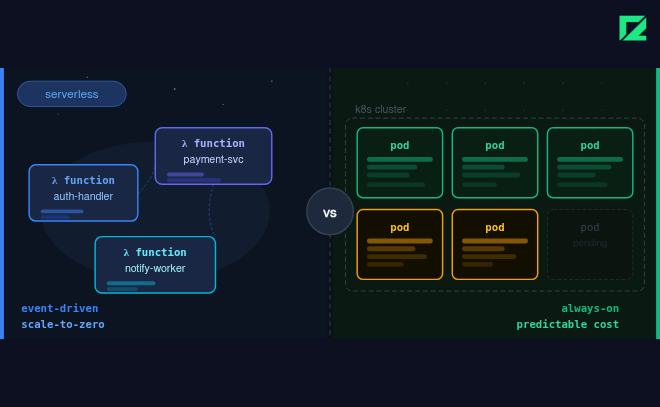
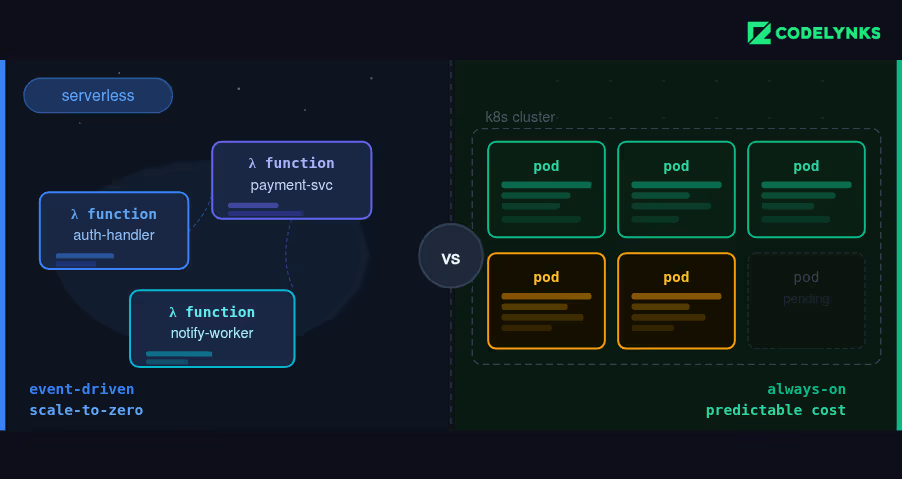
Serverless vs Containers cloud architecture comparison

Serverless vs Containers in 2026: Compare cost, performance, scalability, Kubernetes, AWS Lambda, cold starts, and cloud architecture tradeoffs for modern engineering teams. Every team evaluating cloud architecture in 2026 faces this question: serverless or containers? The answer is not universal, and teams that default to one without understanding the tradeoffs end up paying for it, literally, in infrastructure costs and engineering time.

Serverless vs Containers decisions depend heavily on workload patterns, scalability needs, and operational complexity.

We have built production systems on both. This post is an objective comparison based on real workloads, not vendor marketing.

The Core Tradeoff

Serverless (AWS Lambda, Google Cloud Functions, Azure Functions) gives you automatic scaling, zero infrastructure management, and a pay-per-invocation cost model. You pay only for the compute you use, and you never need to provision or manage a server.

Containers (Docker on Kubernetes) give you consistent runtime environments, portability across cloud providers, and full control over the execution environment. You pay for the nodes running your cluster, whether or not they are handling traffic.

Neither is universally better. The right choice depends on your workload characteristics, team capability, and operational requirements.

Serverless vs Containers: Cost and Performance Comparison

CriteriaServerless (Lambda/Cloud Functions)Containers (Kubernetes)
Cold start latency100ms-3s (varies by runtime)Near zero (always warm)
Cost modelPay per invocation + durationPay per node, running or idle
ScalingAutomatic, per requestCluster autoscaler, slower
Max execution time15 min (AWS Lambda)Unlimited
State managementStateless onlyStateful workloads supported
Operational overheadVery lowMedium to high
Vendor lock-inHigh (runtime-specific)Low (OCI-compatible)
Best forEvent-driven, bursty workloadsLong-running, stateful services

Cost Analysis: When Serverless Is Cheaper (and When It Is Not)

Serverless costs scale linearly with usage. At low and moderate request volumes, serverless is almost always cheaper than running a container cluster. There is no idle compute cost: when no requests come in, you pay nothing. The serverless vs. containers debate became more important as AI and real-time workloads increased in 2026.

Many companies evaluating Serverless vs Containers focus primarily on infrastructure efficiency and scaling behavior.

Where serverless wins on cost

  • Event-driven processing with irregular traffic patterns (file upload handlers, webhook processors, scheduled jobs)
  • Applications with significant traffic variance between peak and off-peak (e-commerce with weekday vs. weekend spikes)
  • Development and staging environments where idle time dominates

Where containers win on cost

  • High-throughput applications with sustained, predictable traffic (SaaS APIs handling thousands of requests per minute continuously)
  • Long-running workloads: AWS Lambda max execution time is 15 minutes. Anything longer requires containers
  • Applications requiring large memory allocations: Lambda max is 10GB, but that configuration is significantly more expensive per GB-second than container memory

The crossover point varies by workload but typically occurs somewhere between 5 million and 20 million invocations per month for typical web API workloads. Above that threshold, a right-sized Kubernetes cluster with spot instances is usually cheaper than Lambda.

Cold Starts: The Serverless Latency Problem

Cold starts remain the primary technical limitation of serverless in 2026. When a Lambda function has not been invoked recently, the first request must wait for the runtime to initialise. This ranges from 100ms for lightweight Node.js functions to over 3 seconds for JVM-based functions or functions with large dependencies.

For user-facing APIs where p99 latency matters, cold starts are unacceptable without mitigation. Options:

  1. Provisioned Concurrency (AWS Lambda): Keeps a defined number of instances warm at all times. Eliminates cold starts but adds a fixed cost comparable to running containers.
  2. Language and runtime selection: Node.js and Python cold starts are measured in milliseconds. Java and .NET cold starts are measured in seconds. Match runtime choice to latency requirements.
  3. SnapStart (AWS Lambda for Java): Available since late 2022, reduces Java cold starts to under 1 second by caching initialised snapshots.

If you need provisioned concurrency to eliminate cold starts, re-evaluate whether containers would be more cost-effective for that workload.

The Vendor Lock-In Question

Serverless has a significant vendor lock-in characteristic that containers do not. Lambda functions use AWS-specific event schemas, runtime interfaces, and execution context. Migrating a Lambda-based architecture to Google Cloud Functions or Azure Functions requires rewriting the integration layer.

Containers built on OCI-compatible images and deployed to Kubernetes are portable. A Kubernetes deployment running on AWS EKS can be migrated to GKE or AKS with infrastructure configuration changes and no application code changes. This portability has real commercial value at contract renewal time.

For most applications, vendor lock-in is an acceptable tradeoff for the operational simplicity of serverless. For applications where cloud provider independence is a compliance or strategic requirement, containers are the right choice.

Our Recommendation: Hybrid by Default

For most production SaaS architectures in 2026, the right answer is hybrid: serverless for event-driven and asynchronous workloads, containers for core stateful services and high-throughput APIs.

Typical pattern we recommend and deploy for clients:

  1. Core API services: Kubernetes (EKS/GKE) with horizontal pod autoscaling
  2. Background jobs and event processors: Lambda or Cloud Functions
  3. Scheduled tasks and data pipelines: Lambda with EventBridge or Cloud Scheduler
  4. File processing, image resizing, data transformation: Lambda triggered by S3/GCS events

This architecture captures the cost efficiency of serverless for irregular workloads while maintaining the predictability and performance of containers for the core application surface.

Need Help With This?

Codelynks has built production cloud architectures across AWS, GCP, and Azure for clients in retail, healthcare, and fintech. Choosing between Serverless vs Containers requires balancing cost, control, latency, and operational overhead. If you are designing a cloud architecture for a new product or evaluating a migration from one approach to the other, talk to our engineering team at Contact us

Serverless Computing: Advantages and Challenges for Developers and Enterprises

Concept illustration of serverless computing with cloud infrastructure automation

Introduction

Serverless computing is transforming modern cloud-native applications by allowing developers to build scalable and event-driven architecture without managing infrastructure manually. Using serverless architecture, businesses can improve cloud scalability, automate deployments, and accelerate application development through services such as AWS Lambda, Google Cloud Functions, and Azure Functions.

What Is Serverless Computing?

Serverless computing is commonly used in microservices architectures where applications are divided into smaller independent services. This approach improves flexibility, scalability, and deployment efficiency for modern cloud applications. With serverless computing, you’ll only pay for resources used because there is no provisioning, managing, or scaling of servers on your own.

So, the thing that comes most closely to the surface about serverless architecture is perhaps Function as a Service, like AWS Lambda, Google Cloud Functions, and Azure Functions. Such platforms execute small, discrete functions in response to the occurrence of certain events, such as an HTTP request or some other update to a database. It goes up scalability and efficiency by leaps and bounds.

Benefits of Serverless Computing for Developers

At the very least, serverless computing presents quite a broad set of advantages, making the development process smooth, and setting developers free to deliver applications faster and more efficiently:

No Infrastructure Management: The biggest attraction of serverless computing is that developers no longer need to manage infrastructure. Developers would have to manage provisioning, configuration, patching, and scaling of servers in traditional approaches. Serverless computing lets a cloud provider do all of this, so developers can focus on the writing and deploying of code.

For instance, with AWS Lambda, a developer can deploy a function in minutes without having to bother about the server capacity or configuration. This ease in deployment accelerates the development cycles, and hence, development teams can deliver features much quicker.

No Headache About Scaling: Serverless platforms scale dynamically in response to demand. Whether your application is getting 10 or 10,000 requests per second, serverless computing makes adjustments right over resources in real time. No manual configuration is required of developers by way of scaling policies and that reduces complexity and the risk of under or over-provisioning of resources.

Another example is Netflix, wherein it leverages AWS Lambda to automatically scale its serverless functions for handling high workloads during the actual view periods while not facing inefficiencies of infrastructure cost.

Cost Efficiency: With serverless, you pay only for the compute time consumed rather than pre-purchasing or overprovisioning resources. With this pay-as-you-go model, really saves money in many parts of an application, especially when applications have variable and unpredictable traffic patterns. Developers can focus on optimizing code without having to worry about maintaining costly idle infrastructure.

For example, an e-commerce company might have a huge spike during Christmas or Black Friday. With serverless computing, the application scales to these peaks in demand, but the firm only pays for actual time spent on computation so it never incurs costs of idle servers when not in usage during off-peak times.

Speedier Development and Deployment: Serverless platforms also support DevOps automation by simplifying CI/CD workflows, infrastructure provisioning, and automated deployments across cloud environments.

This model really sparks innovation. Developers will be so capable of trying new features as well as testing code or providing updates without even the bottlenecks generally associated with managing infrastructure.

Benefits for Businesses With Serverless Computing

Basically, the adoption of serverless computing for businesses generally implies more agility, operational efficiency, and innovation.

Reduced Operational Costs: With serverless computing, companies do not pay unless they have consumed resources; this does reduce the costs associated with conducting business. This is in contrast with traditional usage of cloud services because companies pay for unused capacities of the servers, and with the serverless models, charging directly depends on execution time of functions and may result in huge savings.

For instance, the fintech companies like Capital One are adopting serverless computing whereby they can eradicate infrastructure costs for the company but ensure robust scalable services. In other words, through serverless computing, Capital One removes itself from certain dedicated server maintenance whose cost can, in turn, be reinvested in new initiatives.

Accelerated Time-to-Market: Serverless minimizes time to develop and deploy applications and gives businesses a competitive advantage. Servers do not need to be stood up and maintained in this model; thus, teams focus more on coming up with innovative products and getting these to market as fast as possible.

This agility helps startups and scale-up businesses quickly bring new features to users without the cycles of traditional server-based deployment paradigms.

Scalability for Business Growth: Infrastructure needs to grow with the businesses. Serverless computing automatically scales applications so that increased levels of traffic do not cause a problem without human interference. This enables companies to better serve their customers as demand increases, with no potential downtime or deterioration in performance.

Slack is one of the leading communication platforms, whereby it relies on serverless computing to make sure that thousands of messages are processed within a second during peak times; thereby, making sure that services stay stable and strong as the company expands worldwide.Cloud scalability is one of the biggest advantages of serverless computing because resources automatically adjust based on workload demand without manual intervention.

Disadvantages of Serverless Computing

Serverless computing has a lot of benefits; however, there are challenges that come with this concept:

Cold Start: The main problem in a serverless environment is a cold start, where a function has not executed an action in a specific period of time and is invoked. This causes possible slight delay before execution, affecting performance-sensitive applications.

Vendor Lock-In: Adoption of serverless computing by businesses also causes vendor lock-in with particular cloud providers. For example, when you port the functions created on AWS Lambda to Azure Functions or Google Cloud Functions, much rewriting may be required. One needs to consider the long-term implication of relying on proprietary serverless technologies.

Debugging Complexity: The distributed nature of serverless architecture would make debugging more challenging when executed in isolated environments. Logging and monitoring then become important ways of making the system more visible.

Conclusion

Serverless computing is revolutionary because it not only alters the development processes but also the operations, providing more efficient and cost-effective and scalable solutions for modern applications. Developers can focus on innovation while the cloud providers take care of infrastructure, and businesses will gain advantages such as saving on costs, deploying services fast, and scaling without limits without those aforementioned constraints. As organizations continue adopting cloud-native applications and microservices, serverless computing will play a major role in improving operational efficiency and accelerating digital transformation.

More Blogs : DevOps Security and Compliance: 7 Best Practices for Modern Organizations

  • Copyright © 2026 codelynks.com. All rights reserved.

  • Terms of Use | Privacy Policy
