Table of Contents
Serverless vs Containers in 2026: Compare cost, performance, scalability, Kubernetes, AWS Lambda, cold starts, and cloud architecture tradeoffs for modern engineering teams. Every team evaluating cloud architecture in 2026 faces this question: serverless or containers? The answer is not universal, and teams that default to one without understanding the tradeoffs end up paying for it, literally, in infrastructure costs and engineering time.
Serverless vs Containers decisions depend heavily on workload patterns, scalability needs, and operational complexity.
We have built production systems on both. This post is an objective comparison based on real workloads, not vendor marketing.
The Core Tradeoff
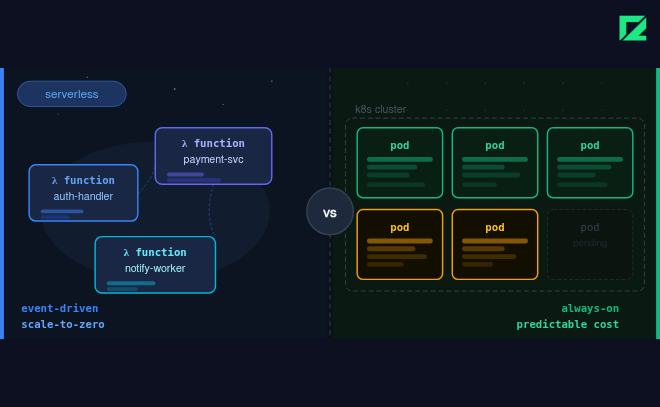
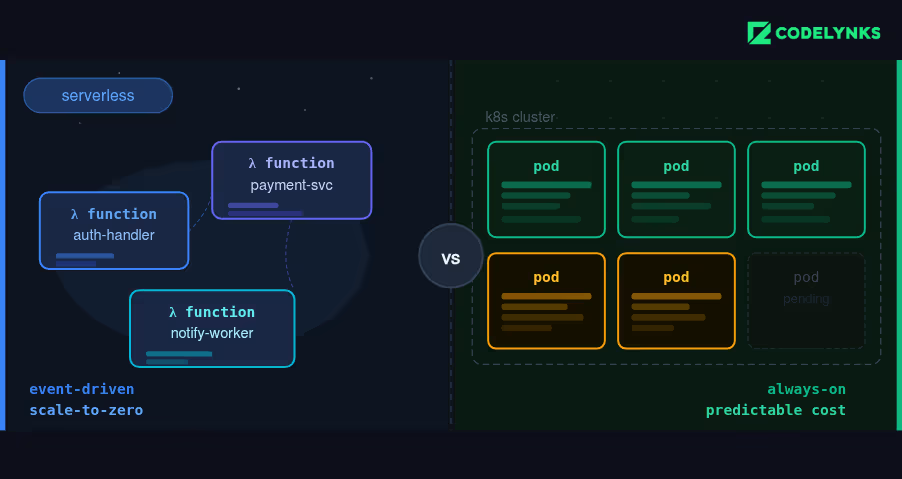
Serverless (AWS Lambda, Google Cloud Functions, Azure Functions) gives you automatic scaling, zero infrastructure management, and a pay-per-invocation cost model. You pay only for the compute you use, and you never need to provision or manage a server.
Containers (Docker on Kubernetes) give you consistent runtime environments, portability across cloud providers, and full control over the execution environment. You pay for the nodes running your cluster, whether or not they are handling traffic.
Neither is universally better. The right choice depends on your workload characteristics, team capability, and operational requirements.
Serverless vs Containers: Cost and Performance Comparison
| Criteria | Serverless (Lambda/Cloud Functions) | Containers (Kubernetes) |
| Cold start latency | 100ms-3s (varies by runtime) | Near zero (always warm) |
| Cost model | Pay per invocation + duration | Pay per node, running or idle |
| Scaling | Automatic, per request | Cluster autoscaler, slower |
| Max execution time | 15 min (AWS Lambda) | Unlimited |
| State management | Stateless only | Stateful workloads supported |
| Operational overhead | Very low | Medium to high |
| Vendor lock-in | High (runtime-specific) | Low (OCI-compatible) |
| Best for | Event-driven, bursty workloads | Long-running, stateful services |
Cost Analysis: When Serverless Is Cheaper (and When It Is Not)
Serverless costs scale linearly with usage. At low and moderate request volumes, serverless is almost always cheaper than running a container cluster. There is no idle compute cost: when no requests come in, you pay nothing. The serverless vs. containers debate became more important as AI and real-time workloads increased in 2026.
Many companies evaluating Serverless vs Containers focus primarily on infrastructure efficiency and scaling behavior.
Where serverless wins on cost
- Event-driven processing with irregular traffic patterns (file upload handlers, webhook processors, scheduled jobs)
- Applications with significant traffic variance between peak and off-peak (e-commerce with weekday vs. weekend spikes)
- Development and staging environments where idle time dominates
Where containers win on cost
- High-throughput applications with sustained, predictable traffic (SaaS APIs handling thousands of requests per minute continuously)
- Long-running workloads: AWS Lambda max execution time is 15 minutes. Anything longer requires containers
- Applications requiring large memory allocations: Lambda max is 10GB, but that configuration is significantly more expensive per GB-second than container memory
The crossover point varies by workload but typically occurs somewhere between 5 million and 20 million invocations per month for typical web API workloads. Above that threshold, a right-sized Kubernetes cluster with spot instances is usually cheaper than Lambda.
Cold Starts: The Serverless Latency Problem
Cold starts remain the primary technical limitation of serverless in 2026. When a Lambda function has not been invoked recently, the first request must wait for the runtime to initialise. This ranges from 100ms for lightweight Node.js functions to over 3 seconds for JVM-based functions or functions with large dependencies.
For user-facing APIs where p99 latency matters, cold starts are unacceptable without mitigation. Options:
- Provisioned Concurrency (AWS Lambda): Keeps a defined number of instances warm at all times. Eliminates cold starts but adds a fixed cost comparable to running containers.
- Language and runtime selection: Node.js and Python cold starts are measured in milliseconds. Java and .NET cold starts are measured in seconds. Match runtime choice to latency requirements.
- SnapStart (AWS Lambda for Java): Available since late 2022, reduces Java cold starts to under 1 second by caching initialised snapshots.
If you need provisioned concurrency to eliminate cold starts, re-evaluate whether containers would be more cost-effective for that workload.
The Vendor Lock-In Question
Serverless has a significant vendor lock-in characteristic that containers do not. Lambda functions use AWS-specific event schemas, runtime interfaces, and execution context. Migrating a Lambda-based architecture to Google Cloud Functions or Azure Functions requires rewriting the integration layer.
Containers built on OCI-compatible images and deployed to Kubernetes are portable. A Kubernetes deployment running on AWS EKS can be migrated to GKE or AKS with infrastructure configuration changes and no application code changes. This portability has real commercial value at contract renewal time.
For most applications, vendor lock-in is an acceptable tradeoff for the operational simplicity of serverless. For applications where cloud provider independence is a compliance or strategic requirement, containers are the right choice.
Our Recommendation: Hybrid by Default
For most production SaaS architectures in 2026, the right answer is hybrid: serverless for event-driven and asynchronous workloads, containers for core stateful services and high-throughput APIs.
Typical pattern we recommend and deploy for clients:
- Core API services: Kubernetes (EKS/GKE) with horizontal pod autoscaling
- Background jobs and event processors: Lambda or Cloud Functions
- Scheduled tasks and data pipelines: Lambda with EventBridge or Cloud Scheduler
- File processing, image resizing, data transformation: Lambda triggered by S3/GCS events
This architecture captures the cost efficiency of serverless for irregular workloads while maintaining the predictability and performance of containers for the core application surface.
Need Help With This?
Codelynks has built production cloud architectures across AWS, GCP, and Azure for clients in retail, healthcare, and fintech. Choosing between Serverless vs Containers requires balancing cost, control, latency, and operational overhead. If you are designing a cloud architecture for a new product or evaluating a migration from one approach to the other, talk to our engineering team at Contact us



