How Clinical AI in India Can Successfully Achieve Compliance in 2026

Clinical AI in India with ABDM-compliant healthcare systems and AI-powered clinical decision support

Introduction

Clinical AI in India is entering a new phase with the rollout of AI-powered decision support systems under the Ayushman Bharat Digital Mission (ABDM). For healthcare technology providers, Clinical AI in India is no longer an experimental initiative but a deployment reality. Clinical AI in India is rapidly evolving as healthcare providers adopt AI-driven decision support systems and ABDM-compliant digital health infrastructure.

Nearly 800 million ABHA health accounts have been created. For any digital health platform building clinical AI in India, that announcement is not a proof of concept to watch. It is a signal about where the infrastructure is heading and what compliance will require. The question is whether your architecture is built to participate or whether it will be locked out when the ecosystem matures.

What the Smart Doctor Rollout Reveals About Clinical AI in India

The Smart Doctor system operates through a rule-based clinical knowledge graph layered over patient data accessed via the ABHA API. It is not, by current descriptions, an agentic system in the AI engineering sense it does not autonomously initiate actions across systems. It reads records and surfaces recommendations within a constrained decision boundary.

That constraint is intentional. And it is where most teams building clinical AI in India get the architecture wrong.The success of Clinical AI in India depends not only on model accuracy but also on interoperability, patient consent management, and adherence to regulatory frameworks. As adoption grows, Clinical AI in India must align with ABDM standards to ensure secure and scalable healthcare delivery.

The instinct when building with LLMs is to give the agent broad tool access. Read the patient record, query the drug database, cross-reference the protocol library, generate the recommendation. This feels efficient. It mirrors how a clinician actually works. The problem is that in a clinical context, the agent’s action surface must be defined before deployment, not discovered through use. Every tool the agent can call is a category of liability. Every write operation is a consent event under the DPDP Act.

An agent that can read a patient’s ABHA-linked records can also write to them. That asymmetry is where clinical AI governance breaks down.

Why ABDM Compliance Is a Hard Engineering Constraint, Not a Policy Checkbox

ABDM defines three integration milestones that any healthcare software must pass to access the ecosystem:

Milestone 1: ABHA number creation and capture. Healthcare providers identify patients through their Ayushman Bharat Health Account number. This milestone establishes the patient identity layer your agent operates on.

Milestone 2: Health Information Provider (HIP) services. Your platform must be capable of sharing structured health records in ABDM-compliant format (FHIR R4) via the Personal Health Records app. This is the data contribution obligation.

Milestone 3: Health Information User (HIU) services. Your platform can request and receive a patient’s health records from other HIP systems, with explicit patient consent managed through the ABDM consent framework. The ABDM consent framework authorizes your agent’s data access at this stage..For organizations building clinical AI in India, Milestone 3 certification is increasingly becoming a prerequisite for accessing patient records across the ABDM ecosystem.

ABDM Milestone 3 is not a feature to add later. It is the architectural contract that determines whether your system can ever be auditable.

The consent manager at the center of ABDM records purpose, scope, and duration for every data access request. For an agentic system, this means the agent’s data access at inference time must be traceable to a consent artifact. If your agent fetches a patient’s diabetes history from a linked HIP without a valid, unexpired consent artifact on record, ABDM rules classify the data access as unauthorized.

A composite digital health platform we work with in western India learned this late in their development cycle. They had built a capable AI diagnostic assistant. It accessed ABHA-linked records, synthesized clinical history, and generated triage recommendations. The consent mechanism was present at the user account level but was not wired into the individual data-fetch operations at the agent level. Every API call to a HIP was executing without a consent artifact lookup. Architecturally, the system was operating outside ABDM’s data sharing rules on every inference.

The fix required redesigning the agent’s tool layer so that each data access function checked consent artifact status before execution. It added three weeks to their launch timeline and changed the data access pattern significantly.

The Clinical Agent Safety Matrix (CASM)

The CASM is a four-quadrant framework for classifying agent capabilities by their risk profile. Use it before defining your agent’s tool access policy.

The two axes are action reversibility (can the output be undone?) and patient impact directness (does the output affect clinical care immediately, or does it inform a human decision?).

Quadrant 1: Low reversibility, direct impact: Agent actions that directly update clinical records, prescribe medications, or trigger care protocols. These require mandatory human confirmation before execution and should not be in scope for initial deployment.

Quadrant 2: Low reversibility, indirect impact: Agent outputs that are transmitted to downstream systems (referral requests, insurance pre-authorization submissions). These require a review queue and an override mechanism before transmission.

Quadrant 3: High reversibility, direct impact: Agent-generated recommendations displayed to a clinician, where the clinician makes the final decision. This is the appropriate scope for a first clinical AI deployment. Recommendations are suggestions, not instructions.

Quadrant 4: High reversibility, indirect impact: Agent-generated summaries, flags, and administrative outputs (appointment scheduling, document indexing). Lowest risk. Good scope for automation without human review on every output.

A responsible clinical agent architecture for a first production deployment limits autonomous action to Quadrant 4, puts Quadrant 3 outputs through a clinician review step, and does not automate Quadrant 1 or 2 without a proven safety record and explicit clinical governance sign-off.

Clinical agents fail gracefully or they fail dangerously. There is no middle ground.

Agentic Architecture Patterns That Hold Up Under Clinical Scrutiny

Pattern 1: Tool-gated access with consent pre-check. Every tool the agent can call patient history fetch, drug interaction lookup, protocol query begins with a consent artifact check. If no valid consent is on file for the requested data category and purpose, the tool returns a structured error rather than calling the HIP API. The agent’s tool definitions enforce this; the application layer does not need to.

Pattern 2: Read-only inference mode as the default. The agent operates in read-only mode by default. Write operations (health record updates, referral submissions) exist as separate tools with a different access policy, a different approval gate, and separate audit logging. This keeps the scope of inference-time risk narrow.

Pattern 3: Structured output enforcement. Clinical recommendations are produced in a typed schema (condition flagged, evidence level, recommended action, confidence band, source citations). Free-text generation is used only for the human-readable summary field, not for the recommendation fields that downstream systems consume. This prevents hallucination from propagating into structured clinical data.

Pattern 4: Version-locked knowledge graphs. Clinical protocols and drug databases are versioned and immutable once deployed. The agent references a specific version by ID. Updates to clinical knowledge require a new knowledge base version with a formal review step, not a live update to the data source the agent queries.

Responsible deployment of Clinical AI in India requires strict governance controls, auditability, and consent-aware tool access mechanisms.

The Data Pipeline Problem in Federated Indian Healthcare

ABDM’s health information exchange model is federated. Records live with the HIP that created them. When your agent requests a patient’s history, it may trigger consent-gated fetches from ten different HIP systems each with different response times, different FHIR implementation quality, and different uptime characteristics.

This creates a latency problem. An agent that needs to wait for ten HIP API responses before generating a recommendation is not clinically usable. The failure mode is not a crash it is a wait state that a busy clinician cannot tolerate.One of the biggest challenges facing Clinical AI in India is managing data access across multiple HIP systems while maintaining performance and compliance.

The practical solution is a consent-aware local cache layer. Records fetched under valid consent are cached for the consent duration. Subsequent agent requests within the same session hit the cache. The cache is invalidated when consent expires or is revoked.

The engineering complexity is in the invalidation logic. Consent revocation must propagate to the cache synchronously. If a patient revokes consent between two agent queries in the same session, the second query must hit the HIP, not the cache and the agent must handle a mid-session data access failure without surfacing patient data that is no longer authorized.

What This Means for Healthcare Technology Leaders

India’s ABDM ecosystem is reaching the point where clinical AI that does not integrate with it is increasingly undeployable at scale. Hospitals and clinics onboarding under ABDM expect their software partners to be Milestone 3 certified. That bar will only move upward as the Smart Doctor rollout creates a new baseline expectation.

The concrete steps you can take this week: audit your current integration status against ABDM Milestones 1, 2, and 3. If you are at Milestone 1 only, you cannot legally access patient records from other HIP systems, which means your agent is limited to the data your own platform has collected. Map that constraint against your product roadmap and decide whether the FHIR/HIU investment is a dependency or a future feature.

If you are building agentic capabilities, start with the CASM quadrant classification before writing any code. The action boundary decisions made at architecture time are extremely difficult to reverse once user behavior is formed around them.Responsible deployment of Clinical AI in India requires strict governance controls, auditability, and consent-aware tool access mechanisms.

About the author: The Codelynks AI engineering team has built ABDM-integrated health platforms and clinical AI systems across private hospital networks in India. Connect on LinkedIn

Conclusion:

The future of Clinical AI in India will be shaped by ABDM integration, FHIR interoperability, and privacy-by-design principles. Organizations investing in Clinical AI in India today can create solutions that are deployable, scalable, and trusted across the healthcare ecosystem. As healthcare digitization accelerates, Clinical AI in India will play a critical role in improving clinical outcomes and operational efficiency.

FAQ’s

What is ABDM Milestone 3, and why does it matter for clinical AI?

Milestone 3 is the Health Information User (HIU) certification that allows a platform to request patient health records from any HIP system in the ABDM network with patient consent. Without it, a clinical AI system can only access data the platform itself has collected, severely limiting its clinical utility.

Does an agentic AI system in healthcare need separate consent for each data access?

Under ABDM’s consent framework, consent is granted by data category and purpose. A single consent artifact can cover multiple fetches within that scope. However, the consent artifact must be validated at the point of data access, not just at login.

How does the DPDP Act affect clinical AI systems in India?

The Digital Personal Data Protection Act requires explicit, purpose-limited consent for processing health data, classified as sensitive personal data. For clinical AI, this means the agent’s data access purpose must match the consent purpose recorded in the ABDM consent manager.

Can a clinical AI agent write to ABHA-linked health records?

Write operations require HIP certification and patient consent covering the write purpose. They carry higher regulatory and clinical liability than read operations and should not be in scope for initial agentic deployments without a proven safety record.

What is the difference between a clinical AI assistant and a clinical AI agent?

A clinical AI assistant generates recommendations for human review. A clinical AI agent can initiate actions across systems based on those recommendations. The governance requirements differ significantly agents require explicit action boundary definitions, consent-aware tool access, and human override mechanisms that assistants do not.
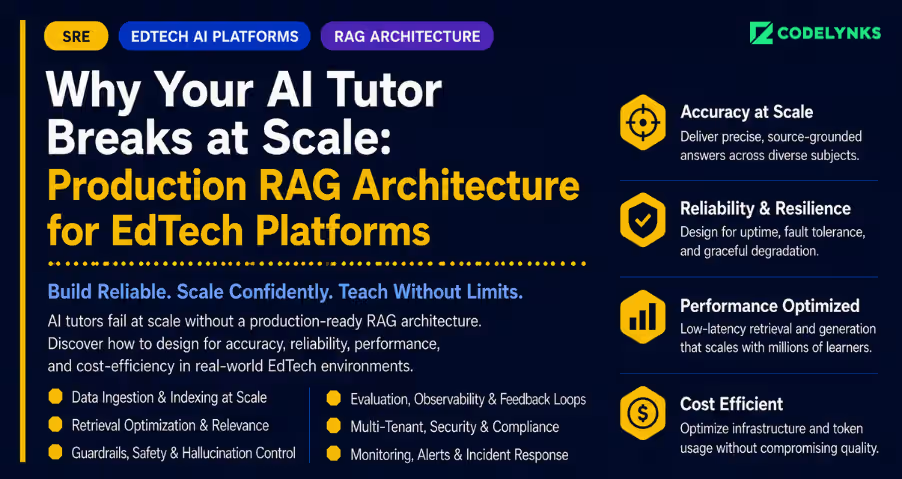
Why Your AI Tutor Breaks at Scale: Production RAG Architecture for EdTech Platforms

Production RAG Architecture for EdTech AI Platforms

Introduction:

A mid-size ed-tech platform in India launched their AI tutor in January 2026. In the demo, it answered curriculum questions in 1.2 seconds with 94% accuracy against their grading rubric. In the classroom pilot with 800 students three months later, it averaged 8.7 seconds per response, hallucinated chapter numbers that did not exist in the NCERT textbooks, and failed entirely when a student asked a question that bridged two subject domains. The architecture that worked in the demo was vector RAG over a flat document store. The architecture that would have survived the classroom was not.

This gap is not unique to that platform. Most EdTech teams building AI tutors in 2026 are deploying architectures that are optimized for demo accuracy and underspecified for production reliability. The research now backs what production deployments have been showing: RAG-based tutoring systems require a different architecture than general-purpose RAG, and the differences are not cosmetic.

Why Vector RAG Fails Curriculum Content at Scale

Vector RAG works by converting a query into an embedding and retrieving the nearest chunks from a document store. For general knowledge retrieval, this is adequate. For curriculum content, it has a structural mismatch.

Curriculum knowledge is relational, not spatial. A student asking, “Why does current increase when resistance decreases?” needs an answer that assumes they have already understood Ohm’s Law. If they have not, the correct answer is to explain the prerequisite first. Vector similarity cannot represent that dependency. The nearest chunks to the query are the most conceptually similar, not the most pedagogically appropriate.

The failure modes this produces in production: responses that assume prior knowledge the student has not acquired, answers that correctly reference a concept but in the wrong order for the student’s current level, and complete retrieval failures when a query involves concepts from two subject areas that were indexed separately.

The PRAG-EDU framework published in *Computer Applications in Engineering Education* this year showed that grade-aware RAG where retrieval is calibrated to a student’s historical module performance, produced a 23.7% improvement in BERTScore F1 over standard vector retrieval. The improvement came from adjusting which chunks were retrieved based on the student’s demonstrated competence level, not from changing the underlying model.

A vector similarity score is not a pedagogical prerequisite. GraphRAG understands that one concept must come before another. Vector RAG does not.

GraphRAG vs Vector RAG: The EdTech Architecture Decision

GraphRAG represents curriculum content as a knowledge graph; nodes are concepts, edges are prerequisite and co-requisite relationships, and each node carries metadata about Bloom’s Taxonomy level and grade alignment.

When a student asks a question, GraphRAG retrieves not just the most similar chunk but the contextually adjacent concepts in the learning graph. This enables the tutoring system to answer the question, identify what the student needs to understand next, and detect gaps in foundational knowledge three things a vector store cannot do.

The practical objection is build cost. GraphRAG requires upfront curriculum ontology work someone must map the prerequisite relationships in your content. For a platform with 10,000 hours of NCERT-aligned content across 12 subjects, that is a significant indexing project.

The answer is to start with GraphRAG for high-stakes subject areas (mathematics, physics) where prerequisite dependencies are strict and the cost of wrong retrieval is highest, and use hybrid retrieval (graph + vector) for subjects where the knowledge structure is more associative (history, literature). The LPITutor system (published in PMC 2026) demonstrated this hybrid approach at the curriculum scale, using RAG with structured prompt engineering to handle both factual and explanatory query types.

LLM-agnostic architecture is worth addressing separately. The model behind your tutor will change probably annually. Every system prompt, retrieval pipeline, and session memory structure should be model-independent. Platforms that hardcoded GPT-4 or Gemini 1.5 Pro into their retrieval logic are rebuilding integration layers each time a better model ships.

The Five Production Failure Modes in AI Tutoring Systems

Based on deployments we have run and audited, the five failure modes that cause AI tutors to break in classroom conditions are consistent:

Failure Mode 1: No session memory isolation. Multiple students use the same system. Without session-level memory isolation, retrieval contexts bleed between sessions. A question from one student’s earlier session influences the next student’s answer.

Failure Mode 2: Flat document chunking. Textbook chapters chunked at fixed token intervals break concept boundaries. A 512-token chunk that starts mid-explanation and ends before the example is unretrievable for any meaningful query. Chunking must respect semantic boundaries paragraphs, concept blocks, and worked examples.

Failure Mode 3: No query classification. “What is the formula for kinetic energy” and “I don’t understand momentum” require different retrieval strategies. Without a query classification layer that routes to factual retrieval vs explanatory retrieval vs diagnostic retrieval, every query hits the same pipeline with the same retrieval parameters.

Failure Mode 4: No latency budget enforcement. A tutoring system in a live classroom has a usability ceiling around 3 to 4 seconds. Beyond that, students disengage. Most teams discover this threshold in production. Retrieval latency must be measured per pipeline stage and bounded, not monitored passively.

Failure Mode 5: Hallucination in low-retrieval-confidence scenarios. When the retrieval stage returns low-confidence results (the question is outside the indexed curriculum), the model defaults to generating from training data. For NCERT-specific content, training data is often imprecise. The system needs an explicit fallback: “This question is outside the material for this course. Please ask your teacher.”

The Tutoring System Reliability Stack (TSRS)

The TSRS is a five-layer framework for evaluating and designing production AI tutoring systems. Each layer has a pass/fail criterion.

Layer 1: Knowledge Representation

Is your curriculum represented as a knowledge graph with prerequisite relationships or as a flat vector store? Pass: GraphRAG or hybrid graph/vector. Fail: flat vector store only.

Layer 2: Session Context Management

Does each student session have isolated memory, and is session context bounded by a token budget to prevent context window overflow over a 45-minute class period? Pass: isolated sessions with explicit context pruning. Fail: shared context or unbounded session memory.

Layer 3: Query Routing

Does the system classify queries into factual, explanatory, and diagnostic types before routing to retrieval? Pass: classification layer with distinct retrieval strategies per type. Fail: uniform retrieval pipeline for all query types.

Layer 4: Latency Governance

Is there a latency SLO per pipeline stage? Is the retrieval stage bounded independently from the generation stage? Pass: per-stage SLOs with circuit breakers. Fail: end-to-end latency monitoring only.

Layer 5: Confidence Gating

Does the system measure retrieval confidence and fall back to an out-of-scope response when confidence is below threshold? Pass: explicit confidence gate with tested fallback. Fail: model generates from training data when retrieval fails.

A platform that passes all five layers can be trusted in a live classroom. A platform that passes three is ready for supervised pilots. Fewer than three means the system needs architecture work before student-facing deployment.

What Latency Actually Costs in a Classroom

The counterintuitive number: a tutoring system averaging 6 seconds per response at 800 concurrent students consumes more tokens in retries and regeneration than in successful first-attempt completions. Students who do not get a response within 4 seconds re-submit the query. The system processes both. Reducing latency from 6 seconds to 3 seconds on a platform of this size reduced inference spend by 34% in one engagement, not by optimizing the model, but by fixing the retrieval architecture so regeneration requests dropped.

Your AI tutor’s latency problem is not a model problem. It is an architecture problem that your model is paying for.

The fix was hybrid retrieval (GraphRAG for structured concept queries, vector for open-ended questions), smaller semantic chunks with richer metadata, and a query classifier that routed 60% of queries to a cached factual response layer that did not invoke the LLM at all.

What This Means for EdTech Leaders

If you are in production with an AI tutor and have not audited against the five TSRS layers, do it this week. The audit is a one-hour structured review of your retrieval architecture, session management design, and latency data. It will surface the failure mode your platform is most likely to hit during scale.

Three actions you can take without engaging anyone:

1. Pull your median response latency for the last 30 days and check whether it exceeds 4 seconds for any query category.

2. Ask your engineering team whether your retrieval pipeline uses the same strategy for factual queries and explanatory queries. If the answer is yes, you do not have query routing.

3. Run a test: ask your AI tutor a question that requires knowledge from two separate subject chapters. If the response retrieves only one chapter’s context, your knowledge representation is flat.

The EdTech platforms that will hold adoption in 2026 are the ones that close the gap between demo accuracy and classroom reliability. The architecture is understood. The build is an execution problem.

About the author: The Codelynks AI engineering team builds and audits LLM-powered applications for regulated and consumer-facing products across India and Southeast Asia.

FAQ’s

What is the difference between vector RAG and GraphRAG for AI tutoring systems?

Vector RAG retrieves content based on semantic similarity between a query and stored text chunks. GraphRAG represents content as a knowledge graph with explicit prerequisite and co-requisite relationships between concepts. For tutoring systems, GraphRAG is better suited because it can represent which concepts must be understood before others a relationship vector similarity cannot capture.

How fast should an AI tutor respond to be usable in a live classroom?

Based on classroom deployments, usability drops significantly beyond 4 seconds per response. Students re-submit queries after 4 to 5 seconds, which creates duplicate inference load and increases cost. A target of 2 to 3 seconds for most query types is achievable with a properly structured retrieval pipeline.

What is the Tutoring System Reliability Stack (TSRS)?

The TSRS is a five-layer evaluation framework for production AI tutoring systems developed by Codelynks. The five layers are knowledge representation, session context management, query routing, latency governance, and confidence gating. A system must pass all five layers before student-facing deployment at scale.

Can an AI tutoring platform work offline for students with poor connectivity?

Offline tutoring requires a fundamentally different architecture smaller, quantized models, on-device inference, and locally cached knowledge graphs. Recent research has demonstrated feasibility for constrained environments, but the current-generation RAG architectures described in this post require network connectivity to the retrieval and generation services.

How much does it cost to build a GraphRAG knowledge base for a K-12 curriculum?

The primary cost is ontology work mapping prerequisite relationships in the curriculum. For a 12-subject NCERT-aligned curriculum, this typically requires 6 to 10 weeks of curriculum specialist and engineering time. The technical infrastructure cost is lower than ongoing vector store embedding costs at comparable query volumes. 

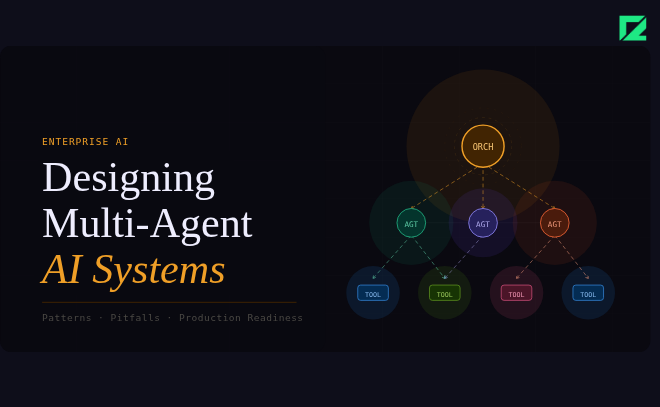
Designing Multi-Agent AI Systems for Enterprise: Patterns, Pitfalls, and Production Readiness

multi-agent AI systems architecture for enterprise workflows

Single-agent AI handles one task at a time. Multi-agent AI handles workflows. The shift from the former to the latter is where enterprise AI moves from demonstration to measurable business value.

IDC projects that 80% of enterprise applications will embed AI agents by 2026. Google Cloud’s AI agent trends report describes 2026 as the year AI agents move from isolated deployments to orchestrated systems handling end-to-end workflows. Databricks’ State of AI Agents report found that the enterprises getting the most value from AI are the ones that have figured out multi-agent coordination, not just single-agent prompting.

This post covers the architecture decisions that determine whether a multi-agent system works in production.

Why Multi-Agent AI Systems Matter

A single agent with a very long context window and access to many tools can handle complex tasks. But it has limitations:

  1. Context window constraints: Long workflows generate long context. At some point, the model’s ability to reason over earlier steps in the context degrades.
  2. Specialization: A general-purpose agent does not outperform a specialist agent on domain-specific tasks. A customer support agent trained on your support corpus performs better on support tasks than a general-purpose agent.
  3. Parallelism: Independent sub-tasks can execute simultaneously. A single agent executes sequentially.
  4. Reliability boundaries: When a single agent fails, the entire workflow fails. Multi-agent systems allow failure containment and retry at the sub-task level.

Core Multi-Agent Architecture Patterns

1. Hierarchical AI Agent Orchestration: An orchestrator agent receives the top-level task, decomposes it into sub-tasks, and delegates to specialist worker agents. Worker agents complete their assigned subtasks and return results to the orchestrator. The orchestrator synthesizes results and either completes the workflow or creates additional sub-tasks based on what it receives.

This pattern works well for well-defined workflows with predictable decomposition. It is the most common pattern in production enterprise deployments in 2026.

Example: A contract review workflow. The orchestrator receives a contract document. It delegates: one agent extracts key terms, another checks for non-standard clauses, another compares against the precedent database. The orchestrator assembles the findings into a review report.

2. Sequential Pipeline Coordination: Agents are arranged in a sequence where each agent’s output becomes the next agent’s input. No orchestrator is needed. The output of one stage defines the context for the next.

This pattern works well for linear workflows where each step depends on the previous step’s output, and where partial results from earlier steps are not needed by the user until the pipeline completes. Data enrichment pipelines, document transformation workflows, and multi-step classification tasks are good fits.

3. Event-Driven AI Agent Systems: Agents subscribe to an event stream and respond to events that match their specialization. No explicit orchestrator directs agents. The workflow emerges from agents responding to each other’s outputs.

This pattern handles unpredictable workflows that cannot be fully decomposed in advance. Customer service workflows, where the next step depends on what the customer says, are a good fit. The trade-off: debugging is harder, and ensuring workflow completion requires explicit monitoring.

MCP and Inter-Agent Communication

The Model Context Protocol (MCP) standardized how AI agents connect to external tools and data sources. By late 2025, more than 10,000 public MCP servers were deployed across the ecosystem. In 2026, MCP has become the default integration pattern for enterprise AI agent tooling.

For inter-agent communication specifically, MCP defines the interface but not the coordination protocol. Teams typically implement one of:

  1. Direct API calls: The orchestrator agent calls worker agents over HTTP. Simple, synchronous, easy to debug. Works well for hierarchical orchestration with short-running sub-tasks.
  2. Message queue: Agents communicate through a message broker (SQS, Kafka, Pub/Sub). Decoupled, supports async processing, and handles variable sub-task duration. Better for long-running sub-tasks and high-volume workflows.
  3. Shared state store: Agents read and write to a shared state object. Simple for workflows where state evolution is the primary coordination mechanism. Watch for race conditions when multiple agents write to the same state.

Reliability Challenges in Multi-Agent AI Systems

Multi-agent systems introduce failure modes that single-agent systems do not have. Building for production reliability requires addressing these explicitly.

Agent failure and retry: An agent that fails mid-execution should not cause the entire workflow to fail. Design for idempotent sub-tasks: each agent’s output should be reproducible from the same input. Store intermediate results so that a failed workflow can be resumed from the last successful checkpoint rather than restarted from scratch.

Loop detection and termination: In event-driven coordination patterns, agents can trigger each other in loops. An escalation agent responds to an unresolved ticket by escalating it, which triggers the escalation agent again. Set maximum execution counts per workflow instance. Log every agent invocation with a workflow trace ID. Alert on any workflow instance that exceeds a defined execution depth.

Observability and Distributed Tracing: A workflow that spans five agents is almost impossible to debug without distributed tracing. Every agent invocation should emit a trace with the workflow ID, the agent ID, the input received, the output produced, the tools called, and the execution time. OpenTelemetry is the standard. Any multi-agent system going to production needs a tracing backend (Jaeger, Zipkin, or a commercial APM platform) configured before the first production deployment.

Human-in-the-Loop Workflow Design: Not every step in a multi-agent workflow should be fully autonomous. High-stakes actions, irreversible operations, and edge cases that fall outside the agent’s confident operating range should require human approval.

Design explicit pause points in your orchestration: moments where the workflow suspends and sends a notification to a human reviewer. The reviewer approves, rejects, or modifies the proposed action, and the workflow resumes. This is not a workaround for agent unreliability. It is the correct design for workflows where mistakes are expensive.

Define which actions require human approval before you build the workflow. Getting this wrong in either direction (too many approvals make the system unusable; too few create operational risk) is easier to fix in the design stage than in production.

Need Help With This?

Codelynks designs and builds multi-agent AI systems for enterprise clients across healthcare, retail, and fintech. If you are evaluating an agentic AI architecture or need help getting from prototype to production, talk to our engineering team at contact us.

How to Build a Context Engineering Layer for Production in 2026

Context engineering layer architecture for production AI agents

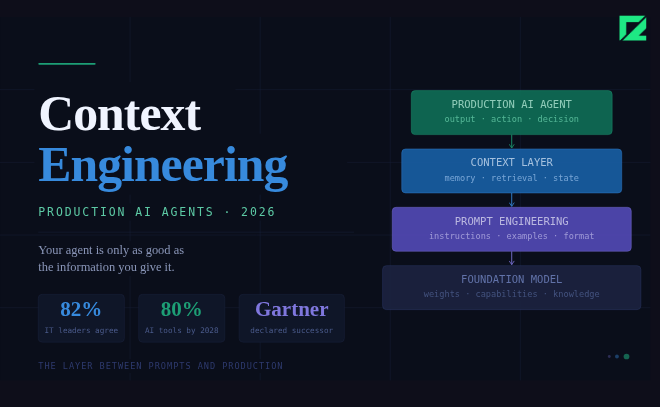
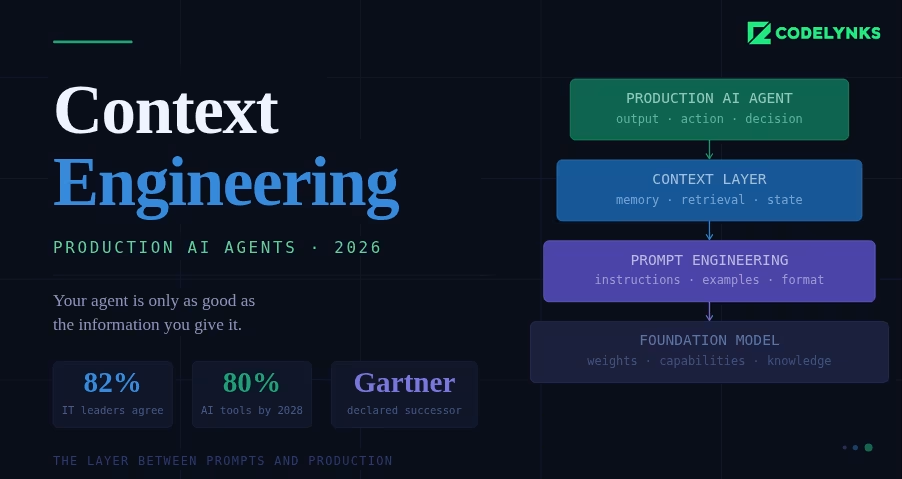
Your AI agent is only as good as the information you give it. Prompt engineering optimises the question. Context engineering optimises the information. In 2026, the difference between AI agents that work in production and agents that fail in production is almost always the context layer.

In July 2025, Gartner declared context engineering the successor to prompt engineering, predicting it will appear in 80% of AI tools by 2028. The 2026 State of Context Management Report found that 82% of IT and data leaders agree prompt engineering alone is no longer sufficient to power enterprise AI at scale. The field has moved. This post explains what a production-ready context engineering layer looks like and how to build one.

Why a Context Engineering Layer Is Not the Same as RAG

The most common mistake when teams encounter context engineering for the first time is treating it as a retrieval problem. They build a vector database, chunk their internal documents, and use semantic search to pull relevant chunks at runtime. That is RAG (Retrieval-Augmented Generation). It is useful. It is not a context engineering layer.

RAG retrieves documents based on query similarity. Context engineering assembles governed, structured, versioned information packages that the agent needs to reason correctly about your business. The difference matters for three reasons:

  1. Reliability. RAG depends on the semantic similarity of the query to the document. Important business rules expressed in language that does not match the query get missed. Structured context products do not rely on similarity search.
  2. Governance. When a policy changes, you need the agent to know immediately. A vector database is eventually consistent at best. A governed context product is updated, versioned, and promoted through a defined lifecycle.
  3. Auditability. When an agent makes a consequential decision, you need to know exactly what context it had. With a versioned context product, you can answer that question. With fuzzy retrieval, you cannot.

The Five Components of an Enterprise Context Engineering Layer

1. Context Inventory: A cataloged store of your organization’s knowledge, structured for machine consumption. This includes business glossary terms and their definitions, data lineage and entity relationships, process rules and decision logic, compliance constraints and policy documents, and product and domain knowledge.

The inventory is not a document dump. It is curated, classified, and kept current. Think of it as the knowledge base your agents draw from, maintained with the same discipline as your code.

2. Integration Architecture: Connectors and pipelines that bring context from source systems into the context registry in near real-time. When a pricing rule changes in your ERP, the context layer needs to know. When a customer account status updates in your CRM, the agent handling that customer’s request needs current data.

This is a data engineering problem as much as an AI problem. Your context pipelines need the same reliability and observability as your data pipelines. Treat them accordingly.

3. Context Products: Versioned, tested bundles of context assembled by domain. A customer service agent gets the customer service context product, which contains the information that agent needs to handle customer queries correctly. A finance agent gets the finance context product. These bundles are version-controlled, tested for completeness, and promoted through a staging and production lifecycle.

Context products should be as small as possible while remaining complete. Giving every agent your entire organisational knowledge base wastes tokens and introduces noise. Domain-specific context products improve both response quality and cost.

4. Orchestration Layer : A runtime system that intercepts each incoming query, classifies its intent, selects the appropriate context product, and injects it before the model sees the query. This is where the majority of your latency and token cost decisions get made.

The orchestration layer also handles dynamic context assembly: pulling current data from live systems when the query requires it (the customer’s current order status, the product’s current inventory level) and combining it with the static context product appropriate for the domain.

5. Governance and Lifecycle Process: The component most teams skip and then regret. Context governance defines who can update a context product, how changes are reviewed and approved, how context products are promoted from development to staging to production, and how stale or incorrect context is identified and corrected.

Without governance, your context layer rots. Business rules change, product details change, policies change, and the context your agents have becomes increasingly wrong. A well-governed context layer is what separates an AI deployment that stays reliable at twelve months from one that degrades.

How to Build a Context Engineering Layer in Five Phases

Building a context engineering layer is a phased effort. Attempting to build all five components simultaneously is how context engineering projects fail.

  1. Inventory existing knowledge assets. Catalogue what you have: internal wikis, policy documents, data dictionaries, process documentation. Classify by domain and assess quality. This phase reveals gaps that need to be filled before the context layer can be useful.
  2. Build integration pipelines. Start with the highest-value source systems. For a customer-facing agent, that is typically the CRM, the product catalogue, and the policy management system. Normalise outputs into a context registry schema.
  3. Package context products by domain. Define the domains your agents operate in. Build the first context product for your highest-priority agent. Validate it against real queries before building the next one.
  4. Deploy query-intent routing. Implement the orchestration layer. Start with simple intent classification (which domain does this query belong to?) and expand to finer-grained routing as you learn from production traffic.
  5. Implement governance and lifecycle management. Define the review process for context product updates. Set up monitoring for context drift (where agent performance degrades because the context has become stale). Build the feedback loop.

What Production Performance Looks Like

Teams that build a proper context engineering layer before scaling agent deployment consistently report better production outcomes than teams that scale first and fix context later. The patterns we see in practice: fewer hallucinations because the agent has accurate, current information rather than relying on model memory; lower token costs because domain-specific context products are smaller than full knowledge dumps; faster remediation when agents behave unexpectedly because the context layer is auditable.

The upfront investment in context infrastructure pays back within the first few months of production operation.

Need Help With This?

Codelynks builds production AI systems for clients in healthcare, retail, and fintech. Context engineering layer design and implementation is a core part of our AI practice. If you are building agents for production deployment and want to get the architecture right, talk to our team at Contact us

AI Personalization in Ecommerce: Why 45% of Conversions Now Depend on It, and What Your Architecture Needs to Deliver

Real-timeAI Personalization in Ecommerce architecture showing streaming data and inference pipeline

Introduction

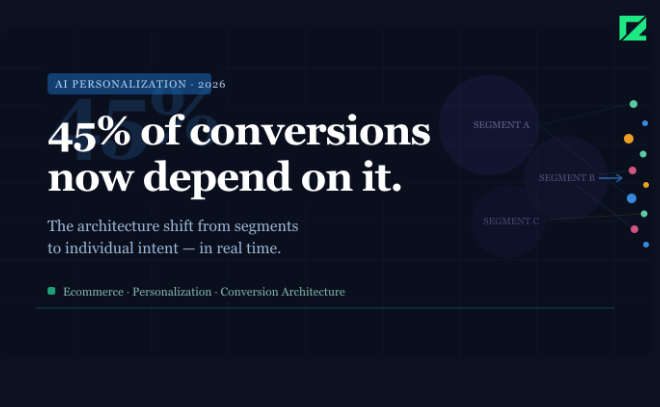
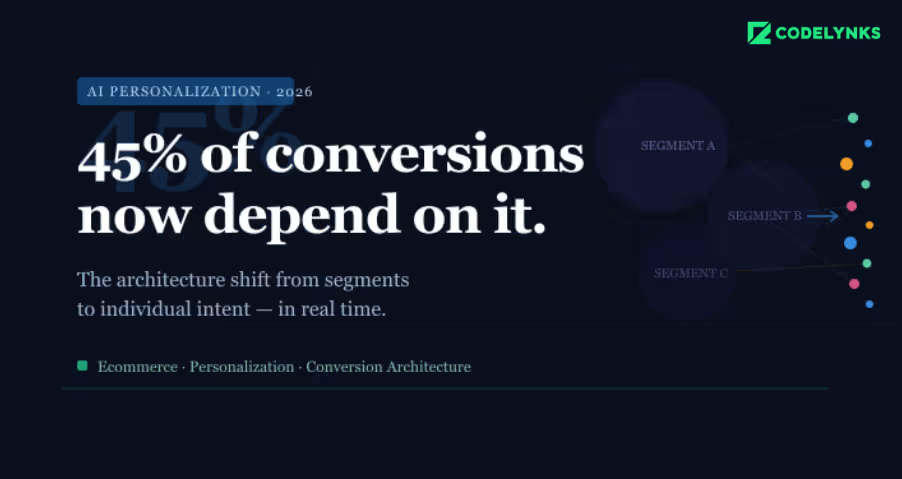
AI personalization in ecommerce has moved from a competitive advantage to a baseline expectation. In 2026, nearly 45% of online conversions are influenced by AI-driven personalization, according to industry analysis.

Most e-commerce product recommendation engines were built on the same premise: group customers into segments and serve each segment a curated experience. Segment-based personalization drove meaningful gains for a decade. In 2026, the data says it is no longer enough.

This post covers what that shift requires architecturally, where most implementations fall short, and how to evaluate whether your current setup can support genuine individual-level personalization. AI personalization in ecommerce now relies on real-time session data instead of static segmentation.

Why AI Personalization in Ecommerce Has Shifted to Real-Time

From Segments to Sessions: What Has Changed : Segment-based personalization works like this: a user who has previously bought running shoes gets shown running accessories. A user in the 25-34 age bracket sees a different homepage banner than a user in the 45-54 bracket. The model is built offline, updated periodically, and applied at request time by looking up the user’s segment and returning pre-computed recommendations.

Individual-level personalization in 2026 works differently. The model observes the current session: what the user clicked, how long they hovered, what they added and then removed from the cart, and what they searched for. It updates its representation of that user’s intent in real time and adjusts the experience, not just the recommendations but also the layout, pricing display, and promotional offers, based on that updated intent.

The distinction matters architecturally. Segment lookup is a read from a pre-computed table. Real-time intent modeling is an inference operation, often involving a neural network, that must be completed within 100-200 milliseconds to avoid impacting page load performance.

The Five Architecture Decisions That Determine Personalization Performance

1. Where inference runs: The most common personalization failure mode is latency. The recommendation model runs in a central data center, 80-150 ms from the user, and the network round trip erodes the user experience before a single recommendation is served.

The biggest limitation of traditional systems is their inability to support AI personalization in ecommerce at the individual level.

The 2026 pattern that high-performing retailers are moving toward is edge inference. Lightweight recommendation models, typically distilled versions of larger models, run at CDN edge nodes close to the user. Full model updates happen centrally and are pushed to the edge on a schedule. The trade-off is model size: edge inference works well for session-level features but cannot run models that require full purchase history or complex cross-session signals.

Decision point: if your target inference latency is under 50ms, edge inference is worth the architecture complexity. If 100-150ms is acceptable, central inference with a well-placed CDN layer is simpler and usually sufficient.

2. Feature pipeline design: Personalization models are only as good as their features. The feature pipeline is the component that transforms raw behavioral events (clicks, searches, purchases, and hovers) into the numerical representations the model uses.

The two-pipeline pattern is now standard: a batch pipeline that processes historical data and generates user embeddings updated daily or hourly and a streaming pipeline that processes real-time session events and updates the in-session representation. At inference time, the model combines both. Historical context provides the long-range signal; session context provides the intent adjustment.

The most common implementation mistake is running only the batch pipeline and calling it real-time personalization. Batch embeddings updated daily cannot capture within-session intent changes. A user who arrived to browse shoes but then searched for a gift idea is being shown the wrong product three pages into their session.

3. Catalogue embedding and search indexing: Recommendation systems need to match a user representation to products in a large catalog. Naive systems do this with collaborative filtering on interaction matrices. Modern systems embed both users and products in the same vector space and use approximate nearest neighbor (ANN) search to find relevant products in milliseconds.

This requires a vector database. Pinecone, Weaviate, and pgvector (for teams already on PostgreSQL) are the common choices in 2026. The catalogue embedding needs to be updated whenever product attributes, inventory, or pricing changes. Serving recommendations for out-of-stock products or products at the wrong price is a trust problem that is harder to recover from than a lower conversion rate.

4. A/B testing infrastructure: Personalization cannot be validated without proper experimentation infrastructure. The challenge is that standard A/B testing assumes independent assignment: user A sees variant 1, user B sees variant 2, and the two groups do not interact.

In e-commerce, users interact: a recommendation served to one user can influence what another user sees in social contexts, inventory is shared, and pricing changes affect the whole market. Rigorous personalization A/B testing uses holdout groups rather than split tests, ensuring a percentage of users always receive the baseline experience and measurement is against that holdout rather than against a simultaneous variant.

The architecture implication: the consent state must be a first-class signal in the feature pipeline. A user who has opted out of behavioral tracking should receive a degraded but functional experience, not an error. Consent management platforms need to integrate directly with the event collection layer, not as an afterthought in the front end.

Businesses investing in AI personalization in ecommerce are seeing measurable conversion improvements.

Build vs Buy: The 2026 Decision Framework

Managed personalization platforms like Dynamic Yield, Bloomreach, and Nosto have matured significantly. For retailers below $50 million in annual GMV, a managed platform almost always delivers better ROI than a custom build. The engineering cost of building and maintaining a two-pipeline feature system, a vector database, and edge inference infrastructure is significant.

Above $50 million GMV, the calculus shifts. At that scale, the recommendation model is a competitive differentiator. Managed platforms apply the same algorithms to all their clients. A custom model trained on your specific catalog, customer base, and business logic can outperform a generic one meaningfully, and the data to train it well is available.

A hybrid architecture is also common: a managed platform for standard recommendation placements and custom models for the highest-value surfaces like the homepage, checkout, and post-purchase experience.

What the Conversion Data Actually Measures

The 45% of conversions driven by AI personalization figure comes from measuring purchases that followed a personalized recommendation or personalized layout change. It does not measure counterfactual conversions, purchases that would have happened anyway without personalisation.

Realistic lift from implementing individual-level personalization over segment-based systems ranges from 15 to 30% in conversion rate, depending on catalogue size, traffic volume, and the quality of the baseline. Smaller catalogues see smaller lifts because the recommendation space is constrained. Higher-traffic sites see larger lifts because the models have more data to work with.

Average order value lift from personalization is typically 8-15%. The mechanism is product adjacency: a well-trained model surfaces complementary products that the customer would not have found through browse navigation.

Key Takeaway

AI personalization in e-commerce is no longer about segments—it’s about real-time intent modeling at the session level.

To compete in 2026, your architecture must support the following:

  • sub-200ms inference
  • streaming + batch feature pipelines
  • vector-based product retrieval
  • consent-aware data systems

Retailers who invest in this shift are seeing 15–30% conversion lifts and measurable revenue impact. Those who don’t are optimizing a model that the market has already outgrown. AI personalization in e-commerce is no longer about segments—it is about real-time intent modeling at the session level.

Need help with AI personalization architecture for your e-commerce platform? Talk to our engineering team at Codelynks. Contact us

More Blogs: FinOps in 2026: Best Ways to Cut Cloud Waste by 30–40%

Internal Developer Platform Architecture: Best Practices for 2026

Internal Developer Platform architecture using GitOps workflows and Kubernetes

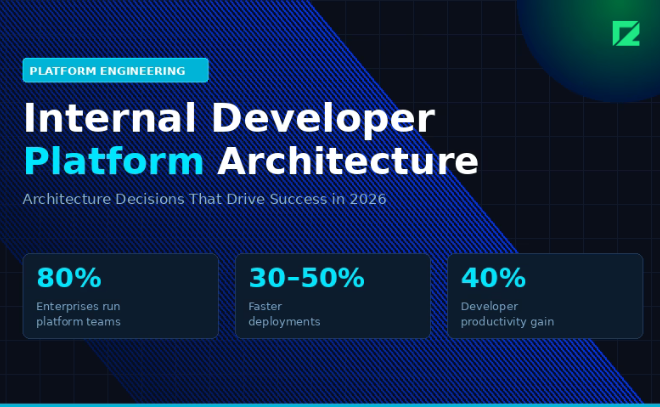
Internal Developer Platform architecture is becoming a critical foundation for modern platform engineering teams. Companies adopting Internal Developer Platforms (IDPs) are improving developer productivity, accelerating deployments, and reducing operational complexity through GitOps workflows, Kubernetes automation, and self-service infrastructure.

An Internal Developer Platform (IDP) solves this. It is a self-service layer that sits on top of your infrastructure and tools, giving developers a consistent interface to provision environments, deploy services, observe systems, and manage the full lifecycle of their applications. Without needing to become a Kubernetes expert or file a ticket.

According to the 2026 State of Platform Engineering Report, 80% of large enterprises now run platform teams. Teams using IDPs report 30 to 50% faster deployments and up to 40% improvements in developer productivity. Gartner estimates that by the end of 2026, 80% of large software organizations will have a dedicated platform engineering function.

What an Internal Developer Platform Is Not

An IDP is not a developer portal. A portal is a UI layer. An IDP is the platform behind the portal: the APIs, the automation, the golden paths, the guardrails.

An IDP is also not a CI/CD pipeline or a Kubernetes cluster. Those are components it orchestrates. The IDP abstracts them so developers do not need to interact with them directly.

The mental model: if a developer needs to learn Terraform to deploy a new service, your IDP has failed.

The Four Layers of an Internal Developer Platform

A well-designed IDP has four layers. Each layer has a distinct responsibility and a clear interface to the layers above and below it.

Layer 1: Infrastructure Abstraction

This layer owns your infrastructure definitions. Terraform or OpenTofu modules, Crossplane compositions, Helm charts. The key principle: no developer writes raw IaC. They consume modules your platform team has already written, tested, and secured.

Recommended tools in 2026: OpenTofu 1.5 for IaC (the open-source Terraform fork, now at feature parity), Crossplane 0.23 for Kubernetes-native resource provisioning, ArgoCD 2.10 for GitOps-based delivery.

This layer should expose no raw cloud provider APIs to developers. All provisioning goes through your modules.

Layer 2: Golden Paths and Templates

Golden paths are pre-approved, fully-configured service templates. A developer picks a service type (Node.js API, Python worker, React frontend, gRPC service) and gets a repository, CI/CD pipeline, monitoring dashboards, and environment provisioning already wired up.

Backstage (CNCF, v1.28 as of Q1 2026) is the dominant platform for building the software catalog and scaffolding templates. It powers IDPs at thousands of organizations and has integrations with most major cloud providers and developer tools.

A golden path is not mandatory. Developers can deviate when they have a legitimate reason. But deviation should require explicit justification, and the platform team should track deviation rates as a signal of where paths need improvement.

Layer 3: Self-Service API and Automation

The self-service API is how everything else talks to your infrastructure. Environment creation, access requests, secret rotation, dependency version bumps: all triggered by API calls, not tickets.

This layer typically combines: a workflow engine (Temporal or Argo Workflows for durable, observable automation), a secrets manager (HashiCorp Vault or AWS Secrets Manager with dynamic credential rotation), and your RBAC and identity layer for access control.

Design this layer to be idempotent. Calling the same operation twice should not create duplicate resources or side effects. This becomes critical when automation fails mid-run.

Layer 4: Developer Portal

The portal is the interface developers actually use. It surfaces the software catalog (what services exist, who owns them, their health status), provides the scaffolding UI for creating new services from golden paths, and links to documentation, runbooks, and on-call schedules.

Backstage handles this well out of the box, but it requires significant investment to configure and maintain. For teams under 50 engineers, a lighter-weight portal may deliver more value with less overhead.

Three Architecture Decisions That Define Your IDP

Decision 1: Push vs. Pull Deployment Model

Push model: your CI/CD system deploys to your clusters. Simple to set up, familiar to most teams. Requires cluster credentials in your CI system, which creates a security surface.

Pull model (GitOps): an agent inside the cluster watches a Git repository and pulls changes. ArgoCD and Flux implement this pattern. The cluster never needs to be externally reachable, which is a significant security advantage.

For most teams building an IDP in 2026, GitOps with ArgoCD is the right default. The security model is cleaner and the reconciliation loop gives you drift detection for free.

Decision 2: Single Cluster vs. Multi-Cluster

Start with a single cluster per environment (development, staging, production). Multi-cluster adds operational complexity that most teams do not need until they hit scale or specific isolation requirements.

Move to multi-cluster when you have: strict data residency requirements, teams that need isolated blast radiuses, or workloads with genuinely different scaling characteristics that are expensive to colocate.

Decision 3: How Much to Abstract

This is the hardest decision. Too little abstraction and your IDP is just a thin wrapper that does not reduce cognitive load. Too much abstraction and developers cannot debug production issues because they cannot see what is actually running.

The principle that works: abstract the provisioning, not the observability. A developer should never need to write a Terraform module to deploy a service. But they should always be able to see the Kubernetes pods, the resource utilization, and the logs when something breaks.

How to Measure IDP Success

Track these metrics from day one:

  • Time to first deployment: how long it takes a new service to reach staging from a blank repo
  • Golden path adoption rate: what percentage of services use a golden path template
  • Mean time to environment: how long it takes to provision a new dev environment on demand
  • Platform ticket volume: the number of requests developers raise to the platform team per week (should decrease as self-service improves)

Where to Start

Do not try to build all four layers at once. Start where the pain is loudest.

For most teams, that is environment provisioning and deployment automation. Get those two things running on a GitOps model with solid IaC modules. That alone will reduce cognitive load and improve delivery speed. Add the portal, the software catalog, and the broader self-service layer once the foundation is stable.

The teams that fail at IDP adoption almost always tried to build the portal before they fixed the pipeline.

Need help designing or building your IDP? Talk to our engineering team at Codelynks.

Contact Codelynks

FinOps in 2026: Best Ways to Cut Cloud Waste by 30–40%

FinOps in 2026 cloud cost optimization dashboard reducing cloud waste

FinOps in 2026 is no longer optional for organizations trying to control rising cloud costs. The average organization wastes 32 to 40 percent of its cloud budget on idle resources, oversized instances, and unmonitored services. That figure has not improved much in three years, despite better tooling.

The problem is not visibility. Most cloud platforms now surface cost data in reasonable detail. The problem is that cost optimization has been treated as a periodic cleanup task rather than a continuous engineering discipline.

FinOps, cloud financial management as a structured practice, changes that framing. Organizations with a mature FinOps practice achieve 30 to 40 percent cost efficiency improvements. This post covers the specific steps to get there.

What FinOps actually means in 2026

FinOps is no longer defined by cloud cost management alone. In 2026, it covers AI compute, SaaS licensing, private cloud, and data center alongside traditional cloud spend. The FinOps Foundation’s State of FinOps 2026 report shows dedicated FinOps teams are now standard at organizations spending over $1 million annually on cloud.

The organizational model that works is federated governance. A small central FinOps team, typically two to four people, sets tagging standards, cost allocation policies, and optimization targets. Embedded engineers on each product team own day-to-day cost accountability. This separates policy from execution without creating a bottleneck.

The leading teams in 2026 have also shifted to shift-left FinOps: forecasting and modeling costs before deployment, not optimizing after the bill arrives. Infrastructure review includes cost estimates the same way it includes security review.

The five highest-impact optimization moves

1. Commitment-based discounts

Reserved Instances and Savings Plans are the highest-leverage move for stable workloads. On AWS, Reserved Instances reduce compute costs by 30 to 72 percent compared to on-demand pricing. Savings Plans offer 25 to 65 percent discounts with more flexibility across instance types.

The mistake is buying commitments before you understand your baseline. Spend 60 days on demand to establish actual usage patterns, then commit to what you know you will use at minimum.

2. Right-sizing underutilized resources

Compute instances provisioned for peak load and running at 10 to 20 percent average utilization are the most common source of waste. Right-sizing, moving to smaller instance types that match actual usage, typically delivers 15 to 25 percent savings on compute costs.

AWS Compute Optimizer, Azure Advisor, and Google Cloud Recommender all generate right-sizing recommendations automatically. The work is not finding the recommendations. It is building the process to review and implement them regularly.

3. Auto-shutdown for non-production environments

Development, staging, and QA environments running around the clock are pure waste. Automating shutdown during off-hours, typically 18 hours per day on weekdays and full weekends, reduces non-production compute costs by 50 to 70 percent.

This is one of the fastest wins in cloud cost optimization. The implementation is straightforward: tag environments by type, create scheduled start and stop rules through AWS Instance Scheduler or equivalent, and enforce through infrastructure-as-code.

4. Storage tiering

Object storage costs are often invisible until they compound. Data that is rarely accessed should not sit in high-performance storage tiers. S3 Intelligent-Tiering moves data automatically between access tiers based on usage patterns. For data with predictable access patterns, S3 Glacier Instant Retrieval costs 68 percent less than S3 Standard for data accessed less than once per quarter.

5. Tagging for cost allocation

You cannot optimize what you cannot attribute. A complete tagging strategy assigns every resource to a cost center, product team, environment, and project. This sounds obvious. Most organizations have 30 to 50 percent of cloud spend that is untagged or inconsistently tagged.

Enforce tagging at the infrastructure provisioning layer through policy, not convention. Resources that do not meet tagging requirements should not be provisionable. Tag compliance above 95 percent is achievable with proper enforcement and is the foundation for all other cost allocation work.

AI-driven cost management: what it actually means in practice

The 2026 FinOps conversation has a lot of references to AI-driven optimization. The practical reality is narrower than the marketing suggests.

Where AI genuinely helps: anomaly detection. Cloud spend has enough signal that ML-based anomaly detection, available natively in AWS Cost Anomaly Detection and Azure Cost Management, catches unexpected spend increases faster than manual review. An instance type change, a runaway data transfer job, or a misconfigured auto-scaling group shows up as an anomaly within hours rather than at month-end.

Predictive forecasting is also improving. Models trained on 6 to 12 months of usage data generate reasonable 30 and 90-day forecasts that help finance teams budget more accurately than spreadsheet extrapolation.

Where AI does not help: it does not make the organizational decisions. Who owns a cost overrun. How to enforce tagging compliance. Whether to buy a commitment for a workload that might be retired. These decisions require judgment, not automation.

Building a FinOps practice from scratch: the sequence

The sequence matters. Teams that start with tooling before establishing accountability structures waste significant time implementing dashboards that nobody acts on.

  1. Establish visibility. Get all cloud accounts into a cost management tool with consistent tagging. You need to see spend by team, product, and environment before any optimization is meaningful.
  2. Assign ownership. Every resource has an owner. Every cost anomaly has someone responsible for investigating it. Without named ownership, cost reviews produce observations, not actions.
  3. Run a quick-win sweep. Auto-shutdown non-production environments. Delete unattached volumes and unused snapshots. Right-size the five most overprovisioned instance families. This typically recovers 15 to 20 percent of waste within 30 days.
  4. Establish a regular cadence. Weekly cost reviews at team level. Monthly commitment to purchasing reviews. Quarterly architecture reviews with cost as an explicit criterion.
  5. Shift optimization left. Add cost estimation to infrastructure change reviews. Build cost budgets into sprint planning. Make cost a first-class engineering concern, not a finance afterthought.

The 30 to 40 percent efficiency gains that mature FinOps organizations achieve are not from one big optimization. They come from eliminating the same categories of waste repeatedly, building the practices that prevent new waste from accumulating, and treating cloud cost as an engineering discipline with the same rigor applied to reliability or security..

Need help building a FinOps practice or optimizing your cloud spend? Talk to our engineering team at Codelynks: codelynks.com/contact

Explore more blogs : 5 Powerful Ways AR-Powered Retail Apps Are Transforming Customer Experience

What is FinOps and why is it important?

FinOps is a cloud financial management practice that helps organizations optimize cloud spending while maximizing business value. By improving visibility, accountability, and resource efficiency, FinOps enables better cloud governance. Learn more in our FinOps in 2026 guide.

RAG vs Fine-Tuning in 2026: The Best Strategy for Your Enterprise AI

RAG vs Fine-Tuning in 2026 enterprise AI strategy comparison

RAG vs. fine-tuning in 2026 is one of the enterprise AI projects stall not because of bad models, but because of the wrong customization strategy. Teams reach for fine-tuning when they need retrieval or build RAG pipelines when behavior consistency is the real problem.

RAG vs Fine-Tuning in 2026, the global enterprise AI market has passed $150 billion. MarketsandMarkets reports that 73% of enterprises now use some form of customized LLM. The RAG vs fine-tuning decision is no longer academic. It is a production architecture choice with real cost and performance consequences. This post breaks down both approaches, when to use each, and what the hybrid model looks like in practice.

What RAG actually does

Retrieval-Augmented Generation (RAG) keeps the base model unchanged. When a user sends a query, the system retrieves relevant documents from a vector store or knowledge base, injects them into the prompt as context, and generates a response grounded in that retrieved content. The key property: RAG changes what the model can see right now. The model’s underlying behavior, its tone, output format, and reasoning patterns, stays constant. What changes is the information available for each response.

What fine-tuning actually does

Fine-tuning adjusts the model’s weights using domain-specific training data. The result is a model that behaves differently at a fundamental level: it uses domain terminology naturally, follows specific output formats consistently, and applies trained reasoning patterns without requiring those patterns to be prompted each time. Fine-tuning changes how the model tends to behave every time, not just what it can reference.

RAG is the right choice when

  1. Your knowledge base changes frequently (pricing, policies, product specs, regulations)
  2. You need the model to cite sources or ground answers in specific documents
  3. You want to avoid retraining costs every time data changes
  4. Your failure mode is stale or missing facts, not inconsistent behavior

Fine-tuning is the right choice when

  1. Your failure mode is behavior inconsistency: wrong output format, unstable tone, or weak classification accuracy
  2. You need the model to reliably follow company-specific workflows or compliance constraints
  3. Domain terminology is specialized enough that a general model makes consistent errors
  4. You want lower inference costs by using a smaller, specialized model instead of a large general one

The cost picture in 2026

RAG setup costs are primarily infrastructure, vector database, embedding model, retrieval pipeline, and chunking strategy. A well-architected RAG system for an enterprise knowledge base typically costs $30,000 to $50,000 to set up properly, with ongoing hosting and query costs.

Fine-tuning a small model (7B to 13B parameters) on domain data runs $5,000 to $20,000 for training, depending on dataset size and the number of training runs. Inference costs drop significantly with a smaller fine-tuned model compared to routing every query through a large general model like GPT-4o or Claude Sonnet.

The hybrid approach, which leading enterprises are converging on in 2026, combines both. Fine-tune a smaller model for behavior and domain language. Pair it with RAG over company documents and live data sources. You get consistent behavior from the fine-tuned weights and current, grounded answers from retrieval.

Where enterprises go wrong

The most common mistake is treating fine-tuning as the solution to knowledge gaps. Teams collect product documentation, support tickets, and internal wikis, fine-tune a model on them, and expect the model to be an accurate knowledge source. This breaks as soon as the underlying data changes. Fine-tuning is not a substitute for a retrieval system.

The second common mistake is building a RAG pipeline and expecting consistent output formatting and tone. RAG does not train the model. Without explicit prompting or fine-tuning, the model will continue to vary its behavior across different retrieval contexts.

The framework for deciding is straightforward. Put volatile knowledge in retrieval. Put stable behavior in fine-tuning. Stop trying to force one tool to do both jobs.

Evaluation matters more than the architecture choice

The 2026 consensus from teams running LLMs in production is that the RAG vs fine-tuning debate is mostly resolved. The harder problem is continuous evaluation. Both approaches degrade over time. RAG degrades when the knowledge base goes stale or chunking quality drops. Fine-tuned models drift when the domain shifts and no retraining happens.

Production-grade AI in 2026 requires an evaluation loop, not just an architecture decision. That means tracking retrieval precision and answer faithfulness for RAG, and classification accuracy and format compliance for fine-tuned models, continuously, not just at launch.

What we recommend at Codelynks

For most enterprise use cases in 2026, start with RAG. It is faster to build, cheaper to iterate, and handles the most common enterprise AI problem: getting accurate answers from internal data.

Add fine-tuning when you have identified a specific behavioral problem that RAG cannot solve: a classification task that needs high precision, a workflow that requires strict output formatting, or a domain where general model errors are frequent and costly.

We have built both approaches in production for clients across healthcare, retail, and fintech. The decision always comes down to diagnosing the failure mode first, then choosing the tool. Never the reverse.

Conclusion: The decision in two sentences

If your AI is returning wrong facts or outdated information, build a retrieval pipeline. If it is returning inconsistent formats, the wrong tone, or classification errors, fine-tune a model on your domain data.

Need help building a production-grade RAG or fine-tuning pipeline for your organization? Talk to our engineering team at Codelynks: codelynks.com/contact

Explore more blogs: 7 Reasons Why DevSecOps is the Future of Secure Software Development

7 Ways AI-Driven AR Experiences Are Transforming User Interactions

AI-driven augmented reality shopping experience

Introduction

AI-driven AR experiences are transforming how users interact with digital content by creating more immersive, intuitive, and engaging interactions across industries. By combining Artificial Intelligence (AI) with Augmented Reality (AR), businesses can deliver personalized customer engagement, interactive AR shopping experiences, and immersive retail environments that improve user satisfaction and digital experiences.

As a pioneering developer in this field, Codelynks combines AI and AR to provide the most innovative solutions that integrate captivation for users as well as promote their engagement levels. This blog shall witness seven ways in which AI-driven AR redefines user engagements towards changing the future of digital engagements.

AI-Powered Personalization in AR Applications

One of the most important advantages that AI-driven AR experiences have is the fact that they can be personalized based on their users’ preferences and behaviors. AI analyzes user data, modifying an AR experience in such a way that the outcome generated by it is relevant information, suggestions, or features, according to individual interests.

For instance, in the retail domain, AI-prompted AR applications would propose customized products based on purchase history or other browsing. AI will change the AR experiences during learning for a student depending on his learning rate and preference in education. In an endeavor to revolutionize the way an enterprise experience is delivered for its user, Codelynks enhances AR solutions by AI. This helps allow users to create highly personalized experience for enterprises increasing engagement and satisfaction.

Interactive AI-Driven AR for Customer Support

Furthermore, the fusion of AI and AR is revolutionizing the customer support feature by creating a more interactive and much more efficient platform. AR applications assist users in visualizing solutions to problems with instructions or guides placed real-time, while AI assists in understanding and predicting user issues.

For example, when debugging a device, AR can give an immediate view of where and how to fix a problem, which will be driven by AI so no long messages or calls related to support are needed. Codelynks provides companies with AI-powered AR tools that make customer support easier to increase resolution times and enhance customer satisfaction.

How AI-Driven AR Experiences Are Transforming Retail

Retail is one such sector where immersive AR platforms is contributing the most. Due to AI, AR-based apps will now be able to create virtual fitting rooms for the users whereby they can “try on” clothes, accessories, or even furniture from the comfort of homes. These interactive AR systems not only foster greater user interaction but also reduce returns by providing an accurate visual representation of the product.

Based on the preference of a user, AI algorithms analyze it and suggest products to a user, thereby making the experience of shopping more personal and thus providing the right kind of products that suit one’s style. Codelynks partners with retail brands to deliver AI-driven AR experiences that enhance customer engagement, boost conversion rates, and create truly immersive shopping journeys. Retail brands are using AI personalization and augmented reality technologies to create immersive retail experiences and interactive AR shopping journeys that improve customer engagement and conversion rates.

AI and AR in Healthcare

AI-driven AR is thus revolutionizing the face of healthcare by changing how professionals interact with patient data and medical tools. The AR headsets, when combined with AI, offer surgeons a view of critical patient data coupled with real-time images so that the precision medical operations are not inaccurate. It works by showing the AI interpretation of imaging data to diagnose the condition and suggesting possible treatment options.

AI-based AR has also completely transformed the means of medical training. Currently, students are able to interact with 3D anatomical models and to simulate surgeries. Codelynks collaborates with healthcare providers as an attempt to develop AI-based AR to support the provision of better care to patients and more effective educational medicine in interactive and healthier health environments.

AI-Driven AR in Entertainment

From entertainment, AI’s powered AR takes a dramatic shift. Whether it is related to the entertainment industry in forms of games or movies, even digital events, AI propels AR to provide more immersive worlds and response dynamically to any user input through the adaptation of the storyline or gaming environment depending on player behavior and so offering unique and personalized experiences.

Such a level of engagement keeps customers engaged for longer periods of time and helps a designer to build even deeper relationships with content. Here, Codelynks is changing the AR entertainment solution that is driven by AI by developing interactivity, relevance to an individual’s personal life, and excitement in engaging with media users.

AI-Enhanced Learning and Training

AI-powered AR changes the game in education and corporate learning. Introducing the exploratory, hand-in-glove kind of learning environment through AR, while AI customized content adaptation caters to the unique learning requirements of every learner; thus, combining the two enables learners to interact with 3D models, simulations, or real-time problem-solving scenarios that adjust to their performance.

For example, in terms of the study of engineering, AR can visualize working machinery in real-time for learners to engage in explorations of the parts and their roles. AI tracks individual performance and makes recommendations for improvement, thereby ensuring a personalized learning path. Codelynks is intensely collaborating with AI-based AR solutions to rethink education and training in terms of making learning more appealing and effective.

AI-Based AR in Smart Cities and Urban Planning

AI and AR are becoming increasingly significant for urban planning and the development of smart cities. AR lets city planners and architects visualize infrastructure projects that they might prepare, while AI analyzes data to make such designs optimized for needs including traffic flow, population density, and environmental impact.

For the citizens, AI-powered AR are interactive systems for navigation that contain real-time information on services and transportation available in the city, as well as current events happening locally. Codelynks is in tight collaboration with smart city initiatives for the development of AI-augmented AR systems toward improving urban living and easing city planning processes.

Conclusion

AI-Driven AR Experiences – A New Era of User Engagement

Integration of augmented reality solutions is already changing the face of various industries, including improved user interaction and engagement beyond what has been possible for years. Such examples range from personalized retail shopping to immersive environments in education where AI and AR together set a new standard in business and user interactions with digital content.

At Codelynks, we are at the forefront of this technological revolution: cutting-edge AI and AR solutions for businesses to help them deliver next-level experiences. It can be enriching customer service, revolutionizing healthcare, or crating immersive entertainment experience, the expertise of Codelynks combines and transforms how users interact with digital platforms in result by increasing engagement and innovative possibilities.

More Blogs: Boost Forecast Accuracy: 7 Essential AI-Powered Business Analytics Tools

5 Steps to Scaling Gen AI: A Data Leader’s Guide to Enterprise Success

Scaling Gen AI in enterprise data strategy

Introduction

Scaling Gen AI opens a door to the potential transformation of organizations around efficiency improvements, better decision-making, and more tailored experiences. Scaling across the enterprise is the challenge. And, thus, the data leader must also possess the capability to construct a strategic operating model accommodating Gen AI.

In this blog, we discuss how data leaders can scale Gen AI effectively-from building an operating model to developing collaboration across teams.

Building a Strategic Operating Model for Scaling Gen AI

An operating model that clearly aligns AI initiatives with business goals must be defined for Scaling Gen AI effectively across the enterprise. There are two options: either fit Gen AI into an existing data or IT team, or establish an especially designed AI team. Each model has its advantages. Integration of Gen AI with the existing teams ensures resource alignment, but the development of a separate team facilitates faster iteration and development outside the boundaries of the existing IT structure.

For example, a logistics company integrated Gen AI into their existing IT system but only went at a snail’s pace because they had to work within the existing architecture. Those organizations which had a differentiated AI team were able to iterate on the Gen AI components faster to at least be one step ahead of the curve.

Designing Core Reusable Gen AI Components

In order to successfully use Gen AI, organizations will need to focus on developing core reusable components. This could include scalable models, frameworks, and tools that can be functionally used across an enterprise. A task force can be established that oversees the process, ensuring IT, data, AI, and business teams all contribute.

Organizations can create component-based development models, whereby they can leverage identical Gen AI tools for myriad different applications, thus ensuring smooth processes and eliminating redundancy. Moreover, aligning similar components with strategies enables value and return on investment.

Data Management as a Foundation for Scaling Gen AI

Proper data management forms the backbone of Scaling Gen AI initiatives within any enterprise. Without robust data governance and infrastructure, Gen AI models will flounder when it comes to retrieving and processing the required information. It is important for data leaders to understand the need for structured data management since nearly 80% of company data is unstructured. Data governance protocols must be put in place such that quality control, access, and compliance checks on both structured and unstructured data are maintained.

Example: A bank-oriented application on managing unstructured data, a business category, and quality of data. This culminated in much more accurate and reliable Gen AI applications with much fewer issues of data being poorly handled.

Collaborative Scalability Approach for Gen AI

Scaling Gen AI successfully requires collaboration between IT, AI, and business teams, not just technical excellence. Open communication with clear roles can actually help the companies avoid duplication of work or disjointed deployment.

Most leading organizations use the strategy of establishing Centers of Excellence (CoE) for Gen AI. CoEs support and enable people in innovation, standardizing AI practices throughout business units.

Example: A global bank rolled out Gen AI in a federated model. This enabled business units to develop Gen AI applications that would exactly meet their individual needs for deployment, hence faster and smoother integration of Gen AI into daily workflows.

Integration of AI with existing systems

The integration of Gen AI into existing data and IT systems will prove difficult, since the technology life cycles of the different systems cannot be set out in the same timeframe. It would be necessary for data leaders to collaborate with their IT departments in synchronizing their roadmaps and establishing a common infrastructure for the AI tools that would work together for better integration.

In addition to the LLMs or orchestration frameworks built, it is essential to think about how components interact with applications already built, so that does not scale into technical debt.

For example, a telecom company tapped on the expertise of their AI team in the development of LLMs incorporated very smoothly into their technology. The type of service they then offered to clients improved and their operations became efficient.

Tools like Microsoft Azure AI and AWS AI Services demonstrate how organizations can integrate Gen AI seamlessly with existing systems to improve scalability and efficiency.

Although Gen AI has wide applicability, not all use cases present equal value. Data leaders should focus high-value use cases in customer engagement, predictive analytics, and operations optimization-those most likely to deliver real business value and improve performance.

Use Case Example: A South American telecom firm implemented Gen AI for customer engagement, and conversational AI reduced operations costs by over $80 million.

Scalability Challenges Organizations have barriers related to scalability, especially around data governance, system integration, and talent acquisition, despite the benefits of Gen AI. In fact, it takes clear change management strategies coupled with continuous upskilling of employees regarding emerging AI technologies.

Organizations should look for quick-win use cases that have an impact in the short term to build trust and garner support from stakeholders, thus avoiding the infamous pilot purgatory.

Conclusion: A Roadmap to Scaling Gen AI

Scaling Gen AI introduces huge opportunities for organizations across industries, but only through strategic means. With reusable Gen AI components, data governance at the center, and co-collaboration, data leaders can make AI across the enterprise a success. Also, strategic identification of high-impact use cases and subsequent integration with the existing systems will be critical to achieve value from Gen AI and create long-term value for businesses that stay ahead of the competition.

The road for data leaders keen to scale Gen AI is complex but full of potential – all those who do it strategically will be well-placed to win.

More Blogs: The AI-Induced Industrial Renaissance: Revolutionizing the Future of Industry

  • Copyright © 2026 codelynks.com. All rights reserved.

  • Terms of Use | Privacy Policy