The Amazing Ultimate 2025 Guide to AI in eCommerce Trends and Predictions

AI in eCommerce trends and predictions for 2025

The eCommerce industry is changing quite rapidly in today’s digital-first world. Online shopping is gaining traction fast, creating pressure on businesses to ensure the heightening of customer experiences and growth aligning with exponentially increasing shopper expectations. AI in eCommerce is reshaping this space with smarter, faster, and more intuitive solutions By tapping into AI capabilities, companies can personalize shopping experiences while streamlining operation and driving greater customer engagement.

This article looks at how AI is transforming eCommerce, making online shopping more intuitive and, of course, more efficient, the next thing after customer-centricity.

Personalization at Scale: Improving Customer Journeys

Personalization is the most significant way artificial intelligence is transforming eCommerce. Consumers today expect a tailored shopping experience, which suits their unique preferences and requirements. AI enables companies to provide personalization at scale by analyzing vast amounts of data-about browsing behavior through to a customer’s purchase history and interactions. This level of personalization defines how AI in eCommerce drives engagement and loyalty.

AI-Powered Product Recommendations: This enables the algorithm to forecast the customer preferences and provide products that could be interested in, based on his requirements. For instance, while browsing through an online store, AI can suggest items based on a consumer’s previous behavior, search history, and even trending products. This degree of personalization not only increases the chances of purchase but also enhances the overall shopping experience since it is more relevant to every user.

Dynamic Pricing and Offers: AI can also help businesses optimize their pricing strategies in real-time. AI can gauge market trends, competitors’ prices, and customer behavior to help firms institute dynamic pricing; thus, prices may change to maximize conversions and profitability. Furthermore, specially tailored discounts and offers can be targeted at specific sets of customers, which enhances engagement and loyalty.

AI-Powered Customer Service and Support

Online retail is a fast-paced industry and timely efficient customer service differs. When AI-based chatbots or virtual assistants change the way businesses communicate with their customers, this helps them be available 24/7, answer instantaneously, and even present automated solutions. The growth of AI in eCommerce has made 24/7 assistance and automated resolution the new standard.

Chatbots for Instant Assistance : AI-powered chatbots can help respond to the most diverse types of customer queries ranging from a particular product, returns, and even order follow up. The chatbots developed are capable of understanding the natural language, giving it a more human touch. Even though AI chatbots manage routine work, human agents are said to concentrate on the highly complex issues of customers, ensuring a seamless experience in efficient support.

With eCommerce technology, such virtual assistants become increasingly common, as virtual assistants powered by AI could provide customers with product recommendations, answer questions, and even help with checkouts while assisting them on their buying journey. This would increase ease of purchase, satisfaction rates, and help decrease the cart abandonment rate on one’s way to smoother buying processes.

Visual Search: Closing the Gaps between In-Store and Online Shopping

The most fascinating area where AI is being applied to eCommerce is in visual search technology. Here, customers will upload pictures of products they are interested in, and the algorithm of AI will scan through the retailer’s inventory for similar items. This enhances the online shopping experience and mirrors how people shop in physical stores. Visual cues drive most purchases and therefore reflect how people really shop.This feature is another sign of how AI in eCommerce bridges the gap between in-store and online shopping.

Improved Search Accuracy: AI-powered visual search engines help make queries more accurate by identifying detail, patterns, and colors in images that customers upload. If the customer uploads a picture of piece of furniture or a cloth, then AI technology (AI in eCommerce) scans the image so that it can then suggest the nearest available matches in the online store. This innovation is changing how customers find products online, as online shopping is now more intuitive and more effective.

AI in Inventory and Supply Chain Optimization

Besides these, AI is creating scenarios that are changing the backend operations of eCommerce companies as well. Here, in artificial intelligence (AI in eCommerce), a game-changer emerge by keeping an eye on inventory management and necessary supply chain logistics so that a business may efficiently operate. Predictive models and logistics automation reflect the future of AI in eCommerce operations.

Predictive Inventory Management: AI algorithms can consider historical sales data, customer demand patterns, and seasonal trends to provide forecast data on the inventory requirements to be generated for the future time period. With this, the uncertainty of stockouts or overstocking would thus be avoided, hence avoiding costs such as unsold inventory and losses on unsold items. AI-powered inventory management keeps the products at the right time, with the overall customers’ satisfaction improved.

Supply Chain Efficiency Improvement: AI can optimize supply chains by determining inefficiencies present, reducing lead times, and delivering with higher accuracy. Through this automation of the supply chain parts, order processing, and route optimization, AI enables companies to make deliveries faster and cheaper. It enhances operational efficiency and brings out an improvement in the whole customer experience for timely deliveries.

Fraud Detection and Prevention

As online shopping continues to spread, so do the risks of fraudulent activities. This is where AI-powered fraud detection systems have been really beneficial in helping eCommerce businesses identify and prevent fraudulent transactions before they cause harm.

AI-Powered Fraud Detection Systems: These systems analyze behavior or transaction data in real-time and detect anomalies that may be indicative of fraud. For example, if a customer is making an unusual purchase at a high value from a new location, the AI system might flag the transaction for closer examination. The proactive nature of fighting fraud is crucial in order to protect businesses and their customers from the emotional drain of financial losses.

Conclusion

The Future of eCommerce is AI-Driven: The integration of AI into eCommerce is transforming the landscape of online shopping-from personalized product recommendations and AI-powered chatbots through visual search and inventory optimization, the functionality of AI will help businesses provide a more personalized, efficient, safe, and secure shopping experience. As technology evolves, AI in eCommerce will continue to redefine how people shop and how businesses deliver value. Its future application will be truly innovative and only continue its surging trend toward transformation in online shopping with yet more updates to come in line.

Read more about The Future of AR in Omnichannel Retail

7 Revolutionary Ways Visual Search in eCommerce is Transforming Online Shopping

Visual search in eCommerce showing how AI is revolutionizing online shopping with image recognition and personalized product discovery.

Introduction

In the fast-evolving world of online retail, Visual Search in eCommerce is emerging as one of the most transformative innovations shaping the shopping experience. Traditional text-based search is giving way to AI-driven tools that allow consumers to search for products using images.  Probably, the most innovative and transformative technology changing the eCommerce landscape is visual search. From old school text-based searching, the tools are now surfacing because of AI-driven tools where consumers can now search for products using images. This isn’t just a more streamlined way to shop but creates a more engaging experience with intuitive usability. Companies like Codelynks are initiating the technological leap through the use of artificial intelligence that changes how customers relate to the online mark

What is Visual Search in eCommerce?

The visual search in eCommerce (Visual Search in eCommerce) of an eCommerce site enables the users to find products by uploading an image rather than writing out descriptions. The eCommerce site based on the uploaded picture tracks the visuals and returns similar or identical products available on the platforms of an eCommerce site. For example, when a user likes a pair of shoes seen in a social media post, they can use the visual search to find the exact or similar item in an online store instead of doing complicated keyword searches.

Codelynks deals with the integration of AI-powered eCommerce solutions like visual search on online retail platforms. This provides users with a better experience while also making product discovery fast and intuitive.

Essentially, AI is the foundation of Visual Search in eCommerce technology.. Algorithms are involved in this respect to allow both machine learning and deep learning on images. Such algorithms are allowed to read even the minute details concerning the pattern, color, and form of the details of images. Then, these features are matched against the retailer’s inventory catalog.

Using cutting-edge AI technologies, Codelynks builds those intelligent systems, and retailers are empowered to offer highly accurate and relevant product recommendations. Through continuous learning and fine-tuning its potential, AI constantly improves the accuracy of visual search, ensuring that this will be something truly a must for eCommerce’s future.

Advantages of Visual Search in eCommerce Improved User Experience

Here are seven key ways visual search and AI are changing the eCommerce experience:

1. Improved User Experience: Visual Search in eCommerce is easier than asking or describing, and customers find what they want exactly without having to put it into words. It increases satisfaction and engagement rates.

2. Increased Conversion Rates: Visual search is more intuitive as far as the discovery process of a product is concerned. So, customers convert faster from being interested in a particular product to buying it. Codelynks used this technology for various eCommerce brands and provided them with a sharp conversion rate lift.

3. Enhanced Product Recommendations: AI-powered Visual Search for Enhanced Product Recommendations can learn about the user preferences built from their search behavior of the retailer. In that manner, retailers can further enhance the personalized recommendations for the users, which increases opportunities to buy and builds trust with the customer.

4. Advantage Over Others for Retailers: With the increasing adoption of visual search facility, the retailers adapting this facility first would create an upper hand than other retailers who use only the classical search facility.

5. Increased Mobile Use: The mobile shopping trend also helps visual search to fit the retailer’s mobile-first strategy. Users can take a picture with their phone and immediately find similar products.

6. Business-ready Product Management: Visual search helps better classify and manage the millions of items in a large inventory. Thus, there is navigation ease for vast product selections by customers.

7. Omnichannel Consistency: Visual search does not require separate channels on desktop, mobile, or even through social media. The high-quality experience across all channels is guaranteed by Codelynks because of its strong AI offerings.

At Codelynks, we recognize that Visual Search in eCommerce powered by AI is now a present business imperative for companies that want to stay ahead in the eCommerce playing field. We offer an integrated solution that allows retailers to tap into the force of visual search technology. We have assisted companies in streamlining their operations so much better while increasing customer satisfaction.

To this end, we provide customized AI-based solutions tailored to the needs of each retailer, so as to support uniform integration within the retailer’s or existing platforms. Our experts are set up to continuously improve AI models in order to deliver faster and more accurate searches.

Why Visual Search Matters for eCommerce Retailers

Visual Search in eCommerce is no longer a fad; it is going to increasingly become a central element that successfully execute their eCommerce. Ground for this requirement would be customers look for quicker and more intuitive method of going shopping. For this reason, retailers have to accept technologies enhancing the user experience. Typically, it doesn’t result in being an effective search technique when buyers do not know what to say to describe exactly what they want. This barrier has been removed with the visual search by enabling the customer to search with an image instead, thereby making the process quicker and much more efficient in totality.

Visual search, being armed with the AI capabilities of Codelynks, can help retailers to meet and exceed customer expectations as they increase engagement and sales.

The future of Visual Search in eCommerce seems bright, with AI likely to continue improving the result accuracy and speed. Integrations with other technologies such as AR and VR will ensure that customers have an even more immersive shopping experience.

At Codelynks, we have always continued to innovate, creating new ways through which AI and visual search can be improved so that our clients are still ahead of the curve in eCommerce innovation.

Conclusion

Further developments in AI will follow more emergence of Visual Search in eCommerce as it moves forward. Another giant step forward, looking from a text-based search to discover products by images is also the discovery of products using images. The kind of technological changes pushed by companies like Codelynks changes eCommerce landscape with AI-enabled solutions. Such technology can be utilized to make online shopping more relevant, streamlined, and engaging for the mass market, preparing retailers for a world that will only grow more digital with each passing day.

More Posts: Navigating Social Media Algorithms: 7 Tips

Boost Forecast Accuracy: 7 Essential AI-Powered Business Analytics Tools

Introduction

AI-Powered Business Analytics is deemed a necessity for better decision making and forecasting. Current conventional techniques in forecasting can no longer be followed aptly to stay atop the volatile markets’ shrunken scenario. Organizations increasingly rely on AI in Business strategies to make data-driven decisions.

As an AI & Business Analyst, using the most advanced analytics tools and techniques that improve accuracy in terms of forecasting is the most fundamental. For this article, therefore, we shall discuss seven must-use AI-enabled tools which can transform your business’s ability to forecast and, thereby, plan better. We begin with

Predictive Analytics in AI-Powered Business Analytics

Predictive analytics is one of the most powerful tools when talking about AI powered business analytics, based on historical data fed into machine learning models and statistical algorithms which have the potential to forecast future outcomes in order to enable businesses to prepare for future fluctuations in demand. This is a core application of AI in Business for forecasting.

  • Apply machine learning models in analyzing sales trends and seasonality.
  • Identify customer behavior patterns to know the demanded quantity of products
  • Integrate predictive analytics with supply chain systems in optimizing inventory levels.
  • Accurate demand forecasting helps reduce wastage, meet the needs of customers promptly, and move ahead of the competition.

Time Series for Financial Planning

Time series forecasting is an analysis where data points collected at a particular interval are used to predict the upcoming trends. It mostly deals with financial forecasting, where one has to predict revenues, expenses, and cash flows.

  • Use ARIMA models or Prophet algorithms to forecast the revenue trend.
  • Apply moving averages to filter out unconnected noise present in financial data.
  • Monitor current data to update correct predictions based on the latest change in the current market condition
  • Time-series prediction thus ensures that businesses take more effective finance decisions that will be long-lived in the future.

Machine learning enables businesses to analyze trends independent of historic events. Such data is more beneficial when a long-term strategy or market forecast has to be made on particular decisions, a common practice in AI in Business applications.

  • Use supervised learning models for trend prediction.
  • Use unsupervised learning to identify the emerging trends in customer preferences.
  • Integrate machine learning with business intelligence dashboards to provide real-time analytics
  • The application of the trend analysis can enable companies to respond rapidly to market shifts thus gaining a competitive advantage

Data Visualization in AI-Powered Business Analytics

Data visualization changes intricate data into intuitive charts and graphs so that stakeholders may comprehend better the trends and insights that come out of them. AI powered visualization tools will enable businesses to create dynamic reports updated in real-time.

  • Tableau, Power BI, or Looker are essential AI-Powered Business Analytics tools for forecasting, enabling faster, data-driven decision making.
  • Interactive dashboards that give an all-round view of business performance.
  • Automate the generation of reports for saving time and ensuring accuracy of data.
  • Clear visuals allow business decision-makers to take faster action on better insights.
AI-Powered Business Analytics data visualization dashboard showing real-time forecasting insights

NLP in forecasting reports

NLP- Enabled tools will make companies extract actionable insight from unstructured data, such as customer reviews and market news. The tools would analyze the text-based data and sentiment trends of the market to help in demand forecasting and customers’ preferences

  • Use sentiment analysis tools to understand the opinions of the customers about any product.
  • Introduce NLP-based algorithms into competitive analysis to get enhanced quality of market forecasts.
  • Automate reports that encompass critical forecasting insights.
  • NLP, because it expands the qualitative realm of data, improves the accuracy of forecasts created.

Automation in Forecasting Workflows

AI-based business analytics is also at work toward automating forecasting workflows to make the process more timely and error-free. With automations done in repetitive tasks, businesses can potentially focus on strategic decision-making and innovation.

  • Automate the process of data collection and data preprocessing from various sources.
  • Schedule auto-forecasts that automatically refresh when new data is generated.
  • Implement AI-powered chatbots for direct real-time forecasting with the ability to get forecast insights on a whim
  • Automation saves time and effort from making forecasting which will allow the company to react quickly to scenario changes

Business Intelligence Tools for 360-Degree Forecasting

Business intelligence (BI) tools offer an integration of data from different sources, and could give business an all-rounded view of their businesses. AI-enabled BI solutions integrate data both in and out of organizations to offer holistic forecasts.

  • The centralization of data can either be in SAP Analytics Cloud or Microsoft Power BI.
  • Trends in the market and even other economic indicators that will aid in the forecasting will be sourced from external data.
  • The alignment of KPIs to the business objectives will continue to be checked in real time while making the forecasts.
  • By using AI business intelligence, a firm will, therefore be able to align its attempt in forecasting with its strategic.

Conclusion

By adopting AI-Powered Business Analytics and embracing AI in Business practices, businesses can improve forecasting accuracy and decision-making efficiency. Predictive analytics, time-series forecasting, machine learning, and automation can help make forecasts more accurate, agile, and efficient. Advanced tools such as data visualization platforms, NLP-based insights, and BI solutions guarantee that insight will be at the fingertips of the decision-maker, enabling data-driven decision making and enhancing AI in Business Forecasting.

An AI & Business Analyst must embrace these tools and techniques in order to navigate the competitive market of today. Regarding forecasting demand, revenue, or customer trends, AI-powered analytics enables businesses to make smarter, data-driven decisions that lead to sustainable growth, while leveraging AI in Business for more precise planning.

Related blogs: The AI-Induced Industrial Renaissance: Revolutionizing the Future of Industry

AR and AI in Customer Experience: 5 Powerful Case Studies Driving Engagement

Illustration showing AR and AI in Customer Experience enhancing user engagement

As customer expectations change with every passing day, there is always innovation in how to better communicate the message to the customers. One such revolutionary change in this space is the integration of Augmented Reality (AR) and Artificial Intelligence (AI) in Customer Experience. Together, AR and AI can help companies create data-driven, personalized, and immersive experiences that can increase the brand’s presence and foster loyalty among its customers.

Here, we’ll discuss five integral ways the combination of AR and AI in Customer Experience is revolutionizing customer interaction, backed by real-life case studies and expert insights from the field.

Personalized Shopping Experiences

The future of the retail industry is bringing a revolution with Augmented Reality (AR) and Artificial Intelligence (AI) in Customer Experience. The blend of AR and AI has changed how retail customers perceive their products. AI-powered recommendation engines create personalized shopping experiences while working closely with AR visualization tools that seem tailor-made for every user.

Case Study: Sephora Virtual Artist:

The virtual makeup try-on feature through the mobile application has seen Sephora successfully integrate AR and AI in Customer Experience into their systems. This means that AI analyzes skin tones and preferences as customers see virtually how different products will look on their skin in real time using AR. This reduces return rates while users achieve higher satisfaction levels because they can make more informed purchase decisions.

Security Concerns: Such an enormous amount of customer data requires strong privacy measures, encryption, and adherence to data protection laws like GDPR. The integrity of the AI algorithms and AR platform must also be guaranteed to prevent breaches that could compromise customer trust.

Enhancing Customer Support with Value-added Goods/Services with AR and AI

AI-powered chatbots and virtual assistants, combined with AR, makes for a seamless support experience with customers. Through these solutions, businesses would automate routine customer queries while providing visual, step-by-step aid using AR.

Case Study: IKEA Place and AR Support

For example, IKEA allows customers to place furniture in their homes through augmented reality (AR) and AI in Customer Experience before making a purchase. This enables users to check the size and style of the furniture prior to buying. The app, enhanced with AI, learns user preferences and subsequently provides tailored suggestions on what to purchase. By improving the customer experience with AR and AI, the service also guides customers in assembling the item, turning what could have been a frustrating process into an interactive and engaging experience.

Security Issues: The AI-based customer service system contains considerable personal data, making security a critical concern in AR and AI in Customer Experience. To ensure protection, it is essential to prevent unauthorized access and cyber-attacks, enabling secure communication between AI systems and users. Therefore, multi-factor authentication (MFA) and robust data encryption should form integral components of any AR and AI-powered customer experience system.

Immersive Brand Experience through AR and AI

AR and AI in Customer Experience together are redefining campaign marketing. Brands can generate experiential outreach that captures customer attention in innovative ways. With AI, customer behavior and preferences are analyzed, enabling highly targeted campaigns, while AR creates memorable and immersive interactions for users.

Case Study: The AR Marketing Campaign of Coca-Cola

Coca-Cola leveraged the application of AR and AI in Customer Experience to provide an interactive marketing experience for users. Customers could use a limited-edition can to unlock virtual games and experiences. AI analyzed patterns of user interaction to refine the campaign, enhancing consumer engagement and interaction. By linking AR with AI, Coca-Cola achieved significant increases in brand awareness and customer experience.

Security Risks : Increased integration of AR and AI in Customer Experience into marketing means there’s an open door to cybersecurity risks such as leaking data, phishing attacks through malicious AR applications, or hacking of the AI model. Hence, organizations need to invest in strong security measures such as penetration testing and also in managing secure APIs, be it for their brand or a product related to their customer’s data.

Product Development and Testing Process Simplified

The product development process has greatly been streamlined with AR and AI in Customer Experience.. On the one hand, AI analytics provide insights into user preferences and behavior, while on the other, AR enables companies to create virtual prototypes and conduct user testing scenarios without the need for physical products.

Case Study: Nike using AR in shoe design

Nike uses AR and AI in Customer Experience to support the product development cycle. With the use of AR, the designers view 3D prototypes of shoes. It can be dynamically changed. The AI makes predictions regarding what the customer may prefer and is based on historical sales data and trends. As a result of this process, the development timelines are reduced while improving how accurately these companies can predict the customers’ demand.

Security Concerns: Proprietary information needs to be safeguarded for organizations using AR and AI in Customer Experience for product development. Malicious parties should be kept at bay from AI and AR systems. Therefore, protecting those systems from industrial espionage and intellectual property theft is a challenge. There must be end-to-end encryption as well as secure DevSecOps for safeguarding a product pipeline.

Data Insights for Experience using AI-Powered

Probably one of the more significant benefits of using AR and AI in Customer Experience is the ability to compile a lot of interaction data of customers. From this, AI can provide actionable insights that companies might be able to use continuously to refine and optimize AR experiences for better engagement and conversion rates.

Case Study: BMW’s AR Configurator

BMW has an AR and AI in Customer Experiencecar configurator through which users can design their automobiles themselves with the help of augmented reality in real time. AI analyzes preferences to give specific color schemes, features, and accessory recommendations. The use of AI would allow for tailored experiences for every user and, therefore, more satisfied customers and higher conversion rates for BMW.

Security issues: The collection and analysis of user interaction through AR and AI in Customer Experience raise significant security concerns. Data integrity has to be assured, storage secured and user data anonymized to protect customers from breaches or misuse by companies.

Conclusion: 

Unlocking AR and AI Potential

By combining AR and AI in Customer Experience,, new avenues are opening for customers to achieve unmatched improvements in life in any given industry. From one’s personalized shopping to immersive brand engagement, AI and AR are already raising the bar on the standard of interactions between a business and its customers. A delicate balance, however, is necessary, with cybersecurity robust powers to prevent hacking into people’s user data.

As a cybersecurity and AI-driven technology services firm, Codelynks customizes solutions to ensure that the AR and AI in Customer Experience systems in question are secure, compliant, and innovative. Through their help, businesses can unlock all the potential of AR and AI without being compromised or violating security and privacy.

Similar links : Personalized Shopping with AR: 5 Ways It’s Transforming Retail Experiences

7 Game-Changing Examples of How AR and AI Integration is Revolutionizing Industries

AR and AI integration transforming industries with innovative solutions by Codelynks

The integration of Augmented Reality (AR) and Artificial Intelligence (AI) is no longer a futuristic concept, but a fast-emerging reality that transforms healthcare, retail, and many more sectors. And as these technologies combine, they open up new areas to enhance user experiences and integrate operations in more innovative solutions to complex problems.

At Codelynks, we design end-to-end solutions integrating AR and AI to the best of our abilities while being strictly tailored for industry-specific needs. The following blog will elucidate the seven ways AR, coupled with AI, is transforming different sectors and noting its potential to revolutionize business performances.

1. AR and AI Integration in the Healthcare Industry

One of the most promising applications of AR and AI integration is in the healthcare industry. AI algorithms can look into medical data, identify diseases, and provide recommendations for treatment. When paired with AR, complex medical data can be visualized in real time by healthcare professionals, allowing deeper insight when operating or having a consultation with patients.

For example, surgical headsets enabling AR can help surgeons visualize organs or bones during surgery, reducing risk and increasing success rates. Meanwhile, the AI-driven system will be constantly studying the patient data; it will suggest improvements for procedures. Codelynks is currently working on designing AR and AI solutions to make surgical training more effective, diagnostics faster, and patient care improved for better health results in the healthcare sector.

2. Retail: Revitalizing In-Store Experience

For one, the retail sector embraces AR and AI to create more personal, immersive shopping experiences. Using AR lets customers try on products from the house – be it clothes, accessories, makeup – without physically touching them. AI takes this further by suggesting products based on user preference or purchasing behavior.

For instance, combining AI-powered chatbots and apps with AR will enable customers to see how the furniture will appear in their home or the size of a piece of clothing that will fit their body type. Using both AR and AI, retailers can optimize the inventory management system, predict trends, and personalize customer interaction. Codelynks engages with market leading retailers who utilize AR and AI in eCommerce application programs and enhance customer experience and sales.

3. Efficient Manufacturing thru AR and AI

AR/AI integration in the manufacturing industry is optimizing the production process towards better worker safety and less downtime. For instance, AR systems can guide workers through complex tasks by projecting step-by-step instructions directly onto machinery. AI scans machine data to predict the need for maintenance and prevent equipment failure.

In this regard, for example, AR glasses can be allowed on the field for technicians to use real-time guidelines and machine diagnostics. The health of equipment is monitored through AI-powered sensors. This way, errors by humans become as low as possible because issues can be detected early. Codelynks leads the adoption charge of manufacturing AR and AI solutions that will raise intelligent factories and boost overall operational performance.

4. Revolutionizing Education through Immersive Learning

In fact, it will be hugely augmented in education because with AR and AI combined. AR brings the students closer to interactive 3D models of complex subjects such as anatomy, engineering, or architecture for example, thus relating their learning to more immersive activities. AI tailors the content of education to the individual style of learning, making recommendations to the students for materials to study or exercises to be done.

For instance, in a class setting, AR can bring historical events to life, while AI would analyze the same student performance data to readjust teaching strategies. Combining these innovations, educators can now more effectively teach and enable better student outcomes. Codelynks is pioneering the design of AR- and AI-powered educational tools that create a highly immersive and personalized learning environment for students across all disciplines.

5. Automotive Industry: Innovation with AR and AI

AR and AI in the auto industry contributes to innovation in design, production, and user experience. AR-backed HUDs can project critical information regarding a driver’s journey directly onto the windshield for the driver to focus on while driving. AI goes one step further by analyzing real-time traffic flow, weather conditions, and behavior of the driver to offer predictive assistance.

Furthermore, AR is changing the way vehicles are designed because it allows engineers to have an in-real-time ability to manipulate 3D models of the designs. AI helps optimize vehicle performance through predictive analytics, which means better fuel efficiency and safety features. Codelynks is working with automakers to introduce such innovations in the process of their productions as well as in-car experiences by integrating AR and AI technologies in the design and interfaces of their user interactions.

6. AR and AI in Improving Customer Services

The integration of AR and AI into customer service helps businesses in providing support from other perspectives. An AI chatbot can immediately respond to a customer’s question, while an AR application allows for visual troubleshooting. For example, a customer can use the AR apps to point their smartphone camera at the malfunctioning device and then be led through repair by AI systems.

This reduces the engagement of human beings, saving cost and increasing satisfaction from customers. Codelynks has developed AI-driven customer service solutions, incorporating AR technology to make problem-solving intuitive and effective.

7. AR and AI Integration in Real Estate

The use of AR and AI in the real estate industry has led to the transformation of the way properties are marketed and sold. With AR, prospective homebuyers can view tours of properties from their homes. Experience is made even more convenient with AI, as it suggests places based on a buyer’s preference and predicts the direction the market will take.

Using an AI algorithm could analyze user preferences and give recommendations of properties that match those criteria. AR, however, lets the buyer explore properties in more detail and even change décor or layout to suit his tastes. Codelynks is allowing real estate companies to adopt AR and AI technologies so that property buying can be an experience that is both interactive and data-driven.

Conclusion: 

The Future of AR and AI Integration: AR and AI hold tremendous promise in revolutionizing industries by going deeper into healthcare, retail, and so much more. While advancements in these technologies, businesses that adopt AR and AI will be in the forefront of innovation for both process optimization and user experience.

At Codelynks, we lead the way to deliver industrial-specific AI-driven AR solutions. We stay ahead of technology trends to ensure that our clients are always ahead in being competitive and maximizing their potential in a world rapidly going digital.

Want to explore more learning tips? Check out our article on AR and AI Ethics: 5 Critical Considerations for Privacy and Security to enhance your skills and knowledge.

AR and AI Ethics: 5 Critical Considerations for Privacy and Security

AR and AI Ethics: Privacy, Security, and Responsible Innovation in Technology

Introduction

The most significant technologies that are sweeping through various sectors such as health care and finance down to entertainment and education include AR (Augmented Reality) and AI (Artificial Intelligence). Innovation has brought excitement but also a challenge that developers and businesses cannot ignore; the concerns involving privacy and security, along with bias, are rapidly becoming important issues meriting thought-provoking solutions and proactive strategies.

The Senior Lead Developer must always create a functional solution but not at the expense of ensuring these technologies adhere to ethical standards. In this article, we will discuss five major ethical considerations developers need to be aware of in designing AR and AI.

Privacy Concerns in AR and AI Ethics

Perhaps, the most important ethical issue in both AI and AR application systems is privacy. The types of AI-powered assistants, as well as AR-enabled apps, collect massive amounts of personal information related to location data and even possible biometric information. If mishandled, this will result in severe breaches regarding privacy.

AI’s operate mainly in processing sensitive information related to user preferences, behavior, and even conversations. AR applications tend to track users’ locations and interactions in real-world environments.
To minimize such privacy risks, developers must take the following actions:

  1. Strategies for collecting only what is necessary through data minimization.
  2. In line with privacy regulations like GDPR and CCPA.
  3. Transparency should provide consent mechanisms to the user and offer the chance to opt out when their data is being collected.
  4. Protection of users’ privacy is essential in creating trust and making innovations adapt to ethical standards.

Security Challenges in AR and AI Ethics

As AR and AI begin to take roots in people’s lives, security risks become an important issue. Such technologies usually deal with sensitive information, and flaws in the design may allow cyberattacks on users.


AI algorithms are vulnerable to adversarial attacks. In this type of attack, the models are manipulated to create wrong outputs. AR devices like smart glasses can become hacked, which allows unauthorized access to sensitive data or real-time manipulation. Overcoming such security issues:

  1. Implement end-to-end encryption to protect data in transit.
  2. Continue conducting vulnerability assessments on AI models and AR systems.
  3. Implement MFA for devices to prevent unauthorized access.
  4. Continue the fight against security threats to better safeguard users and systems integrity on the developers’ side.

Bias and Fairness in AI Systems

One of the most challenging ethical questions that arises in AI concerns the issue of bias in algorithms. AI models are only as good as the training data they get, and if the algorithm reflects biases, the system may continue to perpetuate unfair outcomes. These implications can be huge in some realms, including hiring, lending, and healthcare.

Recruitment tools have been found to favor different demographics over others with AI models. Flawed or prejudiced algorithms employed in AI-based medical diagnosis can result in improper or discriminatory recommendations related to treatment.

To ensure fairness and minimize bias:

  1. Use diverse data sources for populations and viewpoints.
  2. Algorithmic audits should be conducted to detect and rectify biases in the system.
  3. Explainable AI may be used to explain reasons for different decision-making.
  4. For fairness in AI, ethical systems must be established in the right way, working for the good of everyone in equal measure.

Ethical Design in Augmented Reality

AR developers, therefore, have to move beyond mere functionality and take into account the ethical implications in their designs. As AR has the potential to alter the behavior of its users toward the environment, collapse of the technology will amount to a disaster.

Heavy use of AR outdoors results in information overload or social detachment. The invasive use of AR advertisements creates disruptions in the experience of the users and raises questions about autonomy.

Ethical design is guaranteed along the following lines:

  1. Follow user-centered design principles that serve meaningful experiences over gimmicks.
  2. Do not design something that can addict users and manipulate their behavior.
  3. Implement rules on where and how AR content could be placed in public space.
  4. An ethical approach in AR design is conducted so that these technologies will not affect the well-being of the users while offering an improvement in the experience.

Both AR and AI technologies operate in fast-moving regulatory climates. Governments and other regulatory bodies are starting to enact regulations and guidelines that aspire to curb some of the ethical concerns, therefore holding on to responsible innovation. Developers must be current with all the regulations that are being put in place to comply and avoid a legal breach.

  1. Data protection laws such as the GDPR and the CCPA delineate how data should be handled by setting a threshold for data privacy and transparency.
  2. There should be new frameworks for AI governance to overcome risks related to bias, unfairness, and accountability.
  3. Monitor emerging AI regulations and update systems accordingly.
  4. Develop internal ethical guidelines that go by the industry standards.
  5. Work with legal experts in order to recognize laws and compliance in different new markets and regions. Staying ahead of regulatory changes not only ensures compliance but shows responsible development also.

Conclusion

To a large extent, the ethics of AR and AI are closely tied to whether or not these technologies can be absorbed and sustained in the long run. Developers play an important role in doing this with minimal damage: from privacy concerns to security issues, from bias to regulatory compliance.
As a business owner, one should primarily create systems with ethics in the forefront: privacy protection, fairness, and security. The best practices adopted in respect of evolving legislation can create and innovate excellent solutions that have regard for ethical standards while meeting user expectations.
Addressing these five important ethical considerations can not only improve user trust but also pave the way to sustainable innovation of AR and AI.

More Blogs : 5 Powerful Ways AR-Powered Retail Apps Are Transforming Customer Experience

AI and Business Analytics: Transforming Decision-Making in Modern Enterprises

AI and Business Analytics transforming decision-making in modern enterprises

Introduction

Today, in a fast-paced business environment, enterprises are increasingly turning to technology to create a competitive advantage. Business applications of AI and business analytics indeed is a game-changers for organizations seeking to optimize decision-making processes because it enables them to make decisions much faster and more promptly with the ability to process huge volumes of data, track trends, and make predictions based on that data.

This blog delves into 10 key ways through which AI and business analytics are reshaping decision-making in modern enterprises as well as how these technologies shape the future of business strategy.

Empowering Data-Driven Decisions

An ability to allow and help enterprises to rely more on data rather than on intuition in making their decisions is undoubtedly the most powerful way AI and business analytics change decision-making. Decisions that were previously based on experience or assumptions can now be driven by real-time data analysis, leading to more accurate and unbiased decision-making.

Business analytics of AI systems enable the enterprise to analyze big data sets, discover hidden patterns, and make data-driven recommendations, which leads to more accurate decisions and better business results.

Predictive Capabilities

The predictive capabilities of businesses have changed quite a lot because of the powered AI and machine learning approach. The behaviors of customers and even market trends can be predicted by an AI model, in addition to other operational risks, based on historical data.

It enables organizations to anticipate changes in their customers’ demand hence optimizing their inventory management and proactively developing strategies to avoid risks before those risks happen. Predictive analytics gives a company the foresight to remain ahead of its competition.

Optimization of Operational Efficiency

The modern enterprise has always focused on operational efficiency, with AI and business analytics playing a very important role in streamlining operations. The AI-driven analytics tools can analyze the workflows, find the inefficiencies in the system, and suggest improvement processes that will decrease cost and improve productivity.

For example, AI optimizes supply chain management to predict delays in deliveries and suggest alternative routes to save costs and improve service levels.

Enhancing Customer Experience

With the rising customer experience era, AI and business analytics are given prime importance to allow companies to understand customer needs immediately. Through customer behavior, purchase history, and feedback, AI generates recommendations suited to the specific needs of the client, optimizes the pricing strategy, and markets according to the customer’s desire.

Personalization through this degree enhances customer satisfaction with increased loyalty in the long run, and leads to higher revenue.

Facilitating Real-Time Decision Support

The business environment is changing very frequently these days; therefore, most decisions have to be taken in real time. Traditional methods of data analysis are too slow for the demands that are created in such a fast-paced business environment, but AI and Business Analytics help a business analyze data right from the moment it is available.

From market shifts to changes in the price of a particular good or the readjustment of resources, AI analytics provide decision-makers with real-time information,hence acting fast in the right way.

Scenario Analysis and Simulations Enable

AI analytics platforms enable firms to simulate scenarios and to calculate the likelihood of various outputs so that decisions can be made before their implementation. This will enable decision-makers to determine the possible consequences of implementing different strategies – say, launching a new product or entering a new market- without any real-life risks attached to those decisions.

Firms can now make wiser decisions, reduce potential losses, and maximize potential gains.

Cutting through Human Bias in Decision Making

Human bias is the major challenge when decisions are being made. AI and business analytics reduce the influence of subjective judgment with data-driven insights that are free from personal biases or assumptions.

Because the AI algorithms take data without bias, recommendations through the algorithms become fact-based. With this, judgments become more objective, thus more just and accurate, particularly in matters regarding hiring, pricing strategy, or customer relations.

Innovation By Insight

Nowadays, data is the richest treasure a business can have. AI and business analytics unlock the potential of that data for innovation. With an analysis of market trends, customer preferences, and emerging technologies, businesses find new routes toward product development, improvement in services, and process improvements.
AI-driven insights help businesses remain in tune with and ahead of industry trends, thus breeding a culture of continuous innovation and adaptation.

Risk Management Enhancement

In a world where uncertainty and volatility only abound, AI and business analytics form an essential element of improving risk management for businesses. AI models analyze past occurrences and identify and pinpoint elements that may signal possible risks, allowing businesses to take preventive actions in a bid to forestall them.

From financial forecasting to cybersecurity, AI-driven analytics lay the platform to devise comprehensive risk management techniques that protect business assets for long-term sustainability.

Collaboration and Cross-Functional Alignment

AI tools are enabling cross-organizational collaboration possible and breaking down silos because, with AI tools, data is analyzed and shared in one platform, making it easier for teams belonging to different departments-therefore marketing, finance, or operations teams can come together with aligned strategies for common goals.

This improves enterprise decision-making which leads to better outcomes and greater operational harmony.

Conclusion

The fastest-evolving technologies are AI and business analytics, transforming the present decision-making approach of modern enterprises. It has enabled innovation with real-time insights and reduced risk for competitive advantage in any business looking to thrive in today’s data-driven world.

Codelynks helps organizations optimize their decision-making processes by using the power of AI and business analytics. We are now offering customized solutions by inviting expert services from our team in order to enable businesses to drive data-based decision-making that is smarter, faster, and more informed. Partner with Codelynks to transform your business through innovative, AI-driven, and analytics-backed strategies.

More Blog: The Ultimate 7 Transformative Advantages of Multi-Cloud Strategies Empowering Modern Enterprises

Leveraging AI for Competitive Analysis: How Businesses Can Stay Ahead

AI competitive analysis dashboard

Introduction

AI competitive analysis is now transforming the way businesses stay competitive in this rapidly changing market. With constantly evolving competitors and shifting market trends, companies need faster, more accurate ways to gather insights. AI-based competitive analysis provides real-time monitoring, predictive analytics, and sentiment evaluation, helping businesses make smarter decisions and maintain a competitive edge.

In this blog, we’ll talk about how AI-based competitive analysis changes, what benefits it brings to a business, and what are the primary strategies of positioning AI successfully to move ahead of the competitor.

What Is Competitive Analysis?

Competitive analysis is a review of business competitors and their strengths or weaknesses in relation to an enterprise. It conducts analysis of the products and services, marketing techniques, pricing levels, customer feedback, and market positions of competitors. Through this exercise, businesses can make better-informed decisions on their specific strategies and point to weaknesses that call for innovation or upgrading.

The process of competitive analysis, which used to be a tedious process of collecting and interpreting data from diverse sources that filled hours of the day, has now changed because of AI. With AI, a business can process vast amounts of data much quicker than it could have in the past.

AI Competitive Analysis: Artificial intelligence makes competitive analysis a whole game in itself. Capable of collecting, analyzing, and interpreting data at speeds and scales that humans just cannot do, AI tools speed up such analysis and reveal patterns and insights that may otherwise go unnoticed.

One of the greatest benefits of applying AI in competitive analysis would be the ability to automate the gathering and processing of data coming from various sources. These include, but are not limited to, the scanning of website content, social media posts, news articles, and customer reviews about the competitors in real time. Because of this, a lot of time is saved, and data obtained becomes fresher, as it is up-to-date. Also, AI tools clean and pre-process data to make it easier to analyze and draw insights from it.

Predictive Analytics: AI-Supported Predictive analytics helps an enterprise predict future trends as well as the subsequent action a competitor may take. AI can infer, in retrospect, what the marketplace can do next, what new threats can emerge, or what kind of new opportunities can open up. Putting predictive analytics to use could provide a company with what they need to change their strategy before realizing new market changes.

Sentiment Analysis: AI-based sentiment analysis can thus aid businesses in knowing how their customers feel about their competitors. AI will analyze what customers are saying about a competitor’s product or service through customer review websites, social media, and other online interactions and determine public sentiment. Insight is then sought out for evaluating competitor weaknesses, spotting potential gaps in the market, and developing better products and services based on customer needs.

Real-Time Monitoring: In today’s digital world, information is flowing and changing all the time, and with AI tools, monitoring competitors can be made real-time. Businesses will get alerted on anything a competitor might be coming up with- a new product, changes in pricing, or a new marketing campaign. Businesses can be informed of competitors’ activities in real-time with AI tools, which allows for quicker responses and decision-making.

It sets a new benchmark in analyzing web traffic data, SEO rankings, sales figures, or social media engagement because AI can easily handle vast data sets. This form of multiple comparison enables it to give business organizations a comprehensive view of the competitive landscape. Businesses will learn more about how they stand against their competitors and identify trends that might not be so obvious.

Benefits of Using AI in Competitive Analysis

Quick Decision Making: Through AI, data can be aggregated in real-time and analyzed hence enabling the quick formation of decisions. With AI, information is processed fast, and this leads to immediate insight, which helps businesses respond faster to market change or competitor actions when compared with a manual process that may take days or even weeks.

Improved Accuracy: Implementing AI competitive analysis reduces manual errors, accelerates decision-making, and provides deeper insights into market trends. Manual analysis of data holds a chance of introducing errors due to human mistakes, whereas the application of AI minimizes these by effectively automating the gathering and analysis of data. The algorithms can analyze large chunks of data correctly, making them more accurate in insights and minimizing the risk of wrong business decisions.

While analyzing data at the surface level, AI goes ahead to unveil patterns, correlations, and trends that are deep and not easily identifiable by a human analyst. Deeper insights avail businesses with hidden opportunities, predict competitor strategies, and make better decisions.

Cost-effectiveness: Implementing AI solutions is costly in the short term but promises great savings in the long run. For instance, AI frees businesses from the need to have large research teams because repetitive tasks can be automated. It also opens doors for quicker decision-making, hence quick market response and increased profitability in the long run.

Competitive analysis does not happen overnight, but it is an ongoing process. With AI tools, businesses are continuously updated with information regarding competitors. This means that through the constant flow of data, a business can stay ahead in the competition and alter strategies quickly whenever needed.

AI Competitive Analysis: Transforming Business Strategies

To avail maximum benefits of AI-based competitive analysis, businesses should adopt the following strategies:

Determine the right tools of AI: The first step is to identify the right tools of AI that harmonize with the business goal and needs of an enterprise. Most AI-powered competitive analysis tools are now available from social media monitoring platforms to SEO analytics tools. Determine each tool according to the parameter for the capability such as data sources, automation features, ease of use, etc. and take up the best one in order to determine it for your business purpose.

Integrate AI into Current Systems AI is best used in association with existing business systems, for instance, CRM or ERP. The integration of AI insights with the business’s own internal data gives the company a 360-degree view of its competitive space.

Building a data-driven culture in its most effective applications, AI requires a culture of data usage. Only by developing such an environment will businesses be able to encourage teams to build further using data and AI-inspired insights that would back up key decisions. It would then form the basis of employee training on how to work with AI tools and interpret AI-driven insights.

The market landscape is evolving, and every business needs to update its competitive analysis method in order to keep pace. Keeping regular revising and refining AI-driven competitive analysis strategies will ensure businesses maintain their leadership status.

Conclusion

AI transforms the way businesses carry out their competitive analysis. Efficient data gathering, timely tracking, predictive analytics, and deep insights empower businesses to make intelligent decisions and emerge winners in the market. Therefore, Investing in tools and strategies for AI competitive analysis ensures businesses maintain a competitive edge and achieve long-term success.

More blogs : Setting Up Appium for iOS Automation on macOS: Beginner’s Guide

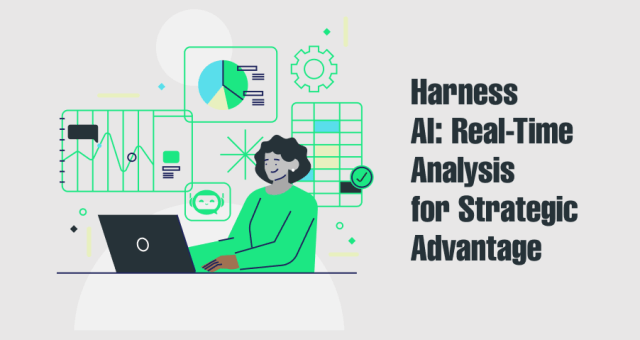
The Role of AI in Real-Time Data Analysis

AI in Real-Time Data Analysis illustration

Introduction

The world is becoming increasingly fast-paced and digital, and, thus, the importance of real-time data analysis for any business looking to stay competitive in today’s market is highly significant. With the exponentially increasing volume of data, processing and analyzing data in real-time can significantly improve decision-making, increase efficiency, and identify trends.

Artificial intelligence plays a significant role in enabling real-time data analysis by providing speed, accuracy, and predictive power that traditional methods cannot match. Real-Time Data Analysis and AI Business Perspective. AI in Real-Time Data Analysis is becoming essential as businesses rely on instant insights to stay competitive.

This article discusses real-time data analysis and its place in business advantage through AI.

Data Analysis in real time helps any firm to react quickly by following the change of business with opportunities. Real-time Data analysis is quite very imperative in sectors such as financial, retail, and so on where instant decisions create a huge impact, and such sectors also involve the manufacturing industry. The concept of Real-time data analysis makes its mark in data processing via the automation of complex analyses by creating patterns and then presenting business actionable insights.

Core Value of AI with Real-Time Data Analysis

Fast Action and Productivity: AI accelerates data processing. This means that a lot of time is saved in trying to analyze large amounts of data.

Predictive Analytics: AI, with machine learning algorithms, predicts future trends with the data that is present. Companies get a proactive approach in this case.

Improved Accuracy: This is because AI eliminates the need for manual analysis and thus reduces errors in providing insights, which are more reliable in nature.

How AI Enhances Real-Time Data Analysis Across Industries

AI-driven real-time analytics is the harbinger of several advantages for businesses across multiple sectors, including operations efficiency improvement to delivering personalized customer experiences. Many sectors now depend on AI in Real-Time Data Analysis to improve accuracy, reduce risks, and enhance operational efficiency. Some of the key areas through which AI-driven real-time analytics will change the dynamics of the industry are:

AI in Finance: Smarter Investments: In the finance sector, real-time analysis using AI is an important tool in monitoring trends in the market, detecting fraud, and managing risks. AI aids companies in responding quickly to fluctuations with real-time processing of financial data, making proper investment decisions, and reducing financial risk.

AI and Algorithmic Trading: Many trading systems are equipped with AI algorithms that scan the market data for patterns and then execute a trade in milliseconds. Therefore, it gives financial organizations a major edge to take opportunities immediately.

Better Customer Experience for Retail: It increases the understanding of consumer behavior in the retail industry through real-time customer data analysis. AI-driven insights would enable retailers to change the inventory, pricing, and marketing campaigns in real time based on customer behavior. It optimizes the inventory and supply chain.

Supply chain optimization: Another key contribution of AI in retail relates to supply chain optimization. On the basis of analysis of trends in demand, AI algorithms can predict requirements in inventory and thus help retailers offer customers the products required exactly when they need them; it reduces inventory cost considerably.

Health: Patient Outcomes Improvement: AI powers data analysis in the health sector, especially in diagnostics and treatment planning. Real-time data analysis through AI helps healthcare providers monitor health conditions in patients and make predictions on impending health complications and timely interventions for improvements in outcomes for patients.

AI and the Enhancement of Diagnostics: AI accelerates the analysis of complex diagnostic data, including imaging scans and lab tests, which enables healthcare practitioners to make quicker accurate diagnoses. This can be crucial in critical care scenarios as well.

Manufacturing and Real-Time Process Optimization

AI data analytics improves operational efficiency since the data from the production lines and equipment is analyzed in real time, making possible the early detection of problems, evasion of time that might be caused by a machine breakdown, and optimization of all the processes related to production.

Increased marketing with real-time insight

A real-time view of data in the marketing space would allow brands to gain insight into customer engagement as well as campaign performance instantly. AI-based marketing analytics can enable a business to optimize its campaigns targeting customers with highly relevant messages based on real-time behavior.

Personalizing Customer Interactions

AI-based personalization can help businesses tailor marketing efforts to individual customer preferences through more effective conversion rates and customer satisfaction. Real-time insights enable an adjustment of marketing messages based on instant responses from the customers.

Key Ingredients to Leverage AI for Real-Time Data Analysis

For real-time data analysis, organizations use several core ingredients to leverage AI efficiently. These help businesses capture the right insights quickly.

Machine Learning Algorithms: Algorithms in machine learning power AI-driven analytics and can be used by computers to make predictions from observed patterns. ML helps process extensive data sets and, accordingly, identifies trends for using them in real-time decisions.

Data Collection and Integration: Real-time analysis gathers data from multiple sources, including customer engagement, IoT sensors, and market data. AI enables the business to integrate and analyze different sources of data in a manner that reflects the entire picture of its performance and trends.

Predictive Analytics: Predictive analytics is based on past data that can predict future events, hence allowing organizations to make proactive decisions. AI makes this possible through the automation of predictions by allowing businesses to react in advance to problems.

Implementing AI-Driven Real-Time Data Analysis in Your Business

For those businesses that are interested in using AI for real-time data analysis, a structured approach can be necessary to achieve their desired outcomes. Here’s how you can implement AI analytics in real-time step by step:

Step 1: Define Business Goals: Determine the goals you wish to achieve by using AI analytics, whether it is to enhance the customer experience, reduce cost, or increase efficiency.

Step 2: Choose the Right AI Tools: Select AI platforms and tools that are relevant to your business needs. Every industry has specific tools that are linked to real-time data analytics, so make sure those tools meet your objectives.

Step 3: Source Integration: Integrate all pertinent data sources like CRM, ERP, and others for AI to understand all of your internal systems completely and work on meaningful analytics.

Step 4: Train Your Team: Obtain the skills required to work with AI-driven analytics tools. Training is essential for maximizing the benefits of AI while working in collaboration with data.

Step 5: Monitor and Adjust: Monitor AI performance after implementation and continually readjust as necessary to ensure that real-time analysis continues to provide valuable insights over time.

The Future of AI in Real-Time Data Analysis

The future of AI-driven data analysis is being improved even more with superior models and algorithms in the coming months. Future advancements expected will be in terms of high precision, faster processes, and increased accessibility – hence, good news to organizations of all sizes.

Automated decision-making: This should help future models of AI yield deeper insight into base decision-making and business propositions.

Better Predictive Capability: Advanced AI models should mean better predictive analytics, which in turn would be stronger in preparing for future difficulties.

Better Security and Compliance: As the technology of AI continues, it must lead to better security and compliance since that is where data security lies.

Business now has to stay on the leading edge of AI developments to be able to continue leveraging AI-driven real-time data analysis for a significant competitive edge.

Conclusion

The integration of AI into real-time data analysis allows businesses to respond, be proactive, and even adapt to the increasingly data-driven market. From a better customer experience to efficient operations, the benefits run deep with AI-driven analytics. Implementing AI in Real-Time Data Analysis helps companies make smarter decisions, respond quickly to changes, and stay ahead of competitors.

At Codelynks, we specialize in delivering AI-powered solutions specifically tailored to meet the business’s unique data analysis needs. Our expertise ensures companies harness the full power of AI to transform their data into actionable insights, putting them ahead of the curve.

More Blog: 6 Essential Secrets Management in Platform Engineering to Secure Multi-Cloud Infrastructures

5 Incredible Ways AI in Augmented Reality is Changing AR Forever

Graphic showing AI-powered augmented reality transforming user experiences with innovative AR features.

Introduction

AI in Augmented Reality, from being a futuristic concept, has transformed into a practical technology, revolutionizing the gaming, healthcare, retail, and education sectors. Unlocking its true potential, however, is through AI and ML. These are what will define AR innovation going forward-to facilitate enhanced user experience, optimized performance, and real-time decision-making capabilities. Let’s see how AI, especially with its mechanism of machine learning, is enriching augmented reality applications and changing the face of interaction with digital content in any form.

AI enriches AR technology in the following ways:

  1. Object Recognition: The AI of AR means that it will understand objects that exist in the real world within real-time.
  2. Gesture Recognition: Machine Learning in AR helps devices to notice the gestures of the user. Users will interact with the AR environment more natively.
  3. Environment Mapping: Using AI and ML, AR dynamically adapts to the user’s environment so that any augmented content becomes more accurate and relevant.

AI-powered Augmented Reality applications are more immersive and responsive and offer personalized and context-aware experiences to users by incorporating these AI-powered capabilities.

AI-Based Object Recognition and Tracking in AR

Object recognition and tracking are critical features in AI-driven AR applications. Through machine learning algorithms, AI enables these capabilities.

  1. Real-Time Object Recognition: AI in Augmented Reality uses computer vision and machine learning to detect objects in real time, thereby enabling AR apps to intelligently interact with the physical world. For instance, retail AR apps use facial and body recognition for virtual try-ons.
  2. Dynamic Object Tracking: With Machine Learning, AR machines can now track moving objects in close precision so that the digital overlay will stay perfectly positioned relative to the real object. It is especially useful in applications for AI-powered AR games and in medial work where accuracy is needed.

Enrichment of User Interaction Using Gesture Identification

AI in AR enhances user interaction through gesture recognition powered by machine learning. Instead of relying solely on controllers, users can now interact with AR interfaces using natural gestures.

  • Gesture-Based Controls: By training machine learning models on diverse movements, AI enables AR systems to interpret gestures. A great example is Microsoft HoloLens, where virtual objects can be manipulated mid-air.
  • Interaction-Hands-Free: Although the gesture recognition capability of AI in Augmented Reality eliminates the requirement of controllers, such interaction is intuitive, immersive, and especially apt for healthcare AR applications, where control needs to be hands-free.

AI and Environment Awareness in AR

For AR technology to seamlessly integrate into real-world environments, it must understand its surroundings ,a challenge solved by AI and machine learning.

  1. Environment Mapping: AI in AR allows system to identify and make a map of its surroundings in real time. With an AR device, one can know the size of a room and react by placing virtual objects in the correct places.
  2. Spatial Awareness: Machine learning in AR accommodates spatial awareness that can make AR apps interact more precisely with the real world. For example, in an architecture and interior design AR app, virtual models or furniture are the correct scale and placed.

AI-based environment awareness makes AR applications more flexible and responsive to environmental changes.

AI in Augmented Reality Applications Across Industries

AI-powered AR is not strictly for gaming and entertainment. The application can be seen in other industries that develop these technologies as a means of improving the user experience and streamlining workflow processes. Here’s how AI and AR are driving digital transformation across sectors:

  1. Healthcare: In healthcare, AI in AR systems, which overlay in real-time any data relevant to the patient being looked at, thereby increasing precision. Using AR with AI enhances diagnostic procedures by analyzing the patient’s data on the AR display.
  2. Retail: AI with AR are changing the game for retail experiences, easy to imagine things in their home or try them on. This eliminates the need for any physical interaction.
  3. Education: AI-driven AR apps enhance learning, including interactive real-time content, that makes it interesting to get these topics through students.
  4. Manufacturing: AI-augmented AR applications allows engineers and technicians to see the ways of assembling something, detect errors on the fly and obtain overlays with data that improve efficiency and precision on the shop floor.

These AI and AR integrations create smarter, more productive, and user-friendly systems across all major industries.

The Future of AI-Driven AR

The future of AI in Augmented Reality is filled with innovation and transformation. As machine learning algorithms evolve and AI’s data-processing power increases, AR systems will become even smarter, more adaptive, and seamlessly integrated into our daily lives.

Future innovations in AI-powered AR include:

  1. AI-Powered Personal Assistants: AR systems combined with AI assistants will provide real-time, personalized guidance tailored to each user’s preferences.

  2. Smart Glasses and Wearables: AI and AR technology will make wearables more intelligent, lightweight, and capable of real-time object detection, translation, and navigation.

Conclusion

The combination of AI and machine learning in Augmented Reality is gradually revolutionizing the field of AR applications. It makes the AR applications more interactive, intuitive, and intelligent by providing augmentation in real-time object tracking and gesture-based controls.
And with every passing day, AI in Augmented Reality will see more involvement of the AI world, forming the future and a life where the applications of augmented reality become part of the routine as enhanced by the efficiency of machine learning and AI innovation.

More Links : AR and AI Ethics: 5 Critical Considerations for Privacy and Security

  • Copyright © 2026 codelynks.com. All rights reserved.

  • Terms of Use | Privacy Policy