Harnessing AI for Predictive Analytics

AI-driven predictive analytics workflow, Predictive analytics business insights, etc.

Introduction

In today’s data-driven world, more and more businesses look to use the enormous amount of gathered data to actionable insight. Among all the robust tools that enable the business to critically examine past data patterns and predict future trends, AI-driven predictive analytics is a mighty force that drives them.

With the use of AI-driven predictive analytics, businesses can make decisions that utilize better data usage and strategize to remain competitive and innovative in highly competitive markets.

We will discuss in this blog how AI-driven predictive analytics has transformed data into valuable insights and real-world industry impact.

What is Predictive Analytics?

Predictive analytics refers to the use of historical data, statistical algorithms, and machine learning techniques to predict what will happen next in business based on past behavior.

Traditional data analysis lets businesses look back at the data to understand what happened, while predictive analytics enables businesses to know what is going to happen next and then act proactively on that knowledge.

For example, predictive analytics can predict the customers’ actions, such as buying behavior; can identify the potential failure in any equipment; and can even optimize the inventory with such an enormous amount of data coming from multiple sources.

With the application of the power of AI, predictive analytics becomes more potent, accurate, and actionable.

Role of AI in Predictive Analytics

Artificial intelligence immensely enhances the capability of predictive analytics. Predictive models learn to predict more accurately by feeding them new data in a continuous learning process.

Increased accuracy: AI algorithms can process huge data sets far quicker than any human could and where patterns and correlations lie, which might not be seen if this were analyzed normally. This would result in very high accuracy forecasts.

Real-time analysis: Business organizations will be able to analyze data using AI in real time, letting them make decisions on the move. For example, this will allow retailers to change pricing strategies according to forecasts of real-time demand generated by AI analytics.

Automation: AI fully automates the process of data collection, analysis, and reporting, reducing the manual errors and valuable resources that could be freed up. This ensures faster deployment of predictive analytics solutions.

Artificial intelligence immensely enhances the capability of predictive analytics. Predictive models learn to predict more accurately by feeding them new data in a continuous learning process.

Key Benefits of AI-driven Predictive Analytics

Predictive analytics with AI allows a variety of benefits empowering businesses to convert raw data into actionable insights. Here are some of the key advantages

Good Decision Making: Predictive analytics lets an organization take on sharper, wiser decisions by predicting the outcomes and showing possible risks. Examples include credit risk assessments and marketing campaign optimization.

Cost Optimization: Data-driven predictions with AI help businesses save money by identifying inefficiencies. In manufacturing, For instance, predicting machine breakdowns enables timely maintenance and reduces downtime.

Improved Customer Experience: Analyzing the customer’s behavior helps businesses predict what their customers might want and, based on the information, offer more personal experiences. For example, through Predictive modeling with AI, an e-commerce platform can recommend products to the customers based on their prior purchases and browsing history to enhance customer satisfaction and loyalty.

Risk Management: For example, predictive analytics for risk reduction in finance, insurance, and healthcare can reduce risk at an early stage. The AI-based model can predict fraud and measure the risk in loaning and predict the medical outcome. Thus, such predictive analytics can help organizations in such a field take proactive measures in order to minimize the risk.

Real-World Use Cases of AI-driven Predictive Analytics

Predictive analytics with AI is already changing many industries because it provides actionable insights for better decision-making. Here are a few examples:

Retail: They apply predictive analytics using AI to help modify pricing strategies and manage inventories, which in turn can help them predict sales trends.

Health care: In healthcare,  AI-based predictive analytics helps hospitals and providers predict patient outcomes, optimize treatment plans, and allocate resources more efficiently.

Finance: Banks and financial institutions use AI for actionable business insights to assess customers’ creditworthiness, detect fraud, and optimize investments.

Production: The manufacturers use predictive analytics to predict the break-down of equipment, thus, offering scheduled maintenance before critical machinery breaks down in time.

How to Implement Predictive Analytics with AI in Your Business

AI analytics solutions deployment to your business will need a strong strategy and right tool set. These are the primary steps leading to its introduction to your business:

Define your goals: Identify business problems to address, such as improved retention, better campaigns, or cost reduction.

Gather and tidy data: Collect quality data from internal databases and external sources, such as customer interactions or market trends. Clean and organize it carefully.

Choose relevant AI tools: Platforms like IBM Watson, Google Cloud AI, and Azure AI enable automation, predictive modeling, and actionable insights.

Test and refine models: Continuously monitor performance and address flaws to maximize output.

Conclusion

The game-changer of today’s competitive business landscapes is the ability to make data actionable for decisions. This predictive analytics approach empowers businesses to make smarter, data-informed decisions.

It leverages predictive analytics across industries to unlock valuable insights into opportunities and improvements and then drives long-term success.

It’s about time to take control of the curve with AI and transform data into actionable business strategies.

More Blogs : 5 Steps to Scaling Gen AI: A Data Leader’s Guide to Enterprise Success

Mastering AI Integration: Best Practices for Business Optimization

AI integration strategy

Introduction

Artificial Intelligence is revolutionizing industries across the globe to offer cutting-edge efficiency, automation, and innovation for businesses. However, to leverage the full potential of AI, organizations have to direct their attention towards the strategic integration and optimization of AI systems. With seamless AI integration, technology not only operates efficiently but also supports existing workflows to accomplish long-term success.

This article will give you the most successful ways of integrating and optimizing AI in your business strategy

5 Best Practices for AI Integration in Business

Start with a Defined AI Strategy: A defined AI strategy is the starting point for effective AI integration. Businesses must consider their needs, define specific goals, and align AI initiatives with comprehensive objectives before adopting AI tools. Some of the questions one may ask are:

  1. What specific business problem do we want to solve with AI?
  2. How does AI help us improve current workflows?
  3. What are metrics to measure the success of AI?

Data Quality and Management: A roadmap cannot be conceived without a plan on quality data and management. Use quality data and not poor data quality.

AI feeds off data, and how this data is managed and of what quality will highly influence AI’s success. Poor quality or inadequacy in data can lead to misprediction, broken models, and suboptimal results. So, ensure your organization develops a robust policy for data governance, regularly cleanses data, and uses high-quality labeled datasets for training AI.

However, that is not all; there must also be scalable data management systems; such systems should provide a soft and smooth flow of data among departments and AI systems, feeding AI algorithms continuously with updated information; hence, AI can deliver better decision-making processes.

Scalable Investment in AI Infrastructure: For instance, artificial intelligence applications can be very resource-intensive and require a lot of computation and storage. The right investment is in an infrastructure that can scale with your organization. There are cloud-based solutions like AWS, Google Cloud, and Microsoft Azure that give you enough flexibility, scalability in computing resources, and adaptation to changing workloads.

Scalable infrastructure also supports the deployment process at a speedier pace and ensures real-time processing demands and has no bottleneck for systems. It allows a company to spend its money on proper hardware as well as cloud solutions in order to avoid downtime and make sure that AI processes are continuously optimized.

Cross-Functional Collaboration End: AI cannot operate in silos to be truly integrated. Its integration requires the collaboration of multiple departments, including IT, engineering, data science, and business operations.

A culture of collaboration enables cross-functional teams to collaborate and share knowledge to focus on finding integration points and optimal AI configurations for practical deployments. Regular feedback cycles involving business and technical teams ensure that AI models are constantly refined toward achieving business outcomes.

Continuous Monitoring and Performance Tuning: After the AI systems are deployed, continuous monitoring would be necessary for optimal system performance. AI models have to be periodically reviewed and upgraded for optimal accuracy and efficient performance. Key performance indicators like precision, recall, and model accuracy would be monitored in order to monitor the development of such systems over time.

But also, consider using automated AI optimization tools for performance tuning. Such tools can detect inefficiencies in your AI models and recommend ways of improving performance-often saving time while improving overall system performance.

Prioritize Ethical AI Practices: As an embedding of AI in business processes necessitates ethics, data privacy, algorithmic bias and can put a spotlight on issues of transparency at the outset. 

Policies to be instituted should include:

  1. Transparency of AI decision making
  2. Data protection policies such as GDPR, CCPA, and many more.
  3. An unbiased model so that AI aids in the equitable treatment of each user.

Such an investment in ethical AI practice will protect a business from future litigations and increase customer and stakeholder trust.

Conclusion

AI deployment and optimization need to be strategic, putting together clear planning, collaboration, and continuous refinement. Everything from data management to infrastructure scalability to ethical considerations puts those who focus on these best practices in a much better place to really unlock the value that is now available through AI.

It will help organizations build a robust and effective AI ecosystem that addresses all the needs of its current scenario, preparing to face those of the future.

More Blogs: 7 Revolutionary Ways Visual Search in eCommerce is Transforming Online Shopping

Top 3 Strategies for Responsible AI: Ethical Innovation with Accountability

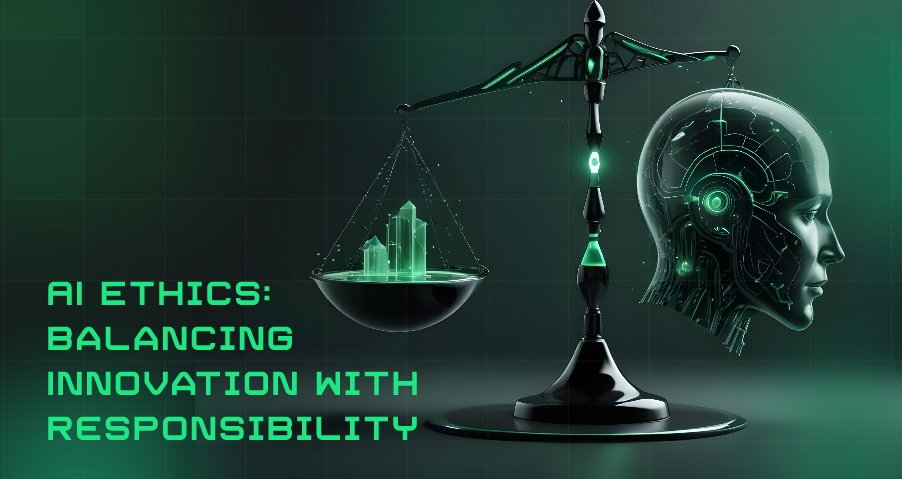
Illustration representing responsible AI practices, highlighting ethical innovation, accountability, and AI strategy

Introduction

Responsible AI, with the inclusion of AI in modern technology, it has become a challenge to develop innovation within AI systems that are innovative yet ethical. Now, just as magnificent as AI technology can be with innovation across various industries, there are some risks to which one has to manage the proper resolution. From biased algorithms to the loss of privacy, even the construction of ethical AI requires maximizing benefits and thus minimizing harm in a delicate balancing act. This opens up to show how organizations can create ethical AI within the risks of rapid innovation.

Why Ethical AI Matters

AI systems are increasingly penetrating decision-making processes affecting people’s lives, from healthcare diagnoses and loan approvals to even criminal justice processes. And as these technologies begin to shape the future, their ethical use assumes an even more important role. Ethical AI is therefore the development of transparent systems free of bias, where human rights and privacy, for example, are respected.

If indeed no ethical considerations were involved in AI, for instance, the party responsible may perpetually be biased, invading privacy and exacerbating inequalities. For instance, if an AI algorithm is trained using biased data and discriminates against certain demographic groups, an outcome may be produced that’s most certainly unfair. Therefore, it is very important to have AI systems with some sort of fairness, accountability, and transparency while ensuring public trust and that the benefits of AI spread.

Innovation in AI development pushes companies to make speed and performance their highest priority over ethical safeguard, yet neglect of ethics is a guarantee to risks. Ethical AI will be built around the innovation-risks balance that companies must innovate with anticipation of risk from ethics.

To achieve a balance, the development of AI should be accompanied by ethical considerations in design, testing, and deployment. When ethics is woven into the fabric of AI innovation, companies can reduce the risks of algorithm bias, lack of transparency, and data misuse to ensure AI systems are cutting-edge while being responsible.

Important Risks of Ethics in AI Development

  1. Bias and Discrimination: AI systems are as good as the information they were trained on. If biased datasets are used to train the algorithms, then AI extends or even amplifies the running inequalities. For example, biased hiring algorithms can especially discriminate against women or minority candidates. The developers should therefore be awakened and caught being vigilant in detecting and mitigating biases so that they would not discriminate in an AI system.
  2. Lack of Transparency: AI algorithms are “black box,” which means their decision making processes are opaque and not easy to understand. Such lack of transparency may raise ethical questions particularly when AI is deployed in critical sectors, such as medicine or criminal justice. Ensuring algorithmic transparency must therefore become a priority to create trust and accountability in AI systems.
  3. Privacy Violations: The capacity of AI to collect and process big data raises significant privacy concerns. Misuse or mishandling personal data may lead to violations of privacy such as unwarranted surveillance or identity theft. Ethical development of AI requires developers to prioritize data privacy to its users so as to be GDPR compliant.
  4. Accountability and Responsibility: It is often tough to attribute accountability when AI systems go wrong. There can even be disputes of accountability for mistakes by the developers, the organization which uses the AI, or the system itself. In certain applications of AI that will directly affect the lives of humans, such as autonomous vehicles or medical diagnoses, these lines of accountability are crucial for ethical AI.

Policies Building Ethical AI

  1. Ethical AI Frameworks: Using an ethical AI framework is a good approach toward ethical AI development. Ethical AI frameworks give organizations the support needed to install moral considerations into their development process. Good examples of these are the EU’s Ethics Guidelines for Trustworthy AI. They highlight principles such as fairness, accountability, and transparency.
  2. Diverse and Inclusive Data Sets: Developers should leverage diverse, representative data sets as a means of countering algorithmic bias. This means the data set that is used for training AI systems must reflect an extensive range of demographic groups so that it does not end up promoting bias that could lead to discriminatory outcomes. Regular audits of AI systems will help identify bias and correct it.
  3. Explainability and Transparency: Developing AI in a manner that is explainable fosters an understanding of how decisions are made. By making AI systems transparent and explainable, a company can earn trust from users, regulators, and the general public. This is especially important where AI decisions may have high-stakes consequences-for instance, for medical treatment or financial decisions.
  4. Continuous monitoring and auditing: The development of ethical AI does not end once a system is in place. Continuous monitoring and auditing of AI systems allow them to perform ethically over time. This could include tracking outcomes in terms of fairness and accuracy and updating the systems to respond to new ethical challenges as they arise.
  5. Collaboration and the formation of ethics committees: Organizations should create AI ethics committees that are diverse, comprising ethicists, legal experts, and representatives from the community at large. This will ensure consideration of ethics during the development of AI as well as the proper focusing on ethical concerns during innovation. The external stakeholders, regulators, and advocacy groups may also work with companies in building more ethical AI systems.

Conclusion

Tremendous promise is believed to lie in the future of AI, and it equally poses risks that companies must monitor carefully. Through ethical systems of AI, this balance will provide a chance for firms to innovate within responsibility, value, and matters of equity, transparency, and accountabilities. In this regard, careful balancing amid the urgent need to speed technological advancement with risking efforts will help bring about certain benefits to greater society in the development of AI systems. The ethos of ethical considerations will be at the core of sustainable innovation since AI profoundly transforms industries.

More Blogs: Securing Your Software Supply Chain with Software Composition Analysis

Driving Digital Transformation with AI Insights

AI-driven insights transforming digital operations and helping businesses stay ahead

Introduction

The hectic pace of today’s digital economy compels businesses to continuously innovate and adapt. At the forefront of change is the artificially intelligent application- a powerful tool that is powering the digital transformation of industries through insights derived from the analysis provided by AI. The business world today has the scope to integrate itself in numerous possibilities offered by AI. It streamlines the operations but also helps ensure a competitive advantage within an increasingly digital world. Here, this blog post shows how AI-driven insights are an important source of a successful digital transformation.

What’s the role of AI in this digital transformation?

Digital transformation is the integration of digital technology in any business, giving rise to changes on a fundamental level about how such a business operates and delivers value to its customers. AI is central to this transformation because it helps companies automate tasks, make decisions based on data, and personalize customer experiences.

Actually, artificial intelligence is the real fuel for the digital transformation. AI processes and analyzes humongous data that enables it to identify patterns and trends that humans cannot decipher and thereby infers actionable insights. All these make business processes more optimized, allow for predicting the outcomes, and quickly adapt to changes that come forth because of market fluctuation. The mantra of efficiency is no longer relevant, and truly, AI becomes a strategic asset, in essence enabling business to maintain relevance within the ever-changing spectrum of digitization.

AI-Powered Decision-Making: Turning Insights into Action

One of the most transformative aspects of AI is improving decision-making processes. In a business, decisions were always made on intuition or on minimal data. AI changes this by processing large data sets in real time to provide data-driven insights that can enable leaders to make better decisions and proper accuracy.
For instance, predictive analytics powered by AI can enable organizations to predict market patterns, customer behavior, and operational requirements. All these enable companies to make proper inventory management, adjust their pricing, and even predict when customers will be demanding certain products or services. All this fosters agility and responsiveness in decision-making processes, which is an important aspect for success in the digital world.

Operational Optimization Through AI Automation

AI is also a major player in the streamlining of operations, automating tasks that are repetitive and optimizing workflows. It’s evidenced in AI-driven customer service chatbots, automated inventory management, and supply chain optimization that benefit businesses by saving them from inevitable operational inefficiencies as well as freeing human resources for value-added tasks.
For example, in the production sector, AI can be used to track the performance of equipment in real-time and predict when maintenance is necessary before the issue becomes a serious problem. This reduces downtime, lowers maintenance costs, and increases overall productivity. With the automation of mundane tasks, companies also limit the scope of human error in the process, further enhancing the efficiency of the operation.

Personalized Customer Experience with AI

Today, customers crave personalized experiences to their liking and preference. AI-driven insights enable organizations to deliver tailored experiences by looking at the individual’s data and predicting his needs. From personalized marketing campaigns to customized product recommendations, AI helps businesses build closer relationships with their customers.
For instance, AI might use browsing behavior, purchase history, and engagement data to give a customer suggestions that will likely be bought again by the customer. This level of personalization improves customer experience, boosts customer loyalty, and increases revenue. Moreover, an AI chatbot can offer real-time customer support so that businesses can engage customers 24/7.

Driving Innovation with AI-Driven Insights

AI is not only optimization of the available processes but also innovation. Analysis with AI can reveal new opportunities for growth and innovation in business based on the trend, customer’s feedback, and competitive landscapes. Companies can introduce new products or enter a new market with the help of AI in data insights to improve available service.
For example, AI may detect new trends in consumer preferences so that businesses can change directions in time and stay ahead. This is but one of the ways by which AI enables businesses to see where market changes are coming from and adapt to them, giving it strategic advantage in this fast-paced digital economy.

Risk Management through AI

Another key space is risk management where AI-based insights are changing the digital strategy. AI can scan humongous volumes of data regarding identified patterns of possible risks such as cybersecurity risks, financial fraud risks, and operational disruptions. Predicted and mitigated risks would enable businesses to safeguard assets, more importantly comply with regulations, and reduce losses in terms of finance.
For instance, artificial intelligence-based fraud detection can detect transactions in real-time and alert suspicious activities to help eliminate the risk of potential breaches. Proactive risk management is a safeguard for the business and enhances a business’s trust among its customers and stakeholders.

Scaling Digital Transformation with AI

Another role AI has in the digital transformation scale is that as businesses grow and expand, the operations of any business will be more complex, and it requires processes to be managed in a way that is difficult for people to handle. AI gives the much-needed scalability to maintain such complexity as it automates most process delivery and provides insight that guides business decisions.
May it be processing huge amounts of customer interactions by artificial intelligence-powered chatbots or data across different departments, AI ensures that scale-up is indeed possible without the loss of efficiency. Scaling becomes very important for firms seeking to further digitize their organizations.

Conclusion

AI-driven insights drive digital transformation by helping companies streamline, make better decisions, and providing highly customized experiences. Companies can use AI for optimization of current operations and potential innovation and scale digital strategies. Given the rapid pace of technological changes, one needs to be competitive, keeping up with such change through reliance on AI insights and tools for survival since companies adapt through digital transformation.

More Blogs : The Amazing Ultimate 2025 Guide to AI in eCommerce Trends and Predictions

Crafting the Perfect AI-Driven Business Strategy

AI-driven business strategy illustration showing data analytics and automation

Introduction

Artificial intelligence is changing the way companies operate, innovate, and grow in ways yet unprecedented; from automation to data-driven decision-making, its potential is immense. But unlocking that potential requires clear and actionable strategy. An AI-driven business strategy goes beyond the adoption of technology-it must also be built in a manner that integrates AI with your company’s overall goals, improves performance, and drives innovation. Here’s a step-by-step blueprint for building a successful AI-powered business strategy.

What Is an AI-Driven Business Strategy?

First, define what your business objectives are. AI should be a tool to accomplish specific goals for the organization-to enhance operational efficiency or customer experience, or even to deliver a completely new revenue source. Start with identifying opportunities where AI is most impactful in your business. Do you want to optimize the operations or free up resources from routine tasks, or should you make better decisions based on richer data insights?

What is more, by knowing these expected results, you will then know how to better prioritize which AI solutions are likely to bring the highest return on investment and fit best with your strategic goals. An AI-Driven Business Strategy allows organizations to leverage artificial intelligence to improve operations and customer experience.

Assess Your Current AI Readiness

Before bringing AI into the door, you will first have to determine your level of current AI readiness, including the state of your company’s data infrastructure and technical capabilities of both its workers and organizations, as AI all operates off of data. Before building an AI-Driven Business Strategy, companies must assess their data readiness.

Add to this assessment your in-house technical competencies. Do you have the staff who can run AI systems, or do you need to partner with an outside vendor or hire AI experts? Knowing your current state of affairs is important to figure out what is missing and how you plan to implement..

Why Your Business Needs an AI-Driven Business Strategy

Now that you have an understanding of the preparedness on your part and clear goals, the next thing to determine is which AI tools and technologies to use. There is a whole gamut of AI applications out in the world-think machine learning algorithms to natural language processing and computer vision. What will be appropriate will depend on business needs as well as capabilities.

For example, to enhance customer service, you can implement AI in a self-service chatbot which provides automated assistance that is likely to further the cause of customer engagement. If, for instance, increasing the efficiency of the supply chain is your goal, then AI will provide predictions related to demand and optimize logistics to manage lower operational expenses.

A scalable AI-Driven Business Strategy helps businesses stay competitive in 2024 and beyond. The strategy is in the type of AI that has been chosen based on the business goals but should also be scalable and agile enough to be expanded for the future.

AI-Driven Business Strategy: Pilot Small Projects

You would therefore implement AI using a pilot approach within your business strategy. Pilot projects help test selected AI applications in specific areas of your business to measure their potential impact before further investment. Pilot projects give insights into successful and failed areas, where you can improve your strategy as you implement it.

For instance, you could start by implementing AI in one specific department. For instance, you could use AI in marketing to personalize the campaigns based on client information. Once deployed, the AI system becomes successful, and you can expand it to sales, operations, and other departments.

Building a Culture for an AI-Driven Business Strategy

Indeed, the success of AI integration is beyond technology and involves the establishment of a culture that excels in innovation and change. A workforce must thus be readied to work with AI, and the investment must be in training and education. Prepare your workforce so they can be proficient at understanding AI tools, how to interpret insights, and making data-driven decisions.

AI must be taken as an enabling tool that supports human capabilities rather than replacing it. If your organization creates an atmosphere whereby the culture of embracing AI is encouraged, then it will maximize its benefits from this revolution and accept change to a minimum. Training teams is a critical part of any AI-Driven Business Strategy.

Importance of Data Security and Ethics

Addressing data security and ethics becomes of utmost concern when AI-driven businesses deal with their cores of huge volumes of highly sensitive data. Your AI systems have to be designed following appropriate data privacy regulations and standards, depending upon your region and industry needs. For example, GDPR applies to Europe, while HIPAA is for North America.

And with that in mind, the ethics surrounding AI worth discussing. The algorithms need to be transparent, unbiased, and reasonable in coming to those decisions. Regular audits and reviews of your AI system help ensure that your system is following set ethical standards, and that you are on a path to maintain the public trust. Every AI-Driven Business Strategy must include strong data governance and ethical considerations.

AI Performance Optimization

AI cannot be a set-it-and-forget-it technology. After you have your AI systems in place, you really need to track performance and then optimize them based on evolving business needs and conditions of the marketplace. These systems learn and improve with time, but they also require periodic updates so they remain relevant and productive.

Monitor KPIs to track the impact of AI on your business, and know where to improve on. Whether it improves efficiency, enhances revenue, or customer satisfaction, continuous optimization is the key to getting the most out of the value proposition that AI could bring to your business.

Conclusion

Building an AI-driven business strategy helps your company compete in today’s digital economy. Aligned to your business goals, assessing the readiness level of your company, and using the appropriate tools can unlock the transformative capabilities of AI for your business. Strategically applied, AI can better innovation, operational efficiency, and, above all, future-proof businesses toward sustained growth. This is the time to embrace AI and lead your business into the future.

More Blog: The Amazing Ultimate 2025 Guide to AI in eCommerce Trends and Predictions

AI for SMBs : Strategic Implementation

AI for SMBs improving operations and customer experience

Introduction

AI for SMBs is no longer a luxury, it’s a strategic necessity for businesses aiming to grow efficiently. AI for SMBs is driving the new revolution in AI, transforming industries all over the global economy, and it’s as much of a chance for small players as large ones-for exploiting the edge of AI in order to lead growth and operational excellence by deriving a competitive advantage. For many SMBs, strategic implementation of AI can fill the resource gap while innovation is required rapidly within this increasingly digital landscape. This blog elucidates how AI for SMBs can be leveraged through judicious yet scalable and impactful strategies.

AI for SMBs: Boosting Operational Efficiency

Probably the most significant benefit of AI for SMBs is operational efficiency, allowing small and medium businesses to optimize resources effectively. AI can automate repetitive tasks, streamline workflows, and reduce the likelihood of human error in activities such as customer services, invoicing, and inventory management. For example, AI-enabled chatbots can provide customers with round-the-clock support by resolving simple issues and answering common questions. This allows the swift execution of services while freeing employees to devote themselves to more important matters.

In addition, AI-based management of inventory tracks stock levels automatically, it forecasts demand and orders automatically, keeps a business at its best possible inventory levels, avoiding overstocking while maintaining adequate supply of supplies that are most important.

Improvement in Innovation and Product Development

The AI-driven industrial renaissance is also encouraging innovation through better processes of product development. AI algorithms can process vast volumes of market and consumer data to allow for the determination of trends and opportunities. Based on such insights, companies can either innovate new products or improve existing ones. For example, in the fashion industry, AI is used to predict trends and design novel collections that resonate with consumer preferences.

The innovation cycles of R&D are accelerated significantly by AI. With machine learning algorithms, companies develop virtual designs of their products and optimize materials to print out actual prototypes in 3D printing. This shortens the lead time from the generation of ideas for products until they hit the market, allowing companies to have an upper hand competitively within faster-paced industries.

How AI for SMBs Enhances Customer Experience

With so much competition in the marketplace, the secret sauce for most SMBs is customer experience. AI helps businesses provide a more personalized and responsive experience. For instance, AI tools can analyze and deliver which products to buy, targeted marketing campaigns, communications aligned with customers’ preferences, and buying behavior.

In addition, AI-based sentiment analysis analytics can help measure how satisfied a customer is through the feedback received through social media and reviews and surveys. Based on such insights, businesses can take the first step to address issues, further customer engagement, and have more significant relationships.

AI-Based Decision Making

For AI for SMBs, making data-driven decisions is necessary for sustainable growth. It’s a difficult task because collecting, processing, and interpreting large volumes of data are very time-consuming and resource-intensive. AI makes it easy by machine learning algorithms that quickly interpret vast datasets with good accuracy. Therefore, business can get actionable insights and formulate informed decisions in marketing and sales and operations.

For example, AI can analyze customer-buying patterns to help SMBs identify potential revenue sources, optimize price structures, and efficiently allocate resources. Decisions are data-driven in real time, and the operations remain agile and responsive to changing market situations.

Automation of Marketing and Sales through AI

Probably, the most important functions that may boost growth of an SMB are marketing and sales, and AI for SMBs can strengthen both through automation and analytics. Artificial intelligence can significantly strengthen these streams. AI-based marketing automation platforms enable businesses to automate routine marketing-related tasks like email campaigns, lead generation, and managing social media such that the marketing is consistent and based on actual data, which allows for higher conversion rates and retention of customers.

Additionally, AI can optimize the sales funnel by analyzing high-quality leads and pushing them through the sales funnel for the sales teams. AI tools analyze customer behavior and engagement data that will show which leads have the highest chances of converting, thereby showing the sales teams what prospect they should focus on. This does not only increase the efficiency level of the sales teams but also improves the revenues.

Scaling AI Solutions for SMBs

Most people do believe that AI technology is a product of huge corporations with big pockets, but the advancement in cloud computing and AI-as-a-Service platforms makes AI accessible and economical for the Small and Medium Businesses. Businesses could easily implement AI tools by relying on cloud-based solutions for AI instead of worrying about suffering from high infrastructure costs or requiring heavy-duty IT expertise.

Small business firms should start with an incremental infusion of AI in small pockets, beginning to start from something like customer support or marketing, thus gradually ramping up the inclusion of AI as the business scales up. By doing so, small business firms can maximize use of AI while keeping costs and risks relatively low at the initial stages.

Challenges in the Adoption of AI

Big advantages come with AI, but the system is a complex one; careful planning goes into implanting a system like this. Some of the possible challenges that SMBs will face include technical expertise, data privacy, and budgets. Businesses must collaborate with AI solution providers who support and train such that their needs are covered by the companies.

The implementation of AI solutions in SMBs also requires data security and compliance. Data related to customers and businesses is to be safeguarded by preventing anything that could possibly break the trust and even lead to potential legal issues in business.

Conclusion

That is not to say AI benefits only huge organizations. SMBs stand to unlock great value with operational efficiency, customer experience, and data-driven decision-making if AI is successfully, strategically implemented. AI-powered tools can help an SMB play its edge in a fast-evolving market, achieve sustainable growth, and future-proof the business for long-term success. Now it is time for SMBs to seize the transformative power of AI for SMBs to fully tap into the system’s potential and stay competitive.

More Blog: AI for Indian SMBs: Driving Growth and Operational Efficiency

AI for Indian SMBs: Driving Growth and Operational Efficiency

AI for Indian SMBs driving growth and operational efficiency

Introduction

The rapid pace of the digital economy has transformed AI for Indian SMBs from a futuristic concept into a critical tool for growth and operational efficiency. For small and medium-sized businesses in India, AI has become a leveler, setting the playing field on an equal level with that of larger enterprises. In Indian SMBs, the mounting pressure to become more competitive has made AI adoption no longer optional but rather indispensable.

Key Benefits of AI for Indian SMBs in Operations

For Indian SMBs, the crux of profitability lies in operational efficiency amidst the competitive landscape. Through AI for Indian SMBs, automation of processes ranging from inventory and customer support to logistics becomes possible. For example, AI-powered chatbots can be configured to interact with customers at any time of day or night, taking the load off of human agents’ desks and ensuring higher customer satisfaction.

Operation Cost Savings

Second, Adopting AI for Indian SMBs can significantly reduce operational cost because AI eliminates repetitive work, enables reduced intervention that hinders machines, and seeks to optimize the usage of resources. These savings can be used in other business areas like product development, marketing, or expansion into new markets.

AI-Powered Marketing and Sales

AI tools can change the marketing and sales approach for Indian SMBs. Marketing software on the basis of AI empowers firms to automate marketing campaigns with the help of social media, track engagement through social media, and also monitor customers in detail. AI can also optimize sales pipelines by helping the firm pick out the best leads and enhance conversion rates, which makes their sales teams more efficient.

Cybersecurity Enhancement

Increased cyber threats are forcing SMBs to carry effective cybersecurity measures that protect both sensitive data and their business operations. AI-based security systems can detect cyber threats in real-time and, with that, ensure businesses do not get breached.

AI learns patterns, therefore it grows and adapts to new security challenges

Accelerating the Digital Transformation

AI is perhaps the biggest component of digital transformation for Indian SMBs. AI will be required for navigating the increasingly digitized business landscape, ensuring Indian SMBs make this transition and remain relevant and competitive. It is also a precursor to the development of IoT, machine learning, and blockchain technologies, thus opening growth avenues.

AI for Better Decision-Making

The other significant advantage of AI is its prowess to process vast amounts of data and derive actionable insights, mostly useful in making much more knowledgeable decisions for SMBs, which often is stymied by limited resources and capabilities in the analysis of data. AI will empower such SMBs to make better decisions by observing how customers behave, market trends, and operations of a business that will capitalize on better strategic and growth opportunities.

Personalized Customer Experience

The market looks for the personalization coming from the customer themselves. This AI-based approach enables an SMB to offer customized recommendations to customers, personalized marketing messages, and even tailored product suggestions based on information about the customers.

This further creates a stronger business-customer relationship, further increasing loyalty and, of course, sales.

AI in Predictive Analytics

With predictive analytics based on AI, Indian SMBs can predict future market trends, customer preferences, and business risks. Using AI algorithms on historical data, SMBs can also predict the demand of any product or service and optimally price it according to the demand and supply dynamics in the market. The possibility of a price hike may also be predicted with the best possible inventory levels, giving an organization an edge over its competitors in the long run.

Innovation and Product Development

AI is likely to make a crucial difference in product development by finding gaps in the markets and assisting the SMBs to come up with innovative products. Analyzing consumer feedback and market trends, AI provides insights toward improving existing products or adding new features as well as the whole development of new products filling in the needs of customers.

Democratizing Access to Advanced Technologies

These AI tools that were available only to big corporations are now more accessible and affordable for an Indian SMB. Cloud-based AI services allow businesses to integrate AI without heavy investments in infrastructure or expertise, making it possible for small-sized businesses to adopt AI.

Conclusion

AI is no longer a luxury for Indian SMBs; rather, it has become a necessity to ensure long-term survival and competitiveness. This technology can bring too many benefits, such as improvements in decision-making quality and customer experience or reduction of operational costs. The right adoption of the AI technology will be beneficial to Indian SMBs as well as their customers in the long run.

More links : The AI-Induced Industrial Renaissance: Revolutionizing the Future of Industry

AI in Industry: How the AI-Induced Industrial Renaissance is Revolutionizing Manufacturing

AI in Industry enhancing manufacturing efficiency

Introduction

AI in industry is driving an AI-Induced Industrial Renaissance in 2025, transforming manufacturing, innovation, and global productivity. Industry is said to be the merging of tool and system applications imbued with AI capabilities into every sector, thereby changing how businesses function, manufacture, or innovate. AI not only helps companies become more productive and efficient but also transforms their respective industries by bringing about production techniques that are smarter and nimbler. All of this finally culminates into a profound change in the global industrial scenario with AI at the forefront of this shift.

AI in industry is driving an AI-Induced Industrial Renaissance in 2025, transforming manufacturing, innovation, and global productivity.

AI in Industry: Automation Redefines Manufacturing

Most apparent is the automation of manufacturing processes by AI in the industry. Evidence of this can be seen in robotic assembly lines and machine-driven machinery, which produce much higher output with greater accuracy and speed. The smart systems work day and night without tiring, thereby increasing output while minimizing human errors. The use of AI in robotics has streamlined such industries as automotive, electronics, and pharmaceuticals to produce goods according to ever-growing consumer needs.

Robotic Assembly Lines and Predictive Maintenance

AI automation enables real-time monitoring and predictive maintenance. AI will predict equipment failure before it occurs, lessen downtime, and maintenance costs by collecting and analyzing sensor data embedded in machines. This proactive approach to industrial management ensures that production lines continue uninterrupted; thus, there is increased efficiency and cost savings.

Accelerating Innovation and Product Development

The AI-driven industrial renaissance is also encouraging innovation through better processes of product development. AI algorithms can process vast volumes of market and consumer data to allow for the determination of trends and opportunities. Based on such insights, companies can either innovate new products or improve existing ones. For example, in the fashion industry, AI is used to predict trends and design novel collections that resonate with consumer preferences.

Faster R&D Cycles with AI

The innovation cycles of R&D are accelerated significantly by AI. With machine learning algorithms, companies develop virtual designs of their products and optimize materials to print out actual prototypes in 3D printing. This shortens the lead time from the generation of ideas for products until they hit the market, allowing companies to have an upper hand competitively within faster-paced industries.

Smart Factories and Industry 4.0

Industry 4.0, commonly referred to as the fourth industrial revolution, has been led by the introduction of AI to manufacturing. It is characterized by the smart factory where machines are able to communicate through IoT and make decisions for themselves on how best to drive the productive processes. The AI allows for automation workflow in real-time, a smoother supply chain and even better quality control processes in those factories.

Digital Twins and IoT Integration

The use of AI in smart factories is revolutionary. Through AI-powered data analytics, manufacturers can find inefficiencies in their production processes and adjust them almost in real-time for the highest output generation. Besides this, digital twins, which refer to a virtual duplicate of a physical system, enable manufacturers to run otherwise impossible experiments on the trials and error process, thereby optimizing production without interfering with actual operations.

AI-Driven Supply Chain Optimization

The industrial renaissance does not end here on the manufacturing floor; it goes to revolutionizing the supply chain through AI. AI algorithms help companies better predict demand, manage inventory at a lower cost of shipment, and at a reduced propensity of shipping interruptions. Analyzing many data sources, which include weather patterns, consumer behavior, and reliability of suppliers about possible hiccups that may arise in the chain and surmises alternative strategies that could be put in place for seamless operations.

Route optimization by AI in logistics enhances the delivery times and conserves fuel for business firms. The possibility of AI being able to aggregate analysis of real-time traffic data and weather conditions ensures that the delivery is made within a short period with minimum operational expenses.

Enhanced Workforce and Human-Machine Collaboration

Automation saw its rise to the world, but Artificial Intelligence was not here to displace jobs of humans; on the contrary, AI was enhancing it. Industrial renaissance powered by AI brought a new era in collaboration between humankind and machine. The routine work pattern as part of the job could be relegated to machines if AI systems supplant it while workers focus on more challenging, added-value work. For instance, in manufacturing, AI could assist technicians in real-time insight and recommendations for improvement in decision-making and problem-solving.

AI-based training systems are also enhancing the upskilling and reskilling capabilities of workers for the changing industrial landscape. Through the application of machine learning algorithms on training programs customized to individual performances, companies will ensure that its people remain relevant in the new world of AI.

Sustainability and Energy Efficiency

AI does have a significant role to play in giving industries a solid sense of sustainability through optimum energy consumption and the lowest percentage of waste that can be generated. AI-powered systems can help monitor their energy usage throughout factories by fine-tuning operations to minimize energy waste. For example, AI will be able to predict the most energy-efficient times at which machinery can be run. This will automatically reduce the environmental footprint of industrial operations.

With AI also employed in research on sustainable materials and recycling processes, it explores newly found technologies that allow industries to reduce their effects on the environment while improving the efficiency of resources-being increasingly demanded by consumers.

Conclusion

All sectors of the globe are transformed under this industrial renaissance powered by AI, leading to sheer innovation, efficient growth, and more productivity. Smart factories, automated supply chains, AI-enhanced workforce collaboration, and other such similar effects of AI will define a new industrial landscape and ensure survival only those industries which take these evolutions forward. Industry’s future has just arrived, and it runs on AI.

More Blogs: The Amazing Ultimate 2025 Guide to AI in eCommerce Trends and Predictions

  • Copyright © 2026 codelynks.com. All rights reserved.

  • Terms of Use | Privacy Policy