Table of Contents
Zero Trust for Insurance: A 4-Level IRDAI Compliance Framework (2026)
On April 6, 2026, IRDAI notified revised information and cybersecurity guidelines that apply to every insurer, reinsurer, intermediary, and TPA operating in India. The guidelines mandate board-level oversight, an independent CISO reporting line, 6-hour breach notification to IRDAI and CERT-In, 180-day log retention, and comprehensive vendor risk management. Penalties for failure to implement reasonable security safeguards reach ₹250 crore under the DPDP Act.
For a life insurer with 8 million policyholders and 14 regional offices, this is not a checkbox exercise. It is a rearchitecting problem.
What Changed in April 2026
IRDAI’s April 2026 guidelines replace the 2023 circular and introduce three structural requirements that most insurers cannot satisfy with their current architecture.
The 6-hour breach notification requirement is the most operationally demanding. To notify CERT-In within 6 hours, you must detect the breach within roughly 4 hours, which means your SIEM must have ingested and correlated the relevant logs before the incident was confirmed. Most insurers in India run SIEM with 24 to 48-hour log ingestion delays from branch systems. That architecture cannot meet a 6-hour clock.
The independent CISO requirement specifying that the CISO shall not report to the Head of IT forces an organizational change that triggers an architecture review. CISOs who previously lived inside the IT cost center now have board visibility and procurement authority. The security controls they could not justify previously are now their mandate.
The vendor risk management requirement extends security obligations upstream. Before engaging any vendor with access to policyholder data, insurers must conduct cybersecurity due diligence and confirm compliance with IRDAI guidelines. This covers cloud providers, TPAs, broking platforms, and health data aggregators.
Why Zero Trust Is the Right Response
Traditional perimeter security cannot satisfy these requirements. Perimeter security assumes that traffic inside the network is trusted. Modern insurance environments have no meaningful perimeter: branch offices connect over public internet, TPAs access policy systems from their own networks, and cloud-hosted customer portals interact with on-premise policy administration systems.
Zero trust security assumes that no traffic, user, or device is trusted by default, regardless of network location. Every access request is authenticated, authorized against policy, and logged. This architecture produces the continuous monitoring and log completeness that IRDAI’s 6-hour notification requirement demands.
IRDAI’s 6-hour breach notification requirement is not a reporting problem it is a detection architecture problem. Zero trust solves the detection problem.
The Insurance Zero Trust Implementation Ladder (IZTIL)
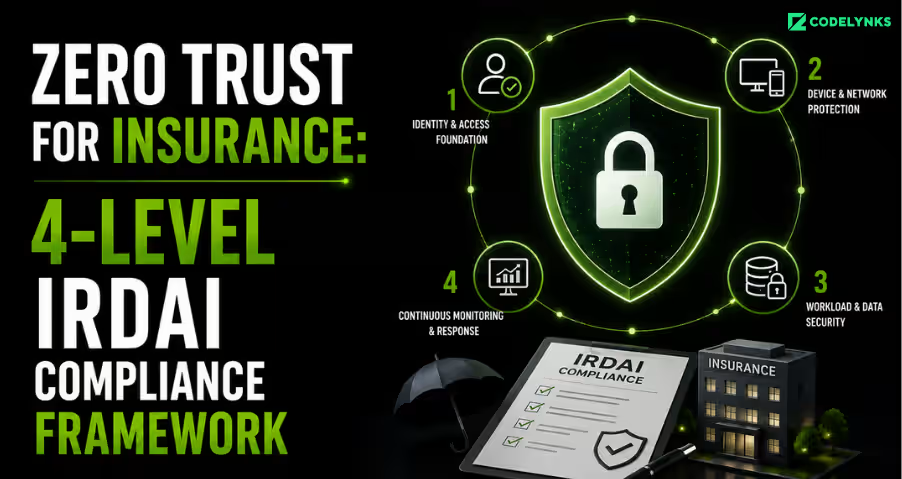
IZTIL is a four-level maturity model for Indian insurers implementing zero trust against the April 2026 guidelines. Each level is a stable operating state, not a transition phase. An insurer can operate at Level 2 and meet most of the mandatory controls. Level 4 is the target for insurers with more than 5 million policyholders or significant digital distribution channels.
Level 1: Data Classification and Identity Foundation
No zero trust implementation can start without knowing where personal data lives. An insurer that cannot identify which systems hold personal data cannot implement zero trust. The data classification comes before the network segmentation.
At Level 1: classify all data stores by sensitivity (policyholder PII, health data, financial data, claims records); deploy identity provider with MFA enforced on all privileged accounts; disable shared service accounts and replace with machine identities; complete an asset inventory covering on-premise systems, cloud workloads, and third-party integrations.
Completion criterion: every system with personal data is tagged, owned, and accessible only via individual authenticated identities.
Level 2: Microsegmentation and SIEM Baseline
At Level 2: implement network microsegmentation between personal-data systems and general administrative networks; deploy SIEM with log ingestion from all systems hosting personal data at under 2-hour latency; establish 180-day log retention with immutable storage; and configure alerting thresholds for anomalous access patterns (off-hours access to claims systems, bulk record downloads, and new device access to underwriting systems).
This is the minimum level at which an insurer can credibly meet the 6-hour notification requirement. It is achievable in 4 to 6 months for a mid-sized insurer with a dedicated security engineering team.
Level 3: Continuous Verification and Vendor Governance
At Level 3: implement device posture checks on all endpoint access to policyholder systems; deploy privileged access management (PAM) with session recording for all administrative access; implement vendor risk assessment workflow covering IRDAI compliance confirmation, security questionnaire, and annual audit rights; extend SIEM ingestion to vendor-operated systems accessing insurer data.
The vendor governance component is frequently underestimated. Most mid-tier Indian insurers work with 40 to 80 vendors with some form of data access. Conducting due diligence across that vendor population takes 3 to 5 months even with automation.
Level 4: Adaptive Access and Automated Response
At Level 4: implement risk-based adaptive access policies that adjust authentication requirements in real time based on user behavior, device posture, and data sensitivity; deploy automated incident response playbooks for common breach scenarios (ransomware containment, credential compromise, and unauthorized data export); and integrate security telemetry with the board-level Cybersecurity Committee reporting dashboard.
Level 4 is where zero trust becomes a genuine business capability rather than a compliance posture.
The Legacy Policy Administration System Problem
Most insurers treat their legacy policy administration system as untouchable. Zero trust architecture disagrees.
The policy administration system (PAS) in most Indian life insurers is an on-premise Oracle or custom-built system running on hardware that is 8 to 15 years old. It holds the most sensitive data in the enterprise every policyholder record, every claim, every beneficiary designation. It also has the weakest security controls: broad shared database credentials, no MFA, minimal audit logging.
IZTIL Level 2 does not require replacing the PAS. It requires wrapping it. Deploy an API gateway between the PAS and all consuming systems. Enforce authentication at the gateway layer. Log all PAS access through the SIEM via the gateway. Implement network segmentation that blocks direct database access from outside the PAS VLAN.
This is less elegant than a modern microservices architecture, but it is achievable in 8 to 12 weeks without touching the PAS codebase. Attempting a full PAS modernization as part of a zero trust project doubles the risk and adds 18 to 24 months to the timeline. Separate the concerns.
DPDP Act Interaction: What Changes in May 2027
The DPDP Rules notified in November 2025 bring substantive compliance requirements into effect in May 2027. For insurers, the relevant obligations compound the IRDAI guidelines: consent for processing health data, data localization requirements for personal data stored in cloud, right-to-erasure workflows for lapsed policyholders.
The zero trust data classification work done under IZTIL Level 1 directly accelerates DPDP compliance. An insurer that has tagged every personal data store, assigned ownership, and inventoried all data flows is 60 to 70 percent of the way to DPDP readiness. Run both programs under the same data governance team.
What This Means for Insurance Leaders
The April 2026 guidelines give the CISO organizational authority that was previously unavailable. Use it now. The three decisions with the highest compliance leverage in the next 90 days are: deploy MFA on all privileged accounts (days 1 to 14, no architecture change required), standing up SIEM with 2-hour log ingestion from PAS and customer data systems (weeks 4 to 8), and completing vendor data access inventory (weeks 6 to 12).
These three steps get you to IZTIL Level 2 and put you in a defensible position for IRDAI examination. Everything else, like microsegmentation, PAM, and adaptive access, can follow in priority sequence. Do not attempt all four levels simultaneously. The implementation risk of a big-bang security rearchitecture in a regulated insurer exceeds the compliance risk of a phased approach.
More Blog: AIS 189 Compliance: What Automotive Engineers Must Do Now