
Content Overview
Internal Developer Platform architecture is becoming a critical foundation for modern platform engineering teams. Companies adopting Internal Developer Platforms (IDPs) are improving developer productivity, accelerating deployments, and reducing operational complexity through GitOps workflows, Kubernetes automation, and self-service infrastructure.
An Internal Developer Platform (IDP) solves this. It is a self-service layer that sits on top of your infrastructure and tools, giving developers a consistent interface to provision environments, deploy services, observe systems, and manage the full lifecycle of their applications. Without needing to become a Kubernetes expert or file a ticket.
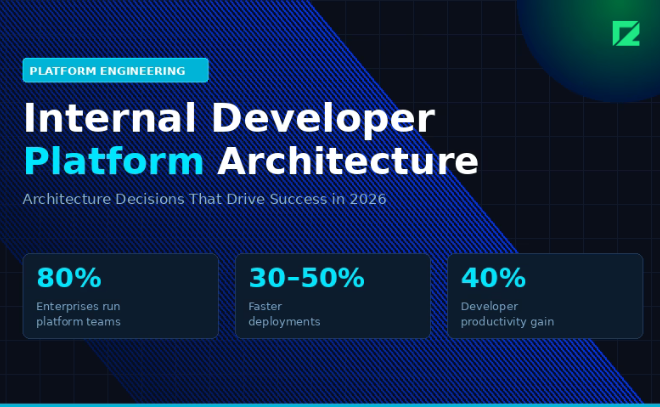
According to the 2026 State of Platform Engineering Report, 80% of large enterprises now run platform teams. Teams using IDPs report 30 to 50% faster deployments and up to 40% improvements in developer productivity. Gartner estimates that by the end of 2026, 80% of large software organizations will have a dedicated platform engineering function.
What an Internal Developer Platform Is Not
An IDP is not a developer portal. A portal is a UI layer. An IDP is the platform behind the portal: the APIs, the automation, the golden paths, the guardrails.
An IDP is also not a CI/CD pipeline or a Kubernetes cluster. Those are components it orchestrates. The IDP abstracts them so developers do not need to interact with them directly.
The mental model: if a developer needs to learn Terraform to deploy a new service, your IDP has failed.
The Four Layers of an Internal Developer Platform
A well-designed IDP has four layers. Each layer has a distinct responsibility and a clear interface to the layers above and below it.
Layer 1: Infrastructure Abstraction
This layer owns your infrastructure definitions. Terraform or OpenTofu modules, Crossplane compositions, Helm charts. The key principle: no developer writes raw IaC. They consume modules your platform team has already written, tested, and secured.
Recommended tools in 2026: OpenTofu 1.5 for IaC (the open-source Terraform fork, now at feature parity), Crossplane 0.23 for Kubernetes-native resource provisioning, ArgoCD 2.10 for GitOps-based delivery.
This layer should expose no raw cloud provider APIs to developers. All provisioning goes through your modules.
Layer 2: Golden Paths and Templates
Golden paths are pre-approved, fully-configured service templates. A developer picks a service type (Node.js API, Python worker, React frontend, gRPC service) and gets a repository, CI/CD pipeline, monitoring dashboards, and environment provisioning already wired up.
Backstage (CNCF, v1.28 as of Q1 2026) is the dominant platform for building the software catalog and scaffolding templates. It powers IDPs at thousands of organizations and has integrations with most major cloud providers and developer tools.
A golden path is not mandatory. Developers can deviate when they have a legitimate reason. But deviation should require explicit justification, and the platform team should track deviation rates as a signal of where paths need improvement.
Layer 3: Self-Service API and Automation
The self-service API is how everything else talks to your infrastructure. Environment creation, access requests, secret rotation, dependency version bumps: all triggered by API calls, not tickets.
This layer typically combines: a workflow engine (Temporal or Argo Workflows for durable, observable automation), a secrets manager (HashiCorp Vault or AWS Secrets Manager with dynamic credential rotation), and your RBAC and identity layer for access control.
Design this layer to be idempotent. Calling the same operation twice should not create duplicate resources or side effects. This becomes critical when automation fails mid-run.
Layer 4: Developer Portal
The portal is the interface developers actually use. It surfaces the software catalog (what services exist, who owns them, their health status), provides the scaffolding UI for creating new services from golden paths, and links to documentation, runbooks, and on-call schedules.
Backstage handles this well out of the box, but it requires significant investment to configure and maintain. For teams under 50 engineers, a lighter-weight portal may deliver more value with less overhead.
Three Architecture Decisions That Define Your IDP
Decision 1: Push vs. Pull Deployment Model
Push model: your CI/CD system deploys to your clusters. Simple to set up, familiar to most teams. Requires cluster credentials in your CI system, which creates a security surface.
Pull model (GitOps): an agent inside the cluster watches a Git repository and pulls changes. ArgoCD and Flux implement this pattern. The cluster never needs to be externally reachable, which is a significant security advantage.
For most teams building an IDP in 2026, GitOps with ArgoCD is the right default. The security model is cleaner and the reconciliation loop gives you drift detection for free.
Decision 2: Single Cluster vs. Multi-Cluster
Start with a single cluster per environment (development, staging, production). Multi-cluster adds operational complexity that most teams do not need until they hit scale or specific isolation requirements.
Move to multi-cluster when you have: strict data residency requirements, teams that need isolated blast radiuses, or workloads with genuinely different scaling characteristics that are expensive to colocate.
Decision 3: How Much to Abstract
This is the hardest decision. Too little abstraction and your IDP is just a thin wrapper that does not reduce cognitive load. Too much abstraction and developers cannot debug production issues because they cannot see what is actually running.
The principle that works: abstract the provisioning, not the observability. A developer should never need to write a Terraform module to deploy a service. But they should always be able to see the Kubernetes pods, the resource utilization, and the logs when something breaks.
How to Measure IDP Success
Track these metrics from day one:
- Time to first deployment: how long it takes a new service to reach staging from a blank repo
- Golden path adoption rate: what percentage of services use a golden path template
- Mean time to environment: how long it takes to provision a new dev environment on demand
- Platform ticket volume: the number of requests developers raise to the platform team per week (should decrease as self-service improves)
Where to Start
Do not try to build all four layers at once. Start where the pain is loudest.
For most teams, that is environment provisioning and deployment automation. Get those two things running on a GitOps model with solid IaC modules. That alone will reduce cognitive load and improve delivery speed. Add the portal, the software catalog, and the broader self-service layer once the foundation is stable.
The teams that fail at IDP adoption almost always tried to build the portal before they fixed the pipeline.
Need help designing or building your IDP? Talk to our engineering team at Codelynks.